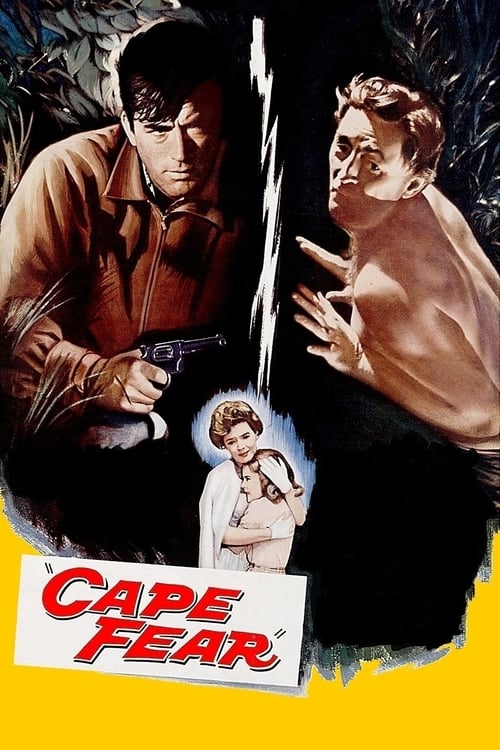
Cape Fear
1962 · J. Lee Thompson
When you're craving a real slow-burn scare — the kind built on menace and implication rather than gore — and you want to remember why black-and-white thrillers could be genuinely frightening.
What it's about
A small-town Southern lawyer once testified against a brutal man and helped send him to prison. Eight years later, Max Cady is out — and he's done his homework. He begins circling the lawyer's wife and teenage daughter, always smiling, always careful to break no law the courts could touch, while the family's respectable life turns into a slow-motion siege.
The experience
A masterclass in dread — almost nothing explicit happens for long stretches, and that's exactly what makes it unbearable. It tightens like a hand on the back of your neck, right up to a swampy, sweat-soaked finale.
Performances
Robert Mitchum's Max Cady is one of the great screen predators — lazy-voiced, physically confident, obscene without ever quite saying anything actionable. Gregory Peck plays the decent man discovering decency won't save him, and the contrast is the movie.
The craft
Bernard Herrmann's brass-heavy score does half the terrorizing on its own, and the stark black-and-white photography keeps the menace coiled in shadows and doorways. The film's discipline — implying violence instead of showing it — is what makes it still work on modern nerves.
Why it matters
It became a template for the home-invasion and stalker thriller, was famously remade decades later, and Cady endures as one of cinema's defining screen villains.
Snapshot
Cape Fear is a black-and-white psychological thriller in which an ex-convict, Max Cady, returns to torment the respectable Southern lawyer whose courtroom testimony sent him to prison. Adapted from John D. MacDonald's 1957 novel The Executioners, the film converts a pulp revenge premise into a sustained study of menace under legal cover: Cady commits no prosecutable act for most of the running time, weaponizing the very legal order Sam Bowden serves. Its lasting reputation rests on three pillars — Robert Mitchum's reptilian performance as Cady, Bernard Herrmann's brass-heavy score, and the film's deliberate refusal of explicit violence in favor of implication. Produced by star Gregory Peck and directed by the British craftsman J. Lee Thompson, it is a transitional Hollywood object: an A-list studio release built on the grammar of film noir and the suspense vocabulary of Alfred Hitchcock, arriving just as the Production Code's grip was loosening. Its 1991 Martin Scorsese remake has since made the original a permanent reference point for discussions of cinematic terror, the limits of censorship, and the figure of the predator who stays inside the law.
Industry & production
The film originated as a Gregory Peck project. Peck's production company (Melville Productions, with Talbot Productions as co-entity) developed MacDonald's novel and the picture was released through Universal-International. This producer-star arrangement was characteristic of the early 1960s, as established stars built companies to control material and capture a larger share of profits in a studio system loosening from the old contract model.
The production's defining external pressure was censorship. The material — a paroled sex offender stalking a family, with explicit menace toward a wife and an adolescent daughter — collided directly with the Production Code administered by Geoffrey Shurlock's office, and with the British Board of Film Censors under John Trevelyan. The negotiations forced substantial softening: the precise nature of Cady's original crime is kept verbally vague, and his threats are conveyed through innuendo and the actors' delivery rather than statement. The British release was cut more heavily still. This adversarial relationship with the censors is not incidental trivia; it is the formal engine of the film, which had to suggest horrors it could not depict and so developed an aesthetic of implication that critics have long counted among its strengths.
Casting set Peck's upright moral persona against Mitchum, an actor whose laconic insolence carried genuine menace and a public reputation (including a 1948 marijuana conviction) that lent his villainy an unsettling authenticity. The supporting cast drew on dependable character players: Polly Bergen as Bowden's wife Peggy, Lori Martin as daughter Nancy, Martin Balsam as the local police chief, and Telly Savalas as a private investigator. Production combined location shooting in and around Savannah, Georgia — supplying the humid Southern atmosphere and the riverine setting of the climax — with studio work at Universal. The Cape Fear River of the Carolinas gives the film its retitled name (MacDonald's The Executioners was discarded), grounding it geographically even as much of the action was constructed on stages and backlot water.
Technology
Cape Fear was shot on 35mm black-and-white film and composed for the widescreen 1.85:1 ratio standard to American features by 1962. The choice of monochrome is the salient technological decision: by the early 1960s color was commercially dominant for prestige releases, and shooting in black and white was an aesthetic election rather than a default — a deliberate alignment with the noir tradition and with the high-contrast, shadow-driven image that suits a story of latent threat. The film uses no exotic process; its power comes from conventional tools (lighting, lens, and sound recording) deployed with discipline. The soundtrack was monaural optical, the norm for a non-roadshow production of its scale, which concentrates Herrmann's score and the dialogue into a single dense channel rather than dispersing them across stereo space.
Technique
Cinematography
Sam Leavitt photographed the film. The visual scheme is essentially noir transposed to bright Southern exteriors and ordinary domestic interiors: Leavitt exploits black-and-white's capacity for hard shadow and silhouette to make Cady a figure who seems to materialize at the edges of safe, sunlit spaces — a pool, a bowling alley, a school, a courthouse. The contrast between the Bowdens' clean, well-lit bourgeois world and the encroaching darkness is built optically. The climactic sequence on the river and houseboat shifts into expressionist night photography, with water, fog, and pooled light isolating figures against blackness. The cumulative effect is that the camera registers Cady as a stain spreading into Bowden's orderly frame.
Editing
George Tomasini cut the film. Tomasini was Hitchcock's regular editor — he assembled Vertigo, North by Northwest, and Psycho — and his presence is one of the most consequential facts of the production. The suspense architecture of Cape Fear, its patient withholding and its precise control of when the audience sees Cady and when Bowden does, bears the imprint of the Hitchcock cutting style: tension built through duration and point-of-view management rather than through action. The editing's restraint is inseparable from the censorship constraints; what cannot be shown is paced and framed so that the viewer's imagination completes it.
Mise-en-scène / staging
Thompson stages the film around the intrusion of the predatory into the everyday. Cady is repeatedly placed within institutions of normal life and law — leaning on a courthouse rail, lounging poolside, appearing at the edge of a domestic scene — so that the threat is dramatized spatially as proximity and trespass rather than overt assault. The staging insists on Cady's leisure: he is unhurried, physically relaxed, occupying space as though entitled to it, which makes his presence more disturbing than any sudden movement would. The Bowden home and the river houseboat function as the two poles of the design, the defended domestic interior and the lawless wilderness to which Bowden must descend.
Sound
Bernard Herrmann's score is the film's most celebrated technical element and arguably its signature. Herrmann — another Hitchcock collaborator, fresh from Psycho (1960) — wrote a dissonant, brass-dominated cue structure whose blaring, repeated figures function as a sonic emblem of Cady himself. The music does not merely underscore tension; it announces menace with a near-physical aggression, and its recurring motif became one of the most recognizable in thriller scoring. The score's stature is confirmed by its afterlife: Elmer Bernstein adapted and re-orchestrated Herrmann's music for Scorsese's 1991 remake, an unusual act of homage that treats the original cues as definitive. Beyond the score, the film's sound design leans on the implicative — Cady's voice, the swamp's ambient noise — consistent with its general strategy of suggestion.
Performance
The film is an acting study in contrasts. Peck plays Bowden as the embodiment of liberal, lawful rectitude — a man whose faith in due process is precisely what Cady exploits, and whose mounting desperation registers as the erosion of that faith. Mitchum's Cady is the performance history remembers: cigar-chewing, drawling, physically insolent, projecting sexual threat and sadistic patience without raising his voice. The role belongs to the lineage of Mitchum's earlier predator, the murderous preacher Harry Powell in The Night of the Hunter (1955), and the two together established Mitchum as cinema's great avatar of soft-spoken evil. The supporting performances — Bergen's frightened wife, Balsam's constrained lawman, Savalas's investigator — supply the texture of a community that the law cannot mobilize against a man who has broken no statute.
Narrative & dramatic mode
The film's dramatic mode is the suspense thriller built on legal helplessness. Its central, ingenious device is that Cady is "always clever enough not to violate the law": the antagonist's strategy is to terrorize without committing a chargeable offense, which strips the protagonist of his professional tools and forces a moral regression from lawyer to armed defender of his family. The narrative is structured as escalating siege — episodes of intimidation (the poisoned family dog, the assault on another woman, the menacing of the daughter) that tighten the screw while leaving Bowden with no legal recourse — culminating in Bowden's decision to use his own family as bait and to confront Cady outside the law on the river. The dramatic engine is thus the collision between civilization and the primitive, with the protagonist driven to the brink of becoming what he opposes. The mode is closer to Hitchcockian suspense than to the detective or action thriller: the audience knows the threat throughout, and the tension lies in anticipation.
Genre & cycle
Cape Fear sits at the junction of several cycles. It is a late entry in the film noir tradition — monochrome, fatalistic, organized around a criminal intrusion into ordinary life — while also belonging to the early-1960s wave of more frank, psychologically charged American thrillers that pushed against the Production Code, a current associated with Psycho (1960) and the loosening of permissible subject matter. It can equally be read as a "home invasion" or family-under-siege thriller, a template it helped to consolidate. Its release in 1962 places it among a set of films testing how much sexual and sadistic menace mainstream Hollywood could imply, and its strategy of suggestion makes it an instructive case in how genre adapted to censorship rather than simply defying it.
Authorship & method
The film is best understood as a confluence of strong collaborators rather than a single auteur statement. J. Lee Thompson, the British director, came to it directly off The Guns of Navarone (1961) and a body of taut British pictures (Ice Cold in Alex, Tiger Bay); he was a skilled handler of tension and performance, and his direction here is controlled and economical, though critics have generally located the film's authorship as much in its collaborators and its star-producer as in him. Gregory Peck, as producer and lead, shaped the project and embodies its moral framework. The screenplay is by James R. Webb, adapting MacDonald. Decisively, two key technicians come straight from Hitchcock's unit — editor George Tomasini and composer Bernard Herrmann — and cinematographer Sam Leavitt supplies the noir image. The recurring critical observation is that Cape Fear feels "Hitchcockian" not by imitation but by personnel: the same hands that built the suspense and sound of Psycho and Vertigo are at work here, which accounts for the film's command of dread.
Movement / national cinema
This is a Hollywood studio production, not the product of a movement, but it is legible within two larger frames. First, the long tail of American film noir, whose visual and moral conventions it inherits and transposes to a Southern setting. Second, the transnational character of early-1960s Hollywood, evident in the British director and the producer-driven financing structure. Its Southern-American milieu — courthouse, small town, swamp river — also connects it to a broader American preoccupation with the South as a space where civilization thins out into something older and more lawless.
Era / period
Cape Fear is a product of the early 1960s inflection point in American cinema, when the Production Code was weakening, color was supplanting black and white for prestige work, and the studio system was giving way to independent, star-led production. The film registers this moment in its very form: it is monochrome by choice, censored in negotiation rather than by fiat, and produced through a star's company. It also reflects the period's anxieties — about the limits of the liberal legal order, about the safety of the suburban family, about a violence that respectable society is unequipped to name. Made at the threshold of the more permissive American cinema that would arrive later in the decade, it shows that cinema straining against constraints it had not yet shed.
Themes
The film's governing theme is the inadequacy of law against a predator who works within it — the gap between justice and legality, and the moral cost of closing that gap by force. Bowden's ordeal is a test of his civic faith: the more scrupulously he respects due process, the more defenseless he becomes, until he is driven to abandon the law to protect his family. Adjacent themes include the fragility of the bourgeois domestic order, the return of the repressed (Cady as the consequence of an old act coming back for payment), and masculine protection curdling toward vigilantism. Sexual menace, though forced into implication by the censors, saturates the film: Cady's threat is pointedly directed at the wife and the adolescent daughter, making the defense of the home also a defense of sexual and familial integrity. The contrast of civilization and savagery — courthouse versus swamp — frames all of these.
Reception, canon & influence
On release the film was recognized as a superior, unusually disturbing thriller, with particular attention to Mitchum's performance and Herrmann's score; it was also a focus of controversy over its menace and its censorship history, especially in Britain. (Precise contemporary box-office and full critical-consensus figures are beyond what I can responsibly reconstruct here, and I won't invent them.) Its standing has risen over time, lifted substantially by the 1991 remake, which returned scholarly and popular attention to the original.
Influences on the film (backward): It draws on the film noir tradition's visual and moral language; on MacDonald's source novel for its premise; on the Hitchcock suspense model, imported concretely through Tomasini and Herrmann; and on Mitchum's own prior incarnation of soft-spoken evil in The Night of the Hunter (1955), which prefigures Cady.
Legacy (forward): Cape Fear became a foundational text for the family-under-siege and home-invasion thriller and a touchstone for the figure of the menacing-but-legally-untouchable stalker. Its most direct legacy is Martin Scorsese's 1991 remake, which retained the title and premise, cast Robert De Niro as Cady, and — in a pointed gesture of homage — gave cameo roles to Gregory Peck, Robert Mitchum, and Martin Balsam from the original, while adapting Bernard Herrmann's score (via Elmer Bernstein) and replicating Saul Bass-style title design. That remake guaranteed the 1962 film's continued visibility and confirmed Herrmann's music and Mitchum's Cady as the enduring core of its reputation. Today the original is routinely cited in accounts of Cold War-era American thrillers, of censorship's paradoxical creative pressure, and of the great screen villains, with Mitchum's Cady standing among the most influential performances of patient, lawful-seeming evil in American cinema.
A Deleuzian reading
Watch how Max Cady occupies a space.
The full Deleuzian reading of Cape Fear →
Reception
In 1962 it was treated as genuinely nasty — censors on both sides of the Atlantic demanded cuts, and critics found it lurid. Now it's ranked among the great American thrillers, with Mitchum's Max Cady canonized as one of cinema's most frightening villains.
How Cape Fear was received, from release to now →
Influences: the films it descends from and the films it influenced
- The Night of the Hunter (1955) — Mitchum's earlier hymn-humming, soft-spoken predator established the patient lawful-seeming menace he refines as Cady — a direct performance lineage in the same actor's body.
- Psycho (1960) — Editor George Tomasini and composer Bernard Herrmann carry the exact shock-cutting and shrieking-string suspense grammar straight into Cape Fear via shared Hitchcock personnel.
- Vertigo (1958) — Herrmann's churning, unresolved brass-and-string dissonance is the orchestral template he reworks into Cady's circling musical menace.
- Shadow of a Doubt (1943) — Hitchcock's blueprint of a charming predator infiltrating a wholesome American family and town supplies the predatory-intrusion-into-the-everyday staging.
- Strangers on a Train (1951) — The affable psychopath who torments a respectable man while staying maddeningly within social and legal bounds prefigures Cady's 'menace within the law.'
- Out of the Past (1947) — Tourneur and Nicholas Musuraca's low-key high-contrast noir photography is the visual idiom Sam Leavitt extends in the swamp-and-shadow expressionist night work.
- M (1931) — Lang's predator whom institutions cannot adequately contain, rendered in expressionist night lighting, is the deep ancestor of 'law inadequate against the predator.'
- The Big Heat (1953) — Lang's noir of organized menace reaching into a lawman's domestic life models the assault on the protective family man and the targeting of wife and child.
- The Desperate Hours (1955) — Wyler's escaped-criminals-besiege-a-suburban-family premise is the immediate template for the escalating home-siege structure Cape Fear formalizes.
- Cape Fear (1991) — Direct remake retaining premise and title, adapting Herrmann's original score via Elmer Bernstein, replicating Saul Bass-style titles, and casting Peck, Mitchum and Balsam in homage cameos.
- Straw Dogs (1971) — Extends the escalating-siege-on-the-home structure to its violent endpoint, forcing the rectitudinous man to meet the intruders with brutal force.
- Wait Until Dark (1967) — Tightens the home-invasion thriller into a single-set siege of a defenseless innocent, distilling Cape Fear's intrusion-into-domestic-space tension.
- Dirty Harry (1971) — Builds its drama on Scorpio, a predator the legal system literally cannot hold, dramatizing 'law inadequate against the predator' that Cape Fear centered.
- Fatal Attraction (1987) — Relocates the obsessive, legally-untouchable stalker into the suburban nuclear family, extending the family-under-siege thriller Cape Fear founded.
- Funny Games (1997) — Strips the home-invasion siege to its formal skeleton to interrogate the very genre of family-terrorized-by-untouchable-intruder that Cape Fear helped establish.
- No Country for Old Men (2007) — Anton Chigurh is a late descendant of Cady's patient, soft-spoken, near-unstoppable evil that outpaces the law meant to contain it.
- Unlawful Entry (1992) — Literalizes 'menace within the law' through a predatory policeman who weaponizes his badge to invade a couple's home with impunity.
- The Guns of Navarone (1961) — Thompson's immediate follow-up applies the identical sustained-dread staging craft — patient escalation of threat toward a single confrontation — that made him the ideal Navarone hire.
Similar films
- The Night of the Hunter (1955) — influence & lineage · same viewing thread
- M (1931) — influence & lineage · same viewing thread
- No Country for Old Men (2007) — influence & lineage · often watched together
- Cape Fear (1991) — influence & lineage
- Psycho (1960) — influence & lineage
- Shadow of a Doubt (1943) — influence & lineage
- Straw Dogs (1971) — influence & lineage
- Out of the Past (1947) — influence & lineage
All the films related to Cape Fear →
Watch it with: curated runs of related films
- The Long Shadow of M — A run from Lang's Weimar crime films through their noir and neo-noir children — killers, con men, masterminds, and manhunts — where you can watch expressionist menace mutate step by step into the modern thriller.