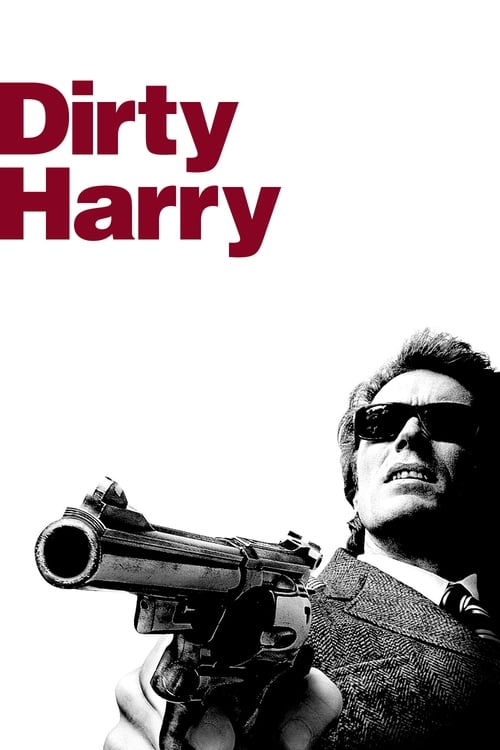
Dirty Harry
1971 · Don Siegel
For when you want a hard-edged, no-fat 70s thriller — gripping on its own terms, and even better if you're in the mood to argue with a movie's politics afterward. Sits between comfort and challenge: easy to watch, uneasy to endorse.
What it's about
A sniper calling himself Scorpio is killing at random in San Francisco and extorting the city for ransom. The manhunt falls to Inspector Harry Callahan, a homicide cop notorious for treating rules, procedure, and his own superiors as obstacles. As the killer toys with the city, the film becomes a collision between a psychopath and a lawman willing to go nearly as far.
The experience
Lean, tense, and propulsive — a manhunt thriller that moves like a coiled spring, punctuated by lines and standoffs that have long since entered the language. It's also deliberately provocative: it wants to rile you about law, order, and what justice costs, and it succeeds.
Performances
Clint Eastwood's flint-hard Callahan is one of the defining screen personas of its era — minimal, glowering, and instantly iconic — while Andy Robinson makes Scorpio genuinely skin-crawling.
The craft
Don Siegel directs with brutal economy: extensive San Francisco location shooting, widescreen compositions that use the city's rooftops and hills like a hunting ground, and Lalo Schifrin's jazz-funk score laying menace under everything. It rewards a big screen and good speakers.
Why it matters
It crystallized the rogue-cop figure in American movies, launched a franchise, was a political flashpoint on release, and set the template for decades of loose-cannon police thrillers.
Snapshot
Dirty Harry is the film that crystallized the figure of the rogue cop in American cinema and gave the postwar crime thriller a sharpened political edge. Directed by Don Siegel for Warner Bros. and built around Clint Eastwood's flint-hard Inspector Harry Callahan, it follows the manhunt for a sniper-killer who calls himself Scorpio as he extorts the city of San Francisco. The film's lean, propulsive craft — its location shooting, its widescreen compositions, Lalo Schifrin's jazz-funk menace — is inseparable from its argument: that procedural restraint and constitutional protections coddle the guilty while the innocent die. That argument made the film a flashpoint on release and has kept it contested ever since. Whether read as a reactionary tract, a brutally efficient genre exercise, or a more ambivalent portrait of institutional rot, Dirty Harry remains a foundational text for the 1970s American thriller and the template against which a half-century of cop films and vigilante narratives have measured themselves.
Industry & production
Dirty Harry arrived at a turning point for both Hollywood and its star. The project had a famously tangled development history: the screenplay, originating with Harry Julian Fink and Rita M. Fink and reworked by Dean Riesner (with uncredited contributions reported over its passage between studios), circulated through several stars and studios before landing at Warner Bros. Frank Sinatra was attached at one stage; other major names were reportedly considered before Clint Eastwood committed. The widely repeated account that Eastwood brought Don Siegel aboard reflects their established working relationship — the two had already collaborated on Coogan's Bluff (1968), Two Mules for Sister Sara (1970), and The Beguiled (1971), and Siegel was a trusted mentor to Eastwood as the actor moved toward his own directing career, which he launched the same year with Play Misty for Me.
The production sits at the meeting point of the studio system's contraction and the rise of star-driven, location-shot genre filmmaking. Eastwood, already an enormous box-office draw from the Sergio Leone "Dollars" trilogy and his Western and war pictures, was consolidating power as a producer-star; his company Malpaso was central to his career strategy of efficient, director-friendly, mid-budget productions. Dirty Harry was made economically and quickly in Siegel's characteristically disciplined manner, leaning heavily on San Francisco locations rather than soundstage recreation. The film was a substantial commercial success and spawned four sequels — Magnum Force (1973), The Enforcer (1976), Sudden Impact (1983), and The Dead Pool (1988) — making Callahan one of the most durable franchise characters of the era. Precise budget and grosses vary across sources, so I won't assert specific figures.
Technology
Technically, Dirty Harry is a film of its moment in mainstream American production rather than a site of formal innovation. It was shot on 35mm color film in anamorphic widescreen (Panavision), a format Siegel and cinematographer Bruce Surtees exploit for both the horizontal sweep of the cityscape and the compression of figures within it. The production's defining "technology" is really its commitment to practical location work — rooftops, stadiums, parks, the streets and bridges of San Francisco — captured with available and naturalistic light wherever possible, a hallmark of Surtees's developing style.
The single most fetishized piece of hardware in the film is diegetic rather than cinematographic: Callahan's Smith & Wesson Model 29 .44 Magnum revolver, which the film's screenplay elevates into an icon through Harry's now-canonical "Do you feel lucky?" monologue. The weapon's outsized power becomes a visual and rhetorical motif, an extension of the character's ethos of overwhelming, individual force. Beyond this, the film relies on conventional tools of its day; there is no significant optical or special-effects program at work, and its impact derives from staging, cutting, and performance rather than technological spectacle.
Technique
Cinematography
Bruce Surtees — soon nicknamed within the industry for his mastery of darkness — gives Dirty Harry a hard, modern look that balances San Francisco's daylight verticality against pools of nocturnal shadow. The anamorphic frame is used with real intelligence: high-angle and elevated shots survey the city as a hunting ground, repeatedly placing Scorpio above the populace (on rooftops, on a cross-shaped tower, in a stadium seen from a god's-eye crane) and aligning the camera's gaze with the sniper's predatory vantage. The celebrated overhead pull-back from the floodlit stadium, isolating Harry and his captive in a vast empty bowl, is the film's signature image of the individual dwarfed by — and operating outside — institutional space. Surtees favors long lenses that flatten and crowd the urban field, and a restrained, often source-driven approach to light that lends the violence a documentary immediacy.
Editing
Cut by Carl Pingitore, the film is a model of economical thriller construction. Siegel's long-held preference for shooting tightly — covering scenes efficiently so that the cut is largely "written" on set — yields a picture with little fat. The editing alternates between patient stalking sequences, where suspense is built through duration and spatial geography, and abrupt eruptions of violence. The Scorpio rooftop and park sequences demonstrate the film's command of classical suspense grammar (establishing the killer's sightline, the victim's obliviousness, the cross-cutting that times the threat), while the action set-pieces are cut for blunt force rather than balletic flourish.
Mise-en-scène / staging
Siegel stages Dirty Harry as a series of confrontations across the public architecture of a real city, using San Francisco's geography as a moral as well as physical terrain. The film opens on a sniper's-eye view of a rooftop swimming pool and proceeds through bus, stadium, park, and quarry; its climaxes are built around verticality (rooftops, towers, the final showdown by water). Staging consistently isolates Harry — at the margins of the frame, apart from his colleagues, framed against institutional backdrops (City Hall, the Hall of Justice) that the film treats with skepticism. The recurring composition of Callahan alone against bureaucratic or civic space visually argues the film's thesis about the lone agent versus the system.
Sound
Lalo Schifrin's score is integral to the film's identity. Working in a jazz-funk and avant-garde idiom, Schifrin attaches to Scorpio a slithering, unstable musical signature — breathy wordless vocals, percussion, dissonant textures — that renders the killer an almost supernatural presence, while Harry's world is scored with cooler, propulsive cues. The music's modernity ties the film to the contemporary urban-thriller sound Schifrin was helping to define. Beyond the score, the sound design leans on the texture of the city — traffic, crowds, gunfire reverberating off concrete — to reinforce the location realism.
Performance
Eastwood's Callahan is a study in controlled minimalism: a squint, a clenched jaw, a flat sardonic delivery that turns threat into deadpan. The performance refines the laconic persona Eastwood built with Leone into a contemporary American register, and it is the film's center of gravity. Against it, Andrew Robinson's Scorpio is deliberately unstable and theatrical — giggling, whimpering, ingratiating, then savage — a performance that courts revulsion and has been read both as effective menace and as caricature. The contrast between Eastwood's stillness and Robinson's volatility structures the film's emotional dynamics. Supporting turns (Harry Guardino, Reni Santoni as Harry's ill-fated partner Chico, John Vernon as the temporizing mayor) populate the institutional world Harry holds in contempt.
Narrative & dramatic mode
The film operates in the mode of the manhunt thriller crossed with the police procedural, but it systematically inverts the procedural's faith in process. Its dramatic engine is a moral provocation rather than a mystery: we know who Scorpio is early, so suspense is generated not by detection but by the question of whether and how Harry will stop him within — or outside — the rules. The narrative is structured around a series of escalating outrages by the killer and a parallel series of institutional failures (legal technicalities, squeamish superiors, a kidnapped victim who dies despite a ransom payment) that progressively strip the case of procedural legitimacy. The famous mid-film sequence in which Scorpio walks free on Fourth and Fifth Amendment grounds — illegally obtained evidence, denial of counsel — is the dramatic hinge, recasting the film as an argument about the costs of due process. The climax, in which Harry hunts Scorpio down on his own and finally throws his badge into the water, frames the resolution as a repudiation of the institution he serves.
Genre & cycle
Dirty Harry belongs to the early-1970s urban crime cycle that responded to rising anxieties about crime, disorder, and the perceived impotence of liberal institutions. It is frequently paired with The French Connection (released the same year, 1971) as twin landmarks of the gritty, location-based cop thriller that displaced the more sanitized police dramas of the prior decade. Where The French Connection foregrounds obsessive procedure and ambiguity, Dirty Harry foregrounds the cop as avenging individual. The film is also a key node in the larger vigilante cycle that runs through the decade — Death Wish (1974) being the most direct civilian counterpart — and it inaugurates a long line of "loose-cannon cop" narratives. Generically it fuses procedural, thriller, and a Western-derived showdown structure: Callahan is, in many readings, a frontier lawman transplanted to the contemporary city, his Magnum standing in for the gunfighter's revolver.
Authorship & method
The film is the product of a genuine creative partnership. Don Siegel brought decades of experience in lean, hard-edged genre filmmaking — including Invasion of the Body Snatchers (1956), Riot in Cell Block 11 (1954), and The Killers (1964) — and a sensibility built on efficiency, anti-authoritarian protagonists, and violence presented without sentiment. Dirty Harry is in many ways the apotheosis of his career-long interest in the individual at odds with institutions. Clint Eastwood, as star and de facto creative force through Malpaso, shaped the project's economy and persona; the Callahan character became one of the two pillars (with the Man with No Name) of his stardom, and the film's method exemplifies the disciplined, director-trusting production model he carried into his own directing career. Eastwood is credited with directing at least one sequence during Siegel's brief illness, by widely repeated accounts.
Among collaborators, cinematographer Bruce Surtees (here near the start of a long association with Eastwood) supplied the film's modern, shadow-rich look; composer Lalo Schifrin supplied its unmistakable sonic identity; editor Carl Pingitore realized Siegel's tight cutting. The screenplay by Harry Julian Fink, Rita M. Fink, and Dean Riesner passed through multiple hands during development, and the finished script's relationship to its various drafts is complicated; its most enduring contributions are structural (the procedural-as-provocation design) and verbal (the Magnum monologues).
Movement / national cinema
Dirty Harry is a quintessential product of "New Hollywood" in its commercial-genre wing rather than its art-cinema wing. It shares the era's appetite for location realism, moral ambiguity, institutional distrust, and frank violence, but it channels these toward a popular, star-driven form rather than the auteurist experimentation of the period's more celebrated young directors. It is firmly American national cinema, and specifically a San Francisco film: the city is not a backdrop but a subject, its civic spaces and topography integral to the film's meaning. Siegel belongs to an older generation of studio craftsmen whose unfussy efficiency the New Hollywood both inherited and was reacting against, making the film a bridge between classical studio genre filmmaking and the rawer sensibility of the 1970s.
Era / period
The film is unintelligible apart from its immediate historical moment: the early 1970s climate of urban crime fear, anti-war and countercultural upheaval, the politics of "law and order" that had carried Richard Nixon to office, and a broader backlash against the liberalizing criminal-procedure decisions of the Warren Court (Miranda, Escobedo, Mapp). The Scorpio character was widely understood at the time to evoke the contemporary Zodiac killer then terrorizing the San Francisco area, lending the film a charge of topical dread. Dirty Harry dramatizes, with deliberate provocation, the era's argument that the legal system's protections for the accused had tipped the balance against public safety — and it does so from a vantage that many critics read as endorsing extralegal force.
Themes
At its core the film stages a conflict between individual moral agency and institutional process. Its central themes include: the failure of liberal institutions to protect the innocent; the tension between due process and substantive justice; the romance and danger of the lone enforcer who answers to his own conscience; and the contamination of the avenger by the violence he combats — the "dirty" in Dirty Harry pointing at once to the unglamorous jobs nobody else will take and to the moral soiling that comes with them. The film is preoccupied with surveillance and predation (the recurring motif of the sniper's gaze, the hunter and hunted exchanging positions), with the body in pain, and with the symbolic weight of institutional emblems — most pointedly the badge Harry discards in the final shot, an image that has been read both as disillusioned rejection of a corrupt system and as triumphant liberation from its constraints. That interpretive openness is the film's enduring provocation.
Reception, canon & influence
On release, Dirty Harry was both a major popular success and the subject of fierce critical division. Its most influential detractor, Pauline Kael, condemned it as "fascist" — a charge that framed decades of subsequent debate and that the film's defenders have continually contested, arguing variously that Siegel's craftsmanship is morally cooler than its politics suggest, that Harry's alienation is critical rather than celebratory, or that the film is best understood as a visceral genre machine rather than a manifesto. Roger Ebert and others engaged the same tension between admiration for the filmmaking and discomfort with its argument. The film has since been widely canonized as a landmark American thriller; it was selected for preservation in the United States National Film Registry by the Library of Congress, a recognition of its cultural and historical significance.
Influences on the film (backward): Dirty Harry draws on the hard-boiled crime tradition and film noir's cynical urban world; on the Western showdown structure (with Callahan as displaced frontier lawman); and on Siegel's own body of anti-institutional genre films. Its procedural-realist texture and location aesthetic connect it to the contemporaneous turn toward grittier crime cinema exemplified by The French Connection.
Legacy (forward): The film's influence is vast and double-edged. It established the "loose-cannon cop" as a durable archetype, directly enabling decades of buddy-cop and rogue-detective films and television, from Lethal Weapon to countless imitators, and it helped license the 1970s–80s vigilante and action cycle. "Go ahead, make my day" (from the sequel Sudden Impact) and "Do you feel lucky, punk?" entered the broader culture as catchphrases detached from their films. Eastwood himself returned to and complicated the figure across his later career — most searchingly in Unforgiven (1992), which interrogates the very myth of redemptive violence that Dirty Harry helped enshrine. The film remains a fixed reference point in scholarly debates about screen violence, the politics of genre, and the relationship between popular cinema and the law-and-order politics of its era — a work whose craft is largely undisputed and whose meaning is permanently in argument.
A Deleuzian reading
The crosshairs find her before we know her name.
The full Deleuzian reading of Dirty Harry →
Reception
Blasted on release as right-wing provocation — Pauline Kael famously branded it 'fascist' — while audiences made it a smash; half a century on it's canonized as a landmark of the American cop thriller, with the politics debate still attached like a permanent footnote.
How Dirty Harry was received, from release to now →
Influences: the films it descends from and the films it influenced
- Riot in Cell Block 11 (1954) — Siegel's semi-documentary, location-shot study of men against a penal institution establishes the anti-bureaucratic toughness and unsentimental violence he carries directly into Callahan's war with City Hall.
- Invasion of the Body Snatchers (1956) — The lean, paranoid model of one alienated man who sees the threat while the institution sleepwalks — Siegel's career-long individual-vs-conformist structure that Dirty Harry restages in a police register.
- The Killers (1964) — Siegel's flat, affectless presentation of brutality and his stripped TV-trained economy of cutting feed Dirty Harry's matter-of-fact staging of gunfire and its refusal to aestheticize death.
- Madigan (1968) — Siegel's earlier rogue-detective procedural — a cop chafing against department protocol across a single manhunt — is the structural dry run for Harry's case-as-provocation design.
- Coogan's Bluff (1968) — The first Siegel–Eastwood pairing invents the displaced-frontier-lawman-in-the-modern-city persona and the trust-the-director Malpaso production economy that Dirty Harry perfects.
- M (1931) — Lang's template of an entire city mobilized to hunt a pathetic, compulsive child-murderer gives Scorpio his lineage as the whimpering psychopath whose monstrousness is also abjection.
- The Big Heat (1953) — Lang's detective who throws away the badge and goes vigilante against a system too corrupt to act is the noir prototype for Harry hurling his star into the water.
- High Noon (1952) — The Western showdown of a lawman abandoned by the community he protects supplies the frontier-marshal structure that Siegel transplants, with Callahan as the institutionally betrayed gunfighter.
- Bullitt (1968) — Establishes the San Francisco-location cop thriller with a laconic, anti-establishment detective and vérité street texture — the precise urban-procedural aesthetic Surtees and Siegel sharpen.
- Point Blank (1967) — Boorman's anamorphic, modernist styling of urban revenge and Lee Marvin's near-wordless minimalism prefigure Eastwood's laconic widescreen menace and the film's cold architectural framing.
- Cape Fear (1962) — Builds its drama on Scorpio, a predator the legal system literally cannot hold, dramatizing 'law inadequate against the predator' that Cape Fear centered.
- Where the Sidewalk Ends (1950) — The late-classical distillation of the enforcer-criminal-line premise: a cop whose methods place him outside the law he enforces, the rogue-cop persona Andrews prototyped.
- Magnum Force (1973) — The direct sequel that interrogates its own archetype, pitting Harry against a police death squad to argue (via Milius's script) where his loose-cannon logic ends.
- Death Wish (1974) — Extends the due-process-provocation engine into pure civilian vigilantism, inheriting the structure of an urban protagonist licensed by the film to answer a failed justice system with the gun.
- Taxi Driver (1976) — Takes the alienated-loner-as-violent-cleanser figure and turns it inward and critical, exposing the pathology that Dirty Harry's loose-cannon framing keeps heroic.
- Sudden Impact (1983) — Eastwood directs himself as Callahan, applying the disciplined Siegel-derived economy he absorbed on the original and minting 'make my day' as the persona's self-aware capstone.
- Lethal Weapon (1987) — Industrializes the loose-cannon-cop archetype into the buddy formula, splitting Harry's insubordinate volatility and procedural competence across a partnered pair.
- Se7en (1995) — Inherits Scorpio's innovation of the serial killer who authors and controls the investigation, taunting and out-maneuvering the detectives so the manhunt becomes the murderer's design.
- Unforgiven (1992) — Eastwood's deliberate auto-critique that dismantles the redemptive-violence myth Dirty Harry helped enshrine, using the same star body to make killing costly rather than cathartic.
- Violent Cop (1989) — Siegel's rogue-detective formula — officer operating outside institutional sanction, using personal violence where procedure fails — provides the genre scaffold Kitano then evacuates of its American satisfaction logic, converting righteous transgression into simple transgression with no moral settlement.
- In the Line of Fire (1993) — Supplies both Eastwood's weary-lawman persona and the template of the taunting killer (Scorpio) who phones the cop to personalize the hunt — the seed of ITLOF's telephone-as-instrument.
- Jack Reacher (2012) — The lone-avenger detective who works outside procedure, framed in scope against an indifferent gray city — the hard-boiled visual and moral posture Reacher inherits wholesale.
- RoboCop (1987) — Codifies the urban-western lone enforcer dispensing summary justice with an outsized sidearm, the police-procedural-as-western armature RoboCop satirizes by literalizing the cop into hardware.
- Million Dollar Baby (2004) — Eastwood's avowed apprenticeship to Siegel's economy — minimal coverage, few takes, lean staging that trusts the actor and the empty frame — is the directorial discipline underwriting Million Dollar Baby's restraint.
- The French Connection (1971) — Released the same year, it shares the gritty handheld location-vérité procedural texture and the obsessive, rule-breaking cop, marking the contemporaneous turn toward documentary-rough crime realism.
- The Beguiled (1971) — Same year, same unit — Surtees's underexposed single-source nights, Carl Pingitore's cutting, Schifrin's scoring — applied to the Eastwood authority figure that The Beguiled spends its runtime dismantling; the two films are a matched pair from one crew.
Similar films
- The French Connection (1971) — influence & lineage
- Taxi Driver (1976) — influence & lineage
- Bullitt (1968) — influence & lineage
- Lethal Weapon (1987) — influence & lineage
- Point Blank (1967) — influence & lineage
- The Killers (1964) — influence & lineage
- Serpico (1973) — shared sensibility
- Duck, You Sucker (1971) — shared sensibility
All the films related to Dirty Harry →