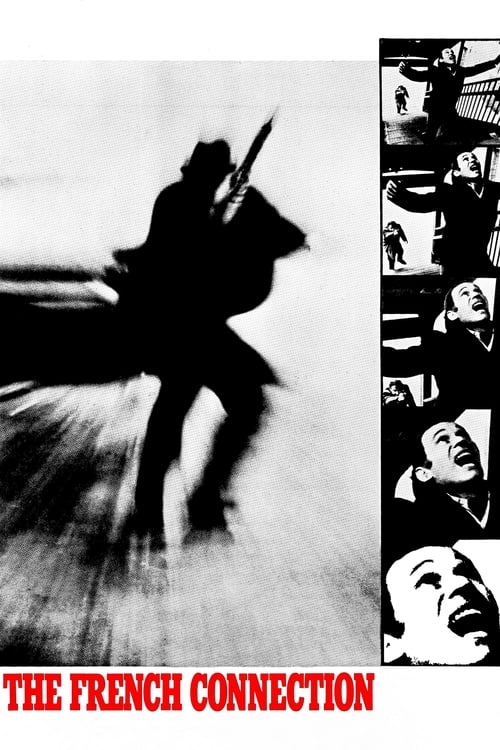
The French Connection
1971 · William Friedkin
For when you want something hard-edged and real — no gloss, no comfort, just tension and grime. Reach for it when a slick modern thriller feels too polished and you want to see where the genre's teeth came from.
What it's about
Two New York narcotics detectives — the bullish, obsessive 'Popeye' Doyle and his steadier partner — catch the scent of a massive heroin shipment coming in from Marseille. What follows is weeks of freezing stakeouts, tailing suspects through subway stations and city streets, as a crude street cop tries to outlast a smooth, untouchable French smuggler. It's a cat-and-mouse where the cat is running on coffee, spite, and bad instincts.
The experience
Gritty, jittery, and relentless — it feels less like watching a thriller than being dragged through a filthy winter in 1971 New York. The famous chase will spike your pulse, and the film's refusal to make its hero likable keeps you off balance the whole way.
Performances
Gene Hackman won the Oscar as Popeye Doyle and it's easy to see why: he plays a cop who is racist, reckless, and frighteningly obsessive, yet you can't look away. Fernando Rey is his perfect opposite — elegant, amused, always one step ahead.
The craft
Friedkin shot it like a documentary — handheld cameras, real locations, available light, scenes grabbed guerrilla-style on New York streets — and the Oscar-winning editing makes the surveillance sequences as gripping as the shootouts. The car chase under the elevated train remains one of the most visceral ever filmed, and it still hits hardest loud and big.
Why it matters
It swept the major Oscars, including Best Picture, and rewrote the rulebook for the American cop film — nearly every gritty police procedural since owes it something.
Snapshot
William Friedkin's The French Connection is a watershed of American cinema: a police procedural so thoroughly committed to abrasion and authenticity that it rewrote the terms on which a Hollywood studio film could represent the city, the law, and the body. Adapted from Robin Moore's 1969 non-fiction account of an actual NYPD narcotics bust, the film follows Detective Jimmy "Popeye" Doyle and his partner Buddy Russo as they stumble into and then obsessively pursue the largest heroin smuggling operation in American history to that point. The film won five Academy Awards including Best Picture, Best Director, Best Actor, Best Adapted Screenplay, and Best Film Editing — a near-sweep that ratified a formal and moral departure from the prestige filmmaking of the previous decade. It remains among the most influential genre films produced in Hollywood, a work whose techniques and attitudes saturated American cinema for the rest of the 1970s.
Industry & production
The film was produced by Philip D'Antoni for 20th Century Fox — a pairing with precedent, since D'Antoni had also produced Peter Yates's Bullitt (1968), another film that staked its identity on a kinetic location-shot car sequence. The project arrived at Friedkin by competitive circumstance; he was not the first choice, and the studio's enthusiasm for location-shot, semi-documentary crime pictures had been validated by the commercial performance of Bullitt and others. D'Antoni had been developing the material and needed a director willing to work fast and cheap on the streets of New York without the infrastructure of conventional production design.
Friedkin cast Gene Hackman over significant resistance. Hackman was not a star, and the character — a racist, physically coercive, institutionally marginal detective — was not the kind of protagonist studios customarily built pictures around. Roy Scheider, playing Russo, was similarly not a name actor at the time. The decision to cast Fernando Rey as the French villain Henri Devereaux came, by Friedkin's own subsequent account, from a miscommunication: the director had wanted Francisco Rabal, a Spanish actor of different physical type, but received Rey instead. Whether or not one accepts the full anecdote, Rey brings to the film something unexpected — an Old World elegance and Buñuelian irony that deepens the contrast with Hackman's ungainly, belligerent Doyle.
The real detectives on whose careers the story is based, Eddie Egan and Sonny Grosso, were brought on as consultants and given small acting roles: Egan plays Simonson, Doyle's superior; Grosso plays Klein, another detective. Their presence anchors the film in a documentary register and also serves as a form of institutional permission — the procedural details carry the weight of men who actually lived them.
Technology
Owen Roizman served as director of photography, and The French Connection was among his first major feature assignments. Roizman shot predominantly with handheld cameras, frequently on fast film stocks pushed in processing to amplify grain. The resulting images are desaturated, often slightly underexposed, prone to the flicker and drift of available-light shooting — a visual vocabulary drawn from cinema verité documentary practice and from European films that had already used it to destabilize the glossiness of commercial cinema.
The production made extensive use of real New York locations with minimal preparation: actual streets, actual crowds who in many cases were unaware a film was being made, actual weather in actual winter. The cold of December and January is palpable in the images — in the actors' breath, in the way pedestrians move — and Roizman's camera often cannot fully control for the chaos of its environment. This is understood as achievement rather than limitation. The camera equipment was lightweight enough to be run through crowds and mounted on vehicles, enabling the car chase sequence to be filmed with cameras attached directly to the pursuit car, with Hackman performing much of the actual driving at speed through live Brooklyn traffic.
Don Ellis composed the score using brass-heavy jazz idioms with unconventional time signatures and an insistent, percussive energy that refuses to romanticize the action. Ellis had a background in avant-garde jazz composition, and his contribution resists the smooth orchestral scoring that marked Hollywood crime pictures of the preceding decade.
Technique
Cinematography
Roizman's approach is defined by compression and exposure management under adversarial conditions. The palette is emphatically urban-winter: grays, browns, the dim greens of fluorescent interiors, the wan yellows of street lighting. Color is present but subdued, never deployed decoratively. The telephoto lens is a recurring instrument — particularly in the surveillance sequences, where the long focal length simultaneously flattens space and isolates figures against cluttered urban backgrounds, producing a visual condition of watching that mirrors Doyle's obsessive spectatorship. There is almost no glamour in the frame: even the Marseilles sequences, which might have invited a European pictorialism, are shot with the same brackish restraint. The grain structure, amplified by push-processing, gives the image a textural roughness that registers as moral sincerity — this is how things look when you refuse to soften them.
Editing
Jerry Greenberg won the Academy Award for Film Editing, and the cut is the film's structural spine. The surveillance sequences accumulate through patient, methodical assembly — long takes, observational rhythms, an editing pattern that builds duration into suspense rather than cutting to escape it. The famous elevated-railway chase, in which Doyle commandeers a car to pursue a would-be assassin riding the Westinghouse IRT above him, inverts this patience: the cutting accelerates to a near-stroboscopic tempo, intercutting between the car below and the train above through matches of direction and speed that maintain spatial logic even as the rhythm becomes nearly unbearable. The sequence's famous impact derives partly from Greenberg's refusal to simplify — the cuts are motivated and clear even at their fastest, so the viewer tracks the geography while being overwhelmed by momentum.
Mise-en-scène / staging
Friedkin's staging refuses the conventional separation between performance and environment. Characters move through spaces that feel genuinely crowded and contingent — the frame is never cleaned to isolate the dramatic foreground from an accommodating background. Doyle and Russo work in the actual chaos of the city. The restaurant stakeout sequence — in which Doyle and Russo eat greasy pizza in the cold while watching Devereaux dine in warm luxury — organizes the film's central class irony in purely spatial and behavioral terms, without dialogue that names the contrast.
The film's violence is sudden and unglamorized. When Doyle shoots the assassin Nicoli in the back while the man is running away, the act is presented without musical punctuation or dramatic heightening — it simply happens, as fact. The staging refuses both the catharsis of heroic violence and the formal elaboration of art-cinema violence. It registers as an institutional given.
Sound
The sound design is deliberately raw. Location recording captures the ambient noise of actual New York — traffic, subway, winter crowds — at volumes that do not subordinate themselves to dialogue. The film was not significantly post-dubbed to clean the track; the roughness is retained. Ellis's score punches in and out rather than sustaining beneath action, creating an irregular relationship between music and image that unsettles classical continuity conventions.
Performance
Hackman's performance as Doyle is the film's moral problem made physical. He is broad, thick, aggressive — a man whose energy is frequently indistinguishable from recklessness. Hackman plays the character's racism not as an aberration but as professional texture, something Doyle carries into every interaction as a habituated instrument of intimidation and social navigation. Scheider's Russo functions as a partial corrective — more contained, more self-aware — but the film does not use that contrast to exonerate Doyle. Rey, whose elegance and ironic self-possession place him in almost a different register of performance, generates a genuine dialectical tension with Hackman: the two men barely share the screen, but the film is organized around their asymmetry.
Narrative & dramatic mode
The film operates in procedural mode — it is interested in the accumulation of investigative labor over time, the false leads, the bureaucratic friction, the physical cost of sustained surveillance. There is no conventional three-act architecture in the Hollywood sense: the film begins in the middle of ongoing work and ends not with resolution but with institutional notation. The final title cards — informing the viewer of the fates of each character, including the escape of the principal drug supplier — refuse catharsis. Doyle shoots an FBI agent by mistake in the final sequence; the drug kingpin Charnier is never apprehended. The narrative is structured around the failure of the law to close around the crime it pursues.
Genre & cycle
The French Connection belongs to the urban crime-procedural cycle of early 1970s American cinema, alongside Klute (1971), Serpico (1973), Chinatown (1974), and Dog Day Afternoon (1975). These films share a commitment to institutional critique embedded in genre — the police procedural and the detective thriller are used to diagnose rather than celebrate American systems of order. The cycle is inseparable from the social conditions of its moment: the collapse of the postwar liberal consensus, Watergate, urban fiscal crisis, and the emergence of a film culture that had absorbed European art cinema's willingness to leave genre pleasures incomplete or contaminated.
The French Connection is also part of a longer tradition of the police film that includes the gritty Italian poliziottesco emerging in the same period, though the traffic of influence runs in both directions and the connections are structural rather than demonstrably direct.
Authorship & method
Friedkin came to the film from television documentary, having directed The People vs. Paul Crump (1962) and worked in live television production. His method on The French Connection reflects this background: an embrace of the unpredictable, a preference for shooting quickly in real environments over constructing controlled ones, and a directorial style that subordinates visible artfulness to the impression of captured reality.
Owen Roizman's contribution is inseparable from the film's identity — his cinematography is not merely illustrative of Friedkin's concept but constitutive of it. Ernest Tidyman's screenplay, adapted from Moore's book, strips the material down to procedural skeleton while preserving the moral ambiguity of the source. Jerry Greenberg's editing builds the film's temporal architecture. Don Ellis's score provides a specifically American urban dissonance that distinguishes the film from European models it otherwise resembles.
Movement / national cinema
The French Connection is central to New Hollywood — the period from roughly 1967 to 1976 in which a generation of American directors assimilated the influence of European art cinema and deployed it within the studio system to produce formally and morally ambitious commercial pictures. The film demonstrates the New Hollywood's characteristic double movement: it uses genre machinery (the cop thriller, the car chase) while simultaneously subverting genre's conventional emotional resolutions. It participates in a broader American cinema of the early 1970s that drew on Italian neorealism, the French New Wave (specifically the policier tradition of Melville and others), and cinema verité documentary.
Era / period
The film captures New York in a moment of visible urban deterioration — the streets are grimy, the institutions are overwhelmed, the city feels on the edge of its own management. This is not neutral backdrop but active historical condition. The drug economy the film depicts is inseparable from the city's fiscal and social crisis, and the film's ambivalent attitude toward its law-enforcement protagonists reflects a broader cultural disorientation about authority and order in early 1970s America. Nixon's War on Drugs had been declared the previous year. The film enters that discourse without resolving it.
Themes
The film's central concerns are obsession and asymmetry. Doyle's pursuit of Charnier is defined by disproportion — Doyle is crude, contingent, operating at the edge of institutional sanction; Charnier is sophisticated, protected, operating through networks that outpace the law's comprehension. The film tracks obsession not as heroism but as pathology: Doyle's fixation costs lives, including those of civilians and colleagues. The institution itself is depicted as barely capable of recognizing what it does not understand.
Class is organized spatially and behaviorally throughout. The film is alert to the gap between the labor of policing — cold stakeouts, administrative friction, physical violence — and the elegance of the criminal networks being policed. Doyle eats bad food in the cold; Charnier eats well in warm rooms. The film offers no consolation for this asymmetry.
Reception, canon & influence
The film was a major commercial and critical success on release, winning five Academy Awards in March 1972 and generating significant cultural discussion about the acceptability of its protagonist. The debate about Doyle — whether the film endorses his racism and brutality or merely depicts them — has not resolved and remains a productive tension in the scholarly literature.
Influences on the film: The most direct antecedents are Italian neorealism's commitment to location shooting and non-professional texture; the French policier, particularly the work of Jean-Pierre Melville (Le Doulos, 1962; Le Samouraï, 1967), which had already developed an aesthetic of surveillance and procedural patience; Bullitt (1968), which demonstrated that a car chase could organize a studio film's identity; and the American cinema verité documentary tradition, particularly the work of D.A. Pennebaker and the Maysles brothers.
Legacy: The film's forward influence is enormous and specific. The car chase established a technical and dramatic benchmark that subsequent action cinema — including Smokey and the Bandit, the Die Hard cycle, Ronin (1998), and many others — has measured itself against or departed from consciously. The visual grammar of urban crime cinema — handheld cameras, desaturated palettes, location shooting, procedural duration — flows substantially from Roizman's work here. The Seven-Ups (1973), also produced by D'Antoni, extends the film's world almost as a sequel. Sidney Lumet's Serpico (1973) and Prince of the City (1981) take up the same institutional terrain. Michael Mann's television work and subsequent films, particularly Heat (1995), inherit the procedural patience and the asymmetrical antagonist structure. The morally compromised law-enforcement protagonist — standard currency by the 1980s and 1990s — was given one of its most influential American formulations here.
The film's canonical status is secure, though its moral discomfort has kept it from the simpler forms of celebration available to less troubled masterworks. It sits at the hinge of American cinema's self-transformation, evidence of what the genre picture could sustain when the system that produced it had temporarily lost faith in its own consolations.
A Deleuzian reading
The cold is in the frame.
The full Deleuzian reading of The French Connection →
Reception
A massive hit on release — it won Best Picture (the first R-rated film to do so) and made Gene Hackman a star — and unlike many early-70s winners it never really fell out of favour; if anything it's now the go-to exhibit for how gritty and morally murky mainstream Hollywood once was.
How The French Connection was received, from release to now →
Influences: the films it descends from and the films it influenced
- The Naked City (1948) — Dassin and DP William Daniels shot entirely on New York streets with a camera concealed in a sound truck, inventing the semi-documentary procedural aesthetic — real crowds, real weather, real geography — that Roizman and Friedkin directly inherited as the template for shooting an unrehearsed city.
- On the Waterfront (1954) — Boris Kaufman's available-light cinematography on Hoboken docks — underexposed, desaturated, grain-heavy, dependent on the industrial environment for its visual texture — established the American urban-realist palette that Roizman extended into French Connection's gray New York winter.
- Breathless (1960) — Raoul Coutard's handheld camera on actual Paris streets, using fast film stock pushed in processing to amplify grain and flicker, established the verité visual grammar — restless framing, ambient sound priority, uncontrolled depth — that Roizman systematically adapted for Hollywood genre filmmaking.
- The Battle of Algiers (1966) — Marcello Gatti deliberately staged fictional scenes to pass as captured documentary footage — handheld, available light, non-actor faces in crowds — perfecting the technique of manufactured authenticity that Friedkin applied wholesale to his New York locations, including using real NYPD personnel as on-screen actors.
- Bullitt (1968) — Producer Philip D'Antoni — who brought the same production model directly to French Connection — commissioned cameras mounted on the pursuit vehicle itself for the San Francisco chase, establishing the engineering solution Friedkin intensified by having Hackman drive at speed through live Brooklyn traffic with no traffic control.
- Z (1969) — Raoul Coutard's handheld procedural rhythm and the investigation structure that refuses institutional resolution — the case is solved, the guilty identified, nothing changes — prefigures both Roizman's restless coverage and French Connection's deliberately unsatisfying ending in which Doyle shoots an unarmed man and Charnier escapes.
- Medium Cool (1969) — Wexler shot his own script with his own camera inside the actual 1968 Democratic Convention riots, establishing the American model of narrative fiction shot within uncontrolled documentary reality — the method Friedkin used to populate his New York frames with genuine pedestrian chaos and unpredictable environmental incident.
- High and Low (1963) — Rapid assembly editing of surveillance operations and procedural pursuit, available-light location shooting that renders the city as a moral-class geography, and sustained institutional police labor as the film's central moral subject — the American procedural line that absorbed and extended High and Low's genre legitimization.
- The Italian Job (1969) — Elevates the intercut, kinetic vehicle chase into Oscar-grade cinema, carrying forward the self-justifying pursuit set piece the film helped legitimize.
- Primary (1960) — Stages narrative with documentary-style handheld, reactive, available-light coverage — the New Hollywood adoption of Primary's verité look as shorthand for realism.
- In the Heat of the Night (1967) — Extends Wexler's long-lens, available-light street-procedural realism into grittier vérité crime filmmaking shot on real urban locations.
- Night and the City (1950) — Revives the semi-documentary location-crime method — handheld real-street shooting and a crosscut city pursuit — that Dassin's Naked City/Night lineage pioneered.
- The Seven-Ups (1973) — D'Antoni directing his own producer follow-up hired stunt coordinator Bill Hickman — who drove the Pontiac in French Connection — and DP Urs Furrer to engineer a car chase through Manhattan and the Palisades using the same vehicle-mounted camera rigs and live-traffic shooting protocol Friedkin had established.
- Serpico (1973) — Lumet and DP Arthur J. Ornitz extended French Connection's semi-documentary procedural template to a real NYPD corruption case, shooting in actual precincts and courtrooms with handheld cameras and available light, and casting the real Serpico as a consultant — a direct adoption of Friedkin's use of Eddie Egan to authenticate institutional detail.
- The Conversation (1974) — Coppola and Walter Murch built the narrative around the surveillance professional's obsessive replaying and re-editing of captured audio — a formal extension of French Connection's patient telephoto surveillance sequences, transposing Doyle's compulsive visual spectatorship into the acoustic register of the wiretapper's isolation.
- Dog Day Afternoon (1975) — Victor J. Kemper shot Lumet's reconstruction of a real Brooklyn bank robbery with handheld cameras and available-light location work, extending French Connection's semi-documentary aesthetic to a siege procedural in which genuine Brooklyn bystanders and passersby remain visible in background frames throughout.
- Taxi Driver (1976) — Michael Chapman's handheld night photography on actual New York streets — steam vents, rain-slicked asphalt, ambient neon — directly extends Roizman's verité urban palette; Scorsese's commitment to the city as an unreconstructed location, shot without traffic control or crowd management, maintains the Friedkin production model.
- To Live and Die in L.A. (1985) — Friedkin replicated his own formal template — handheld procedural verité, morally unmoored federal agent, vehicle chase filmed at speed on live roadways — with DP Robby Müller substituting bleached California light for Roizman's gray New York winter, the film functioning as an explicit self-citation and proof of method portability.
- Heat (1995) — Mann and DP Dante Spinotti extended French Connection's professional-competence procedural into scope-ratio location filmmaking, with the downtown Los Angeles bank robbery sequence shot on actual streets without road closure — the same commitment to live urban space and genuine crowd displacement that Friedkin used in the Brooklyn elevated-railway chase.
- Marty Supreme (2025) — Pioneers the long-lens vérité capture of real New York crowds and streets with handheld immediacy, the compression-and-congestion grammar Khondji extends here.
- The Dark Knight (2008) — Friedkin's practical stunt-driven urban action (the elevated train chase staged at grade with a real moving car) establishes the formal precedent for filming large-scale vehicle action as a real physical event; the practical truck flip on Lower Wacker Drive is a direct heir.
- The Departed (2006) — Owen Roizman's handheld camera — documentary-urgent, surveillance-minded, perpetually at risk of losing its subject in urban institutional space — established the visual grammar of New York police procedural grit that Michael Ballhaus inherits for The Departed's precarious, endangered camerawork in stairwells and corridors.
- Traffic (2000) — Friedkin and Owen Roizman's handheld location cinematography in a drug procedural established the American template of urban grit-as-moral-texture — restless camera, lived-in environments, institutional geography shot without studio approximation — that Traffic inherits and systematizes across three national spaces.
- Training Day (2001) — Friedkin's handheld, surveillance-adjacent camera grammar — chasing subjects through urban space, implicating the audience in morally compromised police action — is the direct cinematographic ancestor of Mauro Fiore's documentary-inflected work for Fuqua.
- Dirty Harry (1971) — Siegel and DP Bruce Surtees simultaneously developed the genre formation of the institutionally unmoored urban cop who operates by coercion outside legal sanction — a concurrent genre crystallization that split the new cop-film between Siegel's warmer classical coverage and Friedkin's abrasive verité, the two films together defining the boundaries of the emergent archetype.
- Chinatown (1974) — Robert Towne's procedural screenplay applied the New Hollywood detective-investigation genre structure French Connection helped crystallize while inverting Friedkin's verité abrasion: John Alonzo's controlled, classical location cinematography produces a period pastiche where French Connection produced a present-tense documentary, demonstrating the genre's formal range.
- Clear and Present Danger (1994) — Ancestor of daylight, ground-level urban action staged for spatial coherence — real streets, practical vehicles, geographically legible pursuit — the lineage behind CAPD's motorcade ambush.
- Network (1976) — Owen Roizman's grainy, available-light documentary realism is the photographic baseline he then 'drifts' toward televisual artifice within Network.
- The Bourne Legacy (2012) — The ur-text for documentary-style urban pursuit shot in real traffic and crowds, the genre innovation behind Legacy's Manila motorcycle-and-rooftop chase climax staged amid actual street density.
- Mission: Impossible - Fallout (2018) — Pioneers handheld, documentary-immediate chase coverage and ground-level kineticism that Rob Hardy's camera echoes in Fallout's Paris motorcycle and foot pursuits.
- Ambulance (2022) — Pioneered the documentary-grit pursuit shot from low, embedded camera positions and cut for raw kinetic disorientation — the chase-as-pure-velocity logic Ambulance amplifies to maximalism.
- Shaft (1971) — Same year and same screenwriter, Ernest Tidyman, sharing documentary-style handheld pursuit through real NYC locations as the era's defining crime-realism mode.
- The Day of the Jackal (1973) — Shares the handheld documentary-daylight, anti-glamour location realism applied to dogged, unglamorous procedural pursuit, made two years prior in the same realist turn.
- Absence of Malice (1981) — Roizman's grainy, documentary available-light cinematography pioneered here becomes his disciplined house style, supplying Absence of Malice its unglamorous, observational urban naturalism.
- Gloria (1980) — Defines the documentary-style handheld New York crime cinema — grabbed location light, real streets, kinetic pursuit — that Fred Schuler's photography grounds Gloria in.
- The Panic in Needle Park (1971) — Same-year NYC documentary-realist location shooting that de-glamorizes the cops-and-heroin world through handheld, grab-shot immediacy.
Similar films
- Serpico (1973) — influence & lineage · same viewing thread
- To Live and Die in L.A. (1985) — influence & lineage · same viewing thread
- On the Waterfront (1954) — influence & lineage · same viewing thread
- The Conversation (1974) — influence & lineage
- Chinatown (1974) — influence & lineage
- Taxi Driver (1976) — influence & lineage
- Heat (1995) — influence & lineage
- Dog Day Afternoon (1975) — influence & lineage
All the films related to The French Connection →
Watch it with: curated runs of related films
- Undercover and Underworld — A run of cops, criminals, and the moles planted between them — watch these back-to-back for how loyalty curdles into betrayal across one corrupt city after another, from the Boston docks to Hong Kong to Marseille-by-way-of-New-York.