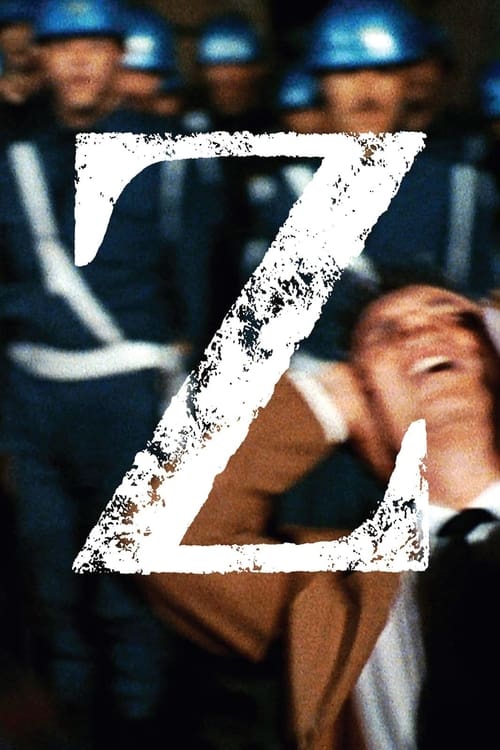
Z
1969 · Costa-Gavras
When you're in the mood to get furious at power and cheer for the one honest person in the room — gripping, righteous viewing for a night when you want a thriller with real stakes behind it.
What it's about
A charismatic opposition politician is struck down at a peace rally, and the government rushes to call it a traffic accident. A methodical young magistrate starts pulling at the threads — and finds police, army, and state apparatus all leaning on him to stop. Based on a real political assassination in 1960s Greece, filmed in defiant exile while a junta held power at home.
The experience
It moves like an action film — urgent, propulsive, angry — while working like an investigation, each witness and lie snapping into place. You feel the outrage building scene by scene, and the film never lets it cool.
Performances
Yves Montand brings warmth and gravity to the doomed politician, and Jean-Louis Trintignant is quietly riveting as the magistrate — a study in stubborn, expressionless integrity that grows heroic without a single grand gesture.
The craft
Costa-Gavras shoots real streets with handheld urgency and cuts with astonishing speed — the editing won an Oscar — while Mikis Theodorakis's driving score turns a court inquiry into something that races. It made political outrage feel like entertainment without cheapening either.
Why it matters
An Oscar winner for Best Foreign Language Film and a rare foreign-language Best Picture nominee, it became the template for the modern political thriller and proof that cinema could take on a living dictatorship in real time.
Snapshot
Z is a French-Algerian political thriller based on Vassilis Vassilikos's 1966 novel of the same name, which fictionalized the 1963 assassination of Grigoris Lambrakis — a Greek peace activist, physician, and member of parliament — in Thessaloniki. Shot in Algeria because the Greek military junta (in power since 1967) made domestic production impossible, the film reconstructs a state-sanctioned murder and the judicial investigation that briefly threatened to expose it, before a coup erases every finding. It won the Academy Award for Best Foreign Language Film and was simultaneously nominated for Best Picture — a rare dual distinction — and became the template for the modern political thriller. Costa-Gavras opens with a sardonic epigraph comparing the suppression of dangerous ideologies to the use of pesticides against agricultural pests, and closes with a cascade of title cards enumerating everything the Greek junta subsequently banned, including the letter Z itself — which in Greek means he lives.
Industry & production
Z was produced as a French-Algerian co-production through Reggane Films and the Algerian state film organization ONCIC (Office National pour le Commerce et l'Industrie Cinématographique). The actor Jacques Perrin, who also plays the investigative photojournalist within the film, served as one of its principal producers — an unusual arrangement that gave the project both creative cohesion and a stake in its commercial success. Jorge Semprún, the Spanish-born novelist and screenwriter who had survived Buchenwald and was deeply embedded in European left politics, co-wrote the screenplay with Costa-Gavras. Their collaboration was ideologically and formally precise: they wanted urgency, not agitprop, and the script compresses and reassigns events from the Lambrakis case without disguising its targets. The film was shot on a modest budget and completed quickly; its economy of means contributed to its kinetic texture. Distribution in France by Paramount Pictures-affiliate Valoria Films gave it reach that most political art cinema of the period could not achieve, and it performed strongly at the box office across Western Europe and North America — though precise figures have not been reliably published in the sources available. What is clear is that it was a commercial as well as critical event, unusual for a film of its political explicitness.
Technology
Raoul Coutard, the cinematographer, shot Z in Eastmancolor on 35mm using a combination of handheld and lightweight dolly-mounted cameras. Coutard had spent the previous decade transforming French cinematography alongside Godard and Truffaut, and his facility with fast film stocks and available or semi-available light gave Z a texture that sits between documentary and classical thriller — neither the cool remove of observational cinema nor the controlled luminosity of studio work. Locations in Algiers stood in for an unnamed Mediterranean city (pointedly never identified as Greece within the film's diegesis), and Coutard exploited the actual light, crowded streets, and open squares rather than constructing period-accurate Greece on a stage. The widescreen frame (shot in a spherical anamorphic-adjacent ratio) is used not for compositional grandeur but for social density — the demonstrations, the street violence, the corridors of power are all spaces in which the frame is filled with bodies. The sound recording, mixed to preserve ambient noise and crowd texture, reinforces the documentary register.
Technique
Cinematography
Coutard's camera is rarely still for long, but it moves with purpose rather than for effect. During the assassination sequence — in which Lambrakis's stand-in, "the Deputy" (Yves Montand), is struck by a three-wheeled vehicle driven by right-wing operatives — the camera plunges into the chaos at ground level, cutting rapidly between disoriented angles that refuse to provide a clean overview. The ambiguity is strategic: no single vantage point commands the event, mimicking the way official inquiry will subsequently contest what anyone saw. In the investigative sequences, Coutard switches to longer lenses and more stable framings, suggesting the steadying — temporarily — of institutional process. The contrast between these modes is one of the film's structural arguments: chaos is engineered, and the tools of observation can only partially overcome it.
Editing
Françoise Bonnot's editing is among the most celebrated aspects of the film, and her Academy Award for Best Film Editing was broadly considered merited. Bonnot — who would go on to edit Costa-Gavras's subsequent political thrillers — constructs sequences with a rhythm that is genuinely musical: the pace accelerates and decelerates in concert with Theodorakis's score, but also against it, creating productive friction. The assassination itself is reprised and reassembled from multiple witness perspectives as the investigation proceeds, a structural device that recalls Kurosawa's Rashomon (1950) but serves a different purpose: where Kurosawa's repetitions multiply subjective truth, Bonnot's accumulate forensic detail. The film does not suggest that what happened is unknowable; it shows that it is being made to appear unknowable by people who know perfectly well what occurred.
Mise-en-scène / staging
Costa-Gavras stages public scenes — rallies, street confrontations, hospital lobbies — with the controlled anarchy of someone who has studied newsreel and cinema vérité while retaining classical dramatic instincts. Extras behave as crowds rather than as arranged background; the camera is often jostled within them. The scenes of official deliberation — interrogations, closed-door meetings among the military and police — are composed with deliberate irony: formal interiors, the apparatus of legitimate authority, men in uniforms performing procedural gravity while the audience knows they are co-conspirators. The spatial contrast between the open, dangerous street and the closed, dangerous room is sustained throughout.
Sound
Mikis Theodorakis composed the score while under house arrest in Greece — his music had been banned by the junta, and the act of using it was itself a political statement. The score moves between bouzouki-inflected melancholy and propulsive, almost dance-like rhythms that the film deploys with deliberate incongruity: festive-sounding music accompanies violence, giving the political assassins a kind of terrible normalcy. The diegetic soundscape — crowd noise, motorcycles, microphone feedback at the rally — is treated with documentary fidelity and carries its own weight. The combination creates a film that is simultaneously emotionally immediate and analytically distanced.
Performance
Yves Montand, as the Deputy, spends the majority of the film incapacitated or dead — his is a characterization built almost entirely in the film's first act before he is struck down. Montand's physicality and political gravitas (he was himself a committed left-wing figure in French public life) carry the character past the screen time available. Jean-Louis Trintignant as the Examining Magistrate — the film's procedural conscience — gives a performance of studied, almost bureaucratic containment; his impassivity is the film's moral bedrock, and the occasional cracks in it register as ruptures. Jacques Perrin plays the photojournalist who documents everything with a quiet intensity that emphasizes witness as active, not passive, resistance. Irene Papas, as the Deputy's widow, has limited screen time but brings a gravity that requires nothing from the script.
Narrative & dramatic mode
Z is structured as a three-act procedural in which the first act establishes the assassination as political murder, the second follows the magistrate's investigation as it patiently assembles proof of state complicity, and the third — delivered almost entirely through title cards — collapses the entire edifice. The investigation succeeds. The findings are real. And then the coup arrives and renders them void. This structure is Costa-Gavras's central formal argument: the correct procedure, faithfully executed, produces the right answer; the system then destroys the procedure. The film's mode is neither nihilistic nor conventionally redemptive — the truth survives in the record, and in the film itself, even though it is suppressed within the story. The opening disclaimer — "Any resemblance to actual events or persons, living or dead, is not coincidental. It is intentional" — signals that the film's drama and its political act are one.
Genre & cycle
Z is foundational to the political thriller as a commercially viable genre form — not its first instance (Francesco Rosi's Salvatore Giuliano in 1962 and Hands Over the City in 1963 are important precedents), but the film that demonstrated the genre could reach mainstream audiences at scale. It belongs to the cycle of politically engaged European cinema of the late 1960s and early 1970s that also includes Rosi's The Mattei Affair (1972), Elio Petri's Investigation of a Citizen Above Suspicion (1970), and Gillo Pontecorvo's The Battle of Algiers (1966) — films that treat contemporary political violence and institutional corruption as subjects for classical genre treatment. Z's success in North America specifically helped seed the American paranoid thriller cycle of the following decade.
Authorship & method
Costa-Gavras (born Konstantinos Gavras, Athens, 1933) came to France in the mid-1950s after his father, a communist resistance figure, was imprisoned, making his son ineligible for the Greek university system. He studied at IDHEC (the Institut des hautes études cinématographiques) in Paris and worked as an assistant director before making his debut feature, The Sleeping Car Murders (Compartiment tueurs, 1965), a thriller that demonstrated his capacity for genre craft. Z was his international breakthrough and established a career-long commitment to politically engaged cinema in genre forms. His method is collaborative and research-grounded — he works closely with screenwriters of strong political formation (Semprún for Z and subsequent films; Donald Stewart for Missing) and chooses cinematographers and editors whose sensibility aligns with documentary urgency.
Jorge Semprún brought to the screenplay a politics forged by direct experience of fascism and clandestine resistance. His adaptation condenses the Lambrakis case without sentimentalizing it and structures the investigation as a race against the film's own foregone conclusion.
Raoul Coutard had been the defining cinematographer of the French New Wave; his work on Z shows how that movement's technical innovations — handheld mobility, available light, location shooting — could be redirected toward politically committed narrative cinema without losing their immediacy.
Françoise Bonnot, working in close dialogue with Costa-Gavras, proved that the political film's argument could be encoded in editing rhythm as much as in dialogue or image composition.
Mikis Theodorakis, whose score was assembled under constraint, contributes music that carries the film's Greek national identity and its political stakes in a register no other element could reach.
Movement / national cinema
Z belongs simultaneously to French cinema (financing, crew, distribution, the Nouvelle Vague inheritance visible in Coutard's work) and to a transnational tradition of committed European political filmmaking that cuts across national categories. Costa-Gavras is a Greek director working in the French system about a Greek political event, with an Algerian production partner and a Spanish screenwriter — its very existence enacts the internationalism it espouses. Within Greek cinema proper, the film exists as an exile document: made outside Greece because the country it addresses had made such a film impossible. Theodorakis's presence ties it to a specifically Greek cultural politics without requiring Greek institutional support.
Era / period
Z appears at the precise intersection of three historical forces: the global upheaval of 1968, which electrified left political filmmaking across Europe; the consolidation of the Greek military junta (1967–1974), which gave the film its immediate subject and its sense of urgency; and the late phase of the French New Wave, whose technical and commercial infrastructure Costa-Gavras inherits and redirects. The film was released in France in late 1968 and internationally in 1969 — a moment when political cinema had both an audience and a cause, and when the formal tools for making it were more agile than they had ever been. The late 1960s also marks the beginning of the decline of the European art-film model in favour of commercially structured genre pictures, and Z demonstrates that the two were not incompatible.
Themes
State violence and its concealment. The film's animating subject is not simply murder but the infrastructure of deniability — the way that official institutions absorb, misattribute, and finally suppress evidence of their own crimes. The Deputy's death is less important than the machinery that ensures no one is held accountable.
The limits of legal process. The magistrate does everything correctly and reaches the right conclusions. The system then dismantles his findings. The film is neither anti-institutional nor naively pro-institutional; it shows the rule of law as genuinely capable of finding truth and genuinely incapable of protecting it from power.
Witness and testimony. Multiple characters — the photojournalist, the examining magistrate, the witnesses who testify at personal risk — model different forms of bearing witness. The film itself is framed as an act of witness: the opening disclaimer and closing title cards position the dossier as an extension of the investigation that the coup interrupted.
Fascism as ordinary. The right-wing operatives who carry out the assassination are petty, provincial, and ridiculous — petty criminals paid by men in uniforms who themselves serve a larger ideological project. Costa-Gavras refuses to aestheticize the villains or grant them tragic weight. Their banality is part of the argument.
Memory and suppression. The junta bans the letter Z. History is an ongoing contest over what can be remembered and stated. The film's continued existence is its riposte.
Reception, canon & influence
Critical reception. Z was widely recognized on release as a major work — commercially and critically unusual in its combination of genre excitement with political seriousness. It received the Jury Prize at the Cannes Film Festival in 1969. At the 42nd Academy Awards it won Best Foreign Language Film and Best Film Editing, and was nominated for Best Picture and Best Director — placing it among the very small number of foreign-language films to compete for the top prize in Hollywood's principal awards forum. Reviews across Western Europe and North America praised its formal control and its urgency; some critics on the left worried that its genre pleasures might neutralize its political argument, a debate that has continued in the scholarly literature.
Influences on the film (backward). Francesco Rosi's Italian political cinema — Salvatore Giuliano, Hands Over the City — is the most direct antecedent in terms of treating political violence as documentary-style narrative. Gillo Pontecorvo's The Battle of Algiers (1966) demonstrated that fiction shot with documentary methods could function as political testimony; the Algerian co-production arrangement for Z is not coincidental in this context. The French New Wave — specifically Coutard's own earlier work — provided the technical grammar. The Italian neorealist tradition underlies all of these. Vassilikos's source novel, with its fractured chronology and multiple focalisers, contributed the investigative structure.
Legacy (forward). Z's most direct lineage runs through Costa-Gavras's own subsequent political thrillers — The Confession (L'Aveu, 1970), State of Siege (État de siège, 1972), and the American-financed Missing (1982) — which together constitute the most sustained body of work in the genre. More broadly, the film was instrumental in demonstrating to American producers that the political thriller could function as mainstream commercial cinema, and its influence is discernible in Alan J. Pakula's paranoid trilogy — Klute (1971), The Parallax View (1974), All the President's Men (1976) — in Sydney Pollack's Three Days of the Condor (1975), and in the investigative procedural strands of films running forward through Michael Mann and Oliver Stone. The formal device of reprising contested events from multiple witness perspectives to accumulate forensic truth — rather than subjective irresolution — has become a standard tool of the genre. The film remains in active canonical circulation and is taught widely as a case study in the relationship between political commitment and genre form.
A Deleuzian reading
The little three-wheeled truck comes through the crowd like a wasp, and then the Deputy is on the ground.
The full Deleuzian reading of Z →
Reception
A genuine sensation in 1969 — a box-office hit that won the Foreign Language Oscar and, remarkably, a Best Picture nomination too. Today it's less watched than the 70s paranoid thrillers it made possible, but cinephiles treat it as the founding document of the political thriller.
How Z was received, from release to now →
Influences: the films it descends from and the films it influenced
- Roma, città aperta (1945) — Rossellini's location shooting in occupied Rome under available light with non-professional extras in politically charged crowd confrontations established the neo-realist grammar — bodies in real spaces under real pressure — that Z inherits and converts into staged political thriller.
- Rashomon (1950) — Kurosawa's multi-witness re-staging of a single violent event as investigative architecture is the structural model Bonnot's editing employs: each successive replay of the Deputy's assassination adds a new vantage point, accumulating forensic fact rather than, as in Kurosawa, multiplying subjective truth.
- À bout de souffle (1960) — Raoul Coutard's handheld, fast-film-stock, available-light 35mm cinematography — developed here for New Wave romance — is Z's direct technical inheritance: Costa-Gavras retained the same cinematographer and the same rejection of studio luminosity, transplanting the method wholesale into political thriller.
- Salvatore Giuliano (1962) — Rosi's forensic reconstruction of a politically motivated Sicilian killing through non-linear testimony, mixed professional-and-non-professional casting, and institutional procedural sequences — hearings, interrogations, official evasions — established the Italian political cinema template that Z imports directly into French production.
- La battaglia di Algeri (1966) — Pontecorvo's pseudo-documentary crowd staging in North African locations — non-professional extras, grain-textured handheld sequences simulating newsreel footage of political violence — provided Z's immediate visual precedent; Algiers served as the unnamed Mediterranean city for both films.
- Foreign Correspondent (1940) — Deploys the journalist-investigator as protagonist in a genre thriller explicitly committed to political intervention, shedding fictional frame to address political reality directly — the propaganda-art fusion mode Foreign Correspondent's closing radio broadcast inaugurated as structural possibility.
- Seven Days in May (1964) — Carries the procedural-investigation engine forward: an institutional cover-up exposed step by step through rapid cross-cutting and a momentum-building reconstruction, proving political argument can drive a propulsive thriller.
- Indagine su un cittadino al di sopra di ogni sospetto (1970) — Petri's procedural inversion — the investigative apparatus is itself the criminal — mirrors Z's structural argument; Morricone's score works ironically against institutional imagery in precisely the manner Theodorakis's bouzouki score generates friction between formal authority and actual violence.
- État de siège (1972) — The third film in Costa-Gavras's political trilogy reproduces Z's procedural-foregone-conclusion structure, title-card epilogue documenting impunity, and controlled-anarchy crowd staging — same formal grammar applied, now with Franco Solinas replacing Semprún, to U.S. intervention in Uruguay.
- The Parallax View (1974) — Gordon Willis's handheld controlled-anarchy crowd sequences in the opening political rally assassination — camera jostled within extras as a politician is killed at elevation — directly echo Z's staging method, establishing American paranoid cinema's visual grammar of witness-as-instability.
- All the President's Men (1976) — Z's investigative procedural DNA — the accumulation of institutional documentation toward a foregone conclusion of impunity — transplants into Watergate journalism; Willis's high-contrast available-light cinematography in the Post bullpen and parking-garage sequences succeeds Coutard's aesthetic as the grammar of institutional accountability.
- Missing (1982) — Costa-Gavras applies Z's template directly to Pinochet's Chile: same procedural investigation of state-sanctioned murder, same title-card epilogue documenting impunity; Jack Lemmon's performance occupies the political-gravitas-in-bureaucratic-containment register that Montand established.
- JFK (1991) — Stone's multi-perspective assassination reconstruction directly descends from Bonnot's editorial method: rapid accumulation of witness footage from successive angles builds forensic weight rather than epistemological ambiguity, and the title-card epilogue documenting aftermath and impunity explicitly replicates Z's closing structure.
- Munich (2005) — Spielberg's political assassination procedural inherits Z's formal grammar: Kamiński's handheld available-light cinematography, political-gravitas ensemble casting in bureaucratic containment sequences, and a procedural structure that indicts institutional violence even as the state authorizes it.
- Spotlight (2015) — McCarthy's institutional investigation procedural inherits Z's bureaucratic containment performance register — investigators who suppress emotion while accumulating documentary evidence against a protected institution — and its foregone-conclusion structure, in which the scale of the crime is revealed procedurally rather than dramatically.
- The China Syndrome (1979) — Costa-Gavras established the procedural dark ending as a political genre convention in which the institutional apparatus reasserts control over evidence and title cards deliver the ironic coda; China Syndrome's closing freeze-frame of Godell shot dead on live television, followed immediately by the corporate statement, is a direct citation of this structural device.
- The French Connection (1971) — Raoul Coutard's handheld procedural rhythm and the investigation structure that refuses institutional resolution — the case is solved, the guilty identified, nothing changes — prefigures both Roizman's restless coverage and French Connection's deliberately unsatisfying ending in which Doyle shoots an unarmed man and Charnier escapes.
- The Bourne Ultimatum (2007) — Raoul Coutard's handheld tracking of figures through dense crowds while withholding spatial overview established the kinetic grammar for the paranoid-institutional thriller — the camera as witness inside rather than observer above — that Greengrass inherits wholesale.
- Serpico (1973) — Costa-Gavras's technique of opening on an aftermath and reconstructing political murder through a fragmented flashback framing device—withholding chronological resolution in favor of procedural accumulation—is the direct structural model for Serpico's non-chronological opening at the shooting scene; Z also established the genre convention that true-story institutional conspiracy requires a documentary texture achieved through location shooting rather than studio simulation.
- L'aveu (1970) — Costa-Gavras and Semprún co-wrote both films; Montand reprises his role of political gravitas under bureaucratic institutional containment — here in a Stalinist show-trial staging — applying Z's controlled formal precision and procedural rhythm to the inverse political target.
- Il conformista (1970) — Storaro's cinematography deploys spatial contrast between intimate interior compositions of fascist complicity and exposed exterior crowd sequences in the same dialectical register as Coutard's deliberate street-versus-room staging in Z, encoding political argument in camera placement.
- Medium Cool (1969) — Cuts documentary-paced vérité urgency into political fiction the same year, treating the thriller as reportage on state violence rather than melodrama.
- The Constant Gardener (2005) — Progenitor of the conscience thriller built on real political atrocity, using investigative momentum and documentary urgency to indict institutional complicity.
- Thirteen Days (2000) — Set the kinetic political-procedural grammar — propulsive cutting through investigation and deliberation that Conrad Buff's countdown editing inherits to keep talk-heavy scenes urgent.
- Titus (1999) — Françoise Bonnot's Oscar-winning associative political montage — rapid juxtaposition of memory, image and motive — is the editing method she carries directly into Titus's fractured visual interludes.
- One Way or Another (1976) — The template European political-thriller autopsy of a state crime, dissecting institutional complicity as procedure — the genre Petri bends toward anti-realist allegory.
- The Wrong Man (1956) — Inherits the procedural-realism engine that turns an investigation's accumulating factual detail into suspense, applying The Wrong Man's institutional dread to overtly political miscarriage.
- Marighella (2021) — Supplies the political-thriller grammar Moura applies to 1969 Brazil — real events compressed into propulsive cross-cut blocks, a composite police/investigator figure invented to give the state a face, and a cutting rhythm that treats documented atrocity with the tempo of genre suspense.
Similar films
- Missing (1982) — influence & lineage · same viewing thread
- State of Siege (1972) — influence & lineage
- Investigation of a Citizen Above Suspicion (1970) — influence & lineage
- Breathless (1960) — influence & lineage
- The Battle of Algiers (1966) — influence & lineage
- JFK (1991) — influence & lineage
- The Secret Agent (2025) — same viewing thread
- Soundtrack to a Coup d'Etat (2024) — same viewing thread
Watch it with: curated runs of related films
- The Long Shadow of the Coup — A run of films tracing political violence from the mutiny and the massacre through martial law to the decades-long reckoning that follows — watch them near each other and the same machinery of power keeps rhyming across continents and eras.
Film essays and courses that include it
- The Machinery of Power
- The Face Under Trial: A Century of Justice on Film
- Revolt in the Frame: Revolutionary Cinema 1925–2006
- The Fix Is In: Cinema's Anatomy of Corruption, 1939–2007
- The Paranoid Machine: A Century of Conspiracy Cinema
- In Camera: The Institutional Chamber Thriller from Joan to Conclave
- The Long Crossing: International Films That Made the World Watch
- The Eyes of the New Wave