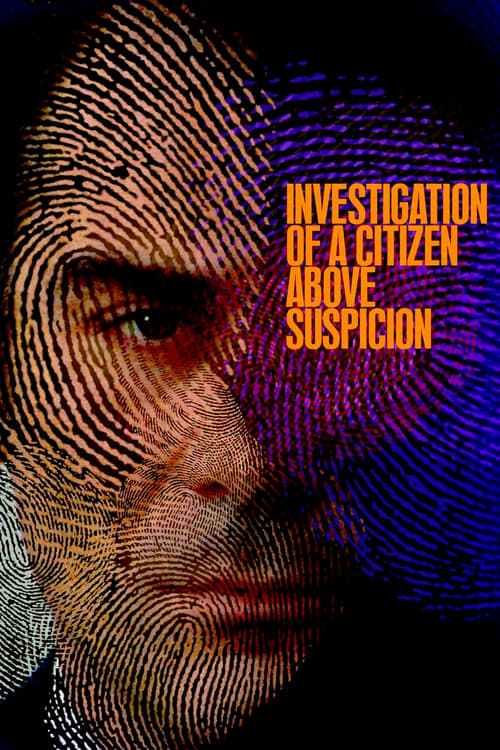
Investigation of a Citizen Above Suspicion
1970 · Elio Petri
For when you're angry at how power protects itself and want a film that channels that fury with style — a thinking-person's thriller that doubles as satire. Challenging, but compulsively watchable.
What it's about
A powerful Rome police official murders his mistress — and then, instead of covering his tracks, deliberately plants evidence pointing straight at himself. As he rises to head the political division, he keeps daring the system to arrest him, and the machine he serves keeps refusing to see what's in front of it: a man of his rank simply cannot be guilty.
The experience
Not a whodunit but a slow-burning provocation — you know everything from the first minutes, and the tension comes from watching institutions bend reality to protect power. It's darkly funny, genuinely unnerving, and builds an almost unbearable ironic pressure.
Performances
Gian Maria Volonté is ferocious as the Inspector — preening, needling, grotesque, and mesmerizing — a portrait of the authoritarian personality so vivid it's hard to look away.
The craft
Petri directs with jagged, aggressive precision, and Ennio Morricone contributes one of his most famous scores — a sardonic, marionette-like theme that turns the whole film into a dance of power. The writing is razor-edged, every interrogation scene a trap snapping shut.
Why it matters
It won the Academy Award for Best Foreign Language Film and stands as the peak of Italy's great wave of political cinema, still the reference point for stories about impunity and institutional rot.
Snapshot
Indagine su un cittadino al di sopra di ogni sospetto is Elio Petri's scalding political thriller about a senior Roman police official who murders his mistress and then, rather than concealing the crime, deliberately strews the scene with clues that point to himself — daring the apparatus of the state to arrest one of its own. The film's engine is not suspense in the whodunit sense (we watch the killing in the opening minutes) but a mounting, almost unbearable irony: the more evidence the Inspector plants against himself, the more his colleagues and the system he serves refuse to believe a man of his authority could be guilty. It is at once a murder story, a satire of power, and a clinical case study of the authoritarian personality. Anchored by Gian Maria Volonté's ferocious lead performance and propelled by one of Ennio Morricone's most instantly recognizable scores, the film became the international face of Italian cinema politico at the turn of the 1970s, winning the Academy Award for Best Foreign Language Film and the Grand Prix at Cannes.
Industry & production
The film emerged from the fertile, politically charged Italian film industry of the late 1960s, a moment when auteur-driven "committed" cinema could still command commercial distribution and international sales. It was written by Petri with his frequent collaborator Ugo Pirro and shot largely in Rome, drawing on the resources of the Italian studio system centered on Cinecittà and the city's institutional locations, which gave the depiction of police headquarters its bureaucratic verisimilitude. Precise financing and budget figures are not something I can state reliably, and I will not invent them; the production is generally associated with producer Daniele Senatore, though I would treat granular corporate details as beyond firm confirmation here.
What is beyond dispute is the film's reception in the marketplace of ideas and awards. It won the Academy Award for Best Foreign Language Film (presented in 1971) and took the Grand Prix (the Special Jury Grand Prize) at the 1970 Cannes Film Festival. A frequently cited quirk of its distribution history is that, owing to the timing of its U.S. release, its screenplay was later nominated for an Academy Award in the original-screenplay category as well — a detail I recall as accurate but flag as the kind of trivia worth double-checking against the record. The film's success helped confirm that a stylistically aggressive, ideologically pointed Italian picture could travel, and it consolidated Petri and Volonté as marquee names of the era's political cinema.
Technology
The film was made on 35mm and in color, the standard professional format for a major Italian feature of 1970. I do not have firm documentation of the exact color process or camera equipment used, and rather than guess I will simply note that the color work is deliberate and stylized: interiors are keyed toward institutional grays, cold blues, and the oppressive off-whites of official spaces, punctuated by warmer, more sensual tones in the flashbacks to the affair. This is a film whose "technology" is subordinated entirely to a controlling design sensibility rather than to any technical novelty — there are no process innovations of note here; the achievement is in orchestration, not apparatus.
Technique
Cinematography
Luigi Kuveiller's photography is central to the film's unease. The camera favors wide-angle framings and a restless mobility that turns architecture into an instrument of power: long corridors, echoing halls, and the vertiginous scale of police headquarters dwarf the human figures within them. Kuveiller and Petri repeatedly place the Inspector at the center of compositions that seem to organize the world around his authority, then destabilize that authority through low angles, distorting proximities, and a sense of surveillance folded back on the watcher. The visual grammar is expressionistic rather than naturalistic — closer to satire and nightmare than to documentary realism — and it works in tandem with the production design to make bureaucracy itself feel like a psychological pathology.
Editing
Ruggero Mastroianni's editing is one of the film's signal achievements. The narrative is fractured, cutting between the present-tense investigation and flashbacks to the Inspector's relationship with Augusta Terzi, so that the past continually erupts into and comments on the present. The intercutting is not merely expository; it is rhythmic and ironic, juxtaposing the Inspector's public performance of law-and-order rectitude with the private cruelty and neurosis that the affair revealed. The film's tempo tightens as the Inspector's provocations escalate, and the cutting collaborates with Morricone's score to produce a mounting, mechanical inexorability.
Mise-en-scène / staging
Staging is where the film's ideas become physical. Petri choreographs the Inspector's movements through official spaces as a kind of theater of dominance — the man performs his own importance, and subordinates perform their deference. The murder scene and its aftermath are staged with a chilling deliberateness: the Inspector arranges evidence the way a director blocks a scene, and the film is acutely aware of this theatricality. Objects and gestures recur with near-Brechtian emphasis, insisting that the audience read the behavior as a demonstration of a thesis about power rather than lose itself in psychological identification.
Sound
Beyond Morricone's score (discussed below), the sound design leans on the acoustic character of institutional space — footsteps, echoing rooms, the clatter of typewriters and telephones, the drone of bureaucratic process — to reinforce the sense of an all-encompassing machine. As with much Italian cinema of the period, the film was post-synchronized in the standard practice of the industry, and the dialogue track carries a slightly heightened, declamatory quality that suits the film's satirical register.
Performance
Gian Maria Volonté's portrayal of the Inspector (identified largely by title and function rather than by an ordinary name) is a tour de force of controlled excess. He plays authority as both seductive and grotesque — magnetic in command, contemptible in intimacy, and increasingly unhinged as his self-incriminating game fails to produce the punishment some part of him craves. Florinda Bolkan, as the murdered mistress Augusta Terzi, gives the flashbacks their charge; her character is at once the Inspector's lover and his goad, exposing the impotence and cruelty beneath his uniform. The surrounding ensemble of functionaries plays deference and complicity with a satirical precision that turns the whole police apparatus into a chorus.
Narrative & dramatic mode
The film inverts the classical detective structure. We are shown the crime and the criminal at the outset; the "investigation" of the title is therefore a bitter irony, because the true subject is the system's structural incapacity to investigate itself. The dramatic mode is that of ironic tragedy crossed with grotesque satire: we watch a man methodically build the case against himself, and we watch power methodically refuse to see it. Flashbacks supply the psychological and erotic backstory, deepening the portrait of a personality that fuses political authoritarianism with private sadomasochism. The famous framing device drawn from Franz Kafka's The Trial — the film closes on Kafka's words about the law's power over the individual — makes explicit the parable underneath the police procedural: this is a fable about guilt, authority, and the impossibility of justice within a self-protecting order.
Genre & cycle
Nominally a crime drama and thriller, the film belongs most precisely to the Italian cinema politico — the wave of politically engaged narrative films that flourished around 1969–1975. It sits alongside, and helped define, a cycle that included Costa-Gavras's Z (1969) and the later "denunciation" thrillers of Francesco Rosi and Damiano Damiani. It is distinct from the more purely commercial poliziottesco (the tough Italian crime-action films that boomed later in the decade): where those films often valorized the hard cop, Petri's picture dissects and indicts him. Within Petri's own filmography it is frequently grouped with The Working Class Goes to Heaven (1971) and Property Is No Longer a Theft (1973) as a loose sequence of works anatomizing power, labor, and property in Italian society.
Authorship & method
Elio Petri (1929–1982) was among the most intellectually combative of Italy's postwar directors, a Marxist filmmaker who nonetheless resisted didactic realism in favor of stylized, expressionistic, sometimes grotesque forms. His method here fuses political argument with a heightened, almost operatic visual and performative style — a deliberate refusal of naturalism intended to keep the audience analytically alert. Central collaborators define the film as much as Petri does:
- Ugo Pirro (co-writer): Petri's key screenwriting partner of the period, with whom he built the film's tight, thesis-driven architecture and its Kafkaesque frame.
- Luigi Kuveiller (cinematographer): author of the film's cold, wide-angled, surveilling visual language.
- Ruggero Mastroianni (editor): one of Italian cinema's great editors (long associated with Fellini), whose fractured cutting gives the film its ironic simultaneity of past and present.
- Ennio Morricone (composer): contributor of a score built on a jaunty, insinuating, mechanically repetitive theme — a plucked, marching motif that is at once comic and sinister, and that has become one of his most identifiable compositions outside the Western genre.
- Gian Maria Volonté (lead): not merely a star but a committed political artist whose collaboration with Petri (continuing into The Working Class Goes to Heaven) was itself a statement of the cinema's engagement.
Movement / national cinema
The film is a landmark of Italian national cinema at the point where the legacies of neorealism and the modernist auteurism of the 1960s converged with an urgent new political militancy. It reflects a generation of Italian filmmakers who believed cinema should intervene directly in national life. Yet it is anti-realist in surface: Petri absorbs the analytic ambitions of political cinema while borrowing the stylization of satire, expressionism, and even absurdist theater. In this it exemplifies a distinctly Italian synthesis — rigorous political content delivered through baroque, self-conscious form — that set the country's political cinema apart from the more sober, procedural mode of, say, Costa-Gavras.
Era / period
Released in 1970, the film is inseparable from its moment: the aftermath of the 1968–69 upheavals, rising labor militancy, and the onset of Italy's anni di piombo ("years of lead"), a period of political violence, state repression, and deep suspicion of the security apparatus. The December 1969 Piazza Fontana bombing and its contested, politically fraught investigation formed part of the atmosphere in which the film landed, sharpening its portrait of a police power that operates above accountability. The picture reads as a direct response to widespread anxieties about authoritarianism, the misuse of state power, and the persistence of fascist reflexes within postwar democratic institutions.
Themes
At its core the film is an anatomy of power and its psychology. Its governing thesis — announced in the Inspector's own dialogue and echoed by the Kafka epigraph — is that authority renders its holders effectively immune to the law they administer, that the system protects itself by refusing to recognize the guilt of its guardians. Braided through this political argument is a psychosexual one: the Inspector's authoritarianism is inseparable from a private complex of impotence, cruelty, and a masochistic longing to be caught and punished. The film thus links the political and the erotic, suggesting that the appetite for domination and the appetite for submission are two faces of the same pathology. Related motifs include surveillance and confession, the theatricality of authority, the bureaucratization of repression, and the corrosion of individual conscience within an all-protecting order.
Reception, canon & influence
Critically and institutionally, the film was among the most celebrated Italian pictures of its year, crowned by the Academy Award for Best Foreign Language Film and the Grand Prix at Cannes 1970. It was widely praised for Volonté's performance, Morricone's score, and the audacity of its structure, and it has retained a secure place in the canon of political cinema; it circulates today in restored form (including through prestige home-video labels) and is regularly taught as a touchstone of the genre.
Influences on the film (backward): The most explicit debt is to Franz Kafka, whose vision of the individual crushed by an unknowable, self-justifying law frames the entire picture. The film also draws on the tradition of the political thriller crystallized by Costa-Gavras's Z the previous year, on the analytic realism of Francesco Rosi's investigative dramas, and, in its stylization and satire, on strands of expressionist and absurdist theater. Morricone's contribution belongs to his broader body of ironic, motif-driven scoring rather than to any single antecedent.
Legacy (forward): The film helped establish the template for the ironic, institution-indicting political thriller and reinforced the international viability of Italian cinema politico, feeding the cycle of denunciation films that ran through the early 1970s. Its central conceit — the criminal who cannot be convicted because power will not permit it — and its fusion of authoritarian politics with sexual pathology have echoed in later films and television concerned with corrupt institutions and untouchable insiders. Morricone's theme has enjoyed an afterlife of its own, sampled and referenced well beyond the film. Perhaps the film's most enduring influence is as a permanent reference point in debates about state impunity: whenever cinema returns to the question of who polices the police, Petri's picture remains the definitive, mordant statement of the problem.
A Deleuzian reading
A man kills his lover in the first minutes of Elio Petri's film.
The full Deleuzian reading of Investigation of a Citizen Above Suspicion →
Reception
A sensation on release — Grand Prix at Cannes 1970, then the Best Foreign Film Oscar — but long hard to see in the English-speaking world; the 2013 Criterion restoration turned it from a whispered-about masterpiece back into required viewing.
How Investigation of a Citizen Above Suspicion was received, from release to now →
How to watch Investigation of a Citizen Above Suspicion: what to notice on a first viewing
- Watch how small the Inspector looks against the headquarters architecture. Cinematographer Luigi Kuveiller uses wide-angle framings and long corridors that dwarf the human figures inside them. The architecture itself starts to feel like a form of power pressing down on everyone in it.
- Notice how deliberately the Inspector arranges evidence at the scene. Petri stages the aftermath with the same care a director gives blocking a scene, each object and gesture placed with visible intention. You are watching a man direct his own incrimination like theater.
- Listen for the score's jaunty, marching little melody. Ennio Morricone's music is plucked and repetitive, comic and sinister at once, recurring throughout the investigation. The tune makes the machinery of power sound almost cheerful, which is the joke.
- Notice how the film cuts between the investigation and flashbacks. Editor Ruggero Mastroianni fractures the timeline so the Inspector's past relationship keeps erupting into and commenting on the present case. The intercutting lets you compare the man's public role and his private self in real time.
- Watch how the other officers respond to each confession. Petri stages their deference and disbelief the same way each time, almost like a repeated ritual rather than individual reactions. Their sameness turns individual colleagues into a single, predictable machine.
Influences: the films it descends from and the films it influenced
- The Trial (1962) — Supplies the Kafka framing device rendered as cinema — disorienting wide-angle lenses and cavernous, oppressive bureaucratic architecture that visualize the individual crushed by an unknowable law, the exact grammar Petri adopts.
- Citizen Kane (1941) — Toland's deep-focus wide-angle portraiture fused with a fractured, flashback-intercut reconstruction of a powerful man models Petri's ironic simultaneity of past and present.
- Salvatore Giuliano (1962) — Establishes the inchiesta method — non-chronological, quasi-documentary reconstruction that indicts institutional complicity rather than a single culprit.
- Hands Over the City (1963) — Casts Volonté as the very embodiment of institutional power and offers the analytic dissection of civic corruption Petri channels into cinema politico.
- Z (1969) — Crystallizes the ironic political-thriller template — investigative flashback montage plus a mordant indictment of state cover-up — that Petri names as a direct debt.
- The Battle of Algiers (1966) — Source of Morricone's insistent, marching institutional-menace motif and the political-cinema welding of documentary texture to orchestrated dread.
- M (1931) — Expressionist staging of the police apparatus and criminal underworld as parallel bureaucratic machines, a stylized-yet-procedural visualization of institutional method.
- The Working Class Goes to Heaven (1971) — Continues the Petri–Volonté collaboration, extending the same grotesque, Brechtian anti-naturalist performance style into a Marxist critique of the factory.
- The Mattei Affair (1972) — Puts Volonté back at the head of an inchiesta into an untouchable power broker, extending Petri's cinema-politico interrogation of institutional impunity.
- Slap the Monster on Page One (1972) — Volonté-led denunciation film of the anni-di-piombo cycle Petri energized, turning the same stylized political-thriller apparatus on a corrupt press institution.
- Sacco and Vanzetti (1971) — A Morricone-scored denunciation film from the early-'70s cycle Petri's success made internationally viable, applying his ironic institutional indictment to a judicial atrocity.
- Illustrious Corpses (1976) — The paranoid 'who polices the police' thriller staged in cold, wide-angled institutional architecture, directly extending Petri's conceit of the untouchable insider.
- Todo Modo (1976) — Pushes Petri's own grotesque, expressionist political allegory with Volonté to its most theatrical extreme, foregrounding Brechtian staging of ruling-class ritual.
- Serpico (1973) — Translates Petri's central 'who polices the police' question into the American cop film, an institution-indicting drama of self-protecting corruption.
- The Parallax View (1974) — Adopts the cold, surveilling wide-angle framing that dwarfs the individual inside an unaccountable institutional apparatus, extending Petri's expressionist paranoia.
- Il Divo (2008) — Revives Petri's expressionist cinema politico — an operatic, grotesquely stylized anti-naturalist portrait of an untouchable Italian power figure carried by an ironic, motif-driven score.
- Ripley's Game (2002) — Morricone's mocking, fastidious chamber-score idiom scoring a cultivated man who commits murder and dares detection — the same composer logic of refined suspense-of-complicity Morricone supplies Cavani.
- La Grazia (2025) — Pioneers the cold, ritualized close study of a single man embedded in state power and institutional procedure — the political-portrait mode La Grazia softens and interiorizes.
- I... for Icarus (1979) — Shares the Morricone motif of obsessive institutional power set to a mocking, mechanical ostinato, and the theme of authority that manufactures its own immunity — the sonic and thematic template for the obedience material.
- The Conformist (1970) — Fuses authoritarian politics with sexual pathology through Storaro's heightened expressionist stylization rather than neorealist naturalism — the same anti-naturalist route to the psychosexual-authoritarian theme.
- Love and Anarchy (1973) — Ennio-Morricone-driven Italian political grotesque that uses satirical exaggeration and irony to indict state power, kin to Wertmüller's confrontational tragicomic anatomy of authority.
Similar films
- One Way or Another (1976) — influence & lineage
- The Working Class Goes to Heaven (1971) — influence & lineage
- Z (1969) — influence & lineage
- Salvatore Giuliano (1962) — influence & lineage
- Serpico (1973) — influence & lineage
- The Conformist (1971) — same viewing thread
- Accattone (1961) — same viewing thread
- Bicycle Thieves (1948) — same viewing thread
All the films related to Investigation of a Citizen Above Suspicion →
Watch it with: curated runs of related films
- Neorealism and Its Shadows — Watch these together to see Italy from the ground up — the unemployed, the sharecropped, the compromised — from neorealism's birth to its stylish, sinister heirs.