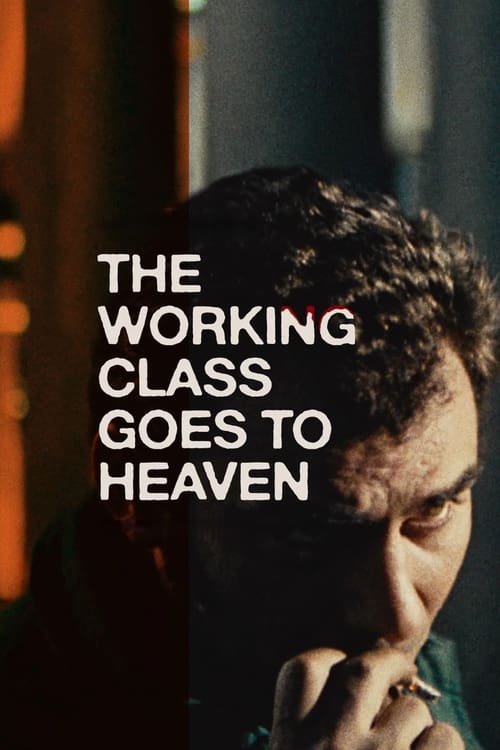
The Working Class Goes to Heaven
1971 · Elio Petri
For when you want cinema with its fists up — a fierce, political, blackly comic character study to argue about afterward. Definitely challenge, not comfort.
What it's about
Lulù Massa is the star worker at an Italian metal factory — a piece-rate machine whose record-breaking output management uses to raise everyone else's quotas. Then a lathe takes one of his fingers, and the injury jolts him awake: suddenly he's caught between the union, the student radicals at the factory gates, and bosses who have no further use for him, while his home life and his nerves come apart. It follows one man ground between the systems that all claim to speak for him.
The experience
Loud, abrasive, and darkly funny — the film runs at the pounding rhythm of the factory floor and rarely lets you exhale. It's angry filmmaking that gets under your skin; you come out rattled, arguing with it and with yourself.
Performances
Gian Maria Volonté is volcanic as Lulù — motor-mouthed, physical, veering from swagger to breakdown — a performance so committed it feels less like acting than possession.
The craft
Petri shoots the factory as a sensory assault: clanging metal, relentless machine rhythms, and a nerve-jangling score that turns industrial noise into music. The camera stays close and restless, making you feel the repetition of piece-work in your own body — worth watching with the sound up.
Why it matters
It shared the top prize at Cannes in 1972 and stands as a defining film of Italy's politically charged early-seventies cinema, capturing the era's labor struggles while refusing to flatter any side of them.
Snapshot
La classe operaia va in paradiso (released in English-speaking markets under the more sardonic title Lulu the Tool) is Elio Petri's fierce, febrile portrait of an Italian factory worker's political awakening and psychic collapse. Its protagonist, Lulù Massa, played by Gian Maria Volonté, is a star piece-worker at a metalworks — a human machine whose prodigious output management exploits to raise the quotas that grind down his colleagues. When he loses a finger in an accident at the lathe, the injury cracks open a dawning consciousness: Lulù is drawn into the orbit of student agitators and union militants, is fired, and is reinstated, all while his private life and mental equilibrium disintegrate. The film shared the Grand Prix (Palme d'Or) at the 1972 Cannes Film Festival with Francesco Rosi's The Mattei Affair, cementing its status as a signal work of Italian political cinema at the high tide of the country's labor unrest. It is the second panel of Petri's loosely grouped trilogy on power and neurosis, following Investigation of a Citizen Above Suspicion (1970) and preceding Property Is No Longer a Theft (1973).
Industry & production
The film was made in the immediate wake of Italy's autunno caldo — the "Hot Autumn" of 1969, a wave of wildcat strikes, factory occupations, and militant labor organizing that convulsed the industrial north. Petri and his co-writer Ugo Pirro conceived the project as a direct intervention into that moment, and the film's currency with contemporary struggle is inseparable from its production context: it is a movie about the shop floor made while the shop floors of Turin and Milan were in open revolt.
The film emerged from Petri's most productive and commercially viable period. Investigation of a Citizen Above Suspicion had won the Academy Award for Best Foreign Language Film and given Petri unusual leverage; The Working Class Goes to Heaven followed quickly, reuniting the core creative team behind that success — writer Pirro, cinematographer Luigi Kuveiller, composer Ennio Morricone, and star Volonté. The factory milieu was recreated with an emphasis on grimy verisimilitude; the production leaned on real industrial spaces and the choreography of assembly-line labor rather than sanitized studio abstraction. I don't have reliable box-office figures to cite, and precise budget details are not something I can verify, so I won't invent them.
Politically, the film occupied contested ground even before release. Petri was a man of the left — long associated with the Italian Communist Party's cultural orbit — and Volonté was among the most openly militant actors of his generation. Yet the film refused to flatter any faction, and its reception on the Italian left was correspondingly fractious, a point taken up below.
Technology
The film was shot on 35mm color stock, the standard professional format of the early 1970s, and there is nothing exotic in its base technology; its innovations are aesthetic rather than instrumental. What distinguishes it technically is the integration of real mechanical noise and factory acoustics into its sound design, and the way Morricone's score is built to interlock with — and mimic — industrial rhythm. The camera work exploits the mobility of period equipment for restless handheld and near-handheld movement through cramped, machine-dense interiors. In broad terms the film belongs to a moment when Italian production cinema had fully absorbed color and portable synchronous-sound technique, allowing Petri to pursue a documentary-adjacent immediacy without sacrificing the expressionist control he favored.
Technique
Cinematography
Luigi Kuveiller's photography is central to the film's oppressive power. The factory is rendered as a claustrophobic, over-full space — a thicket of lathes, belts, gauges, and bodies — shot with wide lenses and close, restless framing that denies the eye any resting point. The camera tends to crowd Lulù, prowling around him at the machine, so that the viewer is implicated in the relentless tempo of piece-work. The palette is deliberately drained and industrial: cold metals, sickly interior light, the gray monotony of the plant set against the equally airless domestic and consumer spaces Lulù inhabits. Kuveiller, who had shot Investigation of a Citizen Above Suspicion, again lends Petri a nervy, kinetic visual signature rather than a composed, classical one.
Editing
The cutting is aggressive and percussive, mirroring the mechanized rhythm of the assembly line. Sequences at the machine are built from short, hammering shots that translate repetitive manual labor into a kind of cinematic tachycardia; the montage does not observe the factory so much as reproduce its assault on the nervous system. As the film proceeds and Lulù's grip on himself loosens, the editing grows more fragmented and disorienting, aligning formal rhythm with psychological decompensation. The film is generally credited to editor Ruggero Mastroianni, a leading Italian cutter of the era; readers wanting a definitive credit should confirm against the film's titles.
Mise-en-scène / staging
Petri stages the film as a series of pressurized environments, each a variant of confinement: the plant, the union hall, the crowded apartment, the psychiatric institution where an old worker has been broken by the same system. The factory is dressed to overwhelm — dense with equipment and human traffic — and the blocking keeps bodies in near-constant collision, so that Lulù is never granted private space. Consumer domesticity is staged as its own trap, the promised reward of overtime revealed as hollow. Petri's mise-en-scène is essayistic and pointed: props, spaces, and gestures are marshaled to argue a thesis about alienated labor, and the staging often tips toward the grotesque and caricatural, refusing naturalist restraint.
Sound
Sound is arguably the film's most striking technical dimension. The mechanical clangor of the plant is foregrounded rather than tucked under dialogue, and Morricone's score works in dialogue with that noise — incorporating harsh, repetitive, machine-like figures and dissonant textures that blur the line between diegetic factory sound and composed music. The effect is to make the industrial soundscape itself expressive, an externalization of Lulù's mounting derangement. The score is characteristic of Morricone's more experimental, non-melodic mode, closer to his work for Petri's other political films than to his famous lyrical Westerns.
Performance
The film is anchored by Gian Maria Volonté's extraordinary, full-throttle performance as Lulù — a portrait of a man as loud, driven, and abrasive as the machinery he serves. Volonté plays the character's early phase as an almost manic productivism, then charts his fracture into confusion, rage, and breakdown with an intensity that borders on the operatic. It is a deliberately unsympathetic and exhausting performance, resisting the ennobled-worker cliché. Mariangela Melato brings sharp definition to Lidia, Lulù's partner, whose life is deformed by his obsessions. Salvo Randone appears as an older worker consumed and discarded by the system, a spectral figure of what Lulù may become. The ensemble surrounding them — foremen, unionists, students — is often played in a broad, satirical register consistent with Petri's caricatural intentions.
Narrative & dramatic mode
The narrative is a compressed, downward-spiraling arc of politicization and disintegration. It follows Lulù from unreflective champion of the piece-rate system, through the rupture of his industrial accident, into contact with the competing forces contending for the workers' allegiance — the institutional union with its measured reformism, and the ultra-left students with their maximalist slogans. Fired for his newfound agitation and then reinstated, Lulù ends neither redeemed nor victorious. The mode is not classical tragedy so much as political fable pitched at a hysterical frequency: Petri uses Lulù's breakdown as a diagnostic device, dramatizing alienation as a lived, bodily condition rather than an abstraction. The film's dramaturgy is frankly didactic and dialectical, staging arguments as much as events, but it channels its polemic through a single overwhelming subjectivity.
Genre & cycle
The film belongs to the Italian cinema politico — the politically engaged, socially interrogative strain of the late 1960s and 1970s that includes Rosi, the Taviani brothers, and Petri himself. Within that field it is specifically a film of labor and class, distinguished from the era's more common conspiracy-and-corruption thrillers by its focus on the factory floor and the interior life of the worker. It sits at the center of Petri's own informal trilogy — with Investigation of a Citizen Above Suspicion and Property Is No Longer a Theft — unified by a study of power, institutions, and the neuroses they produce in the individual. The film also participates in a broader European current of post-1968 cinema grappling with the relationship between the working class, the student left, and the established parties of labor.
Authorship & method
Elio Petri's authorship is defined by the marriage of overt political commitment to a stylized, expressionist, sometimes grotesque form — a refusal of both Hollywood gloss and neorealist plainness. He worked closely and repeatedly with screenwriter Ugo Pirro, whose collaboration shaped the trilogy's dialectical structure and its taste for the film-as-argument; Pirro's contribution to the script's ideological architecture is substantial and well established. Cinematographer Luigi Kuveiller supplied the nervous, mobile, cold-toned visual language that carries across Petri's political films. Composer Ennio Morricone — a frequent Petri collaborator — furnished the abrasive, machine-inflected score that is inseparable from the film's meaning. The editing is generally credited to Ruggero Mastroianni, one of the period's foremost cutters. And in Gian Maria Volonté, Petri had a lead actor whose off-screen militancy and on-screen ferocity made him the ideal instrument for a cinema that wanted to provoke rather than console. Petri's method here is essayistic and confrontational: he builds a thesis about alienated labor and then subjects the audience to it viscerally, through rhythm, noise, and performance.
Movement / national cinema
The film is a landmark of Italian political cinema and cannot be understood apart from the specific conjuncture of the Italian left circa 1969–1972 — the strike wave, the rise of extra-parliamentary groups, the tensions between the PCI, the trade unions, and the student movement. It stands somewhat apart from classical neorealism, which it postdates by two decades, though it inherits neorealism's concern with the laboring poor and refracts it through a modernist, alienation-focused sensibility closer to Antonioni's diagnostics than to De Sica's humanism. Its Cannes recognition placed it within the international art-cinema circuit even as its subject remained resolutely national and particular.
Era / period
Made and set at the turn of the 1970s, the film is a document of a precise historical instant: the aftermath of the Hot Autumn, when Italian industrial workers had won unprecedented gains and militancy but the ultimate direction of that energy remained bitterly contested. It captures the era's characteristic questions — reform versus revolution, the union versus the base, the seductions and traps of consumer prosperity purchased through overtime — while registering the exhaustion and disillusion that would deepen as Italy moved toward the violent anni di piombo (Years of Lead). The film's very ambivalence is a period signature: it belongs to a moment when the left could still argue fiercely with itself on screen.
Themes
The film's governing theme is alienated labor in the Marxian sense — the worker's reduction to an instrument, his estrangement from the product, the process, and finally himself. Lulù's identity is fused with his productivity, and when the machine wounds him, the wound is existential as well as physical. Around this core the film develops several interlocking concerns: the manipulation of the worker by a piece-rate system that turns his own capacity against his class; the failure of both reformist and revolutionary politics to speak to his lived reality, as the union and the students each instrumentalize him; the hollowness of consumerism as compensation for a stunted life; and the intimate cost of all this in the destruction of private life and sanity. Petri refuses a consoling resolution: the "heaven" of the title is bitterly ironic, a paradise perpetually deferred and perhaps illusory. The recurring figure of the institutionalized old worker makes the film's warning literal — this is where the system deposits the used-up.
Reception, canon & influence
Critically, the film's central prize — the shared Palme d'Or at Cannes in 1972, alongside The Mattei Affair — marked its arrival as a major statement of European political cinema and confirmed Petri's international standing after his Oscar-winning Investigation. Yet its domestic reception was genuinely divided, and this division is one of the most historically important facts about the film. Portions of the Italian left criticized it sharply: some found its bleak, near-nihilistic vision of the worker's condition and its caricaturing of both the union bureaucracy and the student ultra-left to be defeatist or insulting to the very class it depicted, while others defended its refusal of pieties as the source of its honesty. That the film could be attacked from within the movement it addressed testifies to how seriously it was taken as an intervention.
Looking backward at the influences on the film: it draws on the Marxian analysis of alienation and on the concrete circumstances of the Hot Autumn; formally it extends the expressionist-modernist current of Italian art cinema and, most directly, Petri's own prior collaboration with Pirro, Kuveiller, Volonté, and Morricone on Investigation of a Citizen Above Suspicion, whose stylized ferocity it recognizably continues.
Looking forward, the film endures primarily as a canonical example of cinema politico and as a touchstone for filmmakers and critics interested in how cinema can represent industrial labor without sentimentality. Its combination of political didacticism and formal aggression has kept it a reference point in discussions of committed cinema, and it remains widely studied as the centerpiece of Petri's trilogy and as one of the defining performances of Gian Maria Volonté's career. Petri's international reputation waned in later decades and has been subject to periodic rediscovery; within that arc, The Working Class Goes to Heaven has consistently been treated as one of his essential works. Beyond that broad legacy, I would be wary of attributing specific direct influences on named later films without firmer documentation than I can responsibly supply here.
A Deleuzian reading
The camera will not leave him alone at the lathe.
The full Deleuzian reading of The Working Class Goes to Heaven →
Reception
It shared the top prize at Cannes in 1972, yet at home it was savaged from every direction — the establishment press found it crude and the militant left found it defeatist. After decades of Petri being weirdly forgotten, restorations and the Letterboxd-era rediscovery of Italian political cinema have pushed it back toward masterpiece status.
How The Working Class Goes to Heaven was received, from release to now →
How to watch The Working Class Goes to Heaven: what to notice on a first viewing
- Notice how short and hammering the cuts are at the lathe. Petri builds the factory scenes from quick, repeated shots that mimic the tempo of piece-work, turning the machine's rhythm into the film's own editing rhythm. You feel the assault of the workday on your own nerves, not just Lulù's.
- Listen for the factory noise mixed as loud as the dialogue. Morricone's score uses harsh, machine-like figures that blur into the plant's actual clangor, so you can no longer tell composed music from the sound of the floor. The noise stops feeling like background and starts feeling like it is coming from inside Lulù.
- Watch how close the camera stays to Lulù at his lathe. Kuveiller's camera prowls around his hands and chest and rarely backs off far enough to show the shop past his shoulder. The framing puts you at the machine with him instead of letting you watch from a safe distance.
- Notice how crowded and airless every room in this film is. The plant, the union hall, the apartment are each staged as their own version of confinement, bodies kept in near-constant collision with no private space. Even the reward for working overtime is its own kind of trap.
The whole guide to watching The Working Class Goes to Heaven, with the keys for a rewatch →
Influences: the films it descends from and the films it influenced
- Investigation of a Citizen Above Suspicion (1970) — The immediate template: the same Petri–Pirro–Kuveiller–Morricone–Volonté unit forged here the stylized-grotesque ferocity, essayistic film-as-thesis structure, and abrasive Morricone motif that Working Class directly extends.
- Strike (1925) — Originates the dialectical, percussive montage that syncs cutting rhythm to factory machinery and collective labor — the ancestor of Mastroianni's assembly-line editing cadence.
- Metropolis (1927) — Establishes the expressionist rendering of the factory as a devouring machine-organism and worker-as-cog, the visual grammar behind Petri's pressurized, man-swallowing industrial staging.
- Modern Times (1936) — Fuses the human body to the assembly line's mechanical tempo — the worker literally fed through the gears — a bodily-mechanical rhythm Petri reworks as Lulù's compulsive piecework cadence.
- Il Posto (1961) — Italian precedent for treating salaried labor as spiritual deadening through observed workplace routine, the sober counter-tradition Petri inflates into grotesque caricature.
- Red Desert (1964) — Carlo Di Palma's cold, chemically-toned industrial landscapes model the alienation-through-color palette Kuveiller renders in Working Class's sickly factory hues.
- La Chinoise (1967) — Pioneers the didactic film-as-Marxist-argument built from slogans and caricatured student ultra-leftists — the confrontational political-fable mode Petri adopts and turns against both union and vanguard.
- The Organizer (1963) — Carries forward the factory-floor labor film and the tragicomic worker portrait, using an against-type star (Volonté) inside the machinery of industrial exploitation as Monicelli did with Mastroianni.
- Blue Collar (1978) — Transplants the exact triangulation — worker crushed between corrupt union bureaucracy and management — into an American auto plant, with clanging foregrounded assembly-line sound and no redemptive sentiment.
- Norma Rae (1979) — Continues the deafening textile-mill soundscape and shop-floor consciousness-raising, though it resolves the union question with the uplift Petri pointedly refused.
- Bread and Roses (2000) — Inherits the committed-cinema aim of dramatizing labor organizing from the workers' side, using restless handheld immediacy to render collective action without gloss.
- Human Resources (1999) — Rebuilds the factory-floor management-vs-labor dialectic with non-professional workers, extending Petri's unsentimental anatomy of alienated labor into the era of downsizing.
- Two Days, One Night (2014) — Carries forward the representation of industrial labor without sentimentality via restless handheld camerawork and a worker set against colleagues by managerial pressure.
- Sorry to Bother You (2018) — Revives Petri's grotesque-caricatural register and hollow-consumerism satire, weaponizing surreal exaggeration of the workplace and union betrayal as political provocation rather than realism.
- The Mattei Affair (1972) — Shared the 1972 Palme d'Or and the cinema politico method — Volonté as combustible lead inside an investigative, dossier-like essay structure indicting Italian institutions.
- Sacco e Vanzetti (1971) — Contemporary committed-cinema entry pairing Morricone's agit-score with a labor-martyr narrative, sharing Working Class's marriage of political didacticism to emotive musical scoring.
- Trevico-Torino: Viaggio nel Fiat-Nam (1973) — A southern migrant on the Fiat line — the same Hot Autumn factory subject rendered with foregrounded industrial noise and worker-alienation, made explicitly as militant intervention.
- One Way or Another (1976) — Same Petri–Volonté engine pushing performance into caricatured physical tics and sweat as social diagnosis, the allegorical-body acting Volonté brings to the retreat.
- They Don't Wear Black Tie (1981) — Factory-floor drama of worker consciousness and alienation that drives its lead toward grounded psychological realism about labor rhythm — the performance mode Guarnieri and Montenegro inhabit.
Similar films
- Investigation of a Citizen Above Suspicion (1970) — influence & lineage
- Il Posto (1961) — influence & lineage
- La Chinoise (1967) — influence & lineage
- The Conformist (1971) — often watched together
- One Way or Another (1976) — shared sensibility
- The Organizer (1963) — shared sensibility
- 1900 (1976) — shared sensibility
- Love and Anarchy (1973) — shared sensibility
All the films related to The Working Class Goes to Heaven →
Watch it with: curated runs of related films
- The Working-Class Long Shot — A run of men whose bodies and grit are their only capital, each grinding toward a single shot at dignity — watch them together and the American bootstrap dream and its bleaker European labor-film shadow start to rhyme.