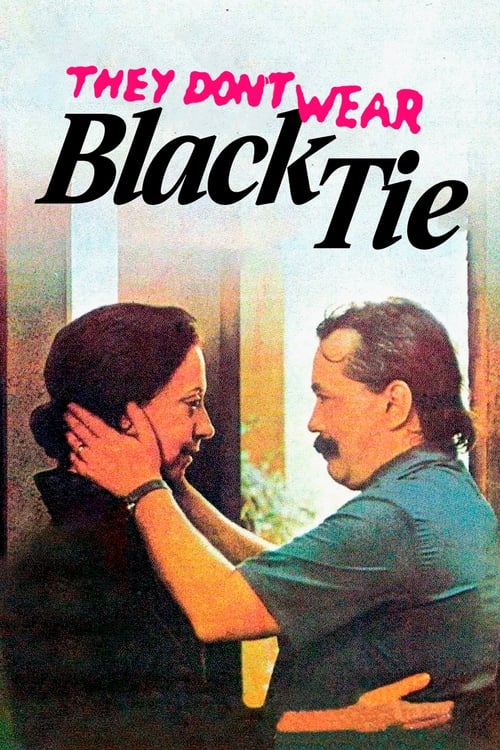
They Don't Wear Black Tie
1981 · Leon Hirszman
For when you want a serious, grounded political drama that plays out at family scale — a film to argue with and chew on afterward, not a comfort watch.
What it's about
At a Brazilian factory on the eve of a strike, an idealistic union leader named Otávio tries to organize his fellow workers against the company's exploitation. His son Tião, employed at the same plant with a pregnant girlfriend to think about, wants no part of the risk — he'd rather keep his head down and his paycheck coming. The strike turns their kitchen table into a battlefield, with Tião's mother Romana caught between the two men she loves.
The experience
Sober, candid, and quietly furious — a film that builds its tension not from action but from arguments you can see both sides of. It leaves you weighing what solidarity actually costs the people who practice it.
Performances
Fernanda Montenegro brings enormous moral weight to Romana, the mother holding the household together, and Gianfrancesco Guarnieri — who wrote the original play — plays Otávio with lived-in conviction.
The craft
Hirszman, a founding figure of Brazil's Cinema Novo, adapts a landmark 1958 stage play into the concrete present of the São Paulo strike wave, shooting with a plainspoken realism that keeps the politics rooted in kitchens, factory floors, and picket lines. The writing gives every position — striker, scab, wife, boss — its honest due.
Why it matters
Made during the slow thaw of Brazil's military dictatorship, it became a touchstone of politically engaged Brazilian cinema, capturing the great metalworkers' strikes at the exact moment they were reshaping the country.
Snapshot
Eles Não Usam Black-Tie is a Brazilian drama of class, family, and the wager of political solidarity, adapted from Gianfrancesco Guarnieri's landmark 1958 stage play of the same name. Directed by Leon Hirszman — one of the founding figures of Cinema Novo — the film transplants Guarnieri's late-1950s material into the concrete present of a metalworkers' strike, staging the collision between an idealistic union leader, Otávio, and his pragmatic son, Tião, who crosses the picket line to protect his job and his pregnant girlfriend. Where the source play belonged to the engaged, agitational theater of the Brazilian left on the eve of the developmentalist boom, Hirszman's film speaks directly to the moment of its making: the great strikes of the São Paulo industrial belt in 1978–1980, the slow thaw of the military dictatorship, and the birth of a new labor movement. It premiered to major international acclaim, taking the Special Jury Prize at the 1981 Venice Film Festival, and stands as one of the summit works of Cinema Novo's mature, more sober phase.
Industry & production
The film was made in the late years of Brazil's military dictatorship (1964–1985), during the period of controlled political liberalization known as the abertura under President João Figueiredo. This loosening of censorship is inseparable from the film's very existence: an openly sympathetic portrait of a factory strike, made while real strikes were convulsing the industrial suburbs of São Paulo, would have been difficult to imagine a few years earlier. Brazilian feature production in this era operated substantially within the orbit of Embrafilme, the state film enterprise that financed, co-produced, and distributed much of the country's serious cinema; Hirszman was among the directors whose work circulated through that ecosystem. I am not certain of the precise producing companies and financing structure for this title and will not invent them.
The project's foundation was a proven cultural property. Guarnieri's play had premiered in 1958 with the Teatro de Arena de São Paulo, a crucible of politically committed Brazilian theater, and had become a touchstone of the modern national stage. Adapting it more than two decades later allowed Hirszman to draw on an established, resonant text while updating its setting to the contemporary labor struggles unfolding as the film was conceived and shot.
Technology
The film was produced on 35mm color stock using the standard synchronized-sound production methods of early-1980s Brazilian narrative cinema; it carries none of the technological experimentation that marked some earlier Cinema Novo work. Its interest lies not in apparatus but in the disciplined, unobtrusive application of conventional tools to realist ends — location and set photography, direct dramatic staging, and a naturalistic sound design keyed to the textures of working-class life. I have no reliable record of specific camera or lab particulars and will not manufacture them.
Technique
Cinematography
The photography — which the record attributes to Lauro Escorel, one of the most accomplished Brazilian cinematographers of the period — favors a grounded naturalism over the expressionist or baroque flourishes associated with the movement's first wave. The visual register is observational: available-feeling light, muted domestic interiors of the working-class household, and the harder public spaces of factory gate, street, and union hall. The camera tends to hold on performance and gesture rather than call attention to itself, reinforcing the film's commitment to social observation. This restraint is thematically loaded — it treats the milieu as real and dignified rather than picturesque.
Editing
The film is cut for dramatic clarity and rhythm, tracking the escalating conflict between father and son and the pressure the strike exerts on the household. The editing serves the performances and the dialectical structure of the drama — cross-cutting private and collective crises so that the domestic argument and the labor struggle read as the same conflict at two scales. I do not have a firmly verified editing credit for this title and will not assert one.
Mise-en-scène / staging
The staging bears the constructive marks of its theatrical origin without feeling stagebound. Hirszman honors the play's chamber intimacy — the family apartment as a pressure chamber where competing moral positions are voiced — while opening the action outward into the strike, the picket line, and the neighborhood. The distribution of characters within the frame carries argument: the father's household as a small polity, the mediating mother positioned between the two men, the son's separations from the collective figured spatially. The result is a mise-en-scène in which physical arrangement continually dramatizes political and generational alignment.
Sound
The sound design is naturalistic, built around dialogue and the ambient life of the working-class community. Guarnieri's language — the film's inheritance from a major playwright — is central, and the film treats speech as its primary dramatic instrument. On the specifics of the musical score and its composer I do not have reliable information, and I will not invent a credit or describe music I cannot confirm.
Performance
Performance is the film's glory and the clearest bridge to its theatrical lineage. Gianfrancesco Guarnieri — author of the original play — plays Otávio, the union militant father, lending the role the authority of someone who had lived inside this material for two decades. Fernanda Montenegro, one of Brazil's greatest actors, plays Romana, the mother who mediates between the two intransigent men; her performance anchors the domestic drama in warmth and weary intelligence. Carlos Alberto Riccelli plays Tião, the son whose pragmatic self-interest becomes betrayal, and Bete Mendes plays Maria, his pregnant girlfriend. The ensemble works in a register of grounded psychological realism, the theatrical heritage audible in the density of the dialogue but tempered into cinematic intimacy.
Narrative & dramatic mode
The film's dramatic mode is realist social tragedy organized around a dialectic. Its engine is the opposition between Otávio's principled collectivism and Tião's individualist realism — the father who will sacrifice for the strike and the son who will not risk his livelihood for it. Around this axis the film builds a domestic drama that is simultaneously a political one: the picket line runs through the family. The pivotal act — Tião crossing the picket line, becoming a strikebreaker to secure his job and his coming child — converts abstract debate into betrayal and rupture, and the personal wound becomes the measure of a political cost. Romana's mediating presence gives the structure its third term, refusing to let the film collapse into a simple thesis. The mode is essentially classical and dramatic rather than modernist: legible characters, escalating conflict, a clear moral reckoning, but without easy consolation.
Genre & cycle
Generically the film is a social-realist drama, and it belongs to a persistent Brazilian cycle of cinema concerned with class, labor, and the dignity and predicament of the poor — a lineage running back through Nelson Pereira dos Santos and the founding impulses of Cinema Novo. It also belongs to a specific early-1980s cycle of Brazilian films responding to the abertura and the resurgence of civil society: works that could finally address strikes, unions, and political repression with a directness previously foreclosed. Its adaptation from a canonical committed play further links it to the tradition of politically engaged Brazilian theater that fed the national cinema.
Authorship & method
Leon Hirszman (1937–1987) was, with Glauber Rocha, Nelson Pereira dos Santos, Carlos Diegues, Ruy Guerra, and Joaquim Pedro de Andrade, among the founding generation of Cinema Novo. His authorship is marked by rigor and restraint rather than the incendiary lyricism of Rocha; his adaptation of Graciliano Ramos's São Bernardo (1972) is exemplary of a sober, literary, formally disciplined realism. He was also a committed documentarian of labor, and his engagement with the São Paulo strikes extended to nonfiction work on the same movement — a series on the strikes that would be completed and released only after his death. Black-Tie sits at the confluence of these commitments: the literary adaptor and the chronicler of workers meeting in a single project.
The film is fundamentally a collaboration with Gianfrancesco Guarnieri, whose 1958 play supplies the structure and language and who performs its central role. The screen adaptation was developed from that source with Guarnieri's participation; the film thus carries a double authorship, playwright and director, that accounts for much of its texture — the theatrical density of the dialogue disciplined by Hirszman's cinematic reticence. The cinematography attributed to Lauro Escorel is the other decisive collaboration, supplying the naturalist visual grammar. On the composer and editor I lack confirmed credits and decline to supply them.
Movement / national cinema
The film is a late, mature statement of Cinema Novo, the movement that from the early 1960s sought a Brazilian cinema of social conscience and formal ambition — famously glossed in the ethos of "an idea in the head and a camera in the hand." By 1981 the movement's revolutionary heat had cooled into something more classical and consolidated, and Black-Tie exemplifies that evolution: still politically committed, but working in a legible realist idiom addressed to a broad audience rather than an avant-garde one. Within Brazilian national cinema it also represents the fertile traffic between the engaged theater of the Teatro de Arena tradition and the screen, and the deep continuity of a cinema preoccupied with class and the working poor.
Era / period
The film is doubly historical. Its dramatic material originates in 1958, at the threshold of Brazil's developmentalist optimism; its setting and urgency belong to 1978–1980, the era of the great metalworkers' strikes in the industrial belt around São Paulo — the "new unionism" that would give rise to the Workers' Party (PT), founded in 1980. This was the period of abertura, when the dictatorship's grip was loosening and organized labor re-emerged as a public force. The film reads as a direct engagement with that conjuncture: a portrait of a strike released precisely as strikes were remaking Brazilian political life, made possible by the same opening it depicts.
Themes
The film's governing theme is the tension between collective solidarity and individual survival — the moral claim of the strike against the concrete pressures of a job, a wage, an unborn child. From this flow its other concerns: the father-son conflict as a clash of political generations and philosophies; betrayal and its irreparability, embodied in Tião's crossing of the picket line; the personal cost of political commitment, borne within the family; and the mediating, sustaining labor of the mother, which the film honors as its own form of moral seriousness. Underlying all of it is the dignity of working-class life and the conviction that private and political fidelity are ultimately the same virtue tested in different rooms.
Reception, canon & influence
Internationally, the film's most conspicuous mark of recognition was the Special Jury Prize at the 1981 Venice Film Festival, a distinction that confirmed its stature and gave late Cinema Novo a prominent festival platform; it was widely received as one of the strongest Brazilian films of its moment. (I have not verified the full slate of its awards and confine myself to what the record clearly supports.)
Looking backward, its influences are unusually explicit. It descends from Guarnieri's 1958 play and the committed theatrical culture of the Teatro de Arena; from the broader Cinema Novo project and its realist engagement with class; and from Hirszman's own literary-adaptation and documentary practices, including his parallel work on the São Paulo strikes. Its realism carries the imprint of a Brazilian tradition of social filmmaking reaching back to Nelson Pereira dos Santos.
Looking forward, the film's legacy is bound to its historical timing. Arriving alongside the birth of the new unionism and the PT, it became a cultural marker of that transformation — a film that helped fix the strike, and the moral drama of solidarity, in the national imagination at the instant those struggles were reshaping Brazilian democracy. Within film history it endures as a benchmark of Cinema Novo's late, classical phase and as a demonstration that politically committed cinema could achieve broad legibility and international honor without sacrificing seriousness. It also stands as a landmark performance record for Fernanda Montenegro and Gianfrancesco Guarnieri, and as a key entry in Hirszman's tragically foreshortened body of work. Where finer-grained claims about its subsequent citation and direct influence on later filmmakers are concerned, the documentary record available to me is thin, and I flag that rather than embroider it.
Reception
A hit at Venice 1981 (Special Jury Prize) and a landmark of Brazil's abertura era, it has only grown in stature — as the real ABC strikes it echoed became the origin story of Lula's presidency, the film went from topical drama to essential historical document.
How They Don't Wear Black Tie was received, from release to now →
How to watch They Don't Wear Black Tie: what to notice on a first viewing
- Watch where Romana stands between the two men. Hirszman blocks the family apartment so the mother is physically positioned between father and son whenever they argue, a third body absorbing the friction. Her position in the frame says she is the mediator before a single line confirms it.
- Notice the light staying plain and undecorated throughout. Escorel shoots the apartment and factory gate in available-feeling light with no expressionist flourish, treating this working-class world as real rather than picturesque. The plain light asks you to take these rooms and this family as fact, not melodrama.
- Listen to how much of the film is just talk. Guarnieri's dense, theatrical dialogue carries nearly every scene, with almost no score to cue emotion, so the arguments have to do all the work. Speech itself becomes the film's main dramatic instrument, the way it would on a stage.
- Watch scenes at the union hall cut against scenes at home. Hirszman cross-cuts the collective strike meetings with the private argument in the family apartment, so the two crises keep interrupting each other. The editing insists the domestic fight and the labor fight are the same conflict at two scales.
- Watch Guarnieri play the very role he wrote decades ago. Gianfrancesco Guarnieri, who wrote the original 1958 play and once played the son onstage, returns here as the father, carrying two decades of the material in his body. The casting alone tells you how long this argument between generations has been going on.
The whole guide to watching They Don't Wear Black Tie, with the keys for a rewatch →
Influences: the films it descends from and the films it influenced
- La Terra Trema (1948) — Neorealist verismo that cast actual laborers and held long observational takes on the economics of collective work — the Cinema Novo inheritance of using non-professionals and location duration to make class structure legible on screen.
- Rocco and His Brothers (1960) — Chamber melodrama of a proletarian family fracturing under migration and wage pressure, staging domestic interiors as a theatrical pressure-cooker — the family-as-social-microcosm blocking Hirszman uses for the strike household.
- The Organizer (I Compagni) (1963) — Textile-strike ensemble built explicitly on picket-line solidarity, the strikebreaker's betrayal, and an intellectual organizer among workers — the direct dramaturgical template for the solidarity-vs-survival dialectic.
- Salt of the Earth (1954) — Blacklisted strike film using the actual strikers as performers, foregrounding the moral economy of the picket line and the domestic cost of holding it — committed labor realism with nonprofessional casting.
- Rio, 40 Graus (1955) — Foundational Cinema Novo location shooting of the working poor, cross-cutting a mosaic of lives to bind individual fate to class structure — the dialectical-crosscutting grammar Hirszman edits by.
- Vidas Secas (1963) — Austere Graciliano Ramos adaptation whose glare-hard, stripped realism established literary-adaptation-as-social-testimony as a Cinema Novo mode — the sober register Hirszman shares.
- São Bernardo (1972) — Hirszman's own Graciliano Ramos adaptation, establishing his formally reticent, cinematically disciplined handling of dense literary language — the restraint he later applies to Guarnieri's theatrical dialogue.
- Matewan (1987) — Mine-strike ensemble structured on solidarity versus strikebreaking betrayal, blocking the picket line and the company store as a spatial moral argument about class.
- Central Station (1998) — Flagship Retomada revival of Cinema Novo humanist realism and the landmark Fernanda Montenegro performance, extending her grounded psychological realism into a new generation.
- Two Days, One Night (2014) — Reduces solidarity-vs-survival to a chamber structure of coworkers voting whether to sacrifice a bonus to save a colleague's job — the picket-line betrayal dialectic distilled through observational, near-real-time naturalism.
- Os Fuzis (1964) — Cinema Novo study of soldiers guarding food from a starving town, using detached, deliberate framing so composition itself argues a class position — the frame-as-argument staging.
- The Working Class Goes to Heaven (1971) — Factory-floor drama of worker consciousness and alienation that drives its lead toward grounded psychological realism about labor rhythm — the performance mode Guarnieri and Montenegro inhabit.
- Bye Bye Brasil (1980) — Contemporaneous late-Cinema Novo state-of-the-nation portrait shot by the same cinematographer, Lauro Escorel, sharing his naturalist location grammar and color sync-sound texture.
- Linha de Montagem (1982) — Documentary chronicle of the very ABC metalworkers' strikes the fiction dramatizes — the observational nonfiction counterpart, framing assemblies and pickets as raw labor testimony.
- ABC da Greve (1990) — Hirszman's own nonfiction record of the São Bernardo strikes (completed posthumously), the documentary twin whose chronicling of real picket lines feeds the fiction's naturalist authority.
- Norma Rae (1979) — Naturalist, dialogue-driven drama of a single worker's awakening into union organizing, staging the shop floor and the decision to risk everything as the drama — solidarity-vs-survival at individual scale.
Similar films
- The Working Class Goes to Heaven (1971) — influence & lineage
- Barren Lives (1963) — influence & lineage
- Rocco and His Brothers (1960) — influence & lineage
- Dear Comrades! (2020) — shared sensibility
- Twenty Years Later (1984) — shared sensibility
- Marighella (2021) — shared sensibility
- I'm Still Here (2024) — shared sensibility
- The Organizer (1963) — shared sensibility