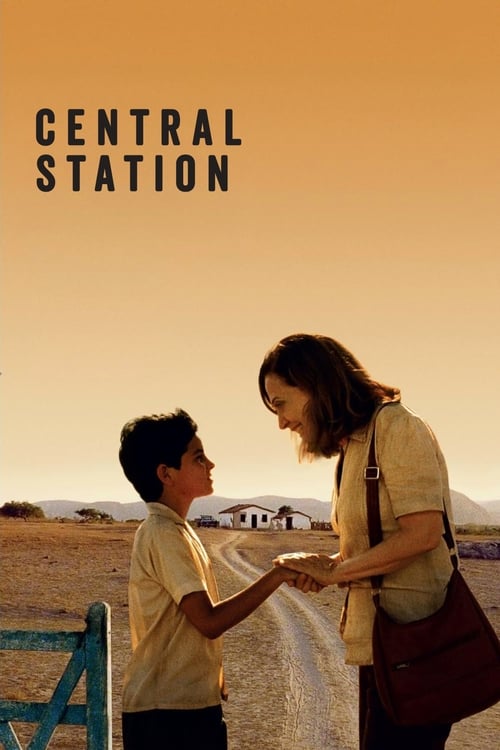
Central Station
1998 · Walter Salles
I'm Still Here became a Brazilian national catharsis about the dictatorship, won Brazil's first Oscar, and turned Fernanda Torres' campaign into a nationwide event — the biggest Latin American reception story since Roma.
For when you need a good cry and want to feel restored rather than wrecked — a film about the possibility of becoming a better person, best watched when you have time to sit with it afterward.
What it's about
Dora, a hardened retired schoolteacher, makes her living writing letters for the illiterate crowds streaming through Rio de Janeiro's central train station — and cynically pockets the postage without mailing them. When a nine-year-old boy is orphaned outside the terminal, she is dragged, resisting all the way, into taking him across Brazil's arid interior to find the father he has never met. What starts as a grudging errand becomes a journey that cracks her open.
The experience
Tender without being soft, it moves at the unhurried pace of buses and back roads, building an emotional charge that lands hard by the end. Expect to be moved — this one earns its tears honestly.
Performances
Fernanda Montenegro gives one of the great screen performances of the 1990s, letting decades of disappointment and buried tenderness fight it out on her face. Young Vinícius de Oliveira, a newcomer, matches her with startling naturalness.
The craft
Walter Salles shoots real stations, real roads, and real faces, giving the journey a documentary-like texture while the story swells into full-hearted melodrama. The landscapes of Brazil's northeast become a character in themselves — it's a film of dusty light and crowded, living frames.
Why it matters
It became the international face of Brazilian cinema's mid-'90s revival, winning worldwide acclaim and launching Salles onto the global stage.
Snapshot
Released in Brazil as Central do Brasil, Walter Salles's Central Station is a road movie and surrogate-family melodrama that became the international face of Brazilian cinema's mid-1990s revival. Dora (Fernanda Montenegro), a hardened, retired schoolteacher, earns a meager living writing letters for the illiterate crowds passing through Rio de Janeiro's Central Station — and pockets the postage for letters she never sends. When a young boy, Josué (Vinícius de Oliveira), is orphaned outside the terminal after his mother is struck by a bus, Dora is drawn against her will into escorting him across the country to find the father he has never met. The film's engine is the transformation of a cynical, complicit woman into someone capable of tenderness, set against a journey from the chaotic metropolis to the arid sertão of Brazil's northeast. It won the Golden Bear at the 1998 Berlin International Film Festival and earned Montenegro an Academy Award nomination for Best Actress — historically significant as the first such nomination for a Brazilian performer — while the film itself was nominated for Best Foreign Language Film.
Industry & production
Central Station was produced by Salles's own Rio-based company VideoFilmes in partnership with the Swiss producer Arthur Cohn, a specialist in prestige foreign-language films with a long record at the Academy Awards. The co-production drew in French financing and resources, a typical configuration for ambitious Brazilian features of the period, which depended on international partners to reach budgets and distribution that the domestic market alone could not sustain. Sony Pictures Classics handled the influential U.S. release, which positioned the film squarely in the late-1990s American art-house circuit alongside other subtitled crossover successes.
The film arrived at a precise institutional moment. Brazilian production had effectively collapsed at the start of the decade when President Fernando Collor de Mello dismantled the state film agency Embrafilme and the supporting cultural apparatus, reducing annual feature output to a handful of titles. The subsequent recovery, known as the Retomada ("the resumption"), was driven largely by new audiovisual and tax-incentive legislation that channeled corporate money into film. Central Station, together with works such as O Quatrilho and Four Days in September, became one of the Retomada's emblematic achievements and its most successful export — proof that the rebuilt industry could compete at the highest festival level.
Technology
The film was shot and finished photochemically on 35mm, the standard for theatrical features of its moment, before the digital transitions of the following decade. Its technological interest lies less in any novel apparatus than in a hybrid shooting practice. The celebrated opening — a procession of faces dictating letters directly toward the lens — was achieved by working with real, non-professional subjects rather than scripted actors, a documentary-derived method that the production's lightweight, mobile coverage made possible. Salles came out of documentary filmmaking, and the picture's technical choices consistently favor portability and immediacy over the controlled artifice of a sound-stage production. Beyond this, the record offers little to suggest the film was a site of technical innovation; its tools were conventional, deployed toward an observational end.
Technique
Cinematography
The cinematography is by Walter Carvalho, one of Salles's most important collaborators. Carvalho's images trace a deliberate arc from the cramped, desaturated, almost grimy congestion of Rio — the station as a churning human mass, shot with handheld restlessness and tight framing — to the wide, light-flooded vistas of the northeastern interior. As the narrative moves inland, the palette warms and the frame opens; the visual progression from claustrophobic urban gray toward dusty ochre and luminous sky externalizes Dora's interior thaw. Carvalho mixes a quasi-documentary handheld register, especially in the opening letter-writing sequences and the crowd scenes, with more composed pictorial landscapes in the sertão. The look is naturalistic rather than glossy, grounded in available light and real locations.
Editing
The editing is credited to Isabelle Rathery and Felipe Lacerda. The cutting honors the road-movie form: episodic, propelled by transitions between modes of transport and waypoints, allowing the central relationship to develop across a series of discrete encounters. The opening montage of dictated letters is the film's most overtly constructed passage, a rhythmic accumulation of faces and voices that establishes Dora's trade and the human ecology of the station before the plot proper begins. Thereafter the rhythm is patient and character-driven, giving Montenegro's performance room while sustaining forward momentum.
Mise-en-scène / staging
Salles stages the film around a sharp dialectic of space. Central Station itself is rendered as a Babel of bodies, noise, and transactional desperation — a place where Dora's letter-writing booth is a small node in a vast machinery of migration and longing. The countryside, by contrast, is staged for openness and a slower, more ritualized social life, culminating in the religious pilgrimage to the shrine town of Bom Jesus do Norte. The recurring motifs are concrete and legible: the written word and its withholding; the bus that kills Josué's mother and the buses and truck cabs that carry the pair onward; photographs and letters as fragile instruments of connection. The casting of Vinícius de Oliveira — a boy Salles is well documented to have discovered working as a shoeshine at a Rio airport — is itself a staging decision, importing a non-actor's unaffected presence into the fiction.
Sound
The score is by Antônio Pinto and Jaques Morelenbaum, and it is integral to the film's emotional architecture, moving from spare, melancholy figures to fuller, more lyrical passages as the journey approaches its resolution. The sound design otherwise leans on contrast: the dense ambient roar of the station — announcements, crowds, trains — against the comparative quiet and wind of the open interior. Diegetic regional music and the sounds of the pilgrimage anchor the northeast as a distinct sonic world. The aural movement from urban din to rural stillness reinforces the same trajectory the image and edit describe.
Performance
The film rests on Fernanda Montenegro, a towering figure of Brazilian theater and television given a rare cinematic lead worthy of her stature. Her Dora is unsentimental, sometimes hard to like — petty, self-justifying, complicit — and the performance earns its emotional payoff precisely by refusing easy warmth early on. The interplay with Vinícius de Oliveira's Josué is the film's living center: the contrast between a consummate professional and an untrained child produces a friction and freshness that more polished pairing might have smoothed away. Marília Pêra appears as Dora's neighbor and confidante Irene, and Othon Bastos features along the journey. The Montenegro–de Oliveira dynamic, built on gradual, grudging trust, is what most contemporary critics singled out.
Narrative & dramatic mode
The dramatic mode is humanist melodrama crossed with the road movie. The structure is a quest — the literal search for the absent father, Jesus — that doubles as a redemption arc for Dora, whose moral failing is established early: she does not always mail the letters entrusted to her, sitting in judgment over strangers' hopes and sometimes discarding them. Her journey north is thus a movement from withholding to giving, from spiritual deadness to renewed feeling, mirrored by Josué's search for paternity and belonging. The screenplay (by João Emanuel Carneiro and Marcos Bernstein, from a story by Salles) is patterned with biblical names — Josué (Joshua), his unseen brothers Moisés and Isaías, the father Jesus — that lend the secular journey a quiet allegorical undertow without tipping into overt religiosity. The resolution is deliberately bittersweet rather than triumphant: connection is found, but at the cost of separation, and the film closes on letters and photographs as the residue of love across distance.
Genre & cycle
The film sits at the intersection of the road movie and the orphan/surrogate-parent drama, two durable forms it fuses with unusual conviction. Within Brazilian cinema it belongs to a lineage of works that read the nation through a journey into the sertão, the mythologized backland of the northeast that runs through the country's literary and cinematic imagination — from Glauber Rocha onward, the interior has served as a space where national identity is interrogated. Central Station renews that tradition in a register more intimate and accessible than the militant Cinema Novo of the 1960s. Internationally it landed within the late-1990s wave of festival-anointed, emotionally direct world cinema that found art-house audiences abroad, and it became a template for the socially engaged but humanist Latin American films that followed.
Authorship & method
Walter Salles came to Central Station from a background in documentary and from an affluent, cosmopolitan family — his father a banker and diplomat — which afforded him an international education and outlook. His earlier fiction feature Foreign Land (Terra Estrangeira, 1995, co-directed with Daniela Thomas) had already engaged themes of displacement and Brazilian identity in crisis. Central Station is the work that consolidated his method: a documentary-rooted attention to real faces, places, and social texture married to classical, emotionally legible storytelling. His discovery and direction of a non-professional child lead is characteristic of this approach, as is his collaborative reliance on a stable team.
Those collaborators matter to the authorship. Cinematographer Walter Carvalho is a major figure of the Retomada in his own right and a recurring Salles partner whose visual sensibility shapes the film's expressive geography. Composers Antônio Pinto and Jaques Morelenbaum — the latter a cellist and arranger associated with Brazilian popular music — gave the film a score that travels internationally. Editors Isabelle Rathery and Felipe Lacerda structured its episodic form. Producer Arthur Cohn brought festival and Academy experience that helped steer the film's global trajectory. The writing team of Carneiro and Bernstein translated Salles's story into its character-driven shape. The film is best understood as the product of this concentrated collaboration rather than a solitary auteur statement.
Movement / national cinema
Central Station is the signature achievement of the Retomada, the renaissance of Brazilian filmmaking after the near-total collapse of production in the early 1990s. Where Cinema Novo had been formally radical and politically confrontational, the Retomada tended toward more accessible storytelling while retaining a strong social conscience — and Central Station exemplifies that recalibration, addressing illiteracy, poverty, internal migration, and the fractured Brazilian family through a film designed to move a broad audience. Its festival triumphs gave the revived national cinema international legitimacy and arguably helped clear the path for the next wave of Brazilian successes, most notably City of God (2002), a film Salles helped enable through his producing and mentoring role.
Era / period
The film is a document of Brazil in the mid-to-late 1990s: a country still marked by deep regional inequality and the legacy of mass rural-to-urban migration, the station functioning as a crossroads for displaced people moving between the impoverished northeast and the cities of the southeast. The narrative is contemporary to its making, and its texture — the informal economy of the station, the religious pilgrimage culture of the interior, the precariousness of the urban poor — registers the social realities of the period without didacticism. The picture's era is also that of the Retomada itself, an industry rebuilding under new incentive laws, and the film cannot be separated from that moment of national-cinematic recovery.
Themes
The governing theme is writing and its power — to connect, to betray, to redeem. Dora's trade makes literacy and its absence concrete: she is the conduit through which the voiceless speak, and her abuse of that trust (withholding letters) is the film's foundational sin. Around this cluster questions of surrogate parenthood and the absent father, with the search for Jesus carrying both literal and allegorical weight. The nation appears as a broken family in need of repair, the journey from Rio to the sertão a passage toward roots, faith, and origins. Redemption, the recovery of feeling after emotional hardening, and the dignity of the poor run throughout, as does a gentle religious symbolism carried by names, pilgrimage, and the recurring image of the photograph as a fragile bridge between separated people.
Reception, canon & influence
Central Station was received as a major event of world cinema. It won the Golden Bear at the 1998 Berlin International Film Festival, where Fernanda Montenegro also took the Silver Bear for Best Actress; it won the Golden Globe for Best Foreign Language Film; and it earned two Academy Award nominations — Best Foreign Language Film and, for Montenegro, Best Actress, a landmark recognition for a performance in Portuguese. (Both Oscars went elsewhere that year, in a season dominated by Life Is Beautiful and Shakespeare in Love.) The film is also widely reported to have won the BAFTA for Best Film Not in the English Language, though readers should treat the precise tally of its many awards with the usual caution. Critically, the consensus centered on Montenegro's performance and on the unforced chemistry between her and Vinícius de Oliveira, with reservations occasionally voiced about the film's sentimental momentum.
Looking backward, the film draws on the road-movie tradition and on the long Brazilian fascination with the sertão as a site of national meaning, refracting the legacy of Cinema Novo through a humanist, audience-facing sensibility; Salles's documentary training informs its observational opening and its location-rooted realism. Looking forward, Central Station became the calling card that established Salles internationally and led to his English-language and pan-American projects, most prominently The Motorcycle Diaries (2004) and, decades later, I'm Still Here (2024). It helped legitimize the Retomada abroad and contributed to the conditions for City of God and the broader 2000s surge of Brazilian and Latin American cinema. Vinícius de Oliveira, plucked from obscurity, went on to a continuing acting career. More than a quarter-century on, the film endures as a touchstone of the Brazilian revival and as the showcase for one of the great screen performances in the country's history — a status reinforced by the renewed attention to Montenegro's lineage following her daughter Fernanda Torres's own acclaim in Salles's recent work.
A Deleuzian reading
Start with the faces.
The full Deleuzian reading of Central Station →
Reception
An arthouse darling on arrival — Golden Bear at Berlin, two Oscar nominations — it settled into '90s foreign-film staple' status before roaring back in 2024–25, when Walter Salles's I'm Still Here sent a new generation of Letterboxd users straight to it.
How Central Station was received, from release to now →
Influences: the films it descends from and the films it influenced
- Bicycle Thieves (1948) — Italian neorealism's template of an adult-child pair traversing a real city on a quest, shot on location with non-professional leads and emotionally legible storytelling — the realist grammar Salles directly adopts.
- La Strada (1954) — The episodic two-hander road journey in which a brusque adult and a vulnerable innocent are bound together, sentimental humanism structured as a series of wayside encounters — Dora and Josué's narrative engine.
- Vidas Secas (1963) — Cinema Novo's drought-migration trek across the sertão with a non-professional cast and unsparing landscape realism — the harsh-geography neorealism Central Station inherits and humanizes.
- Black God, White Devil (1964) — Codified the sertão as mythic national space crossed by a redemptive journey, the Cinema Novo iconography of backland-as-meaning that Salles refracts through an audience-facing sensibility.
- Paper Moon (1973) — The itinerant con-artist and orphaned child whose mutual exploitation thaws into reluctant kinship — the specific redemption-arc mechanism driving Dora's transformation.
- Alice in the Cities (1974) — The adult/lost-girl road pairing searching for an absent relative across an observed landscape, with documentary-flavored attention to passing places — structural blueprint for the surrogate-guardian journey.
- Pather Panchali (1955) — Humanist realism built around a non-professional child's face and unforced observation of poverty, proving festival cinema could carry third-world realism on tenderness rather than spectacle.
- Pixote (1981) — Cast a non-professional Brazilian street child in documentary-rooted urban-poverty realism — the precedent for plucking Vinícius de Oliveira from the station and shooting in real milieus.
- Foreign Land (1995) — Salles's immediate authorial precursor, a Walter Carvalho-shot study of Brazilian displacement and identity-in-crisis that consolidated the documentary-realist method refined in Central Station.
- Black Orpheus (1959) — Salles extended Camus's practice of casting for physiognomy over training — specifically Vinícius de Oliveira, discovered as a shoeshine boy — and sustained the elegiac register and location-authentic shooting across a Brazilian landscape traversal that echoes Black Orpheus's use of geography as destiny, both films ending in the death of the male subject outside the city.
- The Given Word (1962) — Revives classical, performance-centered socially-engaged Brazilian humanism — a monumental lead performance and folk-Catholic pilgrimage narrative — as the national cinema's international-prestige calling card, the role this film first played.
- They Don't Wear Black Tie (1981) — Flagship Retomada revival of Cinema Novo humanist realism and the landmark Fernanda Montenegro performance, extending her grounded psychological realism into a new generation.
- Behind the Sun (2001) — Continues the Carvalho-shot sertão aesthetic and spatial-dialectic staging of harsh backland geography, extending Central Station's landscape-as-character into formalized myth.
- City of God (2002) — The Retomada breakthrough Central Station's international success helped enable, casting non-professional favela youth and pushing the handheld, location-rooted realism toward kinetic energy.
- The Motorcycle Diaries (2004) — Salles's pan-American road movie made possible by Central Station's success, extending the location realism and landscape-as-moral-education across a continent-spanning journey.
- Slumdog Millionaire (2008) — Global poverty-redemption narrative with non-professional child leads and on-location third-world realism, descending from the festival-humanist mode Central Station exemplified for international audiences.
- I'm Still Here (2024) — Direct authorial descendant reuniting Salles's documentary-rooted realism with the Montenegro/Torres performance lineage, closing the loop on the actress-driven humanism Central Station showcased.
- The Blue Trail (2025) — Defines the modern Brazilian road movie as a journey through the interior anchored by an older woman, the structural spine The Blue Trail reroutes onto the river.
- Amores Perros (2000) — Salles demonstrated in a Latin American production context that documentary-adjacent casting — a first-time screen lead placed against non-professional actors in real locations — could achieve emotional authenticity at international festival scale, the direct model for Iñárritu's use of Gael García Bernal in his debut.
- Mango Yellow (2002) — Walter Carvalho's intimate, handheld mobile camera method — pressing close to faces and bodies in unglamorous interiors — carried directly from this Retomada landmark into Mango Yellow's visual grammar.
- Invisible Life (2019) — Supplies Fernanda Montenegro's iconography of Brazilian maternal endurance and the letter-as-lifeline motif, which Aïnouz recasts in her late-film appearance as the aged Eurídice.
- Crossing (2024) — The road-quest that pairs a flinty older woman with a displaced youth, using the journey itself as the mechanism that thaws her, and casting a nonprofessional child against a seasoned lead.
- Lion (2016) — Provides the cross-country search-for-family road structure pairing an untrained child with the landscape, resolving on reunion — the emotional-journey architecture Luke Davies adapts.
- Elite Squad: The Enemy Within (2010) — A flagship of Cinema da Retomada, its naturalistic non-professional textures and available-light realism reestablished the internationally exportable Brazilian social-realist mode the Tropa films commercialize.
- Where Is the Friend's House? (1987) — A child protagonist's small quest across real terrain, performed by non-professionals with patient observational staging — a parallel tradition of the neorealist child-journey Salles works within.
- Y Tu Mamá También (2001) — A Latin American road movie whose journey foregrounds the social landscape passing outside the car, part of the same early-2000s regional revival of socially-observant road cinema.
- Carandiru (2003) — Shares cinematographer Walter Carvalho, whose mobile, textured, handheld naturalism defines both Retomada landmarks' on-the-ground intimacy.
- Kikujiro (1999) — Contemporaneous adult-and-orphan-boy road movie whose abrasive surrogate parent thaws across an episodic journey, anchored by an unschooled child performance.
- Kolya (1996) — A gruff self-interested adult and an orphaned boy as a road odd-couple, guardianship softening across proximity and a class/language gap — the international humanist parallel to Kolya's bachelor-and-boy.
- Salaam Bombay! (1988) — Carries forward the surrogate-family road structure — an adult and an orphaned child bound across a harsh landscape — using non-professional child performance and location realism in the same Latin-neorealist register.
- A Dog's Will (2000) — Contemporary Retomada road film crossing the sertão toward a folk-Catholic pilgrimage, reviving the backlands spiritual landscape A Dog's Will inhabits.
- Brainstorm (2001) — The flagship of the Retomada revival Brainstorm belongs to, sharing its humanist realism, festival-circuit launch strategy, and reliance on lived-in performance over genre spectacle.
- The Second Mother (2015) — Brazilian retomada model of building an entire film on a single weathered working-class woman's performance and gradually thawing buried feeling — the Regina Casé role descends from Fernanda Montenegro's.
- My Sweet Orange Tree (2012) — Bernstein co-wrote this Retomada landmark, and he carries its exact screenwriting architecture — an unlikely older-figure/child bond structured as tender emotional escalation against Brazilian hardship — directly into his direction here.
- To the Left of the Father (2001) — Shot by the same cinematographer, Walter Carvalho, whose expressive naturalist Retomada camera and Brazilian-landscape eye are co-equal author here as in Lavoura Arcaica.
Similar films
- I'm Still Here (2024) — influence & lineage
- The Motorcycle Diaries (2004) — influence & lineage
- Barren Lives (1963) — influence & lineage
- City of God (2002) — influence & lineage
- Foreign Land (1996) — shared sensibility
- Invisible Life (2019) — shared sensibility
- Sambizanga (1973) — shared sensibility
- Hour of the Star (1986) — shared sensibility
All the films related to Central Station →