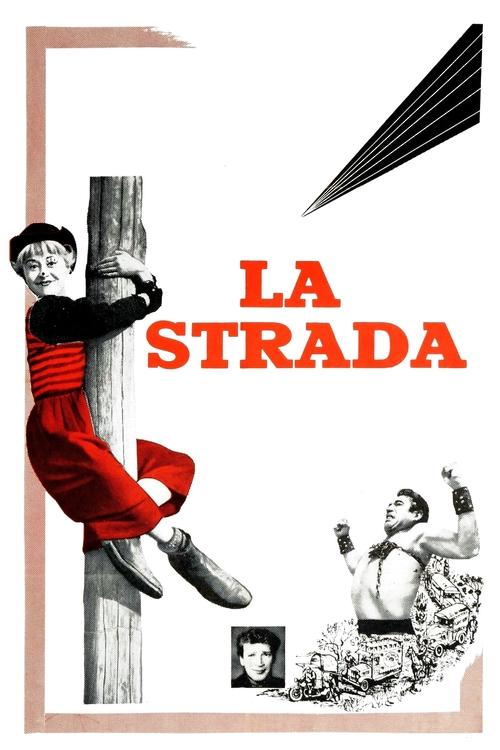
La Strada
1954 · Federico Fellini
For a night when you want to feel something real and don't mind a lump in your throat — a good cry earned honestly, not manufactured. Gentle to watch, heavy to carry; comfort food this is not.
What it's about
A brutish circus strongman buys a naïve young woman from her impoverished mother to serve as his assistant, cook, and common-law wife, and hauls her across the Italian countryside in a rattling motorcycle caravan. Gelsomina endures Zampanò's coldness and casual cruelty while learning to play the drum and trumpet for his roadside act — until she meets Il Matto, a carefree high-wire fool whose gentleness shows her another way a life could feel. What follows is a love-triangle of sorts, though the real struggle is between one man's armored heart and one woman's stubborn, wounded innocence.
The experience
It plays like a folk tale told at dusk — earthy and funny in flashes, then quietly heartbreaking. The pace is unhurried, the emotion enormous; it sneaks up on you and lands hard, and the ache stays with you long after.
Performances
Giulietta Masina gives one of cinema's great faces — a clownlike, silent-comedy performance of pure expressiveness, joy and hurt crossing her features like weather. Anthony Quinn plays Zampanò as a man made of muscle and shame, brutality with something trapped underneath.
The craft
Fellini shoots the poverty of postwar Italy's back roads with the texture of real dust and cold, then lets a fable float on top of it. Nino Rota's melancholy trumpet theme is the film's soul — a tune so central to the story that you'll hum it, sadly, for days. Black-and-white images of beaches, village squares, and empty roads that reward a quiet room and full attention.
Why it matters
It made Fellini an international name, won the first-ever Academy Award for Best Foreign Language Film, and marked the moment Italian cinema turned from street-level realism toward personal, poetic storytelling.
Snapshot
La Strada is a tragic fable about a brutish circus strongman, Zampanò (Anthony Quinn), who purchases a childlike young woman, Gelsomina (Giulietta Masina), from her destitute coastal family and drags her across the Italian countryside as performer, cook, and common-law wife. She endures his indifference and violence until she forms a spiritual bond with Il Matto (Richard Basehart), a gentle, philosophically inclined acrobat-fool. When Zampanò kills Il Matto in a sudden fit of rage, Gelsomina's fragile spirit breaks, and Zampanò eventually abandons her. Years later, hearing that she has died, he collapses on a night beach in an inarticulate eruption of grief — the film's devastating final image. Made at the hinge point between Italian Neorealism and European art cinema, La Strada is among the most emotionally concentrated films of the twentieth century and the work that established Fellini as one of cinema's irreducible auteurs.
Industry & production
The project originated with Fellini in the early 1950s, gestating through conversations with his longtime screenwriting collaborator Tullio Pinelli. The pair had been developing the story of a brutish man and his long-suffering companion for some time; Ennio Flaiano, Fellini's third regular script collaborator, is also credited on the finished screenplay. After the commercial success of I Vitelloni (1953), producers Carlo Ponti and Dino De Laurentiis agreed to finance the picture, though neither was enthusiastic about its unusual tone or commercial prospects. The budget was modest even by Italian standards of the period, necessitating extensive location work across the Roman countryside and the Abruzzi rather than studio sets.
Casting Zampanò proved contentious. Fellini had initially envisioned the role differently, and the choice of Anthony Quinn — a Mexican-American actor known from Hollywood — was partly pragmatic, reflecting the co-production arrangements that Italian producers of the era used to secure foreign distribution. Quinn threw himself into physical preparation and reportedly had a productive if sometimes turbulent working relationship with Fellini. Richard Basehart, also an American actor based partly in Italy, was cast as Il Matto. The central casting was never in dispute: Giulietta Masina, Fellini's wife since 1943, was the film's creative and emotional core from conception. The Ponti-De Laurentiis production, distributed by Trans-Lux in the United States after its Italian release, eventually became one of the highest-grossing foreign-language films in the American market of the 1950s, though its domestic Italian reception was more complicated.
Technology
La Strada was shot in black-and-white 35mm at the standard Academy ratio (approximately 1.37:1), a deliberate choice in a year when CinemaScope and other widescreen processes were aggressively transforming Hollywood exhibition. Italian art cinema of this period largely declined the widescreen format, and Fellini's framing sensibility — intimate, face-centred, attentive to isolated figures in vast or indifferent landscapes — would have been compromised by the panoramic proportions. The film's black-and-white photography serves a dual purpose: it anchors the picture in the neorealist visual tradition even as Fellini departs from neorealist philosophy, and it permits a tonal range from sun-bleached rural roads to deeply shadowed winter interiors that color would have flattened. Post-production was completed in Italy with conventional optical sound; Nino Rota's score was recorded and mixed in Rome.
Technique
Cinematography
The cinematography is credited to Otello Martelli, Fellini's principal collaborator on several pictures including I Vitelloni. Martelli navigated the film's tonal ambiguity with care: the outdoor sequences shot in the campagna and along provincial roads have the grainy, overcast naturalism of neorealist documentary, while the circus sequences and key dramatic confrontations move toward a more expressionistically motivated light. The final beach scene is particularly notable — a sparse, lunar composition in which Quinn's figure is isolated against a flat sea and a vast sky, the geometry stripping the image of any social or narrative context so that grief appears as something elemental and inarticulate. Martelli and Fellini were attentive to Masina's face throughout, often framing her in close-up or medium close-up with relatively neutral, even light that allowed her extraordinary mime-trained expressivity to carry full weight without competing shadow.
Editing
The editing was handled by Leo Catozzo, a collaborator Fellini returned to across multiple productions. The cut is notably unhurried; sequences are allowed to develop beyond what strict narrative economy would require, building the rhythmic texture of actual waiting and travel that defines Gelsomina's experience. Catozzo's transitions often favour dissolves rather than hard cuts in passages of temporal ellipsis, reinforcing the episodic, picaresque structure and softening the passage of seasons. The editing of the Il Matto sequences is particularly precise — his aerial routines and philosophical provocations are cut with just enough rhythmic tension to make Zampanò's eventual eruption feel both sudden and long-incubated.
Mise-en-scène / staging
Fellini's staging is consistently expressive without becoming schematic. He uses the frame's depth to separate characters who share physical space but inhabit entirely different emotional registers — Zampanò's back to camera while Gelsomina watches Il Matto perform overhead is a representative example. The circus milieu is rendered without glamour: the troupe's acts are threadbare, their routes provincial, their audiences sparse. This deflation of the circus as spectacle turns it into a social and existential condition rather than an entertainment form. Gelsomina's attempts to perform — her deadpan drum routines, her silent mugging — are staged with enough incompetence to be genuinely funny while simultaneously making her vulnerability absolute. The spatial economy of the Zampanò-Gelsomina encampments — a single motorcycle-powered carriage, a canvas bivouac, a fire — communicates material precarity without editorial comment.
Sound
Nino Rota's score is inseparable from the film's identity. The central theme — a plaintive, circular melody associated with Gelsomina and eventually played on her trumpet — is among the most recognizable in cinema. Rota scored the film with an instrumentation that sounds folk-adjacent but is in fact highly constructed: the theme feels as though it was always there, pre-existing the film, which amplifies its mythic quality. Rota uses silence and near-silence strategically; stretches of road noise, wind, and ambient outdoor sound establish the loneliness of the characters' itinerary before music intervenes. The recurring trumpet motif acquires retroactive tragic weight when Zampanò hears it late in the film, connecting him across time to what he has lost and destroyed.
Performance
Masina's performance is the film's irreducible achievement. Trained in theater and radio drama, she brings to Gelsomina a mime vocabulary — wide, rapidly shifting eyes; precise small gestures; a quality of watchful, birdlike attention — that reads simultaneously as clown technique and as psychological truth. The Chaplin comparison was made immediately by critics and is apt but not exhaustive: Gelsomina's passivity carries religious inflection that Chaplin's tramp, for all his pathos, does not. Quinn's Zampanò is physically imposing and emotionally sealed; the performance's intelligence lies in Quinn's willingness to remain opaque, so that the final beach scene's breakdown does not feel like a revelation of hidden tenderness but like the first time a sealed container has ever cracked. Basehart's Il Matto is delicately calibrated — witty, provocative, genuinely tender — without becoming the film's moral spokesman to a degree that would flatten its ambiguity.
Narrative & dramatic mode
La Strada operates as a secular parable with strong Catholic overtones. Its narrative structure is episodic and additive — a series of encounters strung along a road — rather than causally interlocked in the manner of classical Hollywood dramaturgy. This picaresque looseness reflects a deliberate philosophical position: the film is less interested in plot mechanics than in the gradual accumulation of spiritual evidence. Il Matto's key speech — in which he tells Gelsomina that even a pebble has a purpose, and that if she does not serve Zampanò, no one will — is the film's theological hinge, articulating a doctrine of providential usefulness that Gelsomina accepts and that the film neither endorses nor refutes but simply observes. The tragic irony is that Gelsomina's purpose, in this framework, destroys her. Dramatic compression is achieved not through plot turns but through the progressive erosion of Gelsomina's interiority: her silences grow longer, her performances more mechanical, until she ceases to perform at all.
Genre & cycle
La Strada resists clean generic classification, which was part of what made it contentious in 1954. It borrows the picaresque road structure — then not yet codified as a genre — while inflecting it with circus melodrama, fable, and religious allegory. The film is sometimes grouped with a loose Italian cycle of the mid-1950s that moved away from the social specificity of neorealism toward mythological and psychological concerns, a cycle that includes Antonioni's Le Amiche (1955) and Visconti's Senso (1954), though the three films share little else. More precisely, La Strada initiates what would come to be called Felliniesque cinema: an identifiable mode combining southern Italian popular performance traditions, Catholic symbolic imagery, grotesquerie, and lyrical pathos. That Felliniesque has become a standard adjective is itself evidence of the film's generic novelty — it named its own category.
Authorship & method
The Fellini-Pinelli-Flaiano trio shaped the film's conceptual architecture through multiple drafts, with Pinelli credited as the primary co-author closest to the story's humanist-Catholic sensibility. Fellini's authorial method at this stage of his career was collaborative but asymmetric: he generated the emotional and visual premises, Pinelli and Flaiano refined the dialogue and dramatic logic. The Fellini-Masina creative relationship adds another layer; the film was written explicitly for Masina, and the boundaries between her biography and Gelsomina's character were deliberately blurred — not in any directly autobiographical sense, but as a matter of emotional access. Nino Rota's contribution deserves co-authorial status: Rota and Fellini worked together from I Vitelloni (1953) through Fellini's death in 1993, and their collaboration was among cinema's most sustained creative partnerships. Rota composed to Fellini's scenario descriptions before picture lock, meaning the music shaped performance and editing rather than merely accompanying the finished cut.
Movement / national cinema
La Strada arrives at a crisis point in Italian cinema. Neorealism as a coherent movement — associated with Rossellini's Roma città aperta (1945) and De Sica's Ladri di biciclette (1948) — had begun to fracture in the early 1950s, and Fellini himself had been a significant participant in its founding moment as a screenwriter on Rossellini's early postwar films. La Strada does not repudiate neorealism so much as metabolize it: the location shooting, the use of non-professional or unknown faces in supporting roles, the attention to working-class precarity, and the absence of studio glamour are all neorealist legacies. What Fellini discards is neorealism's implicit social-realist politics, its assumption that cinema's primary obligation is to document and critique material conditions. Italian leftist critics, notably Guido Aristarco writing in Cinema Nuovo, attacked La Strada on precisely these grounds — as a retreat into mysticism and individualist psychology at the expense of class consciousness. This argument, fierce in 1954–55, now reads as ideological narrow-mindedness, but it reflects a genuine tension within Italian culture about what postwar cinema owed its moment. La Strada pointed toward Italian art cinema of the late 1950s and 1960s — Antonioni's alienation trilogy, later Fellini himself — rather than backward toward neorealism's social program.
Era / period
The mid-1950s in European cinema is characterized by the search for a non-Hollywood modernity: widescreen was transforming American exhibition, but European filmmakers disproportionately stayed with classical formats and found their distinctiveness there. Italy was a co-production hub, and international stars like Quinn and Basehart were available to Italian productions as part of Hollywood actors' European sojourns during the red-list era and the general expansion of American presence in postwar Italy. The economic recovery of the paese boom had not yet arrived in the rural south — the landscape La Strada traverses — and the film's imagery of threadbare itinerancy reads as sociologically accurate. The period is also marked by the Catholic Church's continued cultural authority in Italian public life, which shapes the film's reception as much as its content: what might have been read as anti-clerical mysticism in France registers differently in a culture where Christian iconography saturates everyday life.
Themes
The film's deepest concern is grace — whether it exists, whether it can survive contact with human brutishness, and what it costs the person who carries it. Gelsomina functions as a holy fool in the tradition shaped by Dostoevsky's Russian Orthodox fiction and translated into Catholic Italian terms: an innocent whose simplicity perceives truths unavailable to sophisticated understanding, and whose suffering redeems without her knowledge or consent. The theological reading should not be pressed too hard — Fellini was simultaneously devout and skeptical — but it is structural to the film's logic.
Communication and isolation form a second axis. Zampanò cannot speak his interior life; his monologue is the motorcycle engine's roar, his arms breaking chains. Gelsomina's trumpet — a wind instrument requiring breath, expressive of lung and voice — is the film's image of human connection across impossibility. Il Matto exists precisely at the intersection of intelligence and performance, able to translate both upward and downward. His death removes the only mediating figure, and without him Gelsomina and Zampanò are left in mutual unintelligibility.
Fellini is also writing about the gendering of spiritual capacity: Gelsomina's grace is coded as feminine, passive, and vulnerable; Zampanò's violence is coded as masculine, productive, and self-annihilating. This is not a feminist analysis — Fellini's female characters across his career are more archetype than agent — but the film earns its tragic structure precisely because it refuses consolation: grace does not protect, and love does not redeem in time to matter.
Reception, canon & influence
Critical reception. La Strada premiered at the Venice Film Festival in 1954, where it was received as a major work, though the prize jury's deliberations reflected the film's contested status. Italian reception divided sharply along the ideological lines described above. French critical response, mediated through Cahiers du Cinéma and the broader cinephile culture of Paris, was warmer; André Bazin, whose critical framework emphasized cinema's capacity for phenomenological truth rather than social documentation, was broadly sympathetic. American reviews at the time of the 1956 US release were largely enthusiastic, responding to the emotional directness that European intellectual critics sometimes found naïve. At the 29th Academy Awards (March 1957), La Strada won Best Foreign Language Film — the first year this category was offered competitively rather than as an honorary award. It was the first film to win what has since become one of the Oscars' most-watched categories.
Influences on the film (backward). The debts are multiple and acknowledged. Charlie Chaplin's tramp persona is the most direct ancestor of Gelsomina: the bowler hat, the rubber-faced responsiveness, the comedy of inadequacy coexisting with pathos. Fellini was a devoted Chaplin admirer, and Masina reportedly studied Chaplin's movement carefully. The Russian literary tradition — Dostoevsky's holy fools, the yurodiviy — shapes the film's spiritual anthropology, though filtered through Italian Catholic sensibility rather than Orthodox theology. Italian commedia dell'arte contributes the stock types that subtend Il Matto and Zampanò (the clever fool, the braggart soldier). German Expressionist cinema of the 1920s — particularly in its use of shadow, grotesque performance, and the road as existential condition — is a more diffuse but traceable influence on the film's visual atmosphere. Rossellini's wartime and immediate postwar films gave Fellini his professional formation and his comfort with location shooting and non-professional performance.
Legacy and forward influence. La Strada's influence operated at multiple levels. On the level of direct lineage, it established the Fellini-Rota-Masina creative triad and the mode of Felliniesque filmmaking that would produce La Dolce Vita (1960), 8½ (1963), and Giulietta degli Spiriti (1965). More broadly, it demonstrated that a non-naturalistic, symbolically structured narrative could achieve mass international audiences — a proof of concept for European art cinema as a commercial as well as critical category. The road-as-existential-structure that La Strada elaborated became available to later filmmakers across traditions; the picaresque couple-in-transit, the woman whose suffering marks a man's moral desolation, echoes in films from Agnès Varda's Sans toit ni loi (1985) to Wim Wenders's Alice in the Cities (1974). Nino Rota's approach to film music — thematic, emotionally precise, resistant to the symphonic bombast of Hollywood scoring — was widely studied and admired; his later work with Francis Ford Coppola on The Godfather (1972) introduced Rota's sensibility to a global popular audience. Giulietta Masina's performance remained a touchstone for discussions of screen acting, mime, and the relationship between clown technique and tragic register. The film's Oscar win opened the American market to Italian cinema in ways that facilitated the subsequent international success of filmmakers from Antonioni to Leone. It has been included in virtually every major critical canon of world cinema — the Sight & Sound polls, the Vatican's list of important films, national and international curriculum lists — and this canonical status has proved remarkably stable across decades of revisionist reassessment.
A Deleuzian reading
Watch Giulietta Masina's face in the first minutes, before you know anything about her.
The full Deleuzian reading of La Strada →
Reception
In Italy it sparked a genuine culture war — Marxist critics savaged Fellini for 'betraying' neorealism with fable and spirituality, and its Silver Lion at Venice 1954 (while Visconti's Senso went home empty) reportedly ended in a shoving match between the two camps. Abroad it made Fellini an international name, and today it's bedrock canon.
How La Strada was received, from release to now →
Influences: the films it descends from and the films it influenced
- City Lights (1931) — Gelsomina's mime-physical performance technique — conveying pathos and spiritual luminosity through gestural economy and facial register rather than dialogue — descends directly from Chaplin's Tramp; Fellini and Masina studied Chaplin's wordless comic-tragic vocabulary explicitly, and the Tramp's technique of loading a single held expression with simultaneous comedy and devastation is the performance method Martelli's camera applies to Masina throughout.
- The Circus (1928) — Chaplin's technique of deflating the circus milieu from spectacle to site of marginality and pathos — threadbare acts, provincial venues, an isolated performer whose grace goes unseen by the crowd — is the direct structural template for Zampanò's troupe; the romantic triangle of powerful man, innocent woman, and graceful rival fool resolved through abandonment and belated grief is reproduced in La Strada's basic architecture.
- Sunrise: A Song of Two Humans (1927) — Murnau's template for the rural parable built around a brutish man and an innocent woman: expressionist lighting within naturalistic location settings, dissolve-heavy editing as the punctuation of moral and temporal transitions, and a parable-simple moral geometry that strips social context away so that elemental figures — grace versus violence — can be read without mediation.
- The Passion of Joan of Arc (1928) — Dreyer's devotional use of the extreme close-up as the primary site of spiritual revelation — reading interiority through physiognomy alone — establishes the face-centred framing Martelli and Fellini apply to Masina; the technique of sustained, neutral light on a face that must carry full spiritual weight without competing shadow or dramatic cutting is Dreyer's specific contribution to La Strada's visual grammar.
- Paisà (1946) — Rossellini's episodic picaresque structure — discrete vignettes crossing the Italian landscape, alternating documentary location texture with melodramatic emotional peaks to produce a secular moral portrait of the nation — provides the narrative architecture La Strada adapts into a single sustained parable; the technique of letting actual roads and ruins bear the weight of meaning that neorealist interiors had carried is directly inherited.
- The Flowers of St. Francis (1950) — Rossellini's holy fool archetype as the structuring figure of an episodic picaresque — the innocent whose incomprehension of the brutal world constitutes its moral criticism — and his technique of mixing non-professional and trained performers in the same frame to achieve devotional naturalism directly precede Fellini's construction of Gelsomina as secular saint among actual itinerant workers.
- La Terra Trema (1948) — Visconti's technique of the held, unhurried take that forces a face and its surrounding location to accumulate emotional meaning before cutting — using the duration of observation itself as a formal argument about endurance — and his face-centred close-ups of non-professional performers as an instrument of social and spiritual revelation feed directly into La Strada's editorial pacing and Martelli's treatment of Masina.
- Limelight (1952) — Extends the pathos-of-the-itinerant-clown tradition, with Gelsomina's recurring trumpet theme functioning structurally exactly as Chaplin's 'Eternally' leitmotif does in Limelight.
- Nights of Cabiria (1957) — Fellini's direct extension of La Strada's performance architecture: Giulietta Masina carries the same mime-trained physical vocabulary and holy fool characterization into a new episodic picaresque of the Roman margins, and Nino Rota's leitmotif structure — a recurring melodic phrase attached to the female innocent's spiritual condition — is redeployed note-for-note as the affective skeleton of the film.
- 8½ (1963) — Fellini transposes La Strada's circus imagery to the film-set as existential condition, extends Rota's leitmotif architecture into a full autobiographical score, and develops the episodic picaresque into explicit self-reflexivity — the holy fool of Gelsomina becomes the auteur-as-holy-fool who cannot produce the redemptive artwork he imagines, the Catozzo-style dissolve transitions now marking memory rather than travel.
- Au Hasard Balthazar (1966) — Bresson's secular parable of an innocent passed between brutish or indifferent owners across an episodic picaresque directly inherits La Strada's structural template; the technique of reading spiritual grace through an expressionless, receptive face under physical suffering — the donkey's blankness as the formal equivalent of Masina's mime stillness — is Bresson's rigorous extrapolation and de-sentimentalization of the Gelsomina method.
- Mouchette (1967) — Bresson's female holy fool in rural France — victimized by a brutish social order, carrying invisible grace through expressionless endurance — refines La Strada's secular parable structure; the elliptical editing that withholds cathartic release until a final elemental act and the technique of ambient natural sound as emotional register rather than scored punctuation push the formal devices of La Strada toward austerity.
- Amarcord (1973) — Fellini's seasonal episodic picaresque through collective memory extends the structural and sonic architecture of La Strada: Rota's score continues the leitmotif method with recurring melodic identities, the holy fool figures embedded in the ensemble (the incapacitated grandfather, the manic fascist, the dreaming Gradisca) multiply and democratize the Gelsomina archetype, and the Academy-ratio instinct for isolating figures against a vast landscape persists.
- La Dolce Vita (1960) — Nino Rota's scoring method of undercutting emotional weight with deceptively simple melodic material — jaunty tunes playing against suffering — is fully crystallized here; La Dolce Vita inherits this as its primary tonal instrument, with Rota's themes for the celebrity demimonde operating in the same ironic-counterpoint mode.
- Stroszek (1977) — Gelsomina as 'holy fool' protagonist—an innocent exploited by a coarser world whose unguarded simplicity reads as moral authority—is the structural and ethical template Stroszek translates directly into Bruno S., including the device of casting a performer whose off-screen fragility is continuous with the role.
- Opening Night (1977) — Giulietta Masina's Gelsomina — a woman's suffering rendered without psychological retreat or emotional decoration — established the register of non-cathartic female endurance that Rowlands, placed alongside Masina by European critics, inhabits in Opening Night.
- Central Station (1998) — The episodic two-hander road journey in which a brusque adult and a vulnerable innocent are bound together, sentimental humanism structured as a series of wayside encounters — Dora and Josué's narrative engine.
- Santa Sangre (1989) — Models the itinerant circus as a theater of cruelty and tenderness — a brute strongman lashed to a fragile innocent — and the bittersweet performer-melodrama Jodorowsky tunes to operatic pitch.
- A Dog's Will (2000) — Draws its leads straight from commedia dell'arte street-performer masks (the Fool, the brute), the same stock-type physical comedy grammar animating the two-conman duo.
- Happy as Lazzaro (2018) — Gelsomina establishes the Italian holy-fool archetype — the radiant simpleton whose innocence measures the brutality around her — that Lazzaro's performance channels.
- Umberto D. (1952) — De Sica's technique of unhurried, face-centred observation that forces the audience to inhabit the full duration of a vulnerable figure's experience — accumulating loneliness through the ordinary choreography of waiting and tending rather than through dramatic event — runs as a formal parallel to La Strada's episodic refusal of narrative economy in the long passages of Gelsomina's watching and enduring.
- Viaggio in Italia (1954) — Rossellini's contemporary technique of using Italian location shooting — ancient ruins, sacred sites, volcanic landscape — as a moral and emotional force that acts directly upon characters' interiors, culminating in an unreasoned eruption of feeling as the parabolic resolution, parallels La Strada's use of the campagna and the final beach scene where Quinn's grief appears as something geological rather than psychological.
- Il Grido (1957) — Antonioni's episodic picaresque of a man and woman traversing the Po Valley — location shooting in the Italian industrial hinterland deployed to externalize emotional desolation, editorial pacing calibrated to accumulate spatial loneliness rather than drive plot — extends the post-neorealist formal syntax that La Strada is simultaneously developing from the opposite emotional extreme.
- The Seventh Seal (1957) — Fellini structures an episodic morality play in which a holy fool perceives grace invisible to brutal others, using a traveling troupe format and allegorical pilgrimage structure that directly parallels Jof and Mia's troupe as carriers of transcendence through a ravaged landscape.
- Ikiru (1952) — Fellini uses a recurring diegetic melody — Gelsomina's theme played on her own trumpet — as the film's primary emotional architecture, its reappearances marking spiritual transformation; this matches Ikiru's structural use of 'Gondola no Uta' as the diegetic song that crystallizes, in a single fixed composition, Watanabe's achieved self-knowledge.
Similar films
- Nights of Cabiria (1957) — influence & lineage
- Amarcord (1973) — influence & lineage
- Il Grido (1957) — influence & lineage
- 8½ (1963) — influence & lineage
- Journey to Italy (1954) — influence & lineage
- I Vitelloni (1953) — shared sensibility
- Cinema Paradiso (1988) — shared sensibility
- Shoeshine (1946) — shared sensibility
All the films related to La Strada →
Film essays and courses that include it
- Federico Fellini
- Streets of Rubble, Faces of Truth: Italian Neorealism and Its Aftermath
- From the Ruins: Italian Cinema's Century of Reinvention
- The Weight of Absence: Cinema's Grammar of Grief
- The Necessary Image: Italian Cinema from Neorealism to Now
- When the Camera Learned to Wait: From the Rubble of Rome to the Silence of Antonioni
- The Parade
- The Melody That Smiles and Weeps