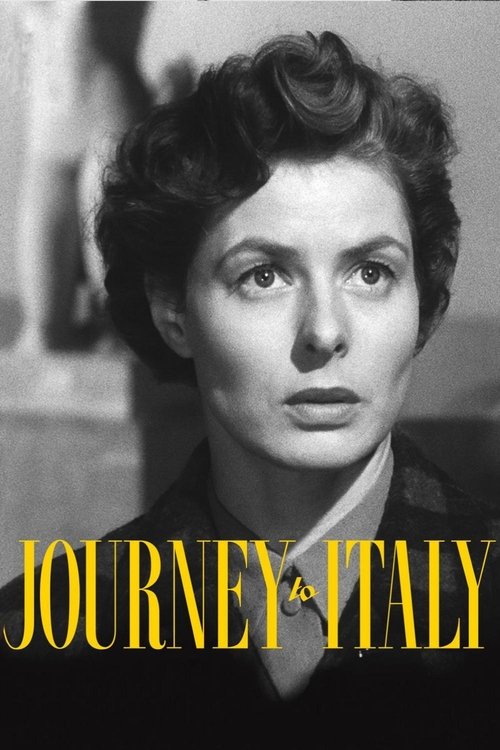
Journey to Italy
1954 · Roberto Rossellini
For when you want a slow, contemplative film to sit with — something about love, distance, and mortality that you'll be turning over for days. Not a date-night crowd-pleaser; a film for a reflective evening.
What it's about
An English couple, married eight years, drive to Naples to sell a villa they've inherited — and realize on the way that this is the first time they've truly been alone together. While Alex bristles and flirts, Katherine wanders museums, ruins, and Pompeii, and the trip becomes an unplanned audit of everything their marriage is and isn't. Very little 'happens'; everything changes.
The experience
Quiet, drifting, and quietly devastating — the tension lives in silences, sidelong glances, and the strange pressure the ancient landscape puts on two modern people. It sneaks up on you: what feels like a slow travelogue becomes one of the most piercing films ever made about being married.
Performances
Ingrid Bergman is extraordinary in a nearly wordless register — whole arguments happen in her face — and George Sanders's clipped, defensive charm makes the couple's estrangement painfully believable.
The craft
Rossellini shoots Naples, Pompeii, and the volcanic fields around them almost like documentary, and lets the places do the emotional work: dead cities and museum statues keep confronting a couple who've stopped really looking at each other. The loose, unforced structure felt baffling in 1954 and looks decades ahead of its time now.
Why it matters
Dismissed on release, it was championed by young French critics as a new kind of cinema and became a foundation stone for the modern art film — the movie that showed a story could be built from wandering, looking, and feeling rather than plot.
Snapshot
Journey to Italy (Viaggio in Italia) is the third and most radical of the films Roberto Rossellini made with Ingrid Bergman, and the one that posterity has elevated above the rest. Its premise could not be slighter: an English couple, Katherine and Alexander Joyce (Bergman and George Sanders), drive south to Naples to dispose of a villa inherited from an uncle, and over a few days of enforced proximity discover how little marriage has bound them together. Almost nothing "happens" in the conventional sense. Katherine wanders through museums, ruins, and the dead landscapes of the Phlegraean Fields; Alex bristles and flirts; the marriage frays, declares itself finished, and is then restored by a sudden, unmotivated rush of feeling in a religious procession. What looked in 1954 like an artistic failure — a star vehicle without a script, a drama without dramatic incident — has come to be regarded as a hinge on which cinema turned, the film in which the documentary impulse of neorealism dissolved into the interior, drifting, time-saturated cinema of modernism. Jacques Rivette's claim that all other films aged a decade overnight is the standard origin myth of that shift.
Industry & production
The film belongs to the troubled, fertile partnership Rossellini formed with Bergman after she left Hollywood and her marriage to join him — a scandal that cost Bergman her American career and shadowed the couple's joint productions (Stromboli, 1950; Europe '51, 1952) with hostile publicity. By 1953 their collaborations had become commercial liabilities, and Journey to Italy was made on modest means, largely on location around Naples, Pompeii, Cumae, the Solfatara, and the National Archaeological Museum, with interiors that retained the rough, improvised feel of the exteriors.
Rossellini's working method was the defining production fact and the chief source of friction. He shot without a finished screenplay, arriving with situations rather than scenes, dictating dialogue close to the moment of filming, and reshaping the day's work around what the locations offered. For Bergman, trained in the disciplined Hollywood studio system, this was disorienting; for George Sanders — a polished professional accustomed to knowing his part — it was, by widely repeated accounts, a source of real distress and bewilderment on set. That tension is not merely anecdotal: the estrangement and unease the actors genuinely felt bleed into the characters' alienation, and the film effectively converts production difficulty into subject matter.
The picture was a commercial and critical failure on release, particularly in Italy, where Rossellini's reputation had already declined from its postwar height. It circulated in several languages and under several titles (including Voyage to Italy and, in cut English-language versions, Strangers / The Lonely Woman), and existed for decades in compromised prints before restorations — notably work associated with the Cineteca di Bologna — recovered something closer to the intended film.
Technology
Journey to Italy is a black-and-white, monaural production made with lightweight, location-friendly equipment characteristic of Italian postwar filmmaking. There are no technological novelties here — no color, no widescreen, no elaborate optical work — and the absence is the point. Rossellini's aesthetic depended on a camera mobile and unobtrusive enough to follow Bergman through actual streets, museums, and excavation sites without staging them as sets. The film was shot with direct attention to available locations and natural light where possible; like much Italian cinema of the era, it was post-synchronized, with dialogue and sound dubbed in afterward, which afforded Rossellini freedom to shoot in noisy, uncontrolled public spaces. The technical modesty is inseparable from the film's realism: the apparatus recedes so that place and duration can press forward.
Technique
Cinematography
The cinematography is credited to Enzo Serafin. Its great achievement is a kind of attentive plainness. The camera observes Katherine observing — trailing her through the rooms of the Naples museum past classical statuary, into the eerie steaming ground of the Solfatara, through the catacombs, and finally to the excavation at Pompeii. The famous traveling shots from the moving car, with the Italian landscape sliding past Bergman's reflective, dissatisfied face, establish a rhythm of looking and drifting rather than acting. Rossellini favors longer takes and a roving, sometimes restless framing that keeps the human figure embedded in, and frequently dwarfed by, the surrounding world of objects, ruins, and crowds. The visual style refuses the expressive close-up as a vehicle of psychology; feeling is registered obliquely, through what the characters see and how long the camera dwells on it.
Editing
Edited by Jolanda Benvenuti, the film is built less on dramatic cutting than on accumulation and juxtaposition. The structure alternates Katherine's solitary excursions with Alex's separate idylls, letting boredom, dead time, and the texture of an unhappy holiday register fully rather than be compressed away. The editing tolerates "empty" passages that a conventional drama would trim — this patience is precisely what later critics identified as modern. The film's most discussed cut is its last: the abrupt swing from total marital collapse to reconciliation amid the surging crowd of a Naples procession, an ending so unprepared that it has been read variously as a religious "miracle," a structural provocation, and a deliberate refusal of psychological causality.
Mise-en-scène / staging
Rossellini stages the marriage against a landscape saturated with death, antiquity, and fertility: the petrified lovers of Pompeii, the bones in the catacombs, the smoking volcanic earth, the pregnant women Katherine keeps noticing in the streets. The villa, the museum galleries, and the ruins are not backdrops but interlocutors — the environment carries the meaning the dialogue withholds. Staging is loose and quasi-documentary, with real crowds and real sites incorporated rather than reconstructed. The decisive instance is the Pompeii sequence, where excavators pour plaster into a void and reveal the cast of a man and woman who died together; Katherine's overwhelmed reaction to this image of intimacy fixed in catastrophe does the emotional work that the script's sparse dialogue deliberately avoids.
Sound
Like most Italian films of the period, Journey to Italy was post-synchronized, and its soundtrack mixes naturalistic ambience — traffic, crowds, the bustle of Naples, the murmur of tourist sites — with a score by Renzo Rossellini, the director's brother and frequent collaborator. The music is used sparingly and pointedly, swelling at the moments of revelation (the Pompeii cast, the closing procession) where the film reaches for the transcendent. Much of the picture, however, rests on the texture of real-world sound and silence, reinforcing the sense of two people stranded in a foreign acoustic environment they cannot share.
Performance
The performances are central to the film's reputation and were extracted under duress. Bergman gives one of her finest and least mannered screen performances as Katherine — restless, wounded, hypersensitive to a country that overwhelms her, her famous luminosity here turned inward and anxious. Sanders, working in conditions he reportedly found exasperating, channels that genuine discomfort into Alex's brittle, defended Englishness: clipped, evasive, increasingly cruel. The naturalism Rossellini sought — actors not fully in command of the next scene, reacting in something close to real time — produces a rawness unusual for two stars of their pedigree, and the friction between Bergman's emotional openness and Sanders's armored reserve becomes the marriage's whole drama.
Narrative & dramatic mode
The film's most consequential innovation is its dramatic mode. It substitutes situation for plot and duration for event. There is no clear inciting incident, no rising action engineered toward a crisis, no exposition that explains who these people were before. Instead, the film offers a series of largely undramatic encounters whose cumulative effect is the slow exposure of an emptiness at the marriage's center. Causality is loosened: characters drift, observe, and feel without the tidy motivation classical narrative requires, and the ending withholds the psychological explanation that would make the reconciliation legible. This is the "dedramatized" cinema that critics would later trace forward to Antonioni and beyond — a narrative built on dead time, wandering, and the spectator's own work of interpretation rather than on incident.
Genre & cycle
Nominally a marital melodrama and a star romance, Journey to Italy belongs more truly to several emergent lineages it helped inaugurate: the film of marital crisis and bourgeois estrangement, the travel film in which a journey abroad becomes a journey into the self, and — through its automobile-bound structure and landscape-as-mirror — a forerunner of the modern road movie. Within Rossellini's own career it forms a trilogy with Stromboli and Europe '51, the "Bergman films," each centered on a woman in spiritual and existential crisis confronting an alien environment. It is also, loosely, a film of conversion or grace, akin to the Catholic strain in Rossellini's work — the sudden ending reads as a secular miracle, an arrival of feeling unearned by the plot.
Authorship & method
The film is unmistakably Rossellini's, and it has become the keystone of the case for his authorship. His method — improvisation, location shooting, the integration of documentary reality, the patience with empty time, the openness to the accidental — is fully realized here. The screenplay is credited to Rossellini with the Sicilian novelist Vitaliano Brancati; the film is widely understood to derive, loosely and without a clean rights chain, from Colette's novel Duo, a connection often noted but best stated with caution given the murky adaptation history. Rossellini's key collaborators were a tight circle: cinematographer Enzo Serafin, editor Jolanda Benvenuti, and his brother Renzo Rossellini as composer, the latter a constant across his postwar work. But the film's deepest collaborator is Bergman, whose presence, vulnerability, and real-life entanglement with the director are inextricable from the character of Katherine. The authorship here is less that of a controlling craftsman than of a director willing to let reality, and his actors' genuine states, write the film with him.
Movement / national cinema
Journey to Italy occupies the threshold of Italian neorealism's exhaustion and its transformation. Rossellini had been, with Rome, Open City (1945) and Paisà (1946), a founding figure of neorealism — the postwar movement committed to location shooting, nonprofessional textures, contemporary social reality, and an ethics of observation. By 1954 the movement's first program had largely run its course, and Journey to Italy shows neorealism turning inward: the documentary attention to the real Italy remains, but it is now directed at a psychological and metaphysical interior rather than at social conditions. The film is thus often described as the bridge from neorealism to modernism within Italian cinema, retaining the former's commitment to the actual world while pioneering the latter's subjectivity and narrative drift.
Era / period
The film is a product of the early-to-mid 1950s, a moment of postwar reconstruction, growing tourism, and the beginnings of the economic transformation that would soon become Italy's "boom." Its English protagonists are affluent foreigners encountering a south still steeped in antiquity, popular Catholicism, and the visible nearness of the dead — a confrontation between modern, secular, emotionally repressed northern Europe and an older, sensuous, faith-saturated Mediterranean world. That period tension between modernity and the ancient, between cool detachment and overwhelming physical and spiritual presence, is the film's living context.
Themes
The governing themes are estrangement and the unknowability of intimate others; the proximity of love and death; sterility against fertility (the childless marriage set among Pompeii's eternal lovers, pregnant women, and teeming streets); and the possibility of grace arriving unbidden. Katherine's encounters with relics, ruins, and the casts of the dead repeatedly stage the persistence of feeling and connection beyond death, throwing the deadness of her own living marriage into relief. The film is also a meditation on looking — on travel and the tourist's gaze as a mode of confronting the self — and on the limits of language to repair what has gone wrong between two people. The ending's contested "miracle" crystallizes the central question: whether love is a matter of will and understanding or of sudden, inexplicable grace.
Reception, canon & influence
On release the film failed — commercially weak, critically dismissed, and especially poorly received in Italy, where it confirmed perceptions of Rossellini's decline. Its rescue came almost entirely from the young critics of Cahiers du Cinéma, who recognized in it the future of the medium. Jacques Rivette's 1955 "Letter on Rossellini" is the landmark text, arguing that Journey to Italy opened a path all subsequent cinema would have to follow and famously suggesting that other films had aged overnight beside it. The broader Cahiers circle — André Bazin's realist criticism providing the theoretical ground, and the future New Wave directors Truffaut, Godard, Rohmer, and Rivette as advocates — adopted Rossellini, and this film in particular, as a foundational model. Their championing made the film a cornerstone of politique des auteurs and a touchstone of cinematic modernism; later scholars (among them Rossellini's biographer Tag Gallagher, and critics including Peter Brunette and Laura Mulvey) extended and complicated that canonization.
Backward, the film draws on Rossellini's own neorealist practice, on the Catholic and humanist currents of his postwar work, and — loosely — on Colette's literary anatomy of a failing marriage. Forward, its influence is enormous and is usually framed as the birth of modern cinema: Michelangelo Antonioni's films of alienation and dead time (L'Avventura and after) are its most direct descendants, and its DNA runs through the French New Wave, through modernist directors who built drama from drift and duration, and through the long tradition of marriage-in-crisis and journey films. That a picture so reviled in its day became, within a decade, the agreed-upon origin point of a new cinema is the central fact of its reception history — a reversal so complete that Journey to Italy now reads less as a 1954 release than as a document of where film was about to go.
A Deleuzian reading
Start with her face in the car.
The full Deleuzian reading of Journey to Italy →
Reception
A commercial flop dismissed by many critics in 1954, it was championed almost single-handedly by the young Cahiers du cinéma crowd — Jacques Rivette's 'Letter on Rossellini' hailed it as the birth of modern cinema — and it has since climbed into the Sight & Sound top 50.
How Journey to Italy was received, from release to now →
Influences: the films it descends from and the films it influenced
- Rome, Open City (1945) — Established the neorealist toolkit Journey inherits — shooting in real streets with post-synchronized sound and documentary footage folded into the fiction, so the location carries dramatic weight the script doesn't spell out.
- Paisà (1946) — Its episodic, loosely-causal structure and willingness to let landscape and non-actors set the rhythm pioneered the dedramatized drift that Journey extends across a single marriage.
- Germany Year Zero (1948) — Built drama from a solitary figure walking through ruins, the camera tracking a body through space until the environment becomes the protagonist's interlocutor — the exact device Katherine's museum and Pompeii excursions reprise.
- Stromboli (1950) — The direct template: Bergman as an estranged foreigner stranded in a hostile natural landscape, location-shot, resolved by an abrupt, unprepared eruption of grace — the same crisis-then-sudden-reconciliation structure Journey repeats.
- Europe '51 (1952) — Refined Rossellini's method of letting Bergman's genuine emotional state and unguarded face write the role, the documentary attention to a woman's spiritual crisis that Journey makes its whole subject.
- Bicycle Thieves (1948) — Its structure of walking real city streets in near-real time, finding drama in everyday duration rather than plotted incident, is the neorealist precedent for Journey's aimless excursions through Naples.
- L'Avventura (1960) — The most direct heir — converts Journey's empty-time editing and landscape-as-interlocutor into a whole grammar, letting dead time and an indifferent terrain absorb characters where plot would normally advance.
- La Notte (1961) — Anatomizes a failing marriage by tracking a husband and wife drifting apart across a single day and night, dedramatizing the couple-in-crisis exactly as Journey does with the Joyces.
- L'Eclisse (1962) — Pushes Journey's empty-time aesthetic to its limit, ending on emptied locations devoid of the protagonists — the environment outlasting the human drama that Rossellini's Pompeii sequence first proposed.
- Le Mépris (1963) — An explicit reworking — a marriage disintegrating during an Italian sojourn on Capri, built from long takes of a couple talking past each other and traveling through landscape, openly homaging Rossellini.
- Breathless (1960) — The Cahiers championing of Journey put into practice: improvised performance, real Paris locations, and the jump cut as a descendant of Rossellini's abrupt, causality-loosening elisions.
- Certified Copy (2010) — The most literal modern descendant — a couple drives through Tuscany via traveling-car shots debating whether their marriage is real, reproducing Journey's structure of estrangement worked out on a road trip through Italian landscape.
- Before Midnight (2013) — Stages a marriage's near-rupture as a real-time argument during a trip through a Greek landscape, relying on performed friction and dedramatized duration rather than plot — Journey's method in present-tense dialogue.
- Paris, Texas (1984) — Reunites an estranged couple across a vast landscape rendered through traveling shots, the terrain functioning as interlocutor and the reconciliation arriving as an unearned grace — Rossellini's road-movie-of-estrangement transposed to America.
- Pompei: Below the Clouds (2025) — Its Pompeii excavation sequence — the plaster-cast bodies surfacing before living onlookers — established the Italian template Rosi inherits: the ruin filmed as a collapse of geologic and human time, mortality made physically present rather than narrated.
- Three Colors: Blue (1993) — Rossellini's phenomenological structure — a woman's interior state tracked through encounters with physical space and strangers rather than through plot causality — establishes the mourning-film template Blue inherits: grief as perceptual wandering without narrative resolution.
- Y Tu Mamá También (2001) — Rossellini's technique of letting location reality — Pompeian excavations, street processions, volcanic landscapes — interrupt a relationship's dissolution without comment establishes the template for the Oaxacan roadblocks and village weddings that arrive in Cuarón's frame as they would in documentary.
- Nostalgia (1983) — Rossellini's film establishes the genre prototype of the northern-European protagonist in Italy as spiritual ordeal — Bergman's Katharine stranded in a marriage and a landscape she cannot inhabit or leave — suppressing dramatic incident in favor of spatial accumulation and performed inarticulacy; this template of paralytic incomprehension before Italian landscape is the direct model Tarkovsky inherits for Gorchakov.
- Scenes from a Marriage (1973) — Sustains the unsparing, dedramatized dissection of a couple through long takes of genuine performance friction, extending the documentary-of-a-marriage approach Journey pioneered with its real-life Rossellini–Bergman tension.
- Vagabond (1985) — Builds a portrait from drift and loosened causality across a wandered landscape, with tracking shots and documentary-textured locations replacing dramatic plotting, carrying forward Journey's faith in duration and place.
- La Strada (1954) — Rossellini's contemporary technique of using Italian location shooting — ancient ruins, sacred sites, volcanic landscape — as a moral and emotional force that acts directly upon characters' interiors, culminating in an unreasoned eruption of feeling as the parabolic resolution, parallels La Strada's use of the campagna and the final beach scene where Quinn's grief appears as something geological rather than psychological.
- Europa '51 (1952) — The complementary Bergman-Rossellini film working identical formal means: where Europa '51 descends from bourgeois interiority into Roman social space, Viaggio uses the same duration-shot, passive-presence method to observe a bourgeois marriage dissolve through encounter with Naples' density of death and history.
- The Headless Woman (2008) — Prototype of the interior-crisis film built from a bourgeois woman's aimless observational drift, where landscape and social ritual are filtered entirely through her destabilized attention rather than plot.
Similar films
- Stromboli (1950) — influence & lineage · same viewing thread
- Rome, Open City (1945) — influence & lineage · often watched together
- L'Avventura (1960) — influence & lineage · often watched together
- L'Eclisse (1962) — influence & lineage · often watched together
- Certified Copy (2010) — influence & lineage · often watched together
- Paisan (1946) — influence & lineage · often watched together
- La Notte (1961) — influence & lineage
- Two for the Road (1967) — same viewing thread
All the films related to Journey to Italy →
Watch it with: curated runs of related films
- Love, Memory, and the Long Journey — A run of love films where a journey — by car, by rail, or through memory — quietly lays bare what two people are, or were, to each other.