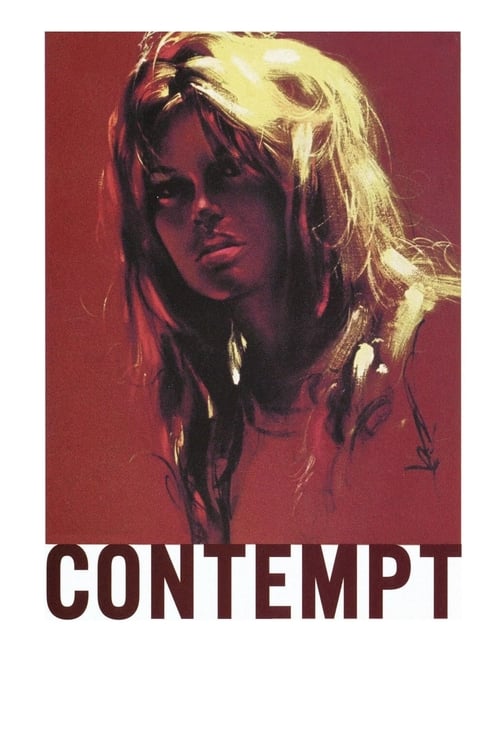
Contempt
1963 · Jean-Luc Godard
For when you want a film to chew on for days — beautiful, adult, and unhurried. Not a comfort watch: it's for the mood where you're willing to sit with heartbreak and let a movie be about big things.
What it's about
A screenwriter is hired by a vulgar American producer to punch up a film of Homer's Odyssey that the great director Fritz Lang — playing himself — refuses to dumb down. Caught between art and money on a shoot that drifts from Rome to the cliffs of Capri, the writer watches something far worse unravel: over the course of a single afternoon, his wife stops loving him. The film traces both collapses at once — the marriage and the movie.
The experience
Sun-drenched and mournful at the same time — long, hypnotic scenes of a couple circling each other in an apartment, set against some of the most ravishing Mediterranean imagery ever shot. It's slow, gorgeous, and quietly devastating; the sadness sneaks up on you.
Performances
Brigitte Bardot, cast as the world's biggest sex symbol, gives a performance of startling plainness and hurt; Michel Piccoli makes the husband's self-justifications painfully human, and Jack Palance is a magnificently brutish producer. Fritz Lang, as himself, is the film's weary conscience.
The craft
Shot in widescreen color by Raoul Coutard, with the villa on Capri and Georges Delerue's aching, endlessly repeating score doing as much emotional work as any dialogue. Godard stages the central marital argument as one long, real-time apartment scene — a piece of filmmaking that's been studied ever since. It absolutely rewards the biggest screen you can find.
Why it matters
One of the most influential films ever made about filmmaking itself, and the moment Godard collided with big stars and big money and turned the collision into the subject. Its images and score echo through decades of movies about doomed love and the movie business.
Snapshot
Le Mépris is a CinemaScope elegy in three registers at once: the death of a marriage, the impossibility of pure cinema under commercial pressure, and a reckoning with the whole weight of Western narrative from Homer forward. Godard adapted Alberto Moravia's 1954 novel Il Disprezzo (A Ghost at Noon), transposing its psychological portrait of crumbling intimacy into the milieu he knew best — the international co-production system — and cast the living embodiment of that system, Brigitte Bardot, as the woman who simply, quietly, stops loving her husband. Fritz Lang plays himself: a great director hired to make a version of the Odyssey and stubbornly refusing to betray it. Between these two poles — Lang's intractable artistic conscience and American producer Jeremy Prokosch's appetite for spectacle — Paul Javal, the screenwriter, negotiates and ultimately loses everything. The film is 103 minutes of sunlit devastation, shot with Raoul Coutard's saturated Technicolor palette across Rome and Capri.
Industry & Production
Contempt is a product of the international co-production boom that defined European art cinema financing in the early 1960s. The film was assembled through Rome Paris Films (France) and Compagnia Cinematografica Champion (Italy), with American completion money supplied by Joseph E. Levine of Embassy Pictures — a distribution executive whose commercial instincts made him the real-life Prokosch. Carlo Ponti and Georges de Beauregard served as the primary Italian and French producers respectively. The budget, reportedly around one million US dollars, placed the film at the expensive end of the French New Wave range and represented a significant commercial risk concentrated on Bardot's star power.
Levine's involvement was the defining industrial constraint. He insisted the film showcase Bardot's body in ways Godard found reductive, and the director's response is embedded in the film's extraordinary opening minutes: a scene in which Paul catalogs Camille's physical attributes in loving detail is filmed through successive colored gels — red, white, and blue, the French tricolor — that render the nudity explicitly artificial, a painted surface rather than titillation. The gesture turned Levine's demand into a comment on the demand itself. Their behind-the-scenes conflict is the film's subject made literal.
The casting of Fritz Lang as himself was one of several decisions that elevated the project beyond prestige production. Lang was 73 at the time of filming, a figure whose career had spanned Weimar Expressionism, exile from Nazi Germany, and decades in Hollywood — living history of exactly the tensions between art and commerce that Godard was dramatizing. His presence collapses the fiction: Lang-as-character and Lang-as-historical-person are inseparable, and every frame he appears in carries that accumulated weight.
Technology
Godard shot Contempt in anamorphic CinemaScope — a deliberate reversal of his habitual practice. His first five features had used the compact, handheld mobility that 16mm-influenced 35mm photography permitted; Contempt demanded a format designed for spectacle and deployed it to examine intimacy. The 2.35:1 frame, used throughout the 1950s for epics and Westerns, becomes here an instrument for registering distance. Two people in the same room can occupy opposite edges of the image as if separated by an ocean.
The film was processed in Technicolor at a moment when the dye-transfer process was still producing the saturated, almost tactile color that later processes could not match. The Villa Malaparte exteriors in particular — the wine-dark Tyrrhenian Sea, the tawny stone, the deep primary red of Camille's towel — carry a chromatic specificity that functions dramatically rather than decoratively.
Technique
Cinematography
Raoul Coutard, Godard's cinematographer on nearly all his films through the mid-1960s, had developed his aesthetic on the streets of Paris with available-light pragmatism. Contempt required him to adapt that intelligence to a monumental format. His signature achievement is the sustained apartment sequence — roughly the film's middle third — in which he tracks Paul and Camille through the confined geometry of their Rome flat with a patience that is almost documentary. The camera does not amplify the drama; it observes it, keeping the wide frame from becoming a container of emotion. On the Capri locations, Coutard renders the Villa Malaparte's brutalist architecture — Adalberto Libera's 1937 structure clinging to the cliffs of Punta Massullo — as something between paradise and trap. The famous roof terrace, its flat expanse backed by open sea, is used in compositions that literalize the characters' exposure.
The opening shot — Coutard himself operating a camera that slowly pans until its lens faces the audience directly — is among the most cited reflexive gestures in cinema. The film announces its own machinery before a word of story has been spoken.
Editing
The editing, credited to Agnès Guillemot (a frequent Godard collaborator in this period), sustains the film's unusually long durations. Where Breathless had made choppy discontinuity a stylistic signature, Contempt is cut with a deliberate slowness, allowing takes to run until silence or stillness does the expressive work that cutting would have foreclosed. The apartment sequence is the clearest example: Godard stages the collapse of the Javal marriage in real time, refusing ellipsis, so that the audience experiences something of the relentless duration of a bad conversation that cannot be ended.
Mise-en-scène / Staging
The staging throughout exploits the tension between the CinemaScope frame's horizontal pressure and the vertical, labyrinthine architecture of the two main locations. In the apartment, the Javals move through corridors and doorways that create depth-planes within the flat image; bodies pass in and out of view, frames within frames multiply. On the villa's staircase and roof, Godard opens to a vastness that reduces the human figures without comforting them. The film's great spatial metaphor is the villa itself: it is simultaneously a beautiful place and a dead end — its famous staircase leads nowhere useful, its roof has no shade.
Jack Palance's Prokosch is staged as pure physical force: he throws film reels, poses on cars, owns whatever room he enters. Fritz Lang is staged as a counterweight — still, deliberate, always slightly apart from the action around him. Michel Piccoli's Paul occupies an anxious middle ground, perpetually framed between these poles.
Sound
Georges Delerue's score is one of the most affecting in French cinema. Its main theme — a swooping, mournful string melody — recurs throughout the film with a frequency that borders on obsession, returning at moments of beauty, irony, and grief alike. The score's insistence is not simply atmospheric; it creates an emotional commentary that runs alongside or against the image, so that scenes of apparent calm are saturated with anticipated loss. Delerue received significant critical attention for this work, and the theme has since become one of the recognized signatures of European art cinema of the period.
Godard's treatment of ambient sound and silence is equally precise. The apartment sequence is punctuated by long stretches in which the characters say nothing useful, and the ambient noise of the Rome streets below — traffic, voices — fills the gap without resolving the tension. On Capri, the sea is a constant presence in the sound mix, indifferent.
Performance
Bardot's performance is the film's emotional ground-zero and its principal critical surprise. Her screen persona at the time was constructed almost entirely on the axis of spectacle; Godard's direction refuses that persona, instead finding a woman of compressed legibility who communicates everything important in micro-adjustments of attention and withdrawal. Camille's contempt, when it arrives, is not dramatic but categorical — a decision already made. Piccoli, playing against his own considerable intelligence as an actor, finds in Paul exactly the quality of self-deception that makes him impossible to fully condemn or fully pity. Lang brings a dry authority that requires no performance: he simply occupies the frame as a historical fact. Palance plays excess with obvious relish, and the film lets him; Prokosch is a caricature, but a frighteningly accurate one.
Narrative & Dramatic Mode
The film's narrative structure is a double helix. In the foreground, Paul and Camille's marriage dissolves across a single day and its aftermath; in the background, the production of Lang's Odyssey stalls and shifts under Prokosch's commercial pressure. The two strands are explicitly linked through the Homeric parallel that runs throughout. Lang's interpretation of the Odyssey — that Penelope may have wished Odysseus gone, may have grown to regard his return as an intrusion — maps onto Camille's emotional reality with a precision that the film trusts the viewer to assemble without underlining.
Godard's narrative mode is closer to the essay than to classical drama. Scenes are allowed to stretch and digress; characters speak at and past each other; the film-within-a-film sequences introduce a meta-fictional register that periodically dissolves the story into its own elements. The result is a film that is both emotionally direct — the Javal marriage is genuinely painful to watch disintegrate — and intellectually porous, generating implications that extend beyond any single reading.
Genre & Cycle
Contempt is generically plural. It is a melodrama (the failing marriage), a film-industry satire (the co-production world skewered from the inside), a literary adaptation (Moravia), and a film about film. It belongs to the European co-production art film cycle of the early 1960s that also produced Antonioni's L'Avventura (1960) and Resnais's Last Year at Marienbad (1961) — works that took the resources of commercial production and used them to dismantle narrative expectation. It also participates in the Italian locations tradition, the sun-drenched-tragedy vein that Rossellini had established with Journey to Italy (1954) and which made the Mediterranean landscape a stage for domestic catastrophe.
Authorship & Method
Godard's adaptation of Moravia stripped away the psychological specificity of the novel's first-person interiority and replaced it with the specificity of cinema. His screenplay retains the architecture — writer hired onto Odyssey film, producer, crumbling marriage — but the subjectivity is now distributed across images, scored durations, and the friction between what characters say and how they are filmed.
Coutard's collaboration with Godard at this stage was characterized by total technical fluency; they had made seven films together and could work at a speed unusual in widescreen production. Delerue had scored Godard's Jules and Jim (1962) and Shoot the Piano Player (1960) — his characteristic blend of chamber-music intimacy and full-orchestral swells was already calibrated to the emotional temperature Godard worked at.
Movement / National Cinema
Contempt sits at the intersection of the French New Wave and the broader European art cinema movement. It is arguably the point at which the New Wave encountered the full weight of commercial international cinema and registered that encounter as subject matter. Unlike the Paris-street films of the movement's first wave, it is explicitly about the industrial system that the New Wave was nominally outside — or trying to be outside. Its Italian location and multi-national cast make it as much a European film as a French one; the dialogue runs in French, English, Italian, and German, with Giorgia Moll's character, Francesca, functioning as the film's internal translator.
Era / Period
Made in 1963, the film arrives at a precise historical junction. The New Wave's first creative explosion (1959–1962) was exhausting itself; the French-Italian co-production model was reaching its structural limits; American money was beginning to reshape European production in ways that the next decade would make even more drastic. Lang, born 1890, represents the entire arc of classical filmmaking from its origins; Godard, born 1930, represents its most radical current disruption. Their coexistence in a film about exactly that history gives Contempt a temporal density unavailable to a purely fictional cast.
Themes
The film's central preoccupation is contempt as an epistemic condition: the moment at which another person becomes opaque, their inner life no longer available to you. Paul cannot understand Camille's withdrawal because he has already performed the act — accepting money to service Prokosch's vision — that made him unknowable to her. The film refuses to adjudicate this cleanly; Camille's contempt arrives before Paul has done anything definitively wrong, and the question of whether she is a sensitive reader of his character or a person who has simply stopped loving him is left genuinely open.
Interwoven with this is a meditation on artistic integrity and the conditions under which it is possible. Lang's resistance to Prokosch is not triumphant; the film offers no comfortable resolution in which art defeats commerce. The theme of the male gaze — and who has the right to look at whom, and under what conditions — runs through every sequence involving Bardot and operates as a self-critical undercurrent in a film that was itself financed partly on the promise of her image.
The Odyssey parallel opens onto questions of marriage, loyalty, and whether return is always desired by those who were left behind — questions that antiquity raised and that domestic life perennially restages.
Reception, Canon & Influence
Backward influences: Rossellini's Journey to Italy is the film's most direct precursor in form and emotional territory — a married couple, an Italian journey, sunlight that exposes rather than warms. Moravia's novel provided the structural scaffold. The whole of Hollywood classical cinema, filtered through Lang's body of work, is the implicit backdrop against which Godard measures every formal decision. The widescreen melodramas of Nicholas Ray and Douglas Sirk are relevant here: Godard was a devoted reader of both, and Contempt can be read as a CinemaScope melodrama that knows it is a CinemaScope melodrama.
Initial reception: The film received a mixed early response. French critics of the Cahiers generation recognized its ambitions; popular audiences, primed for a Bardot vehicle, found it austere. Levine's marketing in certain markets emphasized the star over the substance. Critical re-evaluation came steadily across the following decades.
Legacy: Contempt is now regarded as one of the essential films of its decade, regularly appearing on critics' polls of the greatest films ever made. Its influence on subsequent European cinema is diffuse but traceable: the use of the wide format for intimate domestic drama; the meta-fictional treatment of the film industry as subject matter; the sustained, unmelodramatic staging of relationship collapse — all of these became available as formal options in the years after Contempt demonstrated their viability. Wim Wenders, whose own films are haunted by the figure of the compromised artist, has cited Godard's work extensively. The film has become something like a touchstone for filmmakers engaged with the problem of commercial versus artistic cinema, partly because it does not pretend the problem can be resolved. The Villa Malaparte, after Contempt, became one of the recognizable sacred sites of European film geography, subsequently appearing in other productions specifically because of its association with this film.
A Deleuzian reading
Half an hour of this film is a single argument in an apartment, and the argument is already over before it starts.
The full Deleuzian reading of Contempt →
Reception
In 1963 it was widely read as Godard's compromised 'big-budget' picture — a star vehicle awkwardly saddled with Brigitte Bardot — and reviews were mixed. Its 1997 restoration and rerelease sealed the reversal: it's now routinely called one of Godard's supreme achievements, with critic Colin MacCabe famously dubbing it 'the greatest work of art produced in post-war Europe.'
How Contempt was received, from release to now →
Influences: the films it descends from and the films it influenced
- Journey to Italy (1954) — Rossellini's use of Italian landscape and archaeological sites as psychological externalization of a disintegrating marriage — replacing interior monologue with location — is the direct formal ancestor of Godard's deployment of the Villa Malaparte and Capri coastline to register Camille's withdrawal, treating the Tyrrhenian seascape as an emotional rather than pictorial space.
- And God Created Woman (1956) — Vadim's CinemaScope framing of Bardot's body as an object of unmediated scopophilic display established the prior visual contract Godard then cites and subverts: the opening colored-gel sequence directly addresses this construction by rendering Bardot's nudity as tricolor artifice rather than erotic transparency, converting the producer's demand into a critique of the demand itself.
- Bigger Than Life (1956) — Ray pioneered the grammar of using the CinemaScope 2.35:1 frame for domestic melodrama, placing husband and wife at opposite horizontal edges to literalize marital rupture — the specific compositional vocabulary Godard inherits and extends in the Contempt apartment sequence, where the wide frame registers estrangement across shared rooms.
- Sunset Boulevard (1950) — Wilder's technique of casting living Hollywood figures (Cecil B. DeMille, Buster Keaton) as themselves to collapse fictional narrative and industry biography is the formal precedent for Godard's casting of Fritz Lang as himself, loading the character with the accumulated weight of Weimar Expressionism, Nazi exile, and Hollywood decline.
- Man with a Movie Camera (1929) — Vertov's systematic inscription of the filming apparatus into the film itself — camera, cameraman, and editing table made visible — is the formal ancestor of the Contempt opening shot in which Coutard's camera pans to face its own audience, naming the film's artifice and implicating the spectator before the story begins.
- La Notte (1961) — Antonioni's sustained real-time tracking of a marriage's dissolution through interior architectural space — the party sequence in which Lidia and Giovanni navigate rooms without converging — directly prefigures Contempt's apartment sequence method: long takes through corridors as a spatial map of emotional estrangement, the frame observing rather than amplifying.
- Shoot the Piano Player (1960) — Delerue's score — strings of devastating lyricism playing against scenes of marital collapse and creative failure — is the fullest realization of the ironic-counterpoint mode he first deployed in Piano Player, where musical tenderness refuses to console or confirm the emotional content it accompanies; this became the template for European art cinema's use of beauty-as-distance.
- The Earrings of Madame de... (1953) — Godard, who studied Ophüls intensively at Cahiers, structures the long apartment sequence as an unbroken lateral tracking movement through bourgeois domestic space where camera drift registers psychological estrangement — a direct application of Ophüls's principle that the moving camera is the truest index of a character's emotional condition.
- The Testament of Dr. Mabuse (1933) — Godard casts Lang as himself directing an Odyssey adaptation, a meta-homage that treats the Mabuse-era German master's cinema as living authorship — the 'terror outliving the author' turned into cinephile reverence.
- Pierrot le Fou (1965) — Coutard's colored-gel expressionism, used in Contempt as a single contained subversive gesture, becomes in Pierrot le Fou a structural principle: blocks of saturated primary color function as chapter divisions and emotional keys throughout the film, extending the critique of the commercial image from a prologue device into a total mise-en-scène.
- Two or Three Things I Know About Her (1967) — Godard extends the essay-film voiceover method — philosophical commentary laid over observational footage — that governs Contempt's narrator register, but shifts the object of the analytical gaze from Bardot's body to consumer commodities, with Coutard's extreme close-ups of objects replacing the close-ups of the female star as the site of critical scrutiny.
- Day for Night (1973) — Truffaut inherits the film-production-as-subject structure from Contempt — camera and crew visible, artistic intention vs. practical compromise foregrounded — but inverts the register: where Godard stages the production process as the site of marriage and artistic death, Truffaut stages it as collaborative love, using the same formal device to reach the opposite conclusion.
- The State of Things (1982) — Wenders directly inherits Contempt's industrial architecture: a European art-film crew stranded when American completion money fails, the confrontation between the director's intractable artistic vision and the producer's commercial logic resolved through violence, with the Portuguese Atlantic coastline rhyming geographically and emotionally with Capri's existential isolation.
- Passion (1982) — Godard's explicit return to the Contempt problem: a director's refusal to compromise his film against financial pressure, the same wide-format compositions in video-influenced light marking twenty years of the same struggle, and the art-vs-commerce question — whether pure cinema can survive its industrial conditions — answered again in the negative.
- Irma Vep (1996) — Assayas inherits the technique of casting a real actress (Maggie Cheung as herself) to generate the same collapse between camera desire and subject opacity that Godard achieves with Bardot: the filmmaker's gaze on the female star is simultaneously the film's erotic content and its critical subject, the woman's interiority remaining illegible beneath the image the production constructs around her.
- The Conformist (1971) — Godard and Raoul Coutard demonstrate in CinemaScope how the wide aspect ratio can stage psychological isolation by separating figures within the same frame to a degree impossible in the Academy ratio — characters sharing space but occupying irreconcilable psychological worlds — which Storaro translates into the Techniscope compositions that physically fragment Marcello from every human proximity.
- Weekend (1967) — Coutard's wide-screen lateral tracking and hard primary-color blocks (the red/blue/white apartment, the villa) are the exact cinematographic grammar Weekend's tracking shot extends.
- Betty Blue (1986) — Delerue's single lush string theme returning over the couple's disintegration establishes the score-as-elegiac-counter-voice function that Yared's recurring piano theme performs against Zorg and Betty.
- Before Midnight (2013) — The half-hour apartment sequence in which a marriage curdles in near-real time, the couple's circling movement through the rooms doing the work a cut would otherwise do — blocking-as-editing on a Mediterranean location.
- Bergman Island (2021) — The couple-abroad-on-a-production film — a screenwriter, a villa, a shoot in the background — with the lateral tracking shot through architecture doing the work of psychology; Hansen-Løve keeps the traveling coverage and drops the score's operatic commentary.
- 8½ (1963) — Both films use the director-surrogate figure to dramatize art-vs-commerce pressure within the Italian co-production system, but where Fellini interpolates memory and fantasy into continuous space as markers of the filmmaker's crisis, Godard uses essay-film interruption and colored light — parallel formal solutions to the same industrial predicament, arrived at independently in the same year.
- Jules and Jim (1962) — Georges Delerue's score for Jules and Jim established his leitmotif method — a recurring melodic theme assigned to a character's emotional register and reprised at the moment of loss — which Godard then commissioned for Contempt, where Delerue's 'death' theme functions as the film's emotional spine, marking each stage of Camille's withdrawal before dialogue acknowledges it.
- L'Avventura (1960) — Antonioni's anamorphic rendering of an Italian island (Lisca Bianca) as a space of existential exposure — the horizontal CinemaScope frame generating the characters' vulnerability against sea and stone — runs parallel to Godard's Villa Malaparte compositions, both deploying the wide format's landscape mode to stage intimate emotional drama as geography rather than psychology.
- La Dolce Vita (1960) — Godard shoots in the same Totalscope anamorphic format on Italian locations, deploying the horizontal frame to enforce spatial alienation between figures; Michel Piccoli's passive observer-protagonist — embedded in a film industry milieu, unable to act on what he perceives — mirrors Marcello's structural role as witness to a world he cannot escape or transform.
- Stromboli (1950) — Godard stages the Rossellini-Bergman dynamic as structural ghost — a director, his alienated wife, a crass American producer on a Mediterranean island — with Fritz Lang playing himself as the Rossellinian auteur, repeating Stromboli's woman-entrapped-by-island grammar while making the film's genealogy explicit.
- L'Eclisse (1962) — Godard maps a relationship's disintegration through architectural space using sustained takes and bodies that fail to occupy the same zone — consciously working in the Antonionian mode while adapting a Moravia novel, the same alienated-Italian-bourgeoisie literary milieu that shadows L'Eclisse — and positions Bardot's physical withdrawal as a structural echo of Vitti's.
- Happiness (1965) — Deploys flat primary-color fields (red/blue/white) as emotional punctuation over a dissolving marriage — the same use of saturated color-field fades Varda times as editing beats.
- Two Women (1960) — A near-contemporary adaptation of an Alberto Moravia novel produced by Carlo Ponti, sharing the exact producer-author configuration and Moravia's cool psychological realism that generated Two Women.
- Two for the Road (1967) — Contemporaneous proof that anamorphic scope is a marriage-collapse format: the wide frame holds two people who refuse to turn toward each other, the same lateral tension Challis exploits inside the car.
Similar films
- Pierrot le Fou (1965) — influence & lineage · often watched together
- L'Avventura (1960) — influence & lineage · often watched together
- Journey to Italy (1954) — influence & lineage · often watched together
- 8½ (1963) — influence & lineage
- Day for Night (1973) — influence & lineage
- Jules and Jim (1962) — influence & lineage
- Weekend (1967) — often watched together
- Vivre Sa Vie (1962) — often watched together
All the films related to Contempt →
Watch it with: curated runs of related films
- Death and the French Auteur — A run of French art films where a sensitive man — an aging poet, a recovering drinker, a screenwriter, a war-haunted soldier — drifts through a world already tilting toward death.