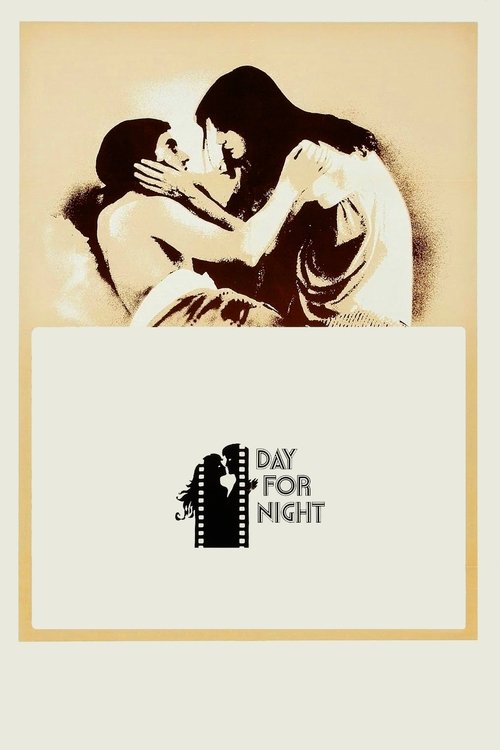
Day for Night
1973 · François Truffaut
For when you love movies and want a film that loves them back — a generous, feel-good evening rather than a demanding one. Perfect if you want charm and craft-nerd pleasure without a heavy heart.
What it's about
A film crew descends on a studio in Nice to shoot a middlebrow melodrama, and the director — played by Truffaut himself — spends seven weeks holding the production together. The obstacles are entirely human: a lovesick young lead, a British star just past a breakdown, an aging actress who drowns her lines in champagne, an insurance man circling the set. It's a backstage story where the real drama is everything that happens between takes.
The experience
Warm, buoyant, and quick on its feet — it plays like eavesdropping on a chaotic family that happens to make movies. Small heartbreaks keep surfacing through the comedy, so you come out both amused and unexpectedly moved.
Performances
Valentina Cortese is devastating and hilarious as the fading actress who can't hold her lines — a performance that earned an Oscar nomination — and Jean-Pierre Léaud brings his signature raw neediness to the volatile young lead. Jacqueline Bisset gives the fragile star a real, touching gravity.
The craft
Truffaut structures the whole film around the mechanics of a shoot — stunts, fake snow, trick shots, the day-for-night filter of the title — so you learn how movies are made while watching one fall lovingly apart. Georges Delerue's soaring score turns production logistics into something close to romance.
Why it matters
It won the Academy Award for Best Foreign Language Film and became the definitive valentine to filmmaking itself, the movie-about-movies that generations of directors cite when they explain why they do this job.
Snapshot
Day for Night — La Nuit américaine in French, the trade term for the filter technique that fakes night in broad daylight — is François Truffaut's film about the making of a film. Its diegetic production, a middlebrow melodrama called Je vous présente Paméla (Meet Pamela), is shot at the Victorine studios in Nice over the course of a fictional seven-week schedule that structures the movie itself. Truffaut casts himself as Ferrand, the director, a partly deaf, unflappable figure who fields the crises of cast and crew: a fragile young leading man (Jean-Pierre Léaud), an English star recovering from breakdown (Jacqueline Bisset), an aging actress losing her lines to drink and grief (Valentina Cortese), a womanizing veteran (Jean-Pierre Aumont), a pregnant actress, a secretly gay actor, a script girl (Nathalie Baye), and the thousand contingencies — weather, a recalcitrant cat, a death — that stand between a shooting script and a finished reel. The film's governing proposition, delivered by Ferrand in voiceover, is that films are more harmonious than the lives that make them: on set there are no traffic jams, no dead time, only the shared, sustaining labor of illusion. Winner of the Academy Award for Best Foreign Language Film, it is at once Truffaut's most transparent love letter to cinema and the occasion of his notorious rupture with Jean-Luc Godard.
Industry & production
Day for Night was produced by Truffaut's own company, Les Films du Carrosse — named for Jean Renoir's Le Carrosse d'or — in a co-production arrangement typical of the French industry of the period, involving French and Italian financing (Truffaut's Carrosse with PECF and the Italian PIC). Truffaut had by 1973 achieved the enviable position of an auteur who was also a reliable commercial and institutional figure: a founder-critic of the New Wave turned working director with a run of successes and international distribution behind him. Shooting took place on location at the Studios de la Victorine in Nice, the storied Mediterranean facility whose backlot streets and sound stages become, in the film, both setting and subject. This choice is doubly meaningful: the Victorine was a real, somewhat faded emblem of an older European studio production, and Truffaut uses its physical plant — the plaster facades, the standing "square," the effects department — to anatomize how a film is actually assembled. The production is candid about the economics and logistics of mid-budget filmmaking: insurance men and completion anxieties, a producer (Jean Champion's Bertrand) juggling money and schedule, the compression of an international cast into a fixed number of shooting days. The film-within-the-film's stock melodrama plot — a young man's wife falls in love with his father — is deliberately unremarkable, so that our attention rests not on what is being made but on the collaborative machinery of making it.
Technology
The film is, in part, a primer on film technology circa the early 1970s, presented not as exposition but as workplace texture. Its very title foregrounds an optical technique: la nuit américaine, the practice of shooting daytime exteriors through filters and with underexposure to simulate moonlit night, historically an American studio economy. Truffaut stages the effects and craft departments as dramatis personae — the prop and special-effects work, the building and dressing of sets, the substitution of a mechanical or trained animal, the candle rigged to relight, the fake snow, the breakaway elements. We watch a tracking shot laid on rails, a crane deployed, sound recorded and then looped, rushes screened and debated. The period is one of largely analog, photochemical practice: heavy 35mm cameras, physical film that must be developed and printed before anyone knows whether a scene "worked," dailies watched communally in a screening room. Much of the film's poignancy derives from this materiality — the sense that cinema is a handcraft of glue, plaster, light and celluloid, vulnerable at every stage to breakage and weather, requiring the coordinated expertise of dozens of specialists.
Technique
Cinematography
Pierre-William Glenn's photography sustains a difficult double register: it must render Meet Pamela in the glossy idiom of the commercial melodrama being shot, and render the "real" world of the production in a looser, more observational key. Glenn moves fluidly between the composed, lit setups of the fiction and the mobile, reactive framing of the behind-the-scenes material, so that the viewer is continually made aware of the seam between a shot and its manufacture. The film opens with a bravura sequence — an elaborate crowd scene in a studio "town square" — that is revealed, when Ferrand calls "Cut," to be a take being filmed, immediately installing the movie's central conceit. Glenn's Mediterranean light and warm palette give the whole an affectionate, sunlit tone appropriate to a film about the pleasures of work.
Editing
Cut by Yann Dedet and Martine Barraqué, the editing is the film's structural intelligence. The schedule — counting down shooting days — provides an armature onto which Truffaut and his editors graft an accretion of vignettes, so that the film feels both episodic and cumulatively shaped. The cutting repeatedly performs the movie's argument by juxtaposing a scene as staged with the same scene as fabricated: a smooth fictional moment set beside the interruptions, retakes and mechanics that produced it. The editing also handles Ferrand's recurring black-and-white dream — a boy in the night approaching a shuttered cinema — doling it out in fragments and withholding its resolution (the child stealing lobby cards from Citizen Kane) until late, a structural gag that doubles as a statement of cinephile origin.
Mise-en-scène / staging
Truffaut's staging is organized around the ensemble and the space of the studio. Rather than isolating protagonists, he choreographs a shifting web of relationships across the Victorine's stages, hotel rooms and backlot, letting minor crew members and their small dramas share the frame with the stars. The mise-en-scène is metacinematic by design: props, camera equipment, marks and lighting units are constantly visible, and the geography of a film set — who stands where, the hierarchy of director, actor, technician — becomes the film's real subject. Truffaut's placement of himself, as Ferrand, at the calm center of a turning wheel of crises is the staging's key gesture.
Sound
Georges Delerue's score is inseparable from the film's emotional address; his recurring "Grand Choral," a stately, string-and-brass theme, sounds the movie's romantic conviction about cinema and recurs as an almost liturgical motif over the making-of montages. Sound is also thematized within the story: Ferrand wears a hearing aid and is partly deaf — a trait Truffaut shared — which quietly rationalizes his imperturbable, screened-off relation to the noise around him. The film shows sound as craft too, in its attention to recording, dubbing and the post-production looping of dialogue.
Performance
The performances operate on two levels — the actors playing actors, and those actors "performing" within Meet Pamela — and the film mines the gap between them. Valentina Cortese, as the declining star Séverine who cannot remember her lines or which door to exit and who covers her lapses with grand theatrical warmth, gives the most celebrated turn, drawing on a long European stage-and-screen career; her performance earned an Academy Award nomination for Best Supporting Actress. Jean-Pierre Léaud, Truffaut's lifelong alter ego, plays Alphonse as a bundle of romantic immaturity, forever asking whether women are "magic" and threatening the shoot with his heartbreak. Jacqueline Bisset lends the fragile Julie both glamour and a bruised interiority; Jean-Pierre Aumont brings a valedictory grace to the aging matinee idol Alexandre; and Nathalie Baye, as the endlessly capable script supervisor Joëlle, embodies the film's respect for the unglamorous professionals who actually hold a production together.
Narrative & dramatic mode
The dramatic mode is ensemble comedy-drama in a reflexive, episodic register. There is no single protagonist's arc in the classical sense; instead the countdown of the shooting schedule supplies forward momentum while a mosaic of subplots — romances, jealousies, an unplanned pregnancy, a fatal accident — accumulate and resolve. The dominant tone is affectionate and comic, punctuated by genuine loss, and held together by Ferrand's voiceover meditations, which lift the anecdote to essay. The film's mode is fundamentally metafictional: it invites the audience to hold two frames at once, the melodrama being shot and the work of shooting it, and locates its meaning precisely in their difference.
Genre & cycle
Day for Night is the preeminent example of the "film about filmmaking," a self-reflexive tradition that runs from Hollywood self-portraits through Federico Fellini's 8½ (1963) — the towering modern precedent for a director's film about creative crisis. Where Fellini's is anguished and oneiric, Truffaut's is genial and procedural, tilting the genre from existential agony toward affectionate craft-comedy. It belongs equally to a cycle of early-1970s auteur films turning inward upon cinema itself, and it stands as a companion-piece within Truffaut's own oeuvre to his fictions about creation and obsession. Its influence helped consolidate "movie about making a movie" as a durable subgenre.
Authorship & method
The film is a summa of Truffaut's method and his collaborative family. He co-wrote it with Jean-Louis Richard and Suzanne Schiffman, longtime associates; Schiffman in particular was Truffaut's indispensable script and production collaborator, and the film's granular authenticity about set life reflects that shared, hands-on experience. Cinematographer Pierre-William Glenn, composer Georges Delerue — one of Truffaut's most important musical partners across many films — and editors Yann Dedet and Martine Barraqué constitute the core craft team. Truffaut's decision to play the director himself is the authorial keystone: Ferrand is a lightly fictionalized self-portrait (down to the deafness and the cinephile boyhood), and the film functions as a statement of artistic creed. That creed is made explicit in a much-noted touch: Ferrand receives a parcel of books on the great directors — the volume covers of masters such as Dreyer, Lubitsch, Bergman, Hitchcock, Hawks, Bresson, Rossellini and Godard among them — a gesture that literalizes Truffaut's critic-turned-director lineage. The film is dedicated to the pioneering American actresses Lillian and Dorothy Gish, binding Truffaut's contemporary practice to cinema's origins.
Movement / national cinema
Truffaut was a founding figure of the French New Wave (Nouvelle Vague), the movement that emerged around Cahiers du cinéma in the late 1950s, championing the politique des auteurs and remaking French cinema with The 400 Blows and its peers. Day for Night, made fifteen years on, is the work of a New Wave founder who had moved toward a more classical, humanist and industrially integrated practice. It can be read as a mature, institutional statement from within French national cinema — a defense of professional, collaborative, mainstream filmmaking as itself a worthy art — and it sharpened the fault line between Truffaut's accommodation with the industry and the radical, anti-illusionist path taken by his former comrade Godard.
Era / period
Released in 1973, the film sits in the high auteurist moment of European cinema and at a hinge in Truffaut's career. It is a distinctly early-1970s artifact in its technology (fully analog, studio-and-location 35mm craft) and in its retrospective mood: a film that already treats the classical apparatus of cinema with nostalgia and reverence, as something to be celebrated and protected. Its period sensibility is elegiac even as it is comic — aware, perhaps, that the studio world it lovingly documents was passing.
Themes
The film's master theme is cinema itself — as labor, as community, and as consolation. Ferrand's conviction that films are more orderly and generous than life ("no traffic jams in films") organizes the whole: the set is figured as a temporary utopia of purposeful collective work, a family assembled and dissolved by the schedule. Adjacent themes cluster around this center: the interpenetration of illusion and reality, and the ethics of an art built on fabrication; the tension between professional discipline and personal chaos, embodied in the contrast between the capable crew and the volatile Alphonse; art as compensation for a wounded life, encoded in Ferrand's deafness and his childhood theft of Citizen Kane stills; mortality and continuity, as death interrupts the shoot yet the film must — and does — go on. Running through all of it is a candid tenderness toward the fragility of the people who make movies.
Reception, canon & influence
Day for Night was widely embraced on release and became one of Truffaut's most honored works, winning the Academy Award for Best Foreign Language Film for 1973; the following year it received further nominations, including Truffaut for direction and screenplay and Valentina Cortese for Best Supporting Actress, an unusual showing for a subtitled film. Critically it has been enshrined as the definitive cinephile's film about filmmaking, admired for its warmth, its structural wit and its documentary feel for set life, though some critics — then and since — have found its very geniality a limitation, reading its harmony as evasion of harder questions about the medium.
Its lines of influence run backward most clearly to Fellini's 8½, the reflexive director-film against which it defines itself, and to the whole cinephile culture of Cahiers and the New Wave, which taught Truffaut to see film history as a living inheritance — a debt the film pays openly in its dedication to the Gish sisters and its parade of directors' names.
Forward, the film's most consequential fallout was personal and polemical: Jean-Luc Godard, by then committed to a radical, anti-illusionist cinema, reportedly wrote Truffaut a scathing letter after seeing the film, provoking a furious reply and effectively ending one of the most famous friendships in film history — a rupture routinely cited as emblematic of the New Wave's split between Truffaut's humanism and Godard's political modernism. As a work, Day for Night helped canonize the making-of film as a genre and has served as a touchstone and template for subsequent movies about movie sets. It endures as both a beloved entertainment and a manifesto — Truffaut's fullest argument that to make films is a way of loving the world, and of surviving it.
A Deleuzian reading
The film opens on a town square.
The full Deleuzian reading of Day for Night →
Reception
A hit from the start — it won the Oscar for Best Foreign Language Film and BAFTA's Best Film — and it's only grown into the definitive love letter to moviemaking, the film every 'movies about movies' list is measured against.
How Day for Night was received, from release to now →
How to watch Day for Night: what to notice on a first viewing
- Watch a busy street scene stop the moment someone yells cut. The film opens on an elaborate crowd shot that looks like a real street, then reveals itself as a take being filmed the instant Ferrand calls a halt to it. In its first few minutes the film tells you exactly what kind of double vision it will ask you to hold for two hours.
- Notice the visual style change between the film and its making. Glenn shoots the melodrama being filmed in a glossy, composed style and the production world around it in a looser, more observational one. You are always aware of which side of the frame line you're currently standing on.
- Notice a grip or clipboard visible at the edge of a shot. Cameras, marks, lighting units, and crew members stay constantly in view, so the geography of who works where on a film set becomes as visible as any story beat. The making of the film is staged with the same care as the film being made.
- Track the shooting days counted off between scenes. Intertitles mark the schedule counting down, and this countdown, not a single character's arc, is what actually holds the film's many small subplots together. The clock is the closest thing this ensemble movie has to a plot.
- Watch an actress forget which door to exit through. Séverine loses her lines and her blocking mid-scene and covers the lapse with grand, warm theatricality rather than visible panic. The recovery is its own kind of performance, layered on top of the one she's actually supposed to be giving.
The whole guide to watching Day for Night, with the keys for a rewatch →
Influences: the films it descends from and the films it influenced
- 8½ (1963) — Supplies the template Day for Night answers back to — the director-as-protagonist self-portrait and film-within-a-film structure, but Truffaut swaps Guido's interior creative-block fantasias for the exterior documentary logistics of the set, keeping only the dream interludes (Ferrand's recurring boyhood dream mirroring Guido's reverie form).
- Citizen Kane (1941) — Directly quoted in Ferrand's recurring black-and-white dream of a boy tapping down a night street with a cane to steal lobby-card stills of Kane from a shuttered cinema — a literal homage that encodes the critic-turned-director's origin myth.
- Le Mépris (Contempt) (1963) — The other 1963 New Wave film-about-a-troubled-production (Lang shooting The Odyssey), scored by the same Georges Delerue whose elegiac string writing recurs in Day for Night — the two films mark the exact fault line between Godard's anti-illusionist set and Truffaut's romanced one.
- The Bad and the Beautiful (1952) — Founds the backstage-ensemble anatomy of a production organized around a central creator, establishing the making-of film's braided structure of crew testimonies that Day for Night converts from flashback melodrama into present-tense set observation.
- Singin' in the Rain (1952) — Pioneers the on-screen dramatization of production mechanics — dubbing, failed takes, technical patch-jobs — the staged-vs-fabricated craft that Truffaut foregrounds in showing how a shot is faked and assembled.
- Broken Blossoms (1919) — Griffith's direction of Lillian Gish as an expressive instrument built through the close-up is the origin-point Truffaut invokes in dedicating the film to the Gish sisters, binding his contemporary set-craft to cinema's founding actress-directing method.
- Children of Paradise (1945) — Transposes the theater-and-life doubling into a film-within-a-film, where the making of the work and the makers' tangled loves continuously interpenetrate.
- Bellissima (1952) — Continues the affectionate-yet-skeptical anatomy of the filmmaking apparatus, exposing the labor and artifice behind the fantasy that Bellissima interrogates from the aspirant's side.
- The Player (1992) — Extends the insider set-anatomy with overlapping ensemble sound and roaming long takes, and pays its own cinephile homage debt (its opening tracking shot references classic long takes) in the way Day for Night references Kane.
- Living in Oblivion (1995) — Builds an entire comedy from the take/retake armature Truffaut foregrounded — booms dipping into frame, blown lines, malfunctioning smoke machines — dramatizing the gap between the fabricated shot and the chaos that produces it.
- Irma Vep (1996) — The most direct French inheritor: a chaotic remake-in-progress with a star (Maggie Cheung) playing a version of herself, extending Truffaut's actors-playing-actors device and the set-as-microcosm into a study of a floundering auteur.
- Cinema Paradiso (1988) — Carries forward the theme of cinema-as-utopian-labor and the critic-turned-lover-of-film sensibility, sentimentalizing into the projection booth the same devotional cinephilia Truffaut literalizes with the parcel of directors' monographs.
- Ed Wood (1994) — Portrays filmmaking as joyful devotional labor persisting through incompetence and chaos — Truffaut's creed that making films is a way of loving the world, transposed to a director with no talent but total faith.
- Hail, Caesar! (2016) — Threads a single studio day across multiple simultaneous productions, extending the staged-vs-fabricated craft and set-geography ensemble into a catalog of how different genres are manufactured on adjacent soundstages.
- Once Upon a Time in Hollywood (2019) — Centers the labor of performance itself — an actor and his stunt double, a child actor coaching between takes — deepening Truffaut's actors-playing-actors interest into a sustained study of craft-work on the set and its off-hours.
- Hugo (2011) — Literalizes film history as living inheritance by reconstructing Méliès's glass studio and process, the same gesture as Truffaut's Gish dedication and directors'-books parcel — cinephilia embedded as historical reverence within the fiction.
- One Cut of the Dead (2017) — Weaponizes the staged-vs-fabricated device structurally: a seamless single-take film is replayed as its own frantic making-of, exposing the improvised patchwork behind the polished shot exactly as Day for Night reveals its fakery.
- Babylon (2022) — Maximalizes the chaotic-set-geography ensemble across the silent-to-sound transition, dramatizing the mechanical struggle to capture a single usable take (the endless sound-stage retakes) that Truffaut treats as the essential comedy of production.
- The Life Aquatic with Steve Zissou (2004) — Establishes the metafictional structure of a film documenting its own troubled making, with the harried director-auteur as a melancholy on-screen protagonist.
- Sentimental Value (2025) — Made the warm procedural of a director shepherding a fragile cast and crew the very subject of the film, the affectionate behind-the-camera reflexivity Trier extends to family.
- Beware of a Holy Whore (1971) — A near-contemporary treatment of the same subject — a film crew as a claustrophobic social organism stranded on location — using the ensemble set-geography Truffaut also builds, but corroded and antagonistic where Day for Night makes it a warm working family.
Similar films
- 8½ (1963) — influence & lineage
- Cinema Paradiso (1988) — influence & lineage
- The Last Metro (1980) — shared sensibility
- Jules and Jim (1962) — shared sensibility
- Stolen Kisses (1968) — shared sensibility
- Betty Blue (1986) — shared sensibility
- Belle de Jour (1967) — shared sensibility
- La Notte (1961) — shared sensibility