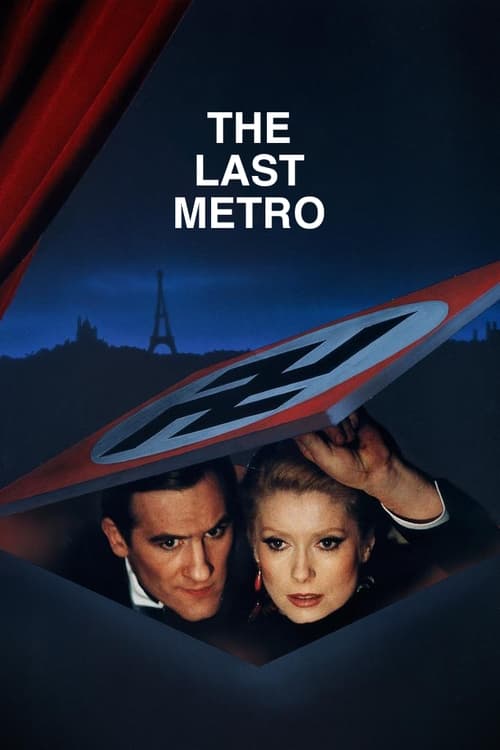
The Last Metro
1980 · François Truffaut
For a night when you want an old-fashioned, absorbing drama with real stakes and real elegance — something suspenseful but humane, that leaves you moved rather than wrung out. Comfort viewing with a spine.
What it's about
In Nazi-occupied Paris, an actress runs a theater alone while hiding a dangerous secret: her Jewish husband, the company's director, hasn't fled the country as everyone believes — he's living in the cellar beneath the stage, listening to rehearsals through a heating duct and directing the play through notes she carries down each night. Into the company comes a charismatic new leading man who has secrets of his own. Backstage, everyone is performing, on stage and off, while collaborationist critics and German patrols circle the building.
The experience
Warm, suspenseful, and quietly romantic — less a war thriller than a story of people keeping a light on in the dark, where tension comes from small things: a knock at the door, a line of gossip, a glance held too long. It builds a lovely double pressure of danger and desire without ever raising its voice.
Performances
Catherine Deneuve is remarkable as a woman who must be composed for everyone — icy in public, tender in secret — and Gérard Depardieu plays against her with rough, restless charm. Heinz Bennent, as the husband directing his own theater from underground, gives the film its aching center.
The craft
Truffaut stages nearly everything inside the theater itself, turning corridors, dressing rooms, and the cellar into a whole world, shot in rich, lamplit color that makes the occupation feel both cozy and claustrophobic. The screenplay is a beautifully engineered machine of overheard lines and double meanings — a play within a film where the wrong word can get someone killed.
Why it matters
One of the biggest French box-office successes of Truffaut's career and a near-sweep at the Césars, it became the defining screen portrait of how French artists lived, compromised, and resisted under the Occupation.
Snapshot
The Last Metro (Le Dernier Métro) is François Truffaut's account of a Parisian theater company operating under the German Occupation, and the most conventionally "well-made" film of his late career. Marion Steiner (Catherine Deneuve) runs the Théâtre Montmartre while her husband Lucas (Heinz Bennent), a Jewish director forbidden to work and presumed to have fled to South America, is in fact living in the theater's cellar, listening to rehearsals through a heating duct and directing the production by proxy through notes passed to his wife. Into this arrangement comes Bernard Granger (Gérard Depardieu), a leading man newly arrived from the Grand Guignol who is also, quietly, working for the Resistance.
The film was Truffaut's largest commercial success in France and swept the second annual César ceremony, taking ten awards including Best Film, Best Director, Best Actor (Depardieu), and Best Actress (Deneuve) — a record haul at the time. It was nominated for the Academy Award for Best Foreign Language Film. Its reputation has always been double-edged: admired as a supremely accomplished piece of classical narrative filmmaking and a moving act of cultural memory, and criticized — particularly by a younger generation of French critics, and later by scholars of Occupation cinema — for aestheticizing a period whose politics it approaches obliquely. Truffaut conceived it as the middle panel of a loose triptych about performance, alongside Day for Night (1973, cinema) and an unrealized project about the music hall.
Industry & production
By 1980 Truffaut occupied an unusual position in French cinema: a founding figure of the New Wave who had become, through Les Films du Carrosse, one of the most stable producer-directors in the country. The Carrosse operation — named for Renoir's Le Carrosse d'or and running since 1957 — gave Truffaut a degree of control rare among his contemporaries, and by the late 1970s his films were reliably financed and reliably distributed. The Last Metro was produced by Les Films du Carrosse with co-financing partners including SEDIF and TF1 Films Production, the television-linked financing arm whose involvement was by then a standard component of French feature budgets.
The project had an unusually long gestation. Truffaut had been accumulating material on the Occupation for years — memoirs, theatrical histories, accounts of collaborationist criticism — and had contemplated a film about the period since at least the mid-1970s. He worked on the screenplay with Suzanne Schiffman, his longtime collaborator and script supervisor turned co-writer, with additional dialogue contributions from Jean-Claude Grumberg, a playwright whose own family history under the Occupation (his father was deported and killed) gave him particular authority on the material. Truffaut's stated ambitions for the film were declared plainly in interviews: to depict the atmosphere of the Occupation as he remembered it from childhood, to give Deneuve a role of genuine authority, and to shoot a film "in a theater."
Casting Deneuve and Depardieu together was, in commercial terms, the film's central asset — two of the largest French stars of the period, neither previously directed by Truffaut in this configuration (Deneuve had made Mississippi Mermaid with him in 1969). The supporting company was assembled with characteristic care: Jean Poiret as the stage director Jean-Loup Cottins, Andréa Ferréol as the designer Arlette, Paulette Dubost as the wardrobe mistress Germaine, Sabine Haudepin as the young actress Nadine, and Jean-Louis Richard — Truffaut's co-writer on The Soft Skin, Fahrenheit 451, and Day for Night — as the collaborationist critic Daxiat.
Production took place largely in Paris in early 1980. The decisive practical choice was to build the theater: rather than shoot in a working playhouse, the production converted a disused space in the 9th arrondissement into the Théâtre Montmartre, allowing the auditorium, backstage corridors, dressing rooms, and cellar to exist as a continuous, controllable geography. This decision shapes almost everything about the film's staging and camerawork.
Commercially, the film was a substantial success in France — Truffaut's biggest — and traveled well internationally, opening in the United States through United Artists Classics. It arrived at a moment when French audiences were unusually receptive to Occupation subjects, a shift traceable to Marcel Ophüls's The Sorrow and the Pity (1969) and Louis Malle's Lacombe, Lucien (1974), both of which had broken the postwar Gaullist consensus that France had been a nation of resisters.
Technology
The Last Metro was shot in 35mm color on Eastman stock, at the standard European widescreen ratio of 1.66:1, with monaural optical sound — a conventional technical package for a mid-budget French feature of 1980, and deliberately so. Truffaut was never a technologically adventurous filmmaker; his interest in apparatus was largely confined to what it permitted dramatically.
The relevant technological facts are therefore ones of period reconstruction rather than innovation. The production's principal challenge was rendering wartime Paris — a city of blackout regulations, curfews, coal shortages, and rationed electricity — in color, without the flatly desaturated palette that had become the default signifier of "the past." Néstor Almendros and Truffaut chose the opposite route: warm, saturated interiors lit as though by scarce and precious light sources. Almendros, whose work with Truffaut and with Éric Rohmer had made him the leading European exponent of naturalistic and available-light-influenced cinematography, had also just completed Days of Heaven (1978) for Terrence Malick, for which he won an Academy Award. His approach here draws on that reputation for source-motivated light while remaining fundamentally a studio-controlled scheme.
The film also makes structural use of a period technology as a plot mechanism: the curfew and the last métro train of the evening, which dictates when performances must end and when characters must be off the streets. The title names an infrastructural constraint, and the film treats the transit schedule as the invisible clock governing every scene.
Technique
Cinematography
Almendros's photography is the film's most consistently praised element. The governing idea is a division of light between two worlds. The theater — stage, auditorium, dressing rooms — is rendered in deep ambers, reds, and golds, light that appears to emanate from footlights, dressing-room bulbs, and practical lamps. The cellar where Lucas hides is darker, cooler, lit as a place of confinement. The exteriors of occupied Paris are grayer and more diffuse, shot in a restrained naturalism that reads as documentary by contrast with the theatrical interiors.
The camera is mobile but unostentatious. Almendros and Truffaut favor sustained takes that follow characters through the theater's connected spaces — from wings to corridor to dressing room — so that the building's architecture is established kinesthetically rather than by establishing shots. Where earlier Truffaut films had used self-conscious devices (iris shots, freeze frames, direct address), The Last Metro almost entirely abandons them. The framing is classical: eye-level, balanced, giving priority to actors' faces.
Deneuve's lighting deserves particular note. Almendros photographs her with a controlled, sculptural key that acknowledges her status as a star of a certain kind — she is lit, at moments, in a manner that recalls the studio glamour photography of the 1940s. This is not incidental; the film is partly about a woman performing a public role, and the cinematography enacts the performance.
Editing
The film was edited by Martine Barraqué, who had worked with Truffaut since the early 1970s and cut most of his late films. The cutting is unemphatic and continuity-driven — a deliberate renunciation of the elliptical, jump-cut-adjacent grammar associated with the New Wave. Scenes are allowed to play; transitions are largely straight cuts and occasional fades.
Two editorial strategies do stand out. The first is the rhythmic alternation between the cellar and the stage, which the film uses to establish Lucas's parasitic-yet-essential relation to the production above him — he hears it, we cut to it, and the geography of the theater is built through juxtaposition. The second is the use of a voice-over narrator (spoken by Truffaut's regular collaborator Michel Lonsdale in the French version) at the opening, delivering compressed historical exposition over documentary-style period images. This device is unusual for Truffaut, and functions to establish the Occupation as a set of hard facts before the drama begins — a way of buying the film license to concentrate on interior life thereafter.
The much-discussed ending, in which an apparent scene of postwar reunion is revealed to be a stage performance, is fundamentally an editing effect: the cut that widens the frame to disclose the theater is the film's single most rhetorical gesture, and it retroactively reframes everything preceding it.
Mise-en-scène / staging
The purpose-built theater is the film's organizing principle. Truffaut treats the Théâtre Montmartre as a vertical section: stage and auditorium at the level of public performance, dressing rooms and corridors as the zone of private negotiation, cellar as the zone of the hidden and forbidden. Characters ascend and descend this axis, and their position in it corresponds to what they are permitted to say.
Within scenes, Truffaut stages for the ensemble. The rehearsal sequences use the full depth of the stage, with actors arranged in overlapping planes and business continuing in the background of dialogue. The film is dense with the texture of theatrical labor — costume fittings, lighting adjustments, prop management, the wardrobe mistress's black-market ham — and this accumulation of process is what gives the Occupation setting its weight. Scarcity is shown through objects rather than stated.
Truffaut also stages the Occupation's public signage with deliberate flatness: antisemitic posters, restriction notices, and German-language directives appear within the frame as environmental fact rather than as emphasized inserts. The approach is consistent with the film's general reluctance to editorialize visually.
Sound
The sound design is conventional monaural, but the film's most distinctive acoustic idea is Lucas's listening. From the cellar he hears the stage through the building's ventilation — a muffled, resonant transmission that Truffaut uses both as plot mechanism (Lucas can direct because he can hear) and as the film's central metaphor for the condition of the hidden person: present, attentive, denied a voice.
Georges Delerue's score is spare by his own standards. Delerue had scored Truffaut since Shoot the Piano Player (1960), and their collaboration is one of the enduring partnerships of postwar French cinema. Here he works largely in strings, in a lyrical register that leans toward melancholy rather than tension, deliberately declining to supply thriller-style suspense cues at moments where a conventional Occupation drama would demand them. Period music — the popular songs and radio broadcasts of the era — supplies much of the historical texture, including the collaborationist radio voice that intrudes into the theater's world.
Performance
The film is built on Deneuve's containment. Marion Steiner is written as a woman who must never be seen to feel anything in public, and Deneuve plays her with a stillness that the film gradually reveals as effort rather than temperament. It is arguably her finest performance for any director outside Buñuel, and it depends on a very small repertoire of expressive gestures deployed at precisely chosen moments.
Depardieu plays against her with physical volatility — Bernard is impulsive, sexually direct, quick to violence — and the contrast is the engine of the film's romantic plot. Heinz Bennent's Lucas is the film's most difficult role, since he must remain a full character while confined to a cellar and denied most of the film's dramatic space; Bennent plays him with an intellectual watchfulness that avoids both martyrdom and self-pity. Among the supporting cast, Jean Poiret's Cottins — a homosexual man navigating the Occupation with practiced social camouflage — and Jean-Louis Richard's Daxiat are the most pointed characterizations. Daxiat, modeled on the milieu of collaborationist theater critics who wrote for the Paris press under the Occupation, is played without caricature, which makes him considerably more disturbing.
Narrative & dramatic mode
The film operates as a chamber drama with a melodramatic substructure, organized around a single sustained secret. Its dramatic mode is fundamentally that of the well-made play — an irony the film is entirely aware of, since it is a film about mounting a well-made play.
Three plots run in parallel: the production of La Disparue, the fictional Norwegian-set play the company is rehearsing; the concealment of Lucas; and the attraction between Marion and Bernard. Truffaut braids them so that each supplies pressure on the others. Bernard's Resistance activity threatens the theater; the theater's survival requires Marion's public composure; her composure is what Bernard finds both maddening and irresistible. The Occupation is not treated as a backdrop but as the mechanism that makes all three plots load-bearing.
The narration is restricted but not strictly so — the film gives us access to the cellar that other characters lack, positioning the viewer as a confidant. This produces the film's characteristic suspense, which is domestic rather than thriller-like: the tension of a dinner conversation that might go wrong, an unannounced visitor, a Gestapo inspection of the building.
The ending's revelation that we have been watching a play is not a twist in the sense of a withheld fact but a modal shift — a declaration that theatrical resolution is available where historical resolution is not. Critics have divided sharply over whether this constitutes an honest acknowledgment of the limits of representation or an elegant evasion of them.
Genre & cycle
The Last Metro belongs to two overlapping cycles. The first is the backstage film — the tradition running from The Golden Coach through Children of Paradise to Truffaut's own Day for Night. From this tradition the film takes its ensemble structure, its interest in professional craft as a moral discipline, and its conviction that performance is a form of survival.
The second is the French Occupation film of the 1970s and early 1980s, a cycle usually described as the mode rétro. Ophüls's The Sorrow and the Pity, Malle's Lacombe, Lucien, and Joseph Losey's Monsieur Klein (1976) had dismantled the resistancialist myth by insisting on French complicity, ambiguity, and opportunism. The Last Metro stands in a complicated relation to this cycle: it acknowledges collaboration, antisemitism, and denunciation as facts of the period, but it locates its protagonists on the side of decency and gives them a theatrical triumph. Some critics have read this as a corrective humanism; others as a retreat from the harder implications of the films that preceded it. It is also, unmistakably, a romantic melodrama, and the tension between melodramatic pleasure and historical gravity is where most serious debate about the film has settled.
Authorship & method
The film is a distillation of Truffaut's late method: the New Wave polemicist who had attacked the French "tradition of quality" in his 1954 essay "Une certaine tendance du cinéma français" arriving, twenty-six years later, at a film of impeccable classical construction. Truffaut had long since made peace with this trajectory, and had said publicly that his early positions were those of a critic rather than a filmmaker. The consistency lies elsewhere: in his fidelity to actors, his interest in enclosed communities of workers, his treatment of art-making as an ethical practice, and his lifelong preoccupation with secrets, letters, and hidden compartments.
The film also draws directly on Truffaut's childhood. Born in 1932, he experienced the Occupation as a boy in Paris, and the film's texture of cold, hunger, curfew, and cinema-and-theater-going as escape is autobiographically sourced. He said in interviews that he wanted to render the period as he had actually experienced it — as daily life rather than as historical spectacle.
Suzanne Schiffman's contribution is central and, historically, under-credited. She had been Truffaut's script supervisor since the early 1960s and became his principal writing partner in the 1970s; her structural sense is evident in the film's tight braiding of plots. Jean-Claude Grumberg's involvement in the dialogue brought the specific idiom of Jewish Parisian experience under the Occupation. Néstor Almendros, Georges Delerue, and Martine Barraqué constitute the technical core, all long-term collaborators. Jean-Pierre Kohut-Svelko designed the production; the period detail is precise without being antiquarian.
Movement / national cinema
Truffaut was the New Wave's most visible figure and, by 1980, its most commercially assimilated. The Last Metro is not a New Wave film in any formal sense — it renounces virtually every stylistic marker of the movement — but it is inconceivable outside the industrial structures the New Wave helped establish: the director-producer with his own company, the auteurist critical apparatus that guaranteed a Truffaut film would be received as authored, and the state and television financing mechanisms that supported mid-budget French auteur production.
Nationally, the film participates in France's extended and painful reckoning with the Occupation — a process the historian Henry Rousso later analyzed as the "Vichy syndrome," charting the movement from postwar repression of memory to the obsessive return of the 1970s. That The Last Metro was the year's great popular success indicates how thoroughly the subject had entered mainstream French culture by 1980.
Era / period
The film sits at the close of the New Wave generation's most productive stretch and at the start of a decade in which French cinema would tilt toward the polished visual style of the cinéma du look. Truffaut made only two more features — The Woman Next Door (1981) and Confidentially Yours (1983) — before his death from a brain tumor in October 1984 at the age of fifty-two. The Last Metro is consequently read as a late-career summation, though it was not intended as one.
Its historical setting — Paris, 1942, the second full year of the Occupation, the period of the yellow star and the Vél' d'Hiv roundup — is chosen with some care. The film registers the deportations at the edge of its frame rather than at its center, a choice that has drawn both defense and criticism.
Themes
Concealment as a mode of life. Nearly every principal character maintains a hidden identity: Lucas in the cellar, Bernard in the Resistance, Cottins in his sexuality, Arlette in hers, Marion in her feelings. The theater — a building devoted to organized pretense — becomes the natural habitat for a society in which honesty is dangerous.
Work as resistance. The film's ethical proposition is that keeping the theater open, paying the company, and mounting a good production constitute a form of refusal. This is a deliberately modest claim, and Truffaut makes no attempt to equate it with armed resistance; Bernard's contempt for the theater's insularity is given real weight.
The ambiguity of performance. La Disparue is performed for an audience that includes collaborators and occupiers. The film refuses to resolve whether art made under such conditions is compromised, subversive, or simply continuous. Daxiat's power as a critic — he can close a theater with a review — makes criticism itself a political instrument, a point with obvious autobiographical resonance for a former critic.
Female authority. Marion's assumption of her husband's professional role is treated as both burden and revelation. The film is unusually attentive to the mechanics of a woman exercising power in a world that grants her none by right.
The triangle. Truffaut's recurring structure — two men and a woman, from Jules and Jim onward — recurs here in a form that ends not in destruction but in accommodation, the film's most contested resolution.
Reception, canon & influence
Critical reception in France in 1980 was strong but not unanimous. The film's popular success and César dominance confirmed Truffaut's institutional standing, while a segment of the French critical community — including writers at Cahiers du cinéma, the journal Truffaut had helped make famous — treated it as evidence of his absorption into the mainstream cinema he had once attacked. Anglophone reviews were largely admiring, praising Almendros's photography, Deneuve's performance, and the film's evocation of period atmosphere. The Academy Award nomination for Best Foreign Language Film reflected its international standing.
Scholarly reassessment has focused on the film's handling of Jewishness and the Holocaust. Critics working in Holocaust studies and French cultural history have argued that the film relegates Lucas's Jewishness — and the deportations occurring in the world outside the theater — to a structuring absence, and that its theatrical resolution offers a consolation the history does not support. Defenders counter that the film's restraint is a considered position about the limits of what fiction can represent, and that the cellar is precisely a figure for what the film declines to dramatize directly. Both readings are well-established in the literature; the debate has not settled.
Backward influences are legible. Marcel Carné and Jacques Prévert's Children of Paradise (1945) — itself shot during the Occupation — is the essential precursor for the theater-as-world conceit, and Truffaut acknowledged the tradition of poetic realism. Jean Renoir, Truffaut's declared master, informs the film's ensemble sympathy and its refusal to condemn. Alfred Hitchcock, the subject of Truffaut's famous 1966 book-length interview, informs the mechanics of suspense-through-withheld-knowledge, though deployed here in a domestic register. Ernst Lubitsch's To Be or Not to Be (1942) is the obvious comparison — a theater company under Nazi occupation — and the difference between Lubitsch's farce and Truffaut's melodrama is instructive about what four decades had changed. Truffaut's own Day for Night is the immediate self-precedent.
Forward, the film's legacy is less a matter of direct stylistic imitation than of demonstrating a viable mode: the historically-set ensemble drama that treats a professional community as a microcosm of a political situation. Its French César sweep and international success helped confirm the commercial viability of prestige period production in 1980s French cinema. Its most enduring specific contribution may be to the careers it consolidated — Deneuve's shift into roles of mature authority, and Depardieu's confirmation as the dominant French male star of the decade — and to the ongoing debate, still active in film studies, about how popular cinema should represent the Occupation. It remains widely available in restored form and is a fixture of Truffaut retrospectives, where it is typically programd as the major achievement of his final period.
A Deleuzian reading
A man in a cellar holds his ear to a heating duct.
The full Deleuzian reading of The Last Metro →
Reception
It was the biggest commercial hit of Truffaut's career — a phenomenon in France that swept the 1981 Césars and got an Oscar nomination — but its very polish became the knock: a strand of critics has always found it too tasteful for late Truffaut. Today it sits comfortably as his beloved late-period peak, even if cinephiles rank it below the '60s work.
How The Last Metro was received, from release to now →
How to watch The Last Metro: what to notice on a first viewing
- Watch the color of the light change as people go downstairs. Almendros gives the stage and dressing rooms deep amber and gold, as if from footlights and bulbs. The cellar is cool and dark. Paris outside is gray and diffuse. You always know which level of the building you are on. The light tells you who is allowed to be seen there.
- Track whether a character is going up stairs or down. Truffaut built the theater as one continuous set: stage and auditorium above, dressing rooms and corridors between, cellar below. Where someone stands decides what they are permitted to say. The building is the film's map of secrecy. Height means visibility, and visibility is the dangerous thing here.
- Listen to the stage the way Lucas hears it. From the cellar he takes in rehearsals through the heating duct, muffled and resonant. He hears everything and sees nothing, then sends notes up the stairs with his wife. The duct holds the whole arrangement in one object. In this building everything can travel except the person.
- Count how few expressions Deneuve uses in public scenes. Marion must never be seen to feel anything. Deneuve works from a very small set of gestures, and Almendros lights her with the sculptural key of 1940s studio glamour. The stillness is effort, not temperament. Her composure is the cover story keeping her husband alive.
- Track what time the performances have to finish. Curfew and the last train decide when the show stops and when everyone must be off the street. Truffaut treats the transit timetable as the clock running over every scene. The occupiers barely appear. They run the schedule instead, which is how the pressure gets into ordinary conversations.
The whole guide to watching The Last Metro, with the keys for a rewatch →
Influences: the films it descends from and the films it influenced
- Children of Paradise (1945) — Builds the entire film out of the Funambules' vertical theater geography — stage, wings, dressing rooms, stage-door alley — so that private drama is always blocked against a working playhouse, the map Truffaut rebuilds at the Théâtre Montmartre (and, shot clandestinely under the Occupation with Trauner and Kosma hidden from credits, the literal precedent for the man in the cellar).
- To Be or Not to Be (1942) — Establishes the troupe-under-occupation plot engine in which costume, cue and impersonation are used operationally against the Nazi apparatus; Truffaut retools Lubitsch's farce timing into restricted-narration melodrama, keeping the mechanism and dropping the joke.
- The Rules of the Game (1939) — Distributes sympathy across a stratified household via braided parallel plots that cut between masters and servants in a shared upstairs/downstairs geography, and refuses to nominate a villain — the ensemble ethic Truffaut transfers wholesale to the theater company.
- The Golden Coach (1953) — Frames the actress torn among suitors inside a proscenium-and-curtain device so that the emotional resolution can only be delivered on stage — the same structural move as Truffaut's closing curtain call, where the reveal is staged rather than narrated.
- All About Eve (1950) — Opens with a voice-over prologue that inventories a theatrical company before the drama starts, then runs its well-made-play dialogue out of dressing rooms treated as the real seat of power — both devices Truffaut adopts intact.
- Notorious (1946) — Generates suspense purely from asymmetric knowledge — a woman performing a public role while the secret is held literally in a cellar — with high-gloss star lighting sculpting the female lead; the withheld-information mechanics Truffaut cataloged in his 1966 interview book and redeploys in a domestic register.
- Le Silence de la mer (1949) — Stages the Occupation as a chamber piece of withheld speech in a single interior, with literary voice-over narration carrying what the images decline to dramatize — the restraint-as-position that Truffaut's cellar extends.
- Days of Heaven (1978) — Almendros's source-motivated lighting doctrine in its purest statement — practicals, windows and firelight as the only justified sources, minimal fill — the exact method he carries into the gaslit stage, the dressing-room mirror bulbs and the single-bulb cellar.
- Day for Night (1973) — Truffaut's own template: a closed professional company filmed so that craft labor — rehearsal, blocking, technicians, the cut-and-continuity of the work itself — gets equal screen time with the romance, and Delerue's score treats the ensemble rather than the couple as the subject.
- Lacombe, Lucien (1974) — The mode rétro turn: collaborators played straight, in desaturated source-lit period texture, with no moral spotlight to mark them — the register in which Truffaut draws the collaborationist critic Daxiat.
- The Sorrow and the Pity (1969) — Dismantled the resistancialist myth by making everyday accommodation the subject, supplying the documentary substrate — collaborationist press, denunciation, cold and queues — that Truffaut converts into ambient production texture rather than plot.
- Au revoir les enfants (1987) — Extends Truffaut's Occupation restraint: a hidden Jewish presence inside an enclosed institution, deportation kept offscreen, and narration restricted to a witness who cannot see the whole — the arrest registered as a look, not a scene.
- Cyrano de Bergerac (1990) — The Depardieu-fronted prestige period production whose commercial viability The Last Metro proved, opening by reconstructing a working Hôtel de Bourgogne with the same stage/pit/gallery vertical geography and source-lit candle rigging.
- Black Book (2006) — A glamour-lit performer running a double game inside an occupied city, with suspense keyed entirely to which member of the company knows what — Truffaut's restricted narration and star-lighting scheme pushed into thriller tempo.
- Inglourious Basterds (2009) — Turns the performance venue into an Occupation trap and builds its centerpiece in a cellar on pure withheld-knowledge mechanics — accent, gesture and overheard detail as the leak — before letting the theater itself deliver the final reveal.
- Indochine (1992) — Precedent for Deneuve as emblem of French national cinema anchoring a period drama — the star-as-organizing-principle of a historical narrative.
- The Woman Next Door (1981) — Same late-Truffaut apparatus a year on: a third-party narrator's voice-over prologue and epilogue bracketing a contained passion, Delerue scoring the withholding, and information rationed so the audience knows only what the observers do.
- Confidentially Yours (1983) — Runs the Hitchcock machinery again in domestic scale — a man hidden in the office while a woman conducts the investigation, glamour-lit in monochrome, resolving on a withheld-identity reveal.
- Mephisto (1981) — Arrives at the identical braid in the same season: onstage performance intercut with backstage accommodation to Nazi patronage, using the actor's craft — makeup, curtain calls, a career built in rehearsal — as the measure of political compromise.
Similar films
- Day for Night (1973) — influence & lineage
- Au Revoir les Enfants (1987) — influence & lineage
- Children of Paradise (1945) — influence & lineage
- Cyrano de Bergerac (1990) — influence & lineage
- Stolen Kisses (1968) — shared sensibility
- Story of Women (1988) — shared sensibility
- Army of Shadows (1969) — shared sensibility
- Elevator to the Gallows (1958) — shared sensibility