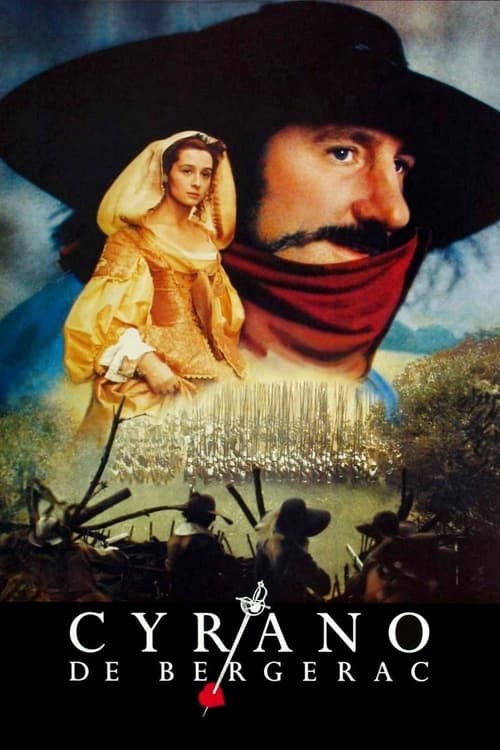
Cyrano de Bergerac
1990 · Jean-Paul Rappeneau
For when you want grand, old-fashioned romance with real ache underneath — a film to sweep you up on a night you're happy to be moved. Comfort viewing with a lump in the throat.
What it's about
In 17th-century Paris, Cyrano de Bergerac is the most feared swordsman and quickest wit in France — and hopelessly in love with his cousin Roxane, a love he won't confess because of his enormous nose. When Roxane falls for Christian, a handsome cadet with no gift for words, Cyrano strikes a heartbreaking bargain: he'll pour his own soul into love letters signed with Christian's name.
The experience
Swashbuckling and swooning in equal measure — duels, banquets, and battlefields delivered at full gallop, all in rhymed verse that somehow feels alive rather than stiff. It's rousing for two hours and then quietly shattering.
Performances
Gérard Depardieu gives one of the great screen performances — a Cyrano of volcanic bravado and hidden tenderness who makes centuries-old verse sound like the way this man simply talks.
The craft
Rappeneau mounts the play as lavish spectacle — crowded theaters, massed battle scenes, candlelit interiors — while keeping Rostand's rhymed alexandrines intact, a gamble on language that pays off completely. The costume and production design are sumptuous enough to justify the biggest screen you can find.
Why it matters
A massive success that swept the Césars and carried Depardieu to international stardom, it remains the benchmark screen version of one of theater's most beloved plays.
Snapshot
Jean-Paul Rappeneau's Cyrano de Bergerac is the definitive screen adaptation of Edmond Rostand's 1897 verse play, mounted as a lavish costume spectacle that never abandons the theatrical DNA of its source. Its central and most audacious decision is fidelity to language: the film is performed almost entirely in Rostand's rhymed alexandrines, adapted by Rappeneau and Jean-Claude Carrière, with Gérard Depardieu as the swordsman-poet whose eloquence is boundless and whose confidence, undone by his oversized nose, is not. The film pairs the intimacy of a chamber romance — Cyrano ghost-writing love to his cousin Roxane on behalf of the handsome, tongue-tied Christian — with the scale of massed battle scenes, crowded theaters, and Baroque interiors. Released to enormous acclaim in France, it swept that year's Césars, won Depardieu the Best Actor prize at Cannes, and secured an Academy Award for its costumes alongside a Best Foreign Language Film nomination. It stands as the flagship of the French "cinéma de qualité" revival of the late 1980s and early 1990s, and as one of the era's most successful arguments that classical theatrical material could be reanimated, rather than embalmed, on film.
Industry & production
The film emerged from a period in which French cinema, buoyed by state support and a renewed appetite for prestige heritage productions, mounted large-budget adaptations of national literary landmarks. Cyrano was among the most expensive French films of its moment, and its production values — thousands of costumes, extensive set construction, large crowds, and staged combat — were foregrounded as a selling point rather than concealed. Rappeneau, a meticulous and comparatively infrequent director, spent years developing the project; the adaptation of a canonical verse play into a shootable screenplay that preserved the poetry was itself a substantial undertaking, entrusted to Carrière, one of the most distinguished screenwriters in European cinema.
Casting Depardieu — by 1990 the preeminent male star of French film and a bankable international name — was decisive both artistically and commercially. His participation anchored the financing and the marketing, and his physical presence suited a role that demands equal fluency in verse-speaking and swordplay. The film was a major commercial success in France and traveled widely abroad, aided in the English-speaking world by a celebrated rhyming subtitle translation from the novelist Anthony Burgess, whose verse rendering allowed non-French audiences to experience the play as poetry rather than as flattened prose glosses. That translation is itself a notable production fact: it framed the film's international release as a literary as well as a cinematic event.
Technology
Cyrano was produced on 35mm film using the conventional prestige-production toolkit of its era: large-format lighting for cavernous interiors, extensive practical sets and costumes, and staged pyrotechnics and crowd choreography for the siege sequences. There is no significant digital or optical-effects innovation to claim here; the film's ambitions are those of classical, resource-intensive filmmaking rather than technological experiment. Its "technology," in the meaningful sense, is craft infrastructure — the costume ateliers, set-building, and armies of extras that a period spectacle requires — rather than any novel apparatus. The detailed record of specific camera and lens packages is thin in general circulation, and I will not invent particulars; what can be said with confidence is that the film belongs to a tradition of analog, artisanal spectacle in which the visible expense is the point.
Technique
Cinematography
The photography, by Pierre Lhomme — a veteran whose credits include Jean-Pierre Melville's L'Armée des ombres — is central to the film's success. Lhomme's images balance two registers: the burnished, candle-and-torchlit intimacy of interior scenes, where faces emerge from shadow in a manner indebted to Baroque painting, and the cooler, more expansive handling of exteriors and battle. The camera is notably mobile, gliding through the crowded opening theater sequence and tracking the physical bravura of the duels, so that the verse never feels statically "recited" but is spoken in motion. Lhomme's control of color and light lends the film a painterly density that keeps the eye engaged during long passages of dialogue, an essential counterweight to a script built almost entirely from a nineteenth-century verse play.
Editing
Noëlle Boisson's editing manages the film's most difficult formal problem: sustaining momentum across extended verse exchanges without either rushing the poetry or letting scenes go slack. The cutting keeps pace with Depardieu's rapid, muscular delivery — famously in the "nose tirade," where Cyrano improvises a cascade of insults against himself — and coordinates the swordplay so that action and speech remain legible together. In the battle and crowd sequences the editing marshals large-scale coverage into coherent geography. The overall rhythm favors continuity and momentum over showy montage, appropriate to a film whose energy comes from performance and language.
Mise-en-scène / staging
The staging negotiates between theater and cinema with unusual self-awareness — fitting, since the film literally opens in a playhouse. Rappeneau exploits deep, layered compositions: foreground action, middle-ground crowds, and detailed backgrounds that establish period density. The famous balcony scene, in which Cyrano lends Christian his words in the darkness beneath Roxane's window, is staged to exploit shadow and vertical separation, dramatizing the gap between the beautiful surface (Christian) and the hidden voice (Cyrano). Interiors are dressed with Baroque richness; exteriors and the military encampment supply grit and scale. The production and costume design are not mere backdrop but active dramatic instruments, marking rank, faction, and the shift from Parisian wit to wartime privation.
Sound
Because the film is fundamentally an act of spoken poetry, the treatment of the voice is paramount: dialogue is recorded and mixed to keep Rostand's meter and rhyme crisply intelligible, even amid battle and crowd noise. Jean-Claude Petit's orchestral score supplies sweep and emotional underlining without overwhelming the verse, swelling in the romantic and tragic passages and driving the action set-pieces. The sound design of the siege — steel, gunfire, massed voices — provides the sensory contrast against which the film's more intimate, whispered scenes register.
Performance
Depardieu's Cyrano is the film's engine and its justification. He fuses physical bulk and swordsman's agility with a verbal virtuosity that makes the alexandrines sound spontaneous rather than declaimed; crucially, he plays the character's wit as armor over wound, so that the bravado and the heartbreak are legible at once. The performance earned him the Best Actor award at Cannes and is widely regarded as one of his finest. Anne Brochet's Roxane grows from précieuse coquetry toward genuine grief, and Vincent Perez gives Christian the necessary beauty and vulnerability — a man aware that he is loved for words not his own. The ensemble sustains the verse convention collectively, which is what allows the stylization to feel like a lived world rather than a recital.
Narrative & dramatic mode
The dramatic mode is neo-Romantic tragicomedy, structured around a single, exquisitely cruel irony: the man with the words cannot use his own face, and the man with the face cannot find the words, so they combine into one impossible lover. The film preserves Rostand's five-act architecture — the theater, the balcony courtship, the battlefield at Arras, and the elegiac final act years later — moving from sparkling comedy of manners toward war tragedy and, finally, deathbed pathos. Its governing value is panache: grace and courage in the face of futility, the willingness to be magnificent even when it changes nothing. The narrative withholds its emotional resolution almost sadistically, allowing Roxane to learn the truth only at the very end, so that the whole film functions as one long, unspoken confession. The verse form is not decoration but dramatic content: language is simultaneously the hero's gift, his disguise, and his prison.
Genre & cycle
The film sits at the intersection of the costume/period drama, the swashbuckler, and the literary romance, and it participates in the late-1980s/1990s French heritage cycle that produced prestige adaptations of national literature and history (the Pagnol adaptations, Zola's Germinal, and the broader vogue for large-scale period productions). Within that cycle Cyrano is distinguished by its refusal to modernize its source's language — most heritage films translate their literary origins into naturalistic screen dialogue, whereas Rappeneau doubles down on the theatrical verse. It thus belongs simultaneously to the tradition of the filmed classic play and to the muscular, action-inflected costume spectacle, a hybrid that helped make a nineteenth-century verse drama commercially viable for a mass 1990 audience.
Authorship & method
The film is an auteur project in the specific sense that Rappeneau — known for elegant, tightly controlled, often infrequent productions — shaped it over a long gestation and directed with evident precision. But its authorship is genuinely collaborative and worth naming as such. The screenplay adaptation was co-written with Jean-Claude Carrière, the celebrated screenwriter of Luis Buñuel's late films and one of European cinema's great adapters, whose skill at compressing and shaping literary material without betraying it was essential to making Rostand filmable. Cinematographer Pierre Lhomme supplied the painterly image; composer Jean-Claude Petit the romantic-symphonic score; editor Noëlle Boisson the momentum; and costume designer Franca Squarciapino the Oscar-winning wardrobe that does so much narrative work. The method throughout is one of disciplined fidelity — preserve the verse, honor the structure — married to cinematic amplification, opening the play out into mobile camerawork, real scale, and physical action that the stage cannot provide.
Movement / national cinema
Cyrano is a landmark of French national cinema at a confident, well-financed moment, and it functions almost as a statement of cultural patrimony: a canonical French play, in French verse, mounted with national resources and fronted by the era's definitive French star. It is not part of an avant-garde movement; rather, it belongs to the mainstream prestige tradition sometimes retrospectively linked to the "cinéma de qualité" — the polished, literary, craft-driven cinema against which the New Wave once rebelled, here revived in a modern, dynamic register. Its international reception reinforced a particular image of French cinema abroad: literate, lavish, and rooted in theatrical and literary heritage.
Era / period
The film depicts seventeenth-century France, moving from the salon-and-theater world of 1640 Paris to the Siege of Arras and its aftermath, drawing on the historical figure of the real Cyrano de Bergerac (1619–1655), the writer and duelist whom Rostand fictionalized. But its sensibility is doubly historical: it renders the Baroque past through the lens of Rostand's own moment, 1897, when the play arrived as a deliberately backward-looking, neo-Romantic riposte to the naturalism then dominant on the French stage. The 1990 film is therefore a period piece nested inside a period piece — a fin-de-siècle Romantic vision of the seventeenth century, re-presented for a late-twentieth-century audience.
Themes
The film's abiding themes are the gap between inner worth and outer appearance; the power and the treachery of language; unrequited and self-sacrificing love; and the ethic of panache — dignity and defiance maintained without reward. Cyrano's tragedy is that his greatest gift, eloquence, becomes the instrument of his own effacement: he wins Roxane's heart while ensuring she loves someone else. The story interrogates authenticity — who is the "real" lover, the face or the voice? — and pride, since it is Cyrano's own vanity and self-consciousness, as much as his nose, that seal his silence. Underlying all of it is a Romantic idealization of the beau geste: the conviction that how one bears an unwinnable situation matters more than the outcome, culminating in the play's and film's insistence on panache as the one thing an enemy cannot take away.
Reception, canon & influence
Critically and commercially, the film was a triumph. It was among the most successful French releases of its year, effectively swept the Césars — commonly cited as a haul of around ten, including major categories such as Best Film, Best Director, and Best Actor — and won Depardieu the Best Actor award at the 1990 Cannes Film Festival. Internationally it earned an Academy Award for Franca Squarciapino's costume design and a nomination for Best Foreign Language Film as France's submission; Depardieu himself drew an Oscar nomination for Best Actor, a rare distinction for a performance in French. English-language critics were broadly enthusiastic, and Anthony Burgess's rhyming subtitles became a talking point in their own right, praised for letting the film's poetry survive translation.
Its influences flowing backward are unambiguous: Rostand's 1897 play above all, together with the long theatrical tradition of Cyrano on stage (originating with the actor Coquelin, for whom Rostand wrote it) and the earlier history of adapting the work to screen. The film absorbs the neo-Romantic aesthetic of its source and the visual vocabulary of Baroque painting through Lhomme's lighting.
Flowing forward, its legacy is twofold. As the reigning screen Cyrano, it set a benchmark that later adaptations and reimaginings have had to reckon with, and it reinforced the viability of verse-faithful, large-scale literary adaptation at a moment when many assumed such material was uncinematic. It also cemented Depardieu's international stature and became a touchstone of the French heritage cycle, exemplifying how national literary patrimony could be turned into globally exportable prestige cinema. The Cyrano story itself has continued to prove endlessly adaptable across media, and Rappeneau's film remains the version against which those descendants are measured. Beyond that broad shaping influence, granular claims about specific later filmmakers it directly inspired are not firmly established in the general record, and I will not overstate them.
A Deleuzian reading
He fights in rhyme.
The full Deleuzian reading of Cyrano de Bergerac →
Reception
A triumph on arrival — Cannes Best Actor for Depardieu, a then-record ten Césars, and a rare Oscar acting nomination for a French-language performance — it's since settled in as the crown jewel of France's heritage-cinema boom. Watching it now carries an extra charge: it's widely called peak Depardieu, made poignant and complicated by everything that came after for the actor.
How Cyrano de Bergerac was received, from release to now →
Influences: the films it descends from and the films it influenced
- Cyrano de Bergerac (1950) — The prior sound-era screen adaptation that proved Rostand's verse could sustain a feature, fixing the alternation of swordplay set-pieces with the balcony-serenade staging Rappeneau later reworks.
- Les Enfants du Paradis (1945) — The template of theatrical-romantic French cinema built on stagecraft and heightened literary dialogue, whose panache-driven doomed lover and opened-out theater milieu Rappeneau inherits.
- The Earrings of Madame de... (1953) — Gliding unbroken tracking and crane movement through period ballrooms models Lhomme's mobile camera continually reframing bodies within deep costumed interiors.
- The Adventures of Robin Hood (1938) — The Technicolor swashbuckler grammar — bounding athletic fencing choreographed and shot in spatial continuity — stands behind Cyrano's duel set-pieces.
- Scaramouche (1952) — Its record-length theater-set duel established the extended, spatially legible sword-fight-as-showpiece that Cyrano's ballad-duel ('à la fin de l'envoi, je touche') echoes.
- The Discreet Charm of the Bourgeoisie (1972) — The collaborator debt — Jean-Claude Carrière's method of compressing and re-architecting literary material without betraying its voice, honed across Buñuel's late films — is what makes Rostand filmable.
- Barry Lyndon (1975) — Candlelit, Old-Master-painting lighting deployed as the film's visual argument prefigures the painterly Baroque image Lhomme pursues in his source-lit compositions.
- The Return of Martin Guerre (1982) — Launched Depardieu's earthy period-hero persona and the model of turning French historical-literary material into scaled prestige cinema.
- Jean de Florette (1986) — A co-defining entry of the French heritage cycle — big-budget literary patrimony, period spectacle, Depardieu — that Cyrano exemplifies and exports.
- Manon of the Spring (1986) — The commercial-critical proof that Berri's template — handsome, faithful French literary adaptation anchored by a star turn — had become the national norm.
- The Last Metro (1980) — The Depardieu-fronted prestige period production whose commercial viability The Last Metro proved, opening by reconstructing a working Hôtel de Bourgogne with the same stage/pit/gallery vertical geography and source-lit candle rigging.
- Germinal (1993) — Extends the heritage playbook — Zola adaptation at scale with Depardieu — in Cyrano's commercial wake as exportable national-patrimony prestige.
- La Reine Margot (1994) — Pushes the same French-history costume mode toward visceral hand-held camerawork, a darker heir to Cyrano's opened-out heritage spectacle.
- Le Hussard sur le toit (1995) — Rappeneau's own follow-up applies the identical grammar — mobile camera, epic landscapes, swashbuckling-romance momentum — to Giono's novel.
- Ridicule (1996) — Carries forward the ancien-régime 'language as weapon' conceit — verbal wit and the spoken duel as instruments of social power — into court comedy.
- Vatel (2000) — Seventeenth-century French court spectacle with Depardieu, chasing Cyrano's fusion of Baroque production design and globally marketed national prestige.
- Cyrano (2021) — The most prominent later reimagining, reworking the material as a musical while retaining the balcony voice-substitution device and measuring itself against Rappeneau's benchmark version.
- 20th Century Girl (2022) — The definitive proxy-wooer plot: one party covertly gathers the beloved's secrets to help another court them and falls in love themselves — the 'surveillance-turned-love' mechanism driving 20CG's plot.
- The Count of Monte Cristo (2024) — The founding template of prestige cinéma du patrimoine literary adaptation: reverent compression of a canonical text, symphonic score as emotional scaffolding, and a virtuoso transformation lead (Depardieu) functioning as the film's controlling intelligence — the Niney casting logic in embryo.
- Green Book (2018) — The ghostwritten-letter device Green Book lifts whole — eloquence loaned from the cultured man to the inarticulate one, the letters delivered in voiceover cut against the recipient reading them, so the collaboration on the page dramatizes an intimacy the men never state aloud.
- Kal Ho Naa Ho (2003) — The source structure for a lover who ventriloquises a rival's courtship while suppressing his own claim, and for the reveal-by-document ending in which the beloved recognizes the true author of the words only at the deathbed.
- Dear You (2026) — The proxy-letter device in its purest form: eloquence composed by one body and credited to another, staged so the camera holds on the ghostwriter's face while the letter is read aloud by or to someone else — the shot *Dear You* repeats at its hinge.
- Danton (1983) — Depardieu anchoring a large-scale French-history prestige piece with declamatory, theatrically scaled performance — the same rhetorical bigness he brings to Cyrano's tirades.
- Roxanne (1987) — A near-contemporary Cyrano reimagining that isolates the ghostwritten-wooing / appearance-vs-inner-worth device as modern-dress counterpoint to Rappeneau's verse-faithful staging.
- Indochine (1992) — Contemporaneous French heritage blockbuster marshaling opulent period mise-en-scène and a marquee star as prestige export in the same commercial mold.
Similar films
- Children of Paradise (1945) — influence & lineage
- Jean de Florette (1986) — influence & lineage
- The Earrings of Madame de... (1953) — influence & lineage
- Henry V (1989) — shared sensibility
- Grand Illusion (1937) — shared sensibility
- The Last Metro (1980) — shared sensibility
- The Count of Monte Cristo (2024) — shared sensibility
- Indochine (1992) — shared sensibility