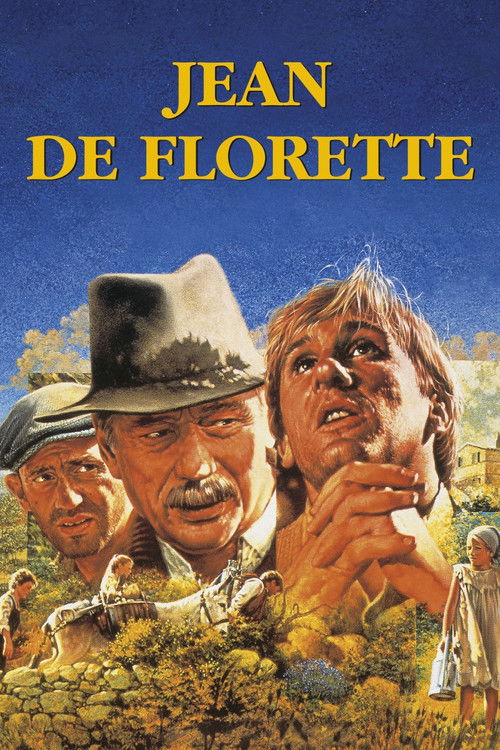
Jean de Florette
1986 · Claude Berri
For when you want a big, novelistic drama to sink into — beautiful landscapes wrapped around a story of greed that leaves a real bruise. Pair it with its companion film for one of cinema's great two-part sagas.
What it's about
In 1920s Provence, an old village patriarch and his eager nephew covet the spring hidden on a neighboring farm — they need the water for their flower-growing ambitions. When the land is inherited instead by Jean, an idealistic hunchbacked outsider from the city who arrives with his family and big plans, the two men secretly block the spring and settle in to watch him break himself against the dry land, one hot summer at a time.
The experience
Sun-drenched and gorgeous on the surface, quietly merciless underneath — the film moves with the slow patience of the seasons while an act of cruelty unfolds in plain sight. You watch hope and hard work collide with hidden malice, and the tension is agonizing precisely because it's so unhurried.
Performances
Yves Montand is chillingly genial as the scheming patriarch, Daniel Auteuil finds a queasy pathos in the nephew torn between conscience and greed, and Gérard Depardieu gives Jean a heartbreaking, full-bodied optimism that makes every setback hurt.
The craft
Claude Berri mounts Marcel Pagnol's novel with lavish care — golden hillsides, dust, and heat photographed so vividly you can feel the drought, and a plaintive score that shadows the beauty with foreboding. It's classical, patient filmmaking that rewards a big screen and a free evening.
Why it matters
A landmark of 1980s French heritage cinema and an enormous international success, it revived the prestige literary epic and, with its companion piece Manon des Sources, became a gateway film for a generation discovering French cinema.
Snapshot
Jean de Florette is the first half of Claude Berri's two-film adaptation of Marcel Pagnol's novel L'Eau des collines ("The Water of the Hills"), released in 1986 and paired with its continuation, Manon des Sources, shot in the same production. Set in a Provençal village in the 1920s, it stages a slow, patient act of rural cruelty: an aging patriarch, César "Le Papet" Soubeyran (Yves Montand), and his nephew Ugolin (Daniel Auteuil) covet a neighboring farm's hidden spring, and when the property passes to an idealistic hunchbacked outsider, Jean Cadoret (Gérard Depardieu), they secretly block the source and watch him ruin himself trying to coax crops from parched land. The film is a landmark of 1980s French "heritage cinema" — lavishly mounted, literary, and pictorially seductive — and it became one of the most widely seen and exported French films of its decade. Its power lies in the collision between its sun-drenched pastoral surface and the patient malice of its story, a tragedy whose full irony is only sprung in the companion film.
Industry & production
Berri conceived the project as a large-scale prestige undertaking, and it was among the most expensive French productions of its time — a deliberate wager that French cinema could mount literary spectacle on a scale usually associated with international costume drama. Berri produced through his own companies, assembling a coalition of French financing typical of the mid-1980s, an era when state support and television co-investment underwrote ambitious "cultural patrimony" filmmaking. The two films were shot together as a single extended campaign in Provence, a logistically demanding approach dictated by the story's dependence on seasons, drought, and the maturing of crops; sources generally describe a lengthy location shoot, and the material need to show land parching under summer heat made the natural environment itself a production constraint rather than a backdrop. The decision to cast three major or rising stars — the internationally established Depardieu, the veteran Montand, and Auteuil, until then known largely for lighter comic roles — signaled the project's ambitions. Its commercial success at home and abroad, particularly in the United Kingdom and other European markets, helped confirm a viable model for exportable French prestige cinema; I would caution against citing precise box-office figures here, as the widely repeated numbers vary, but the film's status as a major popular success is not in dispute.
Technology
The film was made on 35mm color stock with extensive location shooting in the hills of Provence, and its technical program is essentially in service of landscape and light. The central technological and logistical challenge was continuity across a story that moves through seasons and, crucially, through a worsening drought: the production had to render a green, hopeful spring and a scorched, killing summer within the same fictional terrain. Much of the film's texture comes from natural light and real weather on real ground rather than from optical or studio artifice, which was in keeping with its realist-pastoral aims. I do not want to overstate specifics of format, lenses, or laboratory process that I cannot verify; what is clear is that the film belongs to a tradition of handsome, film-based landscape photography, and that its "technology" is less about innovation than about the disciplined marshalling of light, place, and time.
Technique
Cinematography
The photography, by Bruno Nuytten — one of France's most respected cinematographers of the period, and himself later a director (Camille Claudel) — is the film's most celebrated formal element. Nuytten treats the Provençal countryside as both paradise and trap: golden, wide, and abundant in the rains, then bleached and cruel as the water fails. The camera favours the grandeur of the terrain, giving the land a presence that dwarfs the human schemers, so that the beauty of the images works in ironic counterpoint to the ugliness of the plot. Light does much of the moral work: the same sun that makes the hills glorious is the agent of Jean's destruction. This double register — the picturesque and the merciless held in one frame — is the signature of the film's visual style.
Editing
The film's cutting is patient and accretive, matching a narrative built on repetition and waiting: the recurring labor of hauling water, the cycle of hope and failure, the watchers observing the watched. Rather than driving events, the editing lets duration accumulate, so that the audience feels the grinding attrition of Jean's effort and the Soubeyrans' unhurried patience. Editing on the paired films is generally credited to collaborators including Arlette Langmann, Hervé de Luze, and Noëlle Boisson; I would treat exact per-film credit divisions cautiously, but the sensibility is consistent — measured, classical, and unshowy, trusting the material and the performances.
Mise-en-scène / staging
Berri's staging is rooted in the physical reality of peasant labor and property: wells, cisterns, the blocked spring, the flowering fields, the stony farm. Space is organized around watching and being watched — Ugolin and the Papet perpetually observing Jean from a distance, complicit spectators to a suffering they cause. The village itself is staged as a closed moral organism, its collective silence a form of participation. Objects carry weight: the spring, the rabbits and carnations of Ugolin's scheme, the tools of doomed labor. The result is a mise-en-scène of concrete rural detail that grounds an essentially tragic design in tactile everyday work.
Sound
The soundscape is dominated by the natural world — wind, insects, the absence of water — and by a musical motif that became inseparable from the film. Jean-Claude Petit's score adapts a theme from Verdi's opera La forza del destino ("The Force of Destiny"), most memorably voiced on harmonica, and the choice of source is pointed: destiny, fate, and inexorability are precisely the film's subject. The recurrence of this melody lends the peasant story an operatic, tragic scale, framing the small cruelties of a village feud as something like classical fate.
Performance
The acting is the film's engine. Depardieu plays Jean as an educated, book-guided idealist — a tax collector turned would-be scientific farmer, physically marked by a hunched back, whose optimism and faith in reason make his defeat all the more painful. Montand, in one of the signal roles of his late career, gives the Papet a granitic, patriarchal calm; his evil is undemonstrative, a matter of family pride and inherited entitlement rather than melodramatic villainy. Auteuil's Ugolin is the revelation — twitchy, gap-toothed, servile, torn between greed and a flicker of conscience — a transformation that redirected his career toward serious drama and won him major recognition, including the César for Best Actor associated with the two-film cycle. Together the performances make the moral horror legible without ever tipping into caricature.
Narrative & dramatic mode
The dramatic mode is tragedy in a realist, rural key, structured on dramatic irony: the audience knows from the outset that the spring has been blocked, while Jean does not, so that every scene of his hopeful labor is watched with dread. The narrative withholds its full meaning by design — Jean de Florette is the deliberate first movement of a two-part structure, and the deepest irony (a revelation in Manon des Sources about Jean's parentage that recasts the Papet's cruelty as a catastrophe visited on his own blood) is held back for the sequel. As a stand-alone film it functions as a mounting tragedy of attrition; as half of a diptych it is the setup of a fate that will complete itself in the second film. Its rhythm is patient and cumulative rather than twist-driven, deriving suspense from inevitability.
Genre & cycle
The film sits at the center of the 1980s French heritage film (sometimes cinéma du patrimoine) — prestige literary adaptations, period settings, regional or national landscapes, high production values, and an appeal to cultural memory. It is simultaneously a peasant tragedy and a rural melodrama, drawing on a long tradition of Provençal storytelling associated with Pagnol. Within the cycle it belongs alongside other ambitious mid-to-late-1980s French adaptations and period pieces, and it is frequently discussed in comparison with the British heritage cinema of the same years, sharing the mode's pictorialism and literary pedigree while grounding its nostalgia in a harsher, more elemental vision of the land.
Authorship & method
Berri's method here is that of the faithful, resourceful adapter and impresario rather than the stylistic provocateur: his authorship is visible in the choice to mount Pagnol at grand scale, in the fidelity to the source's tragic architecture, and in the marshalling of first-rank collaborators. The screenplay was written by Berri with Gérard Brach, a distinguished screenwriter (long associated with Roman Polanski and others), and their adaptation compresses and shapes Pagnol's novel for the two-film design. The key collaborators define the film as much as the director: Bruno Nuytten (cinematography) supplies its visual grandeur; Jean-Claude Petit (music) supplies its fatalistic operatic frame via Verdi; the editing team gives it its patient classical rhythm. Above all, the film is authored jointly with Marcel Pagnol, its source and presiding spirit — Berri's project is in large part an act of homage to Pagnol's Provence and to Pagnol's own cinema.
Movement / national cinema
As a work of French national cinema, Jean de Florette represents a self-conscious return to literary "tradition of quality" filmmaking, several decades after the New Wave had defined itself against exactly that mode. Rather than the auteurist experimentation of the 1960s, the 1980s heritage film reclaimed handsome adaptation, star casting, and regional patrimony as sources of both cultural prestige and popular appeal. The film is deeply rooted in a specifically Provençal strand of French culture — the language, landscape, and social world that Pagnol had made emblematic — and it functioned internationally as an ambassador for a certain image of France: rural, sunlit, timeless, and tragic.
Era / period
Produced in the mid-1980s, the film belongs to a moment when French cinema, supported by an active cultural policy and by television co-financing, invested confidently in large-scale prestige productions aimed at both domestic audiences and export. This was the era in which the heritage adaptation flourished, and Jean de Florette's scale and success are inseparable from that environment. The film's own fictional period — rural Provence of the interwar years — is rendered as a vanishing traditional world, and part of its 1980s appeal lay precisely in nostalgia for a pre-modern countryside governed by land, water, and lineage.
Themes
Water is the film's master symbol: in a dry landscape it is life, wealth, and power, and control of the spring is control of another man's fate. Around it cluster the film's central themes — greed and covetousness, patient and unglamorous; land, inheritance, and lineage, embodied in the Papet's obsession with the Soubeyran name and property; the outsider versus the closed community, as the "authentic" city man with his books and modern methods is destroyed by a village that closes ranks in silence; and fate or destiny, underscored by the Verdi theme, which frames human scheming as the machinery of tragic inevitability. Nature is presented as sublime and indifferent — the same sun that makes the hills beautiful kills the crops — and the film sets reason and idealism (Jean's faith in knowledge and effort) against an older, crueller order of blood, cunning, and possession, in which the idealist has no defense.
Reception, canon & influence
Critically and commercially, Jean de Florette was a major success, both in France and internationally, and it became one of the most visible French films of the 1980s abroad. It drew wide acclaim for its cinematography, its score, and above all its performances, and it figured prominently in the awards of its period — most durably in the recognition given to Daniel Auteuil, whose Ugolin (across both films) marked his emergence as a leading dramatic actor, and in significant attention at the British and French awards; I would flag that exact per-category award attributions are easy to garble, and the safest statement is that the two-film cycle was a substantial awards presence rather than to over-specify.
Influences on the film (backward): its deepest debt is to Marcel Pagnol — both to the novel L'Eau des collines and to Pagnol's own filmmaking, including his earlier engagement with this very material (Pagnol's 1952 film of Manon des Sources preceded the novel). Berri's adaptation is consciously a return to Pagnol's Provence and to the storytelling of French regional literary cinema, and behind it lies the broader "tradition of quality" that the heritage film revived.
Legacy (forward): the film helped consolidate the 1980s–1990s French heritage cycle as a commercially and critically viable mode, demonstrating that large-scale literary adaptation could succeed globally; its immediate continuation, Manon des Sources, completed the tragic design and secured the pair's standing as a canonical diptych. Its music and imagery also passed into wider popular culture: the film's blend of Provençal landscape and the Verdi-derived theme became strongly associated, in the United Kingdom especially, with a certain aspirational image of French rural life, and is widely reported to have shaped the visual and musical vocabulary of long-running lager advertising built around "expensive," continental refinement. More lastingly, the film endures as a reference point for how beautifully photographed landscape can be turned against its own beauty — a pastoral surface concealing a patient tragedy — and as one of the defining achievements of Claude Berri's career and of French prestige cinema in the 1980s.
Reception
A colossal hit in 1986 France and an international phenomenon that got a generation of non-French audiences into French cinema — though highbrow critics sniffed at it as glossy 'heritage cinema.' Today it's simply canon: the gateway French film your parents, your film teacher, and Letterboxd all agree on.
How Jean de Florette was received, from release to now →
Influences: the films it descends from and the films it influenced
- Manon des Sources (1952) — Pagnol's own three-hour film of the blocked-spring vendetta is the literal source cinema Berri returns to — his diptych inherits its central plot mechanism (secretly stopping up a hillside water source to ruin an outsider) and its two-movement crime-then-retribution architecture.
- Angèle (1934) — Pagnol's decision to shoot a peasant tragedy on real Provençal hillsides rather than studio sets, letting the arid terrain and regional patois carry the drama, establishes the location-realist grammar Berri and Nuytten scale up.
- La Femme du boulanger (1938) — The template for the closed village as a watching chorus — communal staging where the collective gaze surveils and judges the outsider — feeds directly into Berri's 'watching-and-watched' blocking around Ugolin and the Soubeyrans.
- Toni (1935) — Produced under Pagnol in the Midi, Renoir's on-location naturalism — non-glamorized southern landscape, ambient natural sound, workers embedded in real terrain — is the proto-neorealist root of the film's natural-ambience soundscape and unromanticized peasant labor.
- Gervaise (1956) — A model 'tradition of quality' literary adaptation (Zola) with lavish period reconstruction and undemonstrative naturalist performance — the prestige-adaptation mode the 1980s heritage film revived and that Berri consciously mounts at grand scale.
- The Return of Martin Guerre (1982) — The immediate heritage-film precursor: a closed rural French community, an imposture/secret plot turning on land and inheritance, and the same era's move toward earthy, dialect-inflected peasant realism that Jean de Florette consolidates commercially.
- Tess (1979) — Applies the Tess template almost point for point: anamorphic seasonal landscape, a tragedy turning on land and water rights rather than character flaw, and Bruno Nuytten's dust-and-drought palette tracking the calendar across a two-part structure.
- La Gloire de mon père (1990) — A direct extension of the Pagnol-Provence revival Berri reignited — same sun-struck hills, cicada ambience, and nostalgic regional literary source, riding the commercial appetite Jean de Florette proved existed for Pagnol's Midi.
- Cyrano de Bergerac (1990) — The next large-scale literary-heritage blockbuster with Depardieu, extending Berri's demonstration that a lavish, faithful adaptation of a canonical French text could succeed globally in the prestige-export mode.
- Germinal (1993) — Berri's own scaled-up Zola epic applies the exact method — huge budget, fidelity to a canonical novel's tragic architecture, first-rank collaborators, landscape as social battleground — pioneered in the Pagnol diptych.
- Le Hussard sur le toit (1995) — A Giono Provençal-landscape epic that inherits the heritage-film formula of sweeping regional-literary adaptation photographed across the Midi's hills, extending the 'landscape as tragic terrain' vocabulary Berri established.
- Tous les matins du monde (1991) — Extends the heritage film's fatalistic use of pre-existing 'high' music (period viol works) as an operatic frame of doom, the same device Jean-Claude Petit deploys by threading Verdi's La forza del destino through Berri's film.
- A Good Year (2006) — Inherits the aspirational Provence-as-luxury imagery — sun-drenched vines, stone farmhouse, harmonica-and-strings warmth — that Jean de Florette fixed in Anglophone popular culture (and its lager-advertising afterlife) as the visual shorthand for continental refinement.
- Indochine (1992) — Codifies the French heritage-cinema package — literary source, regional landscape, prestige period craft, large budget, international export — that Indochine scales up.
- Days of Heaven (1978) — Nestor Almendros's magic-hour agrarian photography — beauty of wheat, water, and sky turned ironically against human treachery unfolding beneath it — is the international parallel to Nuytten's 'ironic pastoral,' a gorgeous surface concealing patient tragedy.
- The Tree of Wooden Clogs (1978) — Olmi's patient, accretive rhythm — long observation of agricultural routine and natural light building toward a quiet act of cruelty — shares Jean de Florette's editing philosophy of slow tragic accumulation rather than dramatic acceleration.
- Manon des Sources (1986) — The completing panel of the same shoot and design; it delivers the dramatic-irony payoff seeded in the first film (the audience-known secret of Jean's paternity and the water) and closes the deliberately engineered two-part diptych.
- Un dimanche à la campagne (1984) — A contemporaneous French film built on Impressionist landscape light and unhurried pastoral observation, sharing the mid-'80s prestige impulse to photograph the French countryside as painterly, morally charged space.
- Camille Claudel (1988) — Jean de Florette's cinematographer turned director carries his own landscape-and-natural-light method into his feature, making it the clearest through-line of the specific Nuytten visual signature that grands the film's grandeur.
Similar films
- Manon of the Spring (1986) — influence & lineage
- Cyrano de Bergerac (1990) — influence & lineage
- De Gaulle: Liberté (2026) — shared sensibility
- The Count of Monte Cristo (2024) — shared sensibility
- Children of Paradise (1945) — shared sensibility
- La Promesse (1996) — shared sensibility
- The 400 Blows (1959) — shared sensibility
- Au Revoir les Enfants (1987) — shared sensibility