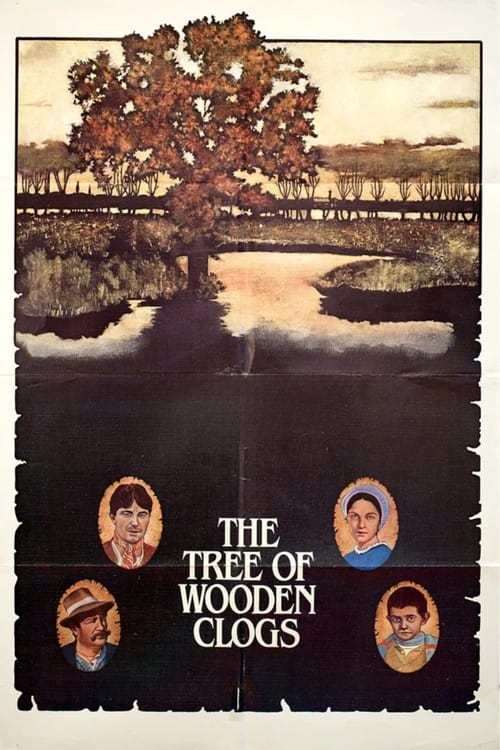
The Tree of Wooden Clogs
1978 · Ermanno Olmi
For a long, unhurried evening when you want to sink into another world completely — a patient, humane film that rewards giving over a whole afternoon or night. Comfort viewing of a serious kind, gentle in tone even when life on screen is hard.
What it's about
Four sharecropping families work a single farmstead in the Lombard countryside at the end of the nineteenth century, handing two-thirds of everything they grow to a landlord they barely see. The film follows a full year of their life — sowing, harvest, a pig slaughter, a courtship, a birth — and one small crisis at its center: a priest persuades a farmer to send his young son to school, a six-kilometre walk away, and when the boy's wooden clog breaks, replacing it means taking a risk the family can't really afford.
The experience
Slow, warm, and quietly absorbing — three hours that move at the speed of seasons rather than scenes, with real farm labor filling the frame. It builds a tenderness for these people so gradually you don't notice how invested you've become, and the smallest events land with surprising weight.
Performances
The entire cast is nonprofessional — actual farming people from the Bergamo region speaking their own dialect — and the result is faces and gestures no trained actor could fake; the film's authenticity rests on them.
The craft
Ermanno Olmi wrote, directed, shot, and edited the film himself, and the unity shows: soft natural light, unforced compositions, and a rhythm built from real work rather than plot beats. The texture of the place — mud, candlelight, animals, weather — is rendered so concretely you can almost smell it, and it rewards a big screen and an uninterrupted sitting.
Why it matters
It won the Palme d'Or at Cannes in 1978 and stands as one of the great films about peasant life, a touchstone for filmmakers working with nonprofessional casts and documentary-level authenticity inside fiction.
Snapshot
L'albero degli zoccoli is a three-hour chronicle of four sharecropping families sharing a single farmstead in the Bergamo countryside around the close of the nineteenth century. It has no protagonist in the conventional sense, no plot engine, and almost no visible antagonist — the landlord who owns the buildings, the land, the animals and two-thirds of everything grown on it appears only in glimpses, insulated in his villa. What the film has instead is a year: sowing, harvest, slaughter, feast day, courtship, birth, death, and the small catastrophe that gives it its title. A boy is sent to school on his priest's advice; he walks six kilometers each way; his clog breaks; his father cuts down a poplar on the padrone's land to carve a new one; the family is evicted.
Olmi wrote, directed, photographed and edited the film himself, cast it entirely with peasants and labourers from the region, and shot it in Bergamasque dialect — subtitled for Italian audiences as if it were a foreign language. It won the Palme d'Or at Cannes in 1978, along with the Ecumenical Jury prize, and it remains the fullest statement of a cinema that treats the ordinary as sufficient subject matter. It also remains a film that the Italian left of its moment found politically intolerable, which is part of its history and should not be smoothed away.
Industry & production
The film exists because of Italian state television. By the mid-1970s RAI had become one of the most consequential patrons of Italian art cinema, financing work that the collapsing commercial sector — squeezed between American imports, genre cycles and falling admissions — would no longer underwrite. The immediate precedent is exact: the Taviani brothers' Padre padrone, another RAI-backed rural film built on dialect and peasant hardship, had taken the Palme d'Or in 1977. Olmi's film took it the following year. Two consecutive Cannes grands prix for films the Italian commercial industry had effectively declined to produce is as clear a picture of the period's economics as one could want.
Television money bought Olmi something specific: length, and the freedom to work slowly with a cast of non-actors. It also imposed a scale of production closer to documentary than to the feature industry — a small crew, real locations, an existing cascina rather than a built set, and a director doubling as his own camera operator and editor. Olmi had come up through exactly this kind of production. He spent the 1950s making industrial and documentary shorts for the film unit of the electrical company Edisonvolta before his first features, and he never fully left that working method behind.
Theatrically, a 186-minute film in an unsubtitled-to-most regional dialect was never a mainstream proposition, and specific Italian grosses are not something the English-language record documents reliably; the Cannes award did the commercial work, opening art-house distribution across Europe and North America. The film's second life came with digital restoration in the 2010s and reissue — in the United States through the Criterion Collection in 2017 — which returned it to circulation for viewers who had known it mostly by reputation.
Technology
The production is a case study in what lightweight equipment and fast film stock made possible by the late 1970s. Olmi shot almost entirely in available light: hearths, oil lamps, the gray diffuse daylight of the Po valley in winter, doorways and small windows as the only sources in the stone interiors. Interiors of that darkness were not practicably shootable without post-war improvements in emulsion speed, and the image pays the price willingly — heavy grain in the lamplit scenes, shallow contrast, colors pulled toward mud, ash and tallow.
The film is widely reported to have originated on 16mm and been enlarged for 35mm theatrical exhibition, which is consistent with its grain structure and its softness; the technical documentation on this point is thinner in English-language sources than one would like, so it is worth stating as the received account rather than a verified specification. What is not in doubt is the aesthetic consequence: the image looks found rather than manufactured, and the restoration wisely preserved that rather than scrubbing it.
The other decisive tool is the zoom lens, used not as a shock device but as a slow instrument of attention — a gradual tightening onto a face or a pair of hands, or a widening that discloses how many other people are in the room. Combined with a camera Olmi could carry and operate himself, this let him work in the manner of a documentarian embedded with a family, adjusting to events rather than blocking them.
Technique
Cinematography
Olmi's own photography favours the plain, frontal, middle-distance view. Figures are given room; the frame is usually wide enough to hold the work being done and the space it is done in. The compositional logic is architectural — doorframes, byre partitions, the long axis of a kitchen — and the camera tends to stay put while people cross through. Critics have reached, almost unanimously and for good reason, for painting: the Le Nain brothers, Millet, Dutch and Flemish genre interiors, the lamplit chiaroscuro associated with Georges de La Tour. The comparison is a description of the film's light and its dignity toward labor rather than a claim about Olmi's direct sources.
Crucially, the camera is never above its subjects. There is no picturesque framing of poverty, no lyrical drift across landscape for its own sake. When the film is beautiful it is because a particular winter morning was beautiful.
Editing
Also Olmi's own work, and the film's most underrated element. The cutting is patient but not inert: it holds a shot until the action inside it is genuinely finished, then moves on without ceremony. The larger structure is braided — the film crosscuts among four households and never signals which strand matters most, so that the tomato-growing of the old man, the widow's fight to keep her children, the miser's lost coin and the boy's schooling all accumulate at the same rate. This is a deliberate flattening of dramatic hierarchy: no thread is a subplot.
Time is organized by agriculture rather than by plot. Ellipses fall between tasks and seasons, so the film's rhythm is cyclical, and the ending's violence lies precisely in its rupture of that cycle — the one event that does not come round again.
Mise-en-scène / staging
The cascina is the film's whole world and is treated as a real, working place: animals present and unruly, tools in use, mud, dung, breath in cold air. Processes are shown at length and correctly — polenta made, a pig killed, a goose plucked, cornhusks stripped by lamplight while stories are told. This procedural completeness is the argument of the film's staging: labor is not background texture, it is the content.
The single most important staging decision is the near-absence of the padrone. Power is off-screen, audible as a piano drifting from the villa, arriving as an accounting of thirds or as an overseer's report. The film thereby stages exploitation as a structure rather than as a villain — which is exactly what its critics on the left objected to, and exactly what makes the eviction land as weather rather than melodrama.
Sound
The soundtrack is dense with the non-musical: hooves, bells, wind, water, wooden soles on stone, the murmured Latin and vernacular of the rosary. Against this, Olmi sets organ works by Johann Sebastian Bach — credited as performed by Fernando Germani — used sparingly and without dramatic underlining. The choice is pointed: liturgical music of enormous formal sophistication laid over the lives of people who own nothing, refusing to score peasant life as folkloric.
The dialogue is Bergamasque, spoken by people for whom it is a first language, and it was subtitled into Italian for domestic release. Italian production practice of the period generally involved post-synchronisation, and the fine detail of how the dialect track was captured and finished is not something the accessible record settles; what matters and is certain is that the voices are the performers' own, with their own idiom intact.
Performance
The entire cast is non-professional, drawn from the Bergamo countryside — among them Luigi Ornaghi as Batistì, Francesca Moriggi as Batistina, Omar Brignoli as the boy Minek, and Teresa Brescianini as the widow Runk. Olmi's method depends on casting people who already possess the physical vocabulary the role requires: they are not performing manual competence, they have it. The result is a register almost without projection — faces that do not perform interiority, gestures that arrive at their own speed. Grief in this film looks like continuing to work.
Narrative & dramatic mode
The mode is chronicle rather than drama. There is exposition without a first act, incident without escalation, and an ending that arrives from the side. Individual strands do have arcs — the widow's struggle to keep her family together, the courtship and marriage of Stefano and Maddalena, the boy's schooling — but Olmi refuses to let any of them organize the whole.
The one excursion beyond the farm is the newlyweds' journey by barge to Milan, where they visit a relative in a convent and return with an infant taken from an orphanage. The city sequence carries the film's only direct political weather: soldiers, a crowd dispersed, men marched away, glimpsed by two people who do not understand what they are seeing and are not invited to. Historically this gestures toward the socialist agitation and state repression of 1890s Lombardy. Olmi keeps it peripheral on purpose — history as something that happens to other people, in another place, while you are getting married.
The title incident is the film's structural key. A tree is cut to make a shoe so a child can attend school; the improvement of one life is charged against property that will always be someone else's; the family is expelled. Cause and consequence are perfectly legible and utterly disproportionate, which is the definition of the system being described.
Genre & cycle
The film sits in the rural chronicle — the peasant film — and is the summit of a small, persistent Italian cycle that runs from Visconti's La terra trema (1948) through the Tavianis' Padre padrone (1977) to Olmi. It belongs equally to a hybrid category the 1970s made room for: ethnographic fiction, the reconstructed past staged with documentary means and local participants.
The instructive contrast is Bertolucci's Novecento (1976), which covers adjacent ground — peasants, landowners, the Italian countryside across the same historical threshold — at operatic scale, with international stars and an explicit Marxist historiography. Olmi's film is the anti-Novecento: the same class relation rendered without epic, without stars, and without a thesis stated aloud.
Authorship & method
Olmi (1931–2018) is the rare cinéaste complet here — writer, director, cinematographer, editor. He was born in Bergamo to a family with peasant roots, and he consistently described the film as issuing from stories told within his own family, his grandmother's among them. That provenance matters to the film's method: it is memory work, reconstructed with the descendants of the people remembered.
The absence of the usual collaborators is itself the authorial signature. There is no composer — Bach substitutes, mediated by an organist's performance — no screenwriter, no director of photography, no editor other than Olmi. What he did delegate, radically, was performance: the cast supply the film's entire behavioral surface.
The film is continuous with the rest of his work. Il posto (1961) and I fidanzati (1963) had already established the observational patience, the non-professional casting and the interest in ordinary economic life; E venne un uomo (1965) and later The Legend of the Holy Drinker (1988) share the Catholic frame. In 1982 Olmi founded Ipotesi Cinema, a workshop for young filmmakers, extending the method into pedagogy.
Movement / national cinema
The film is the great late inheritor of neorealism, and its most direct ancestor is La terra trema: non-professionals playing versions of themselves, an untranslated regional language subtitled for the national audience, an economic system described through one family's ruin. But Olmi departs from neorealism's characteristic mode in two ways. He turns to the past rather than the immediate present, and he substitutes religious patience for political urgency.
That substitution defined its reception in Italy. Critics on the left read the film's Catholicism as quietism — a portrait of exploitation whose implicit answer is endurance, prayer and grace rather than organization and struggle, with the political history of 1898 kept at the edge of the frame. The charge is not baseless, and the film is stronger for being read with it in view rather than around it. Olmi's counter-position was that the dignity and interior life of these people were themselves the political fact, and that a cinema which used them as illustrations of a thesis would be doing them a second violence.
Era / period
Two eras are in play. The depicted one is the Lombard mezzadria at the end of the nineteenth century: sharecropping under a landlord entitled to the greater share, tenancy contingent on his goodwill, and a rural Catholicism that supplied both consolation and social discipline — the priest who urges schooling for the boy also counsels the widow toward surrendering her children. Literacy, migration and socialism are all pressing at the edges of this world; the film catches it just before it breaks.
The era of production is Italy's anni di piombo — political violence, terrorism, economic strain, and a cinema in industrial crisis. The 1970s also saw a genuine Italian intellectual turn toward peasant memory, oral history and popular culture. Olmi's film emerges from that climate: it is an act of recovery aimed at a country that had, within a single generation, become urban and industrial and largely stopped speaking these dialects.
Themes
Labor as dignity and as extraction. The film insists on both simultaneously. Work is shown as competence, knowledge and grace — and as the mechanism by which value flows to a man who is barely on screen.
Faith. Prayer is presented from inside, without irony and without endorsement of its institutional uses. The widow's vigil over her sick cow and the priest's advice to give up her children come from the same church.
Education as hope and as hazard. Schooling is what might release Minek from the cascina; it is also, in the film's brutal arithmetic, what destroys his family.
Property. A single poplar is the film's moral fulcrum. The tree is not scarce, and cutting it is not theft in any sense the family recognizes; it is theft in the only sense that has force.
Community and its limits. The four families share fire, food, stories and labor, and at the end they watch, silently, from behind their shutters as one of them is expelled. Solidarity of daily life turns out not to be solidarity of action — the film's most devastating and least sentimental observation.
Reception, canon & influence
The Palme d'Or in 1978 established the film immediately, and it accumulated significant international honors across the following year. Abroad it was received largely as a masterpiece of humanist observation; in Italy it was also a controversy, with the left's charge of political evasion running alongside the acclaim. Both readings have persisted, and the film has held its canonical position through them, aided in the English-speaking world by its restoration and reissue in the mid-2010s.
Backward. The clearest debts are to Visconti's La terra trema for its dialect, its non-professionals and its structural analysis of a family's ruin; to De Sica and Zavattini for the ethic that everyday life needs no fictional amplification; and, further back, to the verismo of Giovanni Verga, whose peasant fatalism supplies the film's deep literary substrate. Olmi's own documentary apprenticeship is as formative as any of these. Within his filmography, Il posto is the direct methodological ancestor.
Forward. The film is a founding text for the observational, patient, non-professional-cast strand of contemporary art cinema, and its Italian descendants are unmistakable. Michelangelo Frammartino's Le quattro volte (2010) extends its rural attentiveness to the point of near-wordlessness. Alice Rohrwacher is the most-cited heir — The Wonders (2014) and above all Happy as Lazzaro (2018), whose premise of sharecroppers held in unlawful servitude rhymes directly with Olmi's mezzadria, though Rohrwacher braids in a fabulism Olmi never permitted himself. More broadly, the film stands behind a whole international practice: agrarian films built from real labor, real language and non-actors, in which duration is the primary means of respect.
Its most durable legacy may be an ethical one. The Tree of Wooden Clogs demonstrated that a film could depict extreme poverty at length without aestheticizing it, patronizing it, or converting it into argument — and that the resulting portrait would be neither neutral nor comfortable. The debate about whether that is enough has never been settled, which is the surest sign the film is still alive.
A Deleuzian reading
A clog breaks on the road.
The full Deleuzian reading of The Tree of Wooden Clogs →
Reception
It won the Palme d'Or in 1978 and was hailed instantly, though some left-leaning Italian critics grumbled that its peasants were too pious and patient — the anti-1900, basically. The 4K restoration and Criterion release settled the matter: it's now firmly canonized as one of the great humanist epics.
How The Tree of Wooden Clogs was received, from release to now →
How to watch The Tree of Wooden Clogs: what to notice on a first viewing
- Watch a full task done start to finish: butchering, plucking, making polenta. Olmi shows each process at its actual length and correctly, nothing skipped, so labor becomes the film's actual content rather than its background. You are watching real competence, not a montage standing in for it.
- Watch how far back and level the camera stays from the work. Olmi shoots from a plain, frontal, middle distance, giving figures room and never looking down on them from above. The camera never turns poverty into a picturesque view of someone else's hardship.
- Listen for Bach's organ arriving sparingly over scenes of daily labor. Formally sophisticated liturgical music is laid, without underlining, over the lives of people who own nothing. The music refuses to turn these lives into folklore, which is a kind of respect.
- Notice the film crosscut between four households with none singled out. The old man's tomatoes, the widow's struggle, the miser's coin, and the boy's schooling all accumulate at exactly the same rate. Deciding whose story matters most is a choice the film refuses to make for you.
- Watch how little the performers seem to be performing at all. The entire cast is non-professional, people who already possess the physical competence their roles require rather than actors imitating it. Grief in this film looks like continuing to work, not like a performed emotion.
The whole guide to watching The Tree of Wooden Clogs, with the keys for a rewatch →
Influences: the films it descends from and the films it influenced
- La terra trema (1948) — Cast entirely from one village speaking a dialect Italian audiences couldn't follow, it structures a single family's economic ruin as chronicle rather than plot — the exact template Olmi rebuilds in Bergamasque, down to the landlord who governs the story while barely appearing in it.
- Umberto D. (1952) — Zavattini's pedinamento in its purest form — the maid waking, grinding coffee, wetting the floor with her foot, unelided — establishes the principle that a labor procedure filmed at its own length is sufficient narrative, which licenses Olmi's hog-slaughter, tomato-planting and clog-carving sequences.
- Farrebique (1946) — An Aveyron farm family plays itself across four seasons, with bread-baking, plowing and butchery shot as procedure and the film's architecture handed over to the agricultural calendar — the seasonal-cyclical chronicle form Olmi inherits wholesale.
- Il tempo si è fermato (1959) — Grown directly out of Olmi's Edisonvolta industrial documentaries: two non-actors at a snowbound dam, weather and duration substituting for incident, worked out with a crew small enough to shoot in available light — the apprenticeship that made the cascina possible.
- Il posto (1961) — The direct methodological parent — non-professionals directed for behavior rather than performance, the camera holding on queues, corridors and waiting rooms so that an economic initiation is observed rather than dramatized.
- The Naked Island (1960) — A wordless film built entirely from one repeated procedure — hauling water up a terraced island, season after season — proving that labor repetition can serve as a film's syntax, with music rather than dialogue carrying the affect, as Bach does for Olmi.
- The Gospel According to St. Matthew (1964) — Southern peasant non-professionals cast for physiognomy and framed as figures lifted out of Renaissance painting, scored not by a composer but by pre-existing Bach — precisely Olmi's route: Lombard peasant faces composed as Dutch-Flemish genre painting under borrowed organ music.
- Kes (1969) — Barnsley dialect left thick and untranslated, a non-professional local lead, and Chris Menges observing from a long lens in available light so the crew never dictates what happens inside the frame — the same technical means by which Olmi keeps behavior uncoached.
- How Green Was My Valley (1941) — An ensemble chronicle of a peasant labor community across episodic seasons that dignifies ordinary work and shared ritual, secularizing Ford's reverence for communal labor.
- Two Women (1960) — Revives the neorealist ethic Two Women preserved — nonprofessional peasant faces, real locations and dialect, unforced observation of the powerless — for a later generation.
- The New Land (1972) — Olmi shot and edited it himself — the same one-hand total craft — filming peasant material culture with nonprofessionals in natural light at the unhurried tempo of the agricultural year.
- The Flowers of St. Francis (1950) — Uses an entirely non-professional peasant ensemble in humble rural mise-en-scène with painterly natural light, carrying Francis's neorealist depiction of unassuming piety forward.
- Il vento fa il suo giro (2005) — Diritti trained under Olmi at Ipotesi Cinema and applied the method literally: an Occitan Alpine village cast as itself and speaking Occitan, its slow rejection of an incoming shepherd chronicled through cheese-making and seasonal work.
- Le quattro volte (2010) — Extends Olmi's observation to near-wordlessness — charcoal kiln, goat herd, the felling of the ritual fir — in static long takes where off-screen sound and off-screen event carry the drama the camera declines to chase.
- The Wonders (2014) — Hélène Louvart's Super 16 available light on a family's beekeeping labor, with non-professional children and the honey extraction filmed end-to-end as procedure — Olmi's blown-up 16mm texture and labor-as-narrative revived intact.
- Happy as Lazzaro (2018) — Rewrites the mezzadria premise directly — sharecroppers held in unlawful servitude by a landlord who rules from off-screen — using Super 16 blown up, a non-professional lead and communal staging; the fabulist rupture is the one thing Olmi never permitted himself.
- Return to Dust (2022) — Casts a working Gansu farmer (Wu Renlin) as himself and films the mud-brick house being genuinely built, the couple's story braided into one complete agricultural year of sowing, flooding and harvest rather than into a plot.
- Shoplifters (2018) — Olmi's deployment of natural light and dense diegetic sound to build the texture of collective working-class life across an ensemble of non-professionals is the Italian social realist precedent for Kore-eda's multi-generational cast shot in available light with ambient sound layered beneath Hosono's score.
- The Company of Strangers (1990) — Olmi directs actual peasants speaking their own dialect and unhurried rhythms, the non-professional authenticity Scott seeks from her rural-stranded women.
- The Eight Mountains (2022) — Founds the Italian mode of filming peasant labor with documentary patience and a seasonal-cycle structure, agrarian toil observed as the narrative's actual clock.
- La Chimera (2023) — Casts local non-professionals and uses available-light, grainy naturalism to consecrate peasant labor, the earthy ensemble method behind Rohrwacher's tombaroli crew.
- The Quiet Girl (2022) — Grounds the patient agrarian realism — non-professional farm cast, chores filmed in natural light, meaning accreting through observed labor and routine.
- Antonia's Line (1995) — Photographs peasant labor across the turning seasons with non-actor communal ensembles and elliptical time, the pastoral-classicism and rural-chronicle grammar Willy Stassen's lensing echoes.
- Palestine 36 (2025) — Non-professional peasant-village ensemble filmed in the rhythms of agricultural labor and available light — ancestor to Palestine 36's Palestinian ensemble and its livelihood-grounded village texture.
- The Emigrants (1971) — Troell wrote, shot and cut it himself — the same cinéaste complet economy Olmi practices — and renders nineteenth-century peasant subsistence (stone-clearing, sod-cutting, childbirth) in handheld available light held close to the laboring body.
- Barry Lyndon (1975) — Interiors composed after period genre painting and lit by practical sources alone, plus the slow reverse zoom that pulls a scene back into a tableau — Olmi's two signature optical devices, painting-derived light and the distancing zoom, deployed in an opposite register.
- Padre padrone (1977) — The Palme d'Or immediately preceding Olmi's, and its material twin: Sardinian dialect, non-professionals, shepherding labor filmed as procedure, and RAI-financed 16mm blown up to 35mm — the same production route that gave Olmi's film its grain.
- Days of Heaven (1978) — Almendros and Wexler shoot the wheat harvest in magic-hour and available light, the film's structure handed to the agricultural season and its narration to a child observer rather than a protagonist — an American parallel arrived at the same year by different means.
- The Turin Horse (2011) — Subsistence stripped to repeated procedure — the well, the boiled potato, the harnessing — numbered day by day, with duration itself functioning as the ethical instrument that refuses to convert poverty into argument.
- 1900 (1976) — Post-neorealist peasant chronicle acted by real Bergamo farmers and structured by the seasonal agrarian year — the same collective rural rhythm 1900 monumentalizes.
- Jean de Florette (1986) — Olmi's patient, accretive rhythm — long observation of agricultural routine and natural light building toward a quiet act of cruelty — shares Jean de Florette's editing philosophy of slow tragic accumulation rather than dramatic acceleration.
- Manon of the Spring (1986) — Peasant-community naturalism in which the rural collective is the true protagonist and the turning seasons and land dictate the drama, paralleling the community-as-chorus design.
- Kaos (1984) — Contemporary regional peasant realism composed as elegiac, painterly tableau with a wholly non-professional cast — the same neorealist-operatic register and reverence for rural labor and land-and-belonging.
Similar films
- Il Posto (1961) — influence & lineage · same viewing thread
- Umberto D. (1952) — influence & lineage · same viewing thread · often watched together
- The Turin Horse (2011) — influence & lineage
- Happy as Lazzaro (2018) — influence & lineage
- 1900 (1976) — same viewing thread
- Bicycle Thieves (1948) — same viewing thread
- The Conformist (1971) — same viewing thread
- The Emigrants (1971) — influence & lineage · often watched together
All the films related to The Tree of Wooden Clogs →
Watch it with: curated runs of related films
- Neorealism and Its Shadows — Watch these together to see Italy from the ground up — the unemployed, the sharecropped, the compromised — from neorealism's birth to its stylish, sinister heirs.