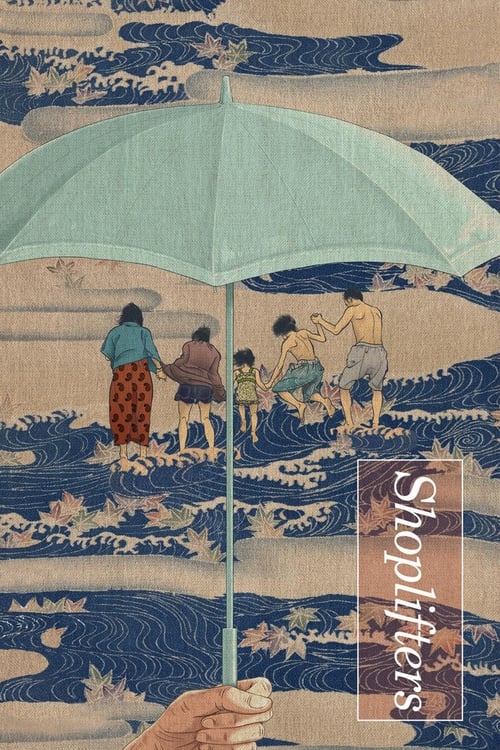
Shoplifters
2018 · Hirokazu Kore-eda
The gentle humanist whose Monster (with a posthumous Sakamoto score and queer-childhood reveal) generated real festival argument; invoked in every conversation about family, ethics, and whether kindness can be an aesthetic.
When you want a film that makes you feel something real about family and belonging — warm company first, a lump in the throat later. Comfort and challenge in one: cozy to sit with, hard to shake.
What it's about
On the margins of Tokyo, six people crammed into a tiny house get by on odd jobs, a grandmother's pension, and shoplifting — a family bound by need and affection rather than blood. When the father figure, Osamu, brings home a small girl who seems neglected by her real parents, they fold her into the household. The warmer things get, the more fragile the whole arrangement becomes.
The experience
Gentle, funny, and lived-in for long stretches — you settle into the household's rhythms like a guest — and then it tightens its grip and doesn't let go. It sneaks up on you: the last act lands with a force the easygoing surface never warns you about.
Performances
Sakura Ando is extraordinary — warmth, mischief, and grief all moving under the surface, with one late scene people still talk about. Lily Franky's shambling, affectionate Osamu and Kirin Kiki's sly grandmother round out an ensemble that feels like an actual family.
The craft
Kore-eda builds the film out of small, precise domestic moments — meals, baths, a trip to the beach — so that the cramped house becomes a world you know by heart. The writing is patient and exact: information arrives exactly when it should, and every casual detail turns out to matter.
Why it matters
It won the Palme d'Or at Cannes in 2018 and became the defining film of Kore-eda's career, sharpening a global conversation about poverty, invisible families, and what care actually looks like.
Snapshot
A found family of six — united by need, habit, and provisional love rather than blood — occupies a cramped Tokyo house at the edge of the city's visibility. They survive through shoplifting, part-time labor, and an elderly grandmother's pension. When Osamu (Lily Franky) brings home a shivering, apparently neglected small girl named Yuri (Miyu Sasaki), their already precarious arrangement begins its slow, tender unraveling. Shoplifters — Japanese title: 万引き家族, Manbiki Kazoku — won the Palme d'Or at Cannes in May 2018, the only feature-length award at that edition. It became one of the defining works of Hirokazu Kore-eda's career and one of the most discussed films of the decade, arriving at the intersection of social-realist tradition and the contemporary crisis of the Japanese working poor.
Industry & production
The film was produced by Fuji Television Network and Gaga Corporation, with distribution handled in Japan by Gaga and internationally through Wild Bunch. Fuji TV had been a long-standing production partner with Kore-eda, and the collaboration reflects the continued importance of television companies as producers of prestige Japanese cinema. The budget was modest by international standards and consistent with the director's working method of small, concentrated crews.
Shoplifters was Japan's submission to the Academy Awards for Best International Feature Film at the 91st ceremony and received a nomination, giving the film unusual dual-track visibility — both arthouse festival circuit and mainstream awards attention. The Palme d'Or win generated political controversy in Japan when members of Prime Minister Shinzo Abe's cabinet criticized Kore-eda for not paying a formal courtesy visit to the government after his victory, a rebuke the director declined to accept, publicly stating that artists owe no obligation of tribute to the state. The episode illuminated the film's implicit critique of Japanese social policy and the government's uneasy relationship with it.
Technology
Shoplifters was shot digitally, continuing the industry-wide migration away from celluloid that defines the era. The confined domestic space — a single-story house cramped with objects, clothing, and evidence of lives accumulated in scarcity — was largely a practical set construction designed to allow the camera specific sightlines into corners, under tables, and through doorways. The set's smallness was a deliberate technological and aesthetic choice: the architecture of the space would itself communicate the family's conditions.
Kore-eda and cinematographer Ryuto Kondo used natural and naturalistic light sources throughout, avoiding the declarative quality of high-contrast or overtly composed lighting. This produces an image that reads as recorded rather than constructed, a quality consistent with the director's documentary origins.
Technique
Cinematography
Ryuto Kondo, who had collaborated with Kore-eda previously, works here in an observational register that refuses exhibitionism. The camera frequently holds at medium or medium-long distance, positioned as if present but unintrusive — a witness rather than an interrogator. Close-ups exist but are sparing, which means they carry weight when deployed. The opening shoplifting sequence establishes the film's visual grammar efficiently: the camera watches Osamu and young Shota (Jyo Kairi) move through a store with the same calm pragmatism the characters bring to the act, declining to editorialize through angle or compression.
Interior framings emphasize the layering of bodies in small space — figures crowd doorways, occupy corners, sit pressed together — while the film's one major exterior sequence, a beach outing in the film's second act, opens the frame in a way that functions structurally as an exhale. The pale light on sand and water, the family scattered in the frame, constitutes the film's fullest expression of what they might have had if the world had been otherwise arranged. Kondo shoots it without sentiment, which makes it more moving.
Editing
Kore-eda edits his own films. This is not a minor biographical fact but a structural feature of his practice: his editing emerges from his shooting, and both are shaped by the same sensibility. He shoots substantially more material than ends up on screen, a documentary habit, and the final film is a result of selective pressure applied over months. The editing in Shoplifters is characterized by patience — scenes develop without hurry, with room for behavioral nuance — and by strategic withholding. Information about the characters' true relationships and histories is parceled out across the film's duration, or withheld entirely until interrogation scenes late in the narrative. The edit does not conceal through trickery but through selection: it shows what the family shows each other, which is not everything.
Mise-en-scène / staging
The house is the film's central character in a practical sense. Every visible surface is covered: clothes on drying racks, containers, food, stacked objects. This accumulation reads simultaneously as poverty (inability to discard, to have a life organized enough to be spare) and as richness (these objects are a record of survival). Kore-eda stages the family's interactions within this density, so bodies navigate around each other and around things with the practiced ease of long cohabitation. The mise-en-scène communicates the family's reality — cramped, warm, provisional — without a line of dialogue.
Staging of the shoplifting sequences is choreographic: Kore-eda treats them as skill rather than vice, and stages them with the calm elegance of a practiced routine. The film's moral argument — that survival under poverty involves a redistribution of means, and that the moral structure of "theft" looks different from inside precarity — is partly made through how these scenes are directed.
Sound
The score was composed by Haruomi Hosono, the musician and producer associated with the Yellow Magic Orchestra and a towering figure in Japanese popular and ambient music. Hosono's contribution is restrained and precisely calibrated: the music functions as atmospheric texture rather than emotional instruction, using synthesizer and minimal melodic material to create a quality of suspended time. The score does not tell the audience how to feel in the scenes it accompanies; it creates a register in which feeling can form unguided.
Ambient sound design is equally deliberate. The sounds of the domestic space — the texture of objects, the small sounds of cooking and movement, the noise of the city as background — ground the film in material reality. Sound here is fundamentally realist, and its realism is part of the film's political argument about the visibility, or invisibility, of the people it depicts.
Performance
The ensemble is among the finest in Kore-eda's career, which is a high standard. Lily Franky as Osamu brings a specific quality of affectionate incompetence to his patriarchal role — he is not capable of protecting his family but is genuinely attached to them, and Franky holds this complexity without resolution. Sakura Ando as Nobuyo gives a performance of controlled depth; her interrogation scene, where she explains the family's understanding of what they took Yuri from, is among the most quietly devastating pieces of acting in recent Japanese cinema.
Kiki Kirin, as the grandmother Hatsue, delivered one of her final screen performances here; she died in September 2018, shortly after the film's release. Her work is suffused with a quality of knowing — a woman who has made her accommodations with a life that gave her little and who has found, late, something worth protecting. Kore-eda's method with child performers — reportedly involving games, improvisation, and a refusal to give young actors full scripts — produces naturalistic behavior from Miyu Sasaki and Jyo Kairi that avoids the performed quality that often plagues child performance. The children in Shoplifters seem to be living, not acting.
Narrative & dramatic mode
Shoplifters is structured around strategic deferral. The film presents itself as a domestic drama about a family — a functional, if legally dubious, family — and asks the viewer to inhabit that frame fully before dismantling it. The revelation that none of the family members are biologically related, and that some of their relationships originate in circumstances ranging from abandonment to questionable decisions, arrives late and arrives not through a dramatic twist but through the bureaucratic machinery of interrogation. The state's interest in sorting these people into their proper categories is what undoes the family; the film understands this as a function of how legal and social structures operate.
The dramatic mode is observational and cumulative rather than plot-driven. Individual scenes resist dramatic resolution; they gather meaning in retrospect and in relation to other scenes. The final sequence — the possibility that Shota, glimpsed through a bus window, may or may not have seen Osamu waving — leaves its central question open not as evasion but as honest representation of what separations look like from inside them.
Genre & cycle
TMDB classifies the film as Drama, Crime, and Thriller, and while "crime" is descriptively accurate — the characters commit crimes throughout — the classification somewhat misrepresents the film's affective register. Shoplifters belongs most naturally to the tradition of social realist drama, with the "crime" elements functioning as a vehicle for investigating poverty, institutional failure, and the definition of family, rather than as sources of suspense or moral ambiguity in the thriller sense. The film participates in a Japanese cycle of working-poor and precariat cinema that grew more prominent in the 2000s and 2010s as Japan's postwar prosperity narrative became harder to sustain against demographic and economic realities.
Within Kore-eda's own filmography, the film represents a culmination of his family-focused period that includes Still Walking (2008), Like Father Like Son (2013), and Our Little Sister (2015), pushed toward greater social explicitness and structural critique.
Authorship & method
Kore-eda wrote, directed, and edited the film, which reflects his practice of maintaining authorial control across the production and post-production process. He began as a television documentary filmmaker in Japan — most notably at TV Man Union, an independent production company with a reputation for humanist documentary work — and his feature practice retains the observational patience and material specificity of that background. His tendency to shoot excess coverage and shape films in the edit, his methods for working with non-professional or child actors, and his preference for natural light all originate in documentary practice.
Ryuto Kondo as cinematographer and Haruomi Hosono as composer were his principal collaborators on this film. Hosono's participation is worth noting not only for the quality of the score but for what it signals: the engagement of a figure associated with the Japanese avant-garde and popular music underground, a choice that positions the film within a broader cultural conversation rather than a purely cinematic one.
Movement / national cinema
Shoplifters occupies a specific position in contemporary Japanese cinema as both a product of and an implicit critique of Japan's social order. The film engages directly with documented social phenomena: the "hidden poor" (kakureta hinkon) — households that fall outside welfare coverage or refuse to engage with it due to stigma; the working poor whose employment provides insufficient income; the informal support structures that substitute for absent institutional ones. Japan's welfare state, historically organized around the assumption of stable employment and the male-breadwinner family model, had by 2018 produced substantial visible precarity in those who fell outside that model.
Kore-eda's position in Japanese cinema is unusual in that he maintains a consistent critical perspective on Japanese social institutions — the family, the state, welfare, law — without engaging in the polemicism that often accompanies social critique in cinema. His films criticize by depicting; they do not lecture.
Era / period
The mid-2010s to late-2010s saw a consolidation of international attention on Asian cinema's engagement with inequality and precarity. Shoplifters arrived in the same broad moment as films like Lee Chang-dong's Burning (also 2018, South Korea) and slightly preceded Bong Joon-ho's Parasite (2019), which would extend many of the same themes — the spatial politics of wealth and poverty, found and performing family, the violence that accumulates in class difference — to a global audience. The Cannes Palme d'Or in 2018 going to Shoplifters and the 2019 Palme going to Parasite marked a sustained period of recognition for social-realist drama from East Asia at the festival's highest level.
Themes
The film's central concern is the nature of family: what makes it, what sustains it, and whether the biological and legal definitions that social institutions enforce correspond to any actual human reality. The film's position, implied rather than argued, is that the found family at its center constitutes a genuine family by any measure that matters — mutual care, attachment, the daily work of maintenance — and that the biological families from which its members escaped or were discarded gave them far less. This does not sentimentalize the found family; its members have failed each other in various ways, and the film sees those failures clearly.
Poverty is a structural condition in the film rather than a circumstance or a backdrop. The family's crimes are intelligible only within an understanding of what poverty actually requires of those who live it, and the film declines to abstract poverty into metaphor. The cramped house, the shoplifting technique, the grandmother's pension — these are specific material realities, and the film stays with them.
The relationship between visibility and power runs throughout: these people are invisible to the Japanese welfare state and social system until the state requires them to be visible in order to sort and adjudicate them. Kore-eda implicates the audience in this dynamic — we have spent the film observing these people with warm attention, doing what the state does not do, and the film's third act makes us aware of this.
Reception, canon & influence
The critical reception at Cannes 2018 was almost universally enthusiastic, and the Palme d'Or was treated by most observers as a defensible if perhaps unexpected choice — the competition that year was strong. The film subsequently maintained near-universal critical acclaim through its international release, earning scores in the high nineties on aggregation sites and sustained prominence in year-end criticism.
Influences on the film (backward): The lineage runs most directly through Yasujiro Ozu, to whom Kore-eda has long acknowledged debt — the domestic space as the proper arena for cinema, the careful attention to routine, the emotional weight of objects and small gestures. Mikio Naruse's working-class family dramas are also legible in the background. Beyond Japanese cinema, Ken Loach's social-realist tradition provides a useful parallel, though Kore-eda's observational restraint is temperamentally distinct from Loach's more agitational impulse. The Italian neorealist tradition — De Sica, the Bicycle Thieves model of poverty observed without aestheticization — is a deeper historical presence. Within Kore-eda's own career, Nobody Knows (2004) — about children abandoned in a Tokyo apartment — is the most immediate predecessor in its focus on children living outside the institutional frame.
Legacy and influence (forward): Shoplifters did not immediately transform Japanese cinema in measurable ways, but its Palme d'Or and Oscar nomination helped sustain international distribution infrastructure for Japanese social drama. It also materially expanded the international audience for Kore-eda himself, enabling his subsequent move to non-Japanese productions: The Truth (2019, France, with Catherine Deneuve and Juliette Binoche) and Broker (2022, South Korea, with Song Kang-ho), the latter also screening in competition at Cannes. The film joined the broader conversation around inequality in contemporary cinema that Parasite would make globally dominant the following year; whether Shoplifters influenced Parasite directly is not established in the record, but the thematic and formal rhymes are striking. In the narrower context of films about found family, poverty, and institutional failure, Shoplifters stands as a reference point that subsequent filmmakers in the region and beyond have had to reckon with.
A Deleuzian reading
Watch Shota's hand in the first scene.
The full Deleuzian reading of Shoplifters →
Reception
No reappraisal needed — it arrived a champion, taking the 2018 Palme d'Or and an Oscar nomination, and has only climbed since, now routinely topping best-of-the-2010s lists as Kore-eda's masterpiece.
How Shoplifters was received, from release to now →
Influences: the films it descends from and the films it influenced
- Tokyo Story (1953) — The low-angle tatami-level framing Ozu developed for domestic interiors is the foundational spatial grammar Kore-eda inherits: both filmmakers treat the household floor plan as moral geography, with camera placement encoding social position rather than dramatic emphasis.
- Bicycle Thieves (1948) — De Sica's practice of casting non-professionals from the depicted milieu and shooting on location without studio artifice establishes the template for Kore-eda's precariat cinema: poverty observed at eye level, with no aestheticizing uplift.
- Umberto D (1952) — De Sica's accumulation of small domestic gestures — a landlady's morning routine, a dog's habits — as the formal language for recording a marginal life directly prefigures Kore-eda's mise-en-scène in which household objects and repeated actions carry the full emotional weight.
- When a Woman Ascends the Stairs (1960) — Naruse's technique of staging working-class characters within confined interiors so that physical compression externalizes psychological pressure prefigures Kore-eda's use of the single-room house as a container where proximity substitutes for legal family intimacy.
- The Tree of Wooden Clogs (1978) — Olmi's deployment of natural light and dense diegetic sound to build the texture of collective working-class life across an ensemble of non-professionals is the Italian social realist precedent for Kore-eda's multi-generational cast shot in available light with ambient sound layered beneath Hosono's score.
- Nobody Knows (2004) — Kore-eda's method of drawing performances from real children through extended improvisation and documentary-style observation reaches its first full expression here; Shoplifters inherits directly the sealed domestic space from which institutional authority is absent, structuring the narrative around what the off-screen world does not know.
- Still Walking (2008) — The domestic reunion as site of withheld family grief — Kore-eda's director-as-editor practice of accumulating banal detail while deferring the emotional revelation to a precisely timed cut — is rehearsed here and refined in Shoplifters into the strategic withholding of the family's entire legal status.
- Tokyo Sonata (2008) — Kore-eda's Palme d'Or winner extends Tokyo Sonata's parallel concealment architecture — each member of a constructed family unit hiding different truths from institutions and from each other — while inheriting its tonal modulation between domestic warmth, deadpan absurdism, and devastating melodrama, now applied to economic precarity at Japan's bottom rather than its middle.
- After the Storm (2016) — Extends danchi-as-character staging (a cramped shack registering improvised kinship) and Kirin Kiki's recurring presence into higher-stakes social-welfare territory, while retaining the same self-edited rhythm of extended scenes and ambient sound design that After the Storm had quietly consolidated.
- After Life (1999) — The culmination of the After Life method: improvisation-friendly ensemble of near-non-actors, sparse scoring and delayed revelation of what binds the makeshift family.
- Like Father, Like Son (2013) — The explicit culmination of the found-family inquiry begun here, again asking whether parenthood is earned or inherited, with the same restrained melodrama and gesture-driven ensemble staging.
- Maborosi (1995) — The culmination of the authorship Maborosi seeds—restraint, ellipsis, and the ethics of continuing to live—now with the improvisational warmth that replaced the debut's architectural control.
- Broker (2022) — Kore-eda directly transplants Shoplifters' found-family architecture and strategic deferral of backstory to the South Korean welfare system, retaining his director-as-editor control over the rhythm of revelation and casting Song Kang-ho in a role structurally identical to Lily Franky's — a male found-family patriarch whose tenderness is inseparable from his criminality.
- Aftersun (2022) — Wells inherits Kore-eda's documentary-origins cinematographic practice — available-light shooting that refuses to beautify poverty, observational distance maintained even in emotionally charged sequences — and applies his strategy of deferring the crucial revelation to the film's final images, forcing retrospective reinterpretation of every prior scene.
- Plan 75 (2022) — Hayakawa extends Shoplifters' institutional-abandonment critique to elderly precariat characters, using the same observational restraint — minimal camera movement, naturalistic light, non-dramatized dialogue — to indict a welfare system that treats vulnerable people as administrative burdens, closing on an open ending that refuses moral resolution.
- Monster (2023) — The delayed revelation that retroactively reframes the entire film's moral architecture — who these people legally and emotionally are to each other — is a structural device Kore-eda refined here and redeploys in Monster's disclosure of what Minato and Yori mean to each other and to the adults who have misread them.
- Rental Family (2025) — Interrogates chosen versus blood family through warm ensemble domestic staging that chooses tenderness over irony — the named tonal and moral template.
- Burning (2018) — Both films premiered at Cannes 2018 and deploy strategic withholding as the primary narrative engine — Lee withholds whether the burning is literal, Kore-eda withholds the family's legal status — with observational restraint and unmarked reaction shots functioning in both cases as the formal instrument of class-anxiety mapping.
- The Florida Project (2017) — Baker's method of eliciting naturalistic child performances through improvisation at a real-location precariat site, with cinematography held at the children's eye level and the institutional threat (social services) deferred until the open final sequence, directly parallels Kore-eda's approach to Jyo Kairi and Miyu Sasaki.
- Capernaum (2018) — Labaki cast a Syrian refugee child with no acting experience and shaped his performance through extended documentary-style shooting in Beirut's underclass neighborhoods — the same non-professional child-performance method and diegetically grounded sound design Kore-eda uses, recognized in the same Cannes 2018 competition.
- I, Daniel Blake (2016) — Loach's accumulative social realist staging of bureaucratic exclusion through non-professional performances and location-bound diegetic sound represents the parallel British tradition to Kore-eda's observational restraint; both build institutional indictment from the density of mundane domestic and administrative detail rather than from dramatic confrontation.
- Parasite (2019) — Bong extends Kore-eda's spatial compression device — the cramped dwelling as class trap — into an explicitly architectural diagram in which each floor of the house encodes a different social stratum, transforming Shoplifters' observational approach to economic exclusion into a genre mechanism.
- Emily the Criminal (2022) — Kore-eda's staging of family theft as economically rational survival behavior — procedurally legible criminal activity rendered with a non-judgmental observational camera and no scoring — shares Emily's central dramaturgical argument that criminality is a coherent response to systemic economic exclusion.
- Anora (2024) — Location-based naturalism with warm available light and non-professional supporting cast; performance withholding as the carrier of suppressed interiority; class critique delivered through structural observation rather than editorial emphasis; terminal act refuses consolation in precisely the register Baker arrives at.
- Microhabitat (2018) — Observes an improvised economy of survival with warm, non-judgmental long takes on domestic space, treating makeshift arrangements as tender rather than pathetic — the humane observational register Microhabitat shares.
- How to Make Millions Before Grandma Dies (2024) — Frames family as an economic arrangement in which care and inheritance are transactional, exposing the money-versus-love tension the seed's title foregrounds.
- Our Little Sister (2015) — Extends the 'family-as-assembled' craft — a chosen household held together by daily ritual and inherited objects — into a darker key, the culmination of the method Our Little Sister perfects in warm form.
- A Sun (2019) — Contemporaneous East Asian family portrait built as social critique, distributing sympathy across a household and disclosing its buried crime by ellipsis and delayed revelation.
- The Son of a Thousand Men (2025) — Builds a found family from society's discarded, structured around shame-and-revelation reversals and ensemble interiority staged within a household treated as its own character.
Similar films
- Nobody Knows (2004) — influence & lineage · same viewing thread
- Still Walking (2008) — influence & lineage · same viewing thread
- Tokyo Story (1953) — influence & lineage · same viewing thread
- Parasite (2019) — influence & lineage
- Our Little Sister (2015) — same viewing thread
- After the Storm (2016) — same viewing thread
- Like Father, Like Son (2013) — same viewing thread
- After Life (1999) — same viewing thread
All the films related to Shoplifters →
Watch it with: curated runs of related films
- The Weight of the Unspoken — A run of quietly shattering films where the largest feelings never get said aloud — love that outlasts reason, grief that gathers over a single family dinner, a long marriage cracked open by one old letter.