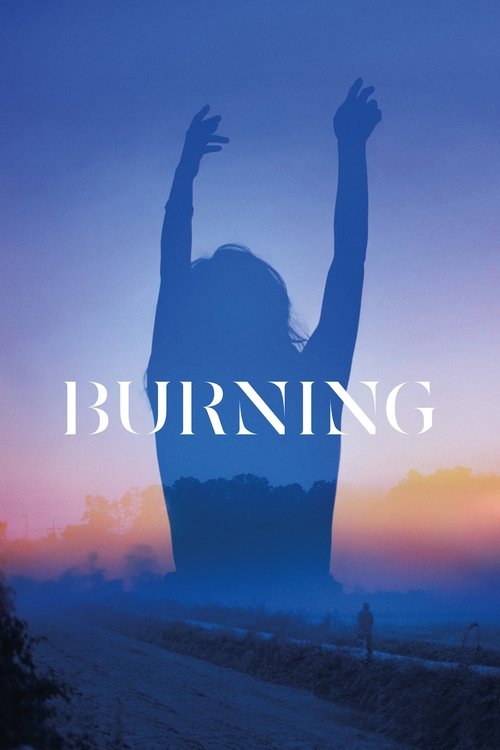
Burning
2018 · Lee Chang-dong
For when you want a film to chew on for days — one that trusts you to sit with ambiguity and rewards patience with a genuine gut-punch. Not a comfort watch; a haunting one.
What it's about
Jong-su, a young deliveryman scraping by near the North Korean border, runs into Hae-mi, a girl from his old neighborhood, and something like love starts. Then she returns from a trip to Africa with Ben — wealthy, charming, unreadable — who one day confides a very unusual hobby. What begins as a lopsided love triangle curdles into an obsession, and a mystery Jong-su can't let go of.
The experience
A slow, hypnotic burn — two and a half hours that tighten around you so gradually you don't notice until you can't breathe. It's melancholy, sensual, and quietly furious, and it ends with your mind still racing.
Performances
Steven Yeun is chilling precisely because he's so pleasant — a smile you can't see behind — while Yoo Ah-in makes passivity riveting and Jeon Jong-seo, in her debut, delivers a twilight dance scene people still talk about.
The craft
Lee Chang-dong shoots rural dusk and Seoul apartments with equal patience, letting sunlight, distance, and silence do the storytelling; the film's most famous sequence is just a person dancing at sundown, and it's devastating. Mowg's prowling score keeps a low hum of unease under everything. It rewards a big screen and zero distractions.
Why it matters
One of the most acclaimed films of its decade, it announced Korean cinema's international breakthrough moment and turned Steven Yeun into a serious dramatic force. Critics' polls still rank it among the century's best.
Snapshot
Lee Chang-dong's Burning is a slow-burning mystery of class, desire, and vanishing — a film that withholds its central question (has a woman been murdered?) while making that withholding its deepest subject. Adapted from Haruki Murakami's short story "Barn Burning" (1983), itself a reimagining of a William Faulkner tale, the film follows Jong-su, a marginal young man from the rural North Korean border region who reconnects with Hae-mi, a childhood neighbor, only to lose her after she introduces him to the wealthy, opaque Ben. Whether Ben burns greenhouses — or women — is never resolved. What the film argues, with devastating precision, is that the lives of people like Hae-mi are structurally unmissable: erased without record, mourned without institutions. Running 148 minutes, it is Lee's most formally rigorous work and his most politically ferocious.
Industry & production
Burning was produced by Pine House Film in co-production with the Japanese broadcasting network NHK and South Korean distributor CGV Arthouse. Lee Chang-dong had been absent from filmmaking since Poetry in 2010, a gap of eight years explained partly by his continuing literary work and partly by the laborious development process the project required. The screenplay, co-written by Lee and Oh Jung-mi, substantially expanded Murakami's spare, enigmatic story — roughly twenty pages — into a fully realized social world, adding the DMZ-adjacent rural setting, the sharply drawn class topology, and a third act that transforms ambiguity into something approaching accusation.
The film premiered in Competition at the 2018 Cannes Film Festival, where it won the FIPRESCI Prize awarded by international critics. It was South Korea's official submission to the Academy Awards in the Best International Feature Film category that year, though it did not receive a nomination. The Cannes showing positioned it immediately as a festival film of major significance; it was picked up for international distribution by Well Go USA in North America and various arthouse distributors elsewhere.
Steven Yeun's casting as Ben marked an early signal of his transition from American television (The Walking Dead) toward more demanding authorial cinema. His bilingual, bicultural presence gives Ben a particular kind of illegibility — a Korean-American whose surface ease with both worlds marks him as belonging, in some sense, to neither.
Technology
Burning was shot on digital, a choice consistent with contemporary Korean art cinema practice. Cinematographer Hong Kyung-pyo, who had previously shot Bong Joon-ho's Snowpiercer (2013) and Mother (2009), exploited the digital sensor's latitude in low-light conditions — particularly during the celebrated golden-hour sequences near Jong-su's family farm. The film's visual texture is deliberately unshowy: clean, high-resolution images that resist the granular romanticism of film stock, reinforcing a world that offers no nostalgic comfort.
The sound design was executed with equivalent restraint. Mowg (the composer's working name), who scored the film, built a minimal, sustained electronic and orchestral palette that functions more as atmospheric pressure than melodic structure. Music enters and withdraws according to emotional temperature rather than conventional cue logic. One exception is the use of diegetic music in the sunset dance sequence, where recorded jazz plays as Hae-mi dances before Jong-su and Ben — a scene in which technology (the record player, the camera's eye) participates in the act of bearing witness to something that will later be denied.
Technique
Cinematography
Hong Kyung-pyo's work here is among his most considered. The film is organized around a series of sustained, unhurried compositions that refuse to telegraph meaning. The Paju farmland near the DMZ — flat, windswept, watched over by North Korean propaganda towers visible on clear days — is rendered without picturesque softening; it is simply the place where Jong-su's family cannot survive economically. The urban spaces contrast sharply: Ben's Gangnam apartment, with its clean sight lines and curated emptiness, is photographed to make opulence look like the absence of need.
The golden-hour sequence deserves particular attention. As the sun drops behind the mountains, Hae-mi dances topless while Jong-su watches and Ben watches both of them, and the camera holds at a middle distance that refuses to sexualize what it sees. The light shifts from amber to blue as she dances, the Boléro-like insistence of her movement unfolding in real time. It is one of the most technically deliberate sequences in recent Korean cinema — natural light managed to a precise expressive threshold.
Editing
Kim Da-won's editing maintains the film's core strategy of dilation and omission. Scenes extend past the point where conventional editing would cut away; information is withheld not by jumping over it but by letting it sit in the frame undisclosed. The film's temporal structure follows Jong-su's obsessive surveillance of Ben — driving past his apartment building, running past the greenhouse he may or may not have burned — and the editing mirrors that repetition without satirizing it. The effect is cumulative dread rather than suspense.
Mise-en-scène / staging
Lee is a former novelist, and his staging carries the precision of literary composition. Objects accumulate significance across the film: the cat that may not exist, the wristwatch Jong-su finds at Ben's apartment, the well on Jong-su's family farm whose reality Hae-mi disputes. Lee does not mark these objects with close-ups or special lighting; they surface in the flow of scenes and are left for the viewer to index. The result is a film that rewards and punishes memory simultaneously — the more carefully you watch, the more you find, and the more you find, the less certain you become.
The staging of Ben in particular exploits Steven Yeun's stillness. He occupies space without filling it; his laughter — the only purely spontaneous-seeming thing he does — functions as a tell rather than a release.
Sound
The soundscape of the border region is present throughout: wind across open fields, the North Korean propaganda broadcasts drifting southward, animal sounds from Jong-su's farm. These are not deployed for thriller effect but as the ambient condition of life at the economic and literal edge of South Korean modernity. The silence in Ben's apartment is an equal and opposite presence. Mowg's score, when it enters, tends toward drones and tonal suspensions that register emotional irresolution rather than resolution.
Performance
Yoo Ah-in carries a performance of dense interiority — Jong-su is educated enough to know his own resentment, inarticulate enough to be trapped by it. His desire for Hae-mi, his fascination with Ben, and his growing conviction that something has been done to her are all played through a kind of blocked affect that the film refuses to pathologize. Jeon Jong-seo, in her film debut as Hae-mi, brings a quality of performance that seems genuinely undefended — she presents herself as someone who has decided that vulnerability is the only honest mode, and the film treats this as both beautiful and fatal. Steven Yeun's Ben is calibrated to the millimeter: at no point does he tip into villainy, and at no point does he release the audience's suspicion.
Narrative & dramatic mode
The film operates in a mode of sustained, principled ambiguity that has clear antecedents in the art cinema tradition — particularly in Antonioni — but is fully embedded in a specific Korean social reality. It is not ambiguous in the way of puzzle films or unreliable narrators; it is ambiguous in the way of a world that systematically fails to register certain disappearances. The central question — what happened to Hae-mi? — is unanswerable not because Lee withholds information arbitrarily but because, as the film constructs it, the social infrastructure for answering the question does not exist. The police are indifferent; Ben is untouchable; Jong-su's obsession is treated by everyone around him as eccentric at best.
The dramatic mode shifts subtly across the film's three movements: the first is a quiet naturalistic romance; the second a surveillance thriller; the third a compressed, violent confrontation that feels less like a genre payoff than a rupture in the film's own register. Lee has described the ending as a kind of explosion — the only possible release for accumulated social pressure.
Genre & cycle
Burning participates in a loose cycle of prestige Korean art cinema that treats genre form (here, the psychological thriller and the social realism film) as a pressure chamber for class analysis. It shares this project with Bong Joon-ho's Parasite (2019), which arrived the following year and made the class argument with blacker comedy and a more legible moral structure. Where Parasite explicates, Burning withholds; the two films are companion pieces more than competitors.
More broadly, the film belongs to an international current of slow cinema inflected by political urgency — films by Cristian Mungiu, Lucrecia Martel, and Carlos Reygadas that use duration and spatial attention to create the conditions for a different kind of social thought than fast-cut narrative permits.
Authorship & method
Lee Chang-dong published two novels before making his first film, Green Fish, in 1997. His subsequent features — Peppermint Candy (2000), Oasis (2002), Secret Sunshine (2007), Poetry (2010) — establish a recognizable authorial preoccupation: the damage done to individuals by historical and economic forces that exceed their comprehension or resistance. Burning continues this project while moving toward greater formal indirection. Lee has spoken of the Murakami source material as a canvas rather than a blueprint; the adaptation doubles the social specificity while preserving and deepening the ontological uncertainty.
Hong Kyung-pyo's contribution cannot be overstated. His ability to sustain long takes without losing compositional integrity, and to use natural light at extreme angles without lapsing into conventionally beautiful imagery, gives the film its particular texture — beautiful and cold in equal measure. Mowg's score demonstrates a rare capacity for restraint: knowing when music would collapse a scene's ambiguity rather than deepen it. Oh Jung-mi's collaboration on the screenplay helped translate Murakami's Japanese suburban register into a distinctly Korean geography of inequality.
Movement / national cinema
Burning is a product of Korean New Wave cinema — the internationally visible, festival-oriented body of work that emerged in the late 1990s following the dismantling of the Korean film censorship system and the concurrent development of a robust domestic production infrastructure. Lee Chang-dong, Im Sang-soo, Hong Sang-soo, and Bong Joon-ho are its central figures, though their styles diverge sharply. Korean New Wave cinema is unified less by aesthetic than by a shared willingness to treat Korean modernity — its rapid industrialization, its unresolved division, its compressed class stratification — as primary subject matter rather than backdrop.
Burning occupies a particular position within this movement as its most internationally legible statement about contemporary Korean class division. Its success at Cannes and in international distribution confirmed that the critical and commercial prestige built by the Korean industry through the 2000s and 2010s had created an audience capable of receiving formally demanding Korean work.
Era / period
The film is a precise document of South Korea in the late 2010s: the generation of young people who arrived into an economy unable to accommodate them, whose higher education credentials function as markers of expectation without delivering the mobility they promised. Jong-su's precariousness — odd delivery jobs, no permanent address, a farm he cannot sustain — is a sociological portrait of what has been called the "sampo generation" (a term coined in Korean discourse to describe young people who have given up on romantic relationships, marriage, and children under economic pressure). Ben represents the untaxed, inheritance-protected upper tier whose visible consumption of experiences — travel, fine dining, gallery openings — makes the distance between the classes felt rather than argued.
The DMZ setting carries historical weight that the film never explains because it does not need to: an audience familiar with Korean history understands that the border region is South Korea's most economically abandoned territory, a landscape held in suspension between two incompatible political systems, neither of which has resolved the lives of the people who live there.
Themes
Class and invisibility are the film's governing concerns. Lee's argument, made through form rather than dialogue, is that extreme wealth does not merely advantage its possessors; it renders them immune to consequence and renders their victims un-grievable. Hae-mi's disappearance is treated by institutional Korea — police, her family, her social circle — as not quite a disappearance at all. Only Jong-su remembers her, and his memory is suspected rather than credited.
Desire triangulates across the three central figures in ways the film does not resolve into psychology. Jong-su wants Hae-mi; Ben wants whatever Ben wants (he is the figure of appetitive opacity); Hae-mi wants to be seen. The "Great Hunger" she describes — a hunger for meaning rather than sustenance, a concept she attributes to an experience in Africa — names the film's existential register. Hae-mi has decided to live as if the pantomime of fullness were possible; the film watches that decision be extinguished.
Fire, throughout, is the trope of purification and erasure. Ben's stated hobby — burning useless plastic greenhouses that nobody misses — carries its allegorical weight without the film ever underlining it. Lee trusts his audience to make the connection between objects that are structurally surplus and people who are structurally surplus.
Reception, canon & influence
Burning received near-unanimous critical acclaim in international release. The aggregated critical response placed it among the most acclaimed films of 2018, with sustained attention to its formal sophistication and thematic density. It occupied top-ten positions on numerous year-end critical lists and was featured prominently in subsequent discussions of 2010s world cinema.
The film's principal influence backward runs through Murakami to Faulkner's "Barn Burning" (1939), which established the burning-as-class-act trope and the unreliable narrator positioned between a violent patriarch and a more controlled antagonist. Murakami's version stripped the Faulkner story of its Deep South specificity and replaced it with Tokyo suburban ennui; Lee's version replaced Murakami's ennui with South Korean economic rage. Antonioni's influence — particularly L'Avventura (1960) and Blow-Up (1966), both organized around disappearances that are not resolved — is widely cited, and Lee has acknowledged it as relevant to his formal thinking. The Highsmithian figure of the charming sociopath (Ben as Ripley) is another legible inheritance.
The film's forward influence is harder to trace with precision, as it was released only months before Parasite entered production and the two films developed in close temporal proximity. What can be said is that Burning demonstrated internationally that Korean cinema could hold the ambiguity of literary fiction within genre-inflected form without collapsing either — a demonstration that informed the critical framing of subsequent Korean prestige cinema. It also contributed to the rehabilitation of Lee Chang-dong's standing as one of the essential directors of his generation, and to the international visibility of Yoo Ah-in and, above all, Steven Yeun, whose performance here opened a second chapter of his career in auteur cinema. The film remains the clearest cinematic argument that Murakami's fiction, so often treated as resistant to adaptation, yields to a director willing to replace the Japanese author's ironic detachment with political conviction.
A Deleuzian reading
There's a well on Jong-su's family farm, or there isn't.
The full Deleuzian reading of Burning →
Reception
It stormed Cannes 2018 with rapturous reviews only to walk away without a main prize (the Palme went to Shoplifters), a snub cinephiles still grumble about — since then it's steadily climbed best-of-the-2010s lists and hardened into modern-classic status.
How Burning was received, from release to now →
Influences: the films it descends from and the films it influenced
- L'Avventura (1960) — Lee inherits Antonioni's structural device of the organizing disappearance that is never resolved — Haemi's absence functions identically to Anna's, generating epistemological uncertainty rather than plot; the film's refusal to confirm what happened to her is not a gap but the form itself, as Lee acknowledged directly in interviews.
- Blow-Up (1966) — Jongsu's nocturnal observation of Ben at the greenhouse maps precisely onto Thomas's photographic enlargement — in both films a protagonist believes he has witnessed a violent act through a mediated or distanced perception, and in both the evidence dissolves under scrutiny, rendering the act permanently uncertain.
- Pickpocket (1959) — Bresson's method of extracting non-expressive performance from non-actors to render class dissociation — Michel's flat affect as the register of a man estranged from labor and belonging — is the direct technical template for Lee's direction of Yoo Ah-in, who uses the same contained, near-absent expressivity to portray Jongsu's alienation.
- Purple Noon (1960) — Clément's visual grammar for the Highsmithian charming sociopath — Tom Ripley rendered luminous and menacing in warm Mediterranean natural light, class envy photographed as sensory beauty — is reproduced in Hong Kyung-pyo's staging of Ben's sun-drenched sequences, where his ease and affluence are rendered through the same hot ambient light that codes him as predator.
- A Brighter Summer Day (1991) — Yang's practice of staging youth violence within naturalistic domestic and suburban space using static long takes held at a patient compositional distance — the camera never rushing toward rupture — is the formal ancestor of Hong Kyung-pyo's patient framings of Paju periphery; both directors use precise distance to make violence feel structural rather than personal.
- Taste of Cherry (1997) — Kiarostami's principled narrative withholding — the refusal to confirm or deny the central act, encoded as an ethical position about the limits of cinema's knowledge — established the ontological ambiguity that Lee extends to Haemi's disappearance; both directors treat unresolution not as irresolution but as the correct epistemological stance.
- Still Life (2006) — Jia's compositional strategy of positioning the human figure against post-industrial landscape in sustained long takes — workers dwarfed by infrastructure their labor built and that now displaces them — is the direct precedent for Lee's staging of Jongsu against the Paju fields and plastic greenhouses, where geography becomes a measure of economic precarity.
- Poetry (2010) — Lee developed in Poetry the two linked devices he extended in Burning: object accumulation as a staging technique where domestic props gradually accrue moral weight, and principled omission of the central crime from direct depiction — both films require the audience to construct the offense from surrounding evidence rather than witness it.
- Memories of Murder (2003) — Both films use the Korean rural investigation-without-resolution to diagnose institutional and economic failure — Bong's detectives and Lee's protagonist each conduct inquiries in which the procedural form's promise of closure is systematically denied, exposing not the perpetrator but the social conditions that produced the crime and will prevent its solution.
- Memoir of a Murderer (2017) — Extends epistemological ambiguity to complete and deliberate irresolution — the central crime may or may not have occurred, the suspect may or may not be a killer, and the film refuses confirmatory closure; it develops the genre's tolerance for withheld resolution that Memoir demonstrated was commercially viable within Korean genre production.
- Peppermint Candy (2000) — Extends Lee's long-take, ambiguity-tolerant realism and his fixation on class wounds and characters seeking a grace the film denies, confirming the throughline of his authorship.
- Millennium Mambo (2001) — Slow-cinema youth malaise and entrapment rendered through elliptical, anti-dramatic duration and naturalistic low-affect performance.
- Parasite (2019) — After Burning demonstrated internationally that Korean cinema could hold literary ambiguity within genre-inflected form without collapsing either, Bong extended the object-staging-as-class-language technique — domestic spaces and props as monuments to stratification — into a more commercially legible thriller register, inheriting the visual grammar while shifting its tonal register from cold ambiguity to controlled horror.
- Minari (2020) — Steven Yeun's performance register in Minari — the contained, non-expressive male protagonist whose blocked affect registers economic precarity and cultural displacement — was first established by his work in Burning; Chung cast him explicitly because that film had demonstrated he could sustain interiority through withholding rather than expression, the rare skill Lee's direction had unlocked.
- Past Lives (2023) — Song deploys temporal dilation and ellipsis as the primary formal language for rendering economic and emotional dispossession in the Korean diaspora — the editing rhythm of withheld time, and the natural-light long-take style that holds faces at a composed distance without rushing toward feeling — extending the formal vocabulary Lee established in Burning into a new generational and geographic register.
- The Wailing (2016) — Na sustains principled ambiguity about whether the violence is supernatural or criminal across the full length of a Korean genre film, using the investigation to expose the investigator's moral limitations rather than resolve the mystery — the same formal commitment to irresolution that Lee employs, both directors treating ambiguity as the ethically correct answer rather than a deferred one.
- First Reformed (2017) — Schrader pairs blocked-affect male performance with a minimal electronic score deployed as negative space — Mark Isham's restrained cues withhold emotional confirmation the same way Mowg's score does in Burning — to render spiritual and economic dissociation in a male protagonist whose controlled surface conceals the possibility of political violence.
- Norwegian Wood (2010) — Tran's adaptation of Murakami pursues atmospheric immersion — using long takes and natural light to reproduce the Japanese author's ironic detachment — precisely the approach Lee's film implicitly argues against; comparing the two Murakami adaptations shows Lee's decision to replace detachment with political concreteness as a deliberate formal choice, not a default.
- No Other Choice (2025) — Korean New Wave study of economic precarity and thwarted male provision, sharing the recession-anxiety register and slow-burn resentment of a man priced out of the bourgeois life.
- Mother (2009) — Wide compositions deploying negative space as a register of social and cognitive uncertainty, paired with crime-genre conventions that promise resolution while permanently withholding it — the same formal strategy Mother uses to implicate the viewer in retrospective recontextualization of what they believed they understood.
- Roma (2018) — Lee's film shares Roma's slow-cut rhythm and its compositional patience — scenes extend beyond conventional dramatic resolution, the camera observing without steering — and deploys ambient environmental sound (wind, insects, distant traffic) as the dominant acoustic texture in lieu of score, treating sonic environment as psychological atmosphere.
- Shoplifters (2018) — Both films premiered at Cannes 2018 and deploy strategic withholding as the primary narrative engine — Lee withholds whether the burning is literal, Kore-eda withholds the family's legal status — with observational restraint and unmarked reaction shots functioning in both cases as the formal instrument of class-anxiety mapping.
- Beasts Clawing at Straws (2020) — Contemporaneous Korean art-crime sibling using liminal spaces (greenhouses, rooftop apartments, border zones) as moral geography, and making material poverty legible through behavioral performance — the way characters move through space — rather than expository declaration.
- Night in Paradise (2020) — Shares the deliberately withheld momentum and long central lull as a formal device, plus landscape-as-emotion cinematography where rural Korean space carries dread the plot refuses to discharge.
- A Sun (2019) — Shares the restrained-spare scoring, class-pressure repression study and an ambiguous off-screen crime withheld from the audience, narrating violence through absence.
Similar films
- Past Lives (2023) — influence & lineage · same viewing thread
- Memories of Murder (2003) — influence & lineage · often watched together
- Poetry (2010) — influence & lineage
- Parasite (2019) — influence & lineage
- No Other Choice (2025) — influence & lineage
- Decision to Leave (2022) — same viewing thread
- Portrait of a Lady on Fire (2019) — same viewing thread
- House of Hummingbird (2019) — same viewing thread
All the films related to Burning →
Watch it with: curated runs of related films
- The Ache of Almost — Watch these together for the way each circles a love that time, distance, or duty keeps just out of reach — long looks, feelings left unsent, and the life that gets lived instead.