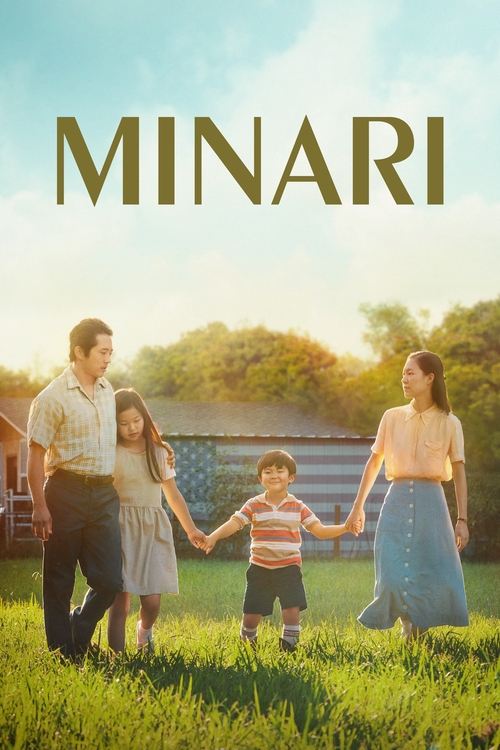
Minari
2021 · Lee Isaac Chung
For when you want to feel something true about family — a tender, unhurried evening film that earns its tears honestly. Comfort with real emotional weight, not sugar.
What it's about
In the 1980s, a Korean American father moves his wife and two young kids from California to a plot of land in rural Arkansas, betting everything on a farm growing Korean vegetables. His wife is unconvinced, the marriage strains, and then her mother arrives from Korea — a foul-mouthed, card-playing grandmother who is nothing like the grandmas her American-raised grandson expects. Much of it unfolds through the eyes of David, the small boy with a heart condition, watching his family fight for a foothold.
The experience
Gentle, patient, and quietly devastating — it moves at the rhythm of farm seasons and family dinners, then catches you off guard with how much you've come to care. Warm and funny in small ways, with an ache underneath.
Performances
Youn Yuh-jung won an Oscar as the grandmother, salty and sly and heartbreaking; Steven Yeun brings stubborn dignity to a father whose dream is also a gamble with his family; and little Alan Kim is effortlessly winning.
The craft
Lee Isaac Chung directs his own childhood memories with remarkable restraint — no big speeches, just closely observed domestic detail, sun-drenched Ozark landscapes, and Emile Mosseri's tender, hymn-like score. The title herb, planted by a creek and thriving on neglect, does the film's talking.
Why it matters
A Sundance double-winner that became an awards-season force and a landmark for Asian American filmmaking, it broadened what an 'American dream' story looks like on screen.
Snapshot
Minari is Lee Isaac Chung's semi-autobiographical account of a Korean American family attempting to build a farm in rural Arkansas in the 1980s. Jacob Yi (Steven Yeun) moves his wife Monica (Yeri Han) and their two children out of California and onto a plot of Ozark land, where he stakes the family's future on growing Korean produce for a market of fellow immigrants. Monica's mother, Soonja (Youn Yuh-jung), arrives from Korea to help mind the children, chief among them the young, heart-troubled David (Alan Kim) through whose eyes much of the film is refracted. The title names a hardy Korean herb (water dropwort) that Soonja plants by a creek, a plant that thrives on neglect and returns each season — the film's central, quietly stated metaphor for immigrant persistence. Premiering at Sundance in January 2020, where it took both the Grand Jury Prize and the Audience Award in U.S. Dramatic Competition, and released widely by A24 in early 2021, the film became a landmark of Asian American cinema, culminating in Youn Yuh-jung's Academy Award for Best Supporting Actress — the first acting Oscar won by a Korean performer.
Industry & production
Minari was produced by Plan B Entertainment, the company co-founded by Brad Pitt, alongside Christina Oh, and distributed by A24 — an alignment of two of the more prestige-oriented forces in American independent film of the 2010s. This pairing is significant for reading the film's positioning: Plan B had built a track record steering personal, socially textured stories (from 12 Years a Slave to Moonlight) toward major awards recognition, and A24 had become the defining boutique distributor of the era's American art film. The budget was modest by studio standards, and the production was compact — the film was shot on location not in Arkansas but in and around Tulsa, Oklahoma, over a short schedule (widely reported as roughly 25 days), a compression that shaped its economical, observational style.
The most consequential industry episode surrounding the film was categorical rather than commercial. The Hollywood Foreign Press Association classified Minari as a foreign-language film under a rule requiring more than half of a film's dialogue to be non-English, making it eligible only for the Golden Globe for Best Motion Picture – Foreign Language (which it won) and ineligible for the Best Picture drama race. The decision drew pointed criticism — filmmaker Lulu Wang, whose The Farewell had faced the same issue, was among the prominent voices objecting — because Minari is an American film, financed and made in the United States by an American director about the American immigrant experience. The controversy crystallized a broader debate about how Anglophone awards bodies define national and linguistic belonging. At the Academy Awards, by contrast, the film competed in the general categories, earning six nominations including Best Picture, Best Director, and Best Original Screenplay.
Technology
Minari was photographed digitally by Lachlan Milne, working in a widescreen frame with an emphasis on available and naturalistic light rather than heavy artifice. (I would flag that the exact camera and lens package is not something I can attest to with confidence; the visible style — soft daylight interiors, sun-flooded exteriors, a warm and slightly diffused palette — is more securely described than the specific hardware.) The technological register of the film is deliberately unshowy: there is no reliance on visual effects spectacle, and the period 1980s setting is achieved through production design, wardrobe, and location rather than digital reconstruction. The score exists partly in a contemporary technological space — Emile Mosseri's compositions layer wordless vocals and processed, dreamlike textures — but the film's overall aesthetic self-consciously resists the gloss of high-tech contemporary cinema in favor of a tactile, grain-adjacent warmth appropriate to memory.
Technique
Cinematography
Milne's camera favors a patient, grounded observation. The film is built substantially at child height and in unhurried compositions that let action unfold within the frame rather than being carved up by coverage. Exteriors exploit the Oklahoma-standing-for-Arkansas landscape — fields, the wooded creek where the minari grows, the family's mobile home raised on blocks — with natural light doing much of the emotional work: golden low-angle sun, overcast softness, the particular glow of a rural dusk. Interiors of the cramped trailer are lit to feel lived-in and close. The visual grammar is closer to lyrical realism than to documentary handheld; there is a composed, almost pastoral quality that several critics connected to the American landscape tradition. The cinematography's restraint is a technique in itself — it withholds emphasis, trusting the viewer to find the drama inside ordinary domestic and agricultural space.
Editing
Harry Yoon's cutting sustains an unhurried rhythm keyed to observation and accretion rather than plot mechanics. The film advances through the gradual accumulation of small incidents — a well running dry, a church visit, a card game, a doctor's appointment for David's heart — and the editing gives these scenes room to breathe, holding on reactions and letting silences land. This measured pace is essential to the film's mode: it converts what could be melodrama into something closer to remembered experience, with time passing in the elastic way it does in childhood recollection. The climactic turn late in the film is staged and cut so that catastrophe and consolation sit uncomfortably close together, a structural choice that refuses tidy resolution.
Mise-en-scène / staging
The film's world is small and concrete: the trailer-home, the barn, the rows of Korean vegetables, the creek. Staging repeatedly emphasizes thresholds and enclosures — the family framed inside the narrow trailer, figures small against wide fields — visualizing both precarity and aspiration. Objects carry meaning: Mountain Dew (which Soonja mistakes for "mountain water"), the deck of cards, the drawer of Korean chili powder and anchovies and folk remedies she brings from home, David's cowboy boots. The grandmother's arrival reorganizes the domestic space and the family's internal balance, and the mise-en-scène tracks that shift. Chung stages the American and Korean elements not as clash but as coexistence within the same rooms, the same meals, the same yard.
Sound
Sound design leans into rural ambience — insects, wind, water, the hum of the land — building an enveloping sense of place. The most distinctive sonic element is Emile Mosseri's score, which uses floating, wordless vocals and warm instrumental textures to lend the material a lullaby-like, dreamlike quality; the vocal performance associated with the film's "Rain Song" involves Yeri Han. Language itself functions as sound and meaning: the film moves fluidly between Korean and English, mapping generational and situational registers — Korean at home and with Soonja, English at church and in the wider world — so that bilingualism becomes part of the film's texture rather than a subtitled inconvenience.
Performance
Performance is the film's engine. Steven Yeun plays Jacob with a banked intensity — pride, stubbornness, and tenderness held in tight balance — in a role that made him the first Asian American nominated for the Academy Award for Best Actor. Yeri Han grounds Monica in weariness and love, giving the marital strain its ballast. The children — Alan Kim as David and Noel Kate Cho as Anne — are directed toward unforced naturalism, and Kim's David anchors the film's point of view. The performance most decorated is Youn Yuh-jung's Soonja: a veteran of Korean cinema, she plays the grandmother as bawdy, unsentimental, and unexpectedly moving, refusing the archetype of the wise elder. Her Oscar win was historic — the first competitive acting Academy Award for a Korean performer — and her scenes with Alan Kim form the film's emotional core.
Narrative & dramatic mode
Minari operates in the register of intimate domestic realism, structured episodically around the passage of a season on the farm and the slow tightening of familial and financial pressure. Its dramatic mode is essentially undramatic by design — it eschews the clear antagonists, escalating stakes, and cathartic arcs of conventional narrative in favor of texture, ambivalence, and the small units of family life. The through-line is Jacob's gamble on the farm and its cost to his marriage, but the film is at least equally the coming-of-age of David and the reconfiguration of the household around Soonja. Autobiography is the crucial frame: Chung has been open that the film draws on his own childhood on an Arkansas farm, and this memoir quality licenses the film's discursive, observational shape — the sense that we are inside a remembered world rather than a plotted one. The late crisis introduces a jolt of near-tragedy, but the resolution is deliberately quiet and open, returning to the image of the minari as an emblem of survival.
Genre & cycle
The film sits within the family drama and the immigrant narrative, inflected by the coming-of-age tradition and the American pastoral. It belongs recognizably to the A24 / American independent art-film cycle of the 2010s–early 2020s — personal, aesthetically refined, festival-launched. More specifically, it arrived amid a visible surge of Asian American and Asian diasporic filmmaking reaching mainstream recognition, a cohort that included Lulu Wang's The Farewell (2019) and the broader wave marked by Crazy Rich Asians (2018) and, in a different register, the international triumph of Bong Joon-ho's Parasite (2019–2020). Where those films varied widely in genre, Minari renewed the immigrant story by rooting it in the rural American heartland rather than the urban gateway city, a setting more often associated with white agrarian mythology — a repositioning that is part of its cultural argument.
Authorship & method
Minari is a strongly authorial work: Lee Isaac Chung wrote and directed it, drawing directly on autobiography. Chung's path is worth noting for context — his debut feature Munyurangabo (2007), shot in Rwanda, premiered at the Cannes Film Festival, marking him early as a filmmaker of international art-cinema sensibility before Minari brought him wide recognition. His method here is one of restraint and trust: naturalistic performance, observational staging, and a refusal of editorializing. He has spoken of literary influence, notably Willa Cather's My Ántonia, whose prairie immigrant narrative resonates with the film's landscape and its interest in the immigrant remaking of American soil.
The key collaborators shaped the film's identity decisively. Cinematographer Lachlan Milne (known also for Hunt for the Wilderpeople and Stranger Things) supplied the naturalistic, light-driven imagery. Composer Emile Mosseri contributed the wordless, dreamlike score that earned an Academy Award nomination and does much to establish the film's memory-suffused tone. Editor Harry Yoon governed the patient, accretive rhythm. And the ensemble cast — Yeun, Han, Youn, and the children — realized the performances on which the film depends. The producing partnership with Plan B and Christina Oh provided the platform.
Movement / national cinema
Minari is best understood as transnational American cinema. It is unambiguously an American film in its financing, production, and subject — the immigrant claim on the American dream and the American land — yet it is bilingual and shaped by Korean cinematic and cultural sensibilities, embodied above all in Youn Yuh-jung, a pillar of Korean film and television. It thus straddles Asian American cinema and the Korean diasporic imagination, and its reception played out against the backdrop of a moment when Korean and Korean-connected cinema had unprecedented global visibility. The Golden Globe foreign-language controversy is, in a sense, a symptom of the film's in-between position: it exposed the inadequacy of national-cinema categories built on language to describe a work this hyphenated.
Era / period
The film is set in the 1980s, the period of Chung's own childhood, and the era is rendered through the modest material culture of rural working life rather than nostalgic pop iconography. That historical setting matters thematically: it places the family within a specific chapter of Korean immigration to the United States and within an American rural economy of small farms and evangelical churches. As a film of its own moment — made and released around 2020–2021 — Minari is equally a product of the late-2010s American independent scene and its heightened attention to previously marginalized stories, and its awards run unfolded during the pandemic-disrupted 2020–2021 season, which delayed and reshaped its theatrical release.
Themes
The film's governing themes are family resilience, the immigrant remaking of home, and the tension between individual ambition and collective survival. Jacob's dream of self-sufficiency through the farm is set against Monica's desire for stability and community, dramatizing the cost of the American dream on the intimate bonds that pursue it. Intergenerational relationship — especially the initially prickly, ultimately tender bond between Soonja and David — carries the film's meditation on inheritance, belonging, and what is passed between generations displaced across an ocean. Faith and community appear through the family's encounter with rural evangelical Christianity, embodied partly in the eccentric farmhand Paul (Will Patton). Assimilation and cultural continuity coexist rather than compete. And over all of it presides the minari plant: hardy, adaptable, flourishing where it is planted with little tending — the film's image of an immigrant persistence that takes root in unlikely ground and returns.
Reception, canon & influence
Critically, Minari was received with wide acclaim, praised for its emotional authenticity, its performances, and its restraint. Its Sundance double win (Grand Jury Prize and Audience Award, U.S. Dramatic) launched it as a festival favorite, and its awards trajectory made it a signal cultural event: six Academy Award nominations, including Best Picture, Best Director, Best Actor for Steven Yeun, Best Original Screenplay, and Best Original Score, with Youn Yuh-jung's Best Supporting Actress win as the historic capstone. That win — the first competitive acting Oscar for a Korean performer — and Yeun's nomination as the first Asian American Best Actor nominee, secured the film's place in the canon of Asian American cinema.
Looking backward, the influences on the film gather around American literary and cinematic pastoral (Chung's stated affinity for Willa Cather) and a lineage of observational, humane family filmmaking; critics have periodically invoked the contemplative domestic tradition associated with Ozu and the natural-light lyricism associated with Terrence Malick, though these are best treated as resonances rather than documented borrowings, and I would not overstate direct lineage where the record is a matter of critical association more than the director's explicit citation.
Looking forward, Minari's influence is bound up with the doors its recognition helped open. Arriving alongside Parasite's Oscar triumph and The Farewell, it contributed to a decisive shift in the visibility and legitimacy of Asian and Asian American storytelling within the American film establishment, and it demonstrated the commercial and critical viability of bilingual, culturally specific immigrant narratives set outside the coastal metropolis. Its success helped consolidate Steven Yeun's standing as a leading dramatic actor and brought Youn Yuh-jung to global prominence. As a template, it affirmed a mode of personal, autobiographical immigrant cinema — quiet, specific, unsentimental — that subsequent filmmakers working in the diasporic vein could point to as proof that such stories could reach the center of the culture on their own terms.
Reception
Premiered at Sundance 2020 winning both the Grand Jury Prize and Audience Award, then rode a pandemic-delayed awards season to six Oscar nominations including Best Picture — it's since settled in as one of the defining American films of that strange 2020–21 stretch.
How Minari was received, from release to now →
How to watch Minari: what to notice on a first viewing
- Notice how often the camera sits at David's height. Milne keeps compositions low and unhurried, letting scenes play out inside the frame instead of cutting them into pieces. You are watching the farm the way a child would, without adult framing telling you what matters.
- Watch where the light comes from in outdoor scenes. Golden low-angle sun, overcast softness, the particular glow of dusk recur across the fields and the trailer's windows. Natural light does the film's emotional work instead of music cues or dramatic dialogue.
- Listen for when the family switches from Korean to English. Korean stays inside the home and with the grandmother; English arrives at church and in the wider world. Language marks which world each scene belongs to, immigrant home or American outside.
- Notice how small the trailer looks against the open fields. Chung repeatedly frames the family inside narrow enclosures, then cuts to figures tiny against wide land. The staging holds both the family's precarity and their reach for something bigger in the same images.
- Listen for the wordless voice in Mosseri's score. The floating vocals return under ordinary moments, not just climactic ones, giving daily life a dreamlike weight. The score treats memory and the present the same way, softening the line between them.
The whole guide to watching Minari, with the keys for a rewatch →
Influences: the films it descends from and the films it influenced
- Tokyo Story (1953) — The low, tatami-level static camera that frames domestic life at the height of a seated body is the direct antecedent of Chung's child-height eye-line, and both build meaning through the same intergenerational family gathered in rooms partitioned by sliding thresholds.
- Days of Heaven (1978) — Sets the template of magic-hour natural-light lensing over agrarian labor, telling an immigrant-worker story on the land through elliptical, near-wordless lyricism rather than plot-driven scenes.
- The Tree of Life (2011) — Reconstructs childhood memory from a low, roving child's-eye perspective and accretive impressionistic editing, married to a hushed, quasi-liturgical score — the memory-suffused mode Chung and Mosseri adapt.
- George Washington (2000) — Transplants Malick's magic-hour naturalism to a rural American backwater seen at child height, proving a lyrical, plotless observation of children in overgrown landscapes could anchor an American indie.
- Killer of Sheep (1978) — Neorealist, observational accretion of a working family's ordinary days — children at play, labor, small domestic ruptures — built without conventional narrative arc, the same patient episodic realism Chung uses.
- Ratcatcher (1999) — Frames a child's world at his own height amid poverty and half-glimpsed adult crisis, using textured natural light and sound to render experience sensorially rather than expositionally.
- The Southerner (1945) — Renoir's naturalistic account of a tenant-farming family staking survival on a plot of raw land — well water, crops, and generational friction — prefigures Minari's immigrant remaking of soil into home.
- Roma (2018) — Chung's semi-autobiographical immigrant family drama extends Roma's template of the memory film as cultural excavation, deploying a similar blend of non-professional and professional performance to reconstruct a specific ethnic-class milieu through a child's partial comprehension — the child's epistemological limit as the film's structural and emotional horizon.
- Burning (2018) — Steven Yeun's performance register in Minari — the contained, non-expressive male protagonist whose blocked affect registers economic precarity and cultural displacement — was first established by his work in Burning; Chung cast him explicitly because that film had demonstrated he could sustain interiority through withholding rather than expression, the rare skill Lee's direction had unlocked.
- House of Hummingbird (2019) — Semi-autobiographical family drama narrated from a child's sightline, letting historical and economic pressure surface through overheard adult tension rather than exposition.
- Past Lives (2023) — Extends Minari's mode of restrained, autobiographical Korean-diaspora storytelling, using bilingual texture and naturalistic underplayed performance to carry emotion the camera refuses to underline.
- Aftersun (2022) — Reconstructs a parent-child bond as fragmentary memory, pairing a child's-eye vantage with a dreamlike, textured score to suspend the film in remembered, rather than dramatized, time.
- Riceboy Sleeps (2022) — Autobiographical Korean-immigrant family drama built on natural light and observational domestic accretion, foregrounding bilingual friction and an intergenerational reckoning with the remade home.
- Thunderbolts* (2025) — Editor Harry Yoon's naturalistic emotional rhythm — cutting on breath and glance to let interior family drama breathe — is the cutting sensibility he brings alongside Wall's precision.
- Dìdi (弟弟) (2024) — Semi-autobiographical Asian American family portrait told from a child's eye level with restrained naturalism and a grandmother's disruptive warmth, proving the hyper-local immigrant family drama at intimate scale.
- The Farewell (2019) — Contemporary autobiographical diaspora film built on bilingual code-switching texture and restrained, unsentimental naturalism, releasing in the same cycle that legitimized culturally specific Asian-American family stories.
- Columbus (2017) — Korean-American quiet cinema that stages emotion through thresholds, doorways, and architectural enclosure, holding composed observational frames and trusting stillness over dialogue.
- The Last Black Man in San Francisco (2019) — Shares composer Emile Mosseri, whose wordless, dreamlike orchestral-choral score suffuses a story of remaking home with the same memory-tinged lyricism he brought to Minari.
- Hunt for the Wilderpeople (2016) — Shares cinematographer Lachlan Milne, whose naturalistic, light-driven framing of a child set loose in wild green landscape is the same craft signature he applies to the Arkansas farm.
- Moonlight (2016) — The Plan B / A24 poetic-realist coming-of-age, rendering a marginalized family in natural-light intimacy and chaptered observational restraint rather than melodrama — the platform and mode Minari inherits.
- First Cow (2019) — Reichardt's patient observational accretion and quiet frontier realism — small figures trying to make a living and a home from unyielding land — parallel Minari's un-editorializing rhythm.
- The Wonders (2014) — Autobiographical rural-family memory shot in natural light at child height, finding drama in agrarian labor and a grandparent's disruptive presence within an insular household.
- How to Make Millions Before Grandma Dies (2024) — Centers a grandmother–grandchild bond within an immigrant family's daily labor, observed with the same restrained, non-sentimental patience and specificity of dialect and food.
- Twisters (2024) — Chung's own authorial antecedent, supplying the observational natural-light attentiveness to rural American labor and community that grounds the tentpole's spectacle in a felt, dignified sense of Oklahoma place.
Similar films
- Past Lives (2023) — influence & lineage · often watched together
- The Farewell (2019) — influence & lineage
- Moonlight (2016) — influence & lineage
- The Tree of Life (2011) — influence & lineage · often watched together
- Little Forest (2018) — shared sensibility
- Parasite (2019) — shared sensibility
- Riceboy Sleeps (2023) — shared sensibility
- A Sun (2019) — shared sensibility