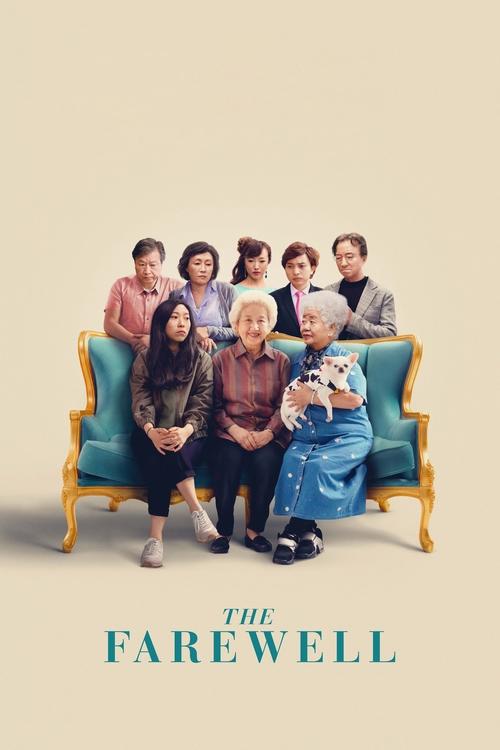
The Farewell
2019 · Lulu Wang
For when you need a good cry that earns it honestly, or when you're missing family — comforting and gently challenging at once. A perfect film to watch with (or about) the people you love.
What it's about
Billi, a Brooklyn writer, flies back to China for a hastily arranged family wedding that is really a goodbye: her grandmother is dying, and the family, following custom, has decided she must never be told. Billi — raised American, sure the truth belongs to the person living it — has to smile through banquets and photo sessions while carrying the secret everyone else has agreed to keep.
The experience
Warm, funny, and quietly devastating, often within the same scene — a comedy of concealment wrapped around a slow ache of grief. It sneaks up on you; the laughs make the lump in your throat bigger.
Performances
Awkwafina, cast against her comic persona, is remarkable in a restrained, grief-heavy register — the performance won her a Golden Globe — and Zhao Shuzhen is pure delight as the grandmother everyone is lying to protect.
The craft
Lulu Wang lived this story and directs it with quiet formal wit: family members arranged in wide, frontal group portraits, slow push-ins as the lie tightens, and Alex Weston's score sung by human voices where strings would normally be. Nothing flashy, everything precise.
Why it matters
A word-of-mouth arthouse hit that opened doors for Asian-American family stories in mainstream American film and made Lulu Wang a major directorial voice.
Billi, a Brooklyn writer, flies to Changchun for a hastily arranged wedding that is really a farewell: her grandmother is dying, and the family, following Chinese custom, has decided she must never know. Lulu Wang lived this story — she first told it on This American Life — and the film opens with the sly disclaimer that it is 'based on an actual lie.' What follows is a comedy of concealment played against a drama of grief, and a genuinely searching inquiry into whether the truth belongs to the individual or the family, the East-West question posed without a thumb on the scale. Wang's framing does quiet work: family members arranged in wide, frontal group compositions like formal portraits, slow push-ins as the lie tightens, Alex Weston's score sung by human voices where strings would be. Awkwafina, cast against her comic persona, won a Golden Globe; Zhao Shuzhen's Nai Nai, oblivious and radiant, is the performance people carry out of the theater. A Sundance sensation, it helped define A24's late-2010s ascendancy.
A Deleuzian reading
The family sits in a wide frontal row, facing the camera, composed the way people compose themselves for a formal portrait.
The full Deleuzian reading of The Farewell →
Reception
A Sundance 2019 sensation that out-grossed Endgame's per-theater average on opening weekend, it went from indie darling to Exhibit A in Oscar-snub discourse when the Academy gave it zero nominations; it's since settled in as one of the defining A24 films of its era.
How The Farewell was received, from release to now →
Influences: the films it descends from and the films it influenced
- Tokyo Story (1953) — The film's static, low, frontal compositions of a family arranged flat across the frame — and the whole structure of a homecoming shadowed by an impending death — descend directly from Ozu's tatami-eye family tableaux and departure/reunion rhythm.
- Yi Yi (2000) — Wang organizes grief and generational fracture around a single ceremonial gathering the way Yang stages his family drama between a wedding and a funeral, using frontal group tableaux where several relatives are held in one balanced, unmoving shot.
- The Wedding Banquet (1993) — The engine of The Farewell — a benevolent-deception plot in which the family stages a wedding to conceal a hard truth from an elder — is the same East-West tragicomic mechanism Ang Lee built, where a fake ceremony protects a parent from reality.
- Eat Drink Man Woman (1994) — Lee's use of the crowded banquet table as the primary staging device — generational tension displaced into food, seating, and toasts rather than confrontation — is the blueprint for Wang's restaurant and dinner scenes.
- Still Walking (2008) — Kore-eda's method of routing mortality and unspoken resentment through cooking, small talk, and the choreography of a family reunion — grief made observational and mundane rather than dramatized — is the emotional-staging model Wang works in.
- The Joy Luck Club (1993) — Wayne Wang's diaspora melodrama of returning to China to reckon with a matriarch established the Chinese-American generational-divide narrative and the trip-home structure The Farewell reworks in a comic key.
- Saving Face (2004) — Wu's concealment comedy — a Chinese-American family managing a shameful secret through indirection and face-saving performance — is a direct precedent for The Farewell's culture-of-concealment plotting.
- In the Mood for Love (2000) — The slow, longing push-in on a still figure and the aesthetic of emotion withheld behind composed surfaces — feeling registered through camera movement rather than dialogue — is the Wong Kar-wai device Wang deploys on Billi and Nai Nai.
- Real Women Have Curves (2002) — Culturally specific immigrant-family drama pivoting on a young woman negotiating tradition against self-determination—the generation-gap-across-assimilation craft carried forward.
- Past Lives (2023) — Song extends Wang's exact toolkit: slow push-ins and held frontal two-shots, East-West diaspora identity carried in silence and posture, and a climax of feeling that stays deliberately unspoken.
- Tigertail (2020) — Yang's autobiographical Taiwanese-immigrant melodrama shares the generational-silence subject and the strategy of staging emotional distance through composed, quiet framing rather than confrontation.
- Dìdi (弟弟) (2024) — Anchors an Asian American family film on a beloved grandmother and choreographs bilingual code-switching blocking — English among the young, Mandarin with elders — the intergenerational staging grammar Dìdi reuses.
- Dear You (2026) — The benevolent-lie family conspiracy staged as logistics: symmetrical frontal ensemble framing at the banquet table where relatives coordinate the deception in the presence of its subject, with the generational language gap doing the comic work.
- Minari (2020) — A near-simultaneous autobiographical Asian-American family film built around a scene-stealing grandmother (Youn Yuh-jung as Zhao Shuzhen's counterpart), sharing the restrained, observational register and the A24 diaspora-realism moment.
- Columbus (2017) — Kogonada's rigorously symmetrical, frontal placement of figures inside architecture — bodies formally framed and centered within static compositions — is the same portrait-framing grammar Wang uses for her group shots.
- Everything Everywhere All at Once (2022) — Casts a comic-energy performer against a Chinese-immigrant family melodrama and mines the mother/elder generational rift — the same tonal move as putting Awkwafina in a grief register, though pushed into maximalism.
- Crazy Rich Asians (2018) — The immediate reference point for Awkwafina-against-type: it defined her broad comic persona, which The Farewell deliberately strips away, and shares the return-to-Asia, family-scrutiny setup in a glossier key.
- The Half of It (2020) — Wu's later film shares the Sundance-indie, quietly-framed handling of Asian-American interiority and concealment, extending the same understated staging of things that cannot be said aloud.
- Riceboy Sleeps (2023) — Structures its drama around a diaspora protagonist's return to the homeland, balancing grief with restraint through composed observational framing of family gatherings.
- How to Make Millions Before Grandma Dies (2024) — Turns a dying grandmother into the magnet that draws a scheming, loving family together, staging it through static meal-table framing and a comic-melodramatic deception over her care.
- The Big Sick (2017) — Runs the identical machinery of withheld disclosure inside a diaspora family — a medical truth deliberately unspoken — staged through crowded dinner-table ambushes and hospital corridors used as emotionally neutral ground, with score withheld through the hardest scenes.
Similar films
- The Wedding Banquet (1993) — influence & lineage
- Saving Face (2004) — influence & lineage
- The Joy Luck Club (1993) — influence & lineage
- Past Lives (2023) — influence & lineage
- Yi Yi (2000) — influence & lineage
- Eat Drink Man Woman (1994) — influence & lineage
- Everything Everywhere All at Once (2022) — influence & lineage
- How to Make Millions Before Grandma Dies (2024) — shared sensibility