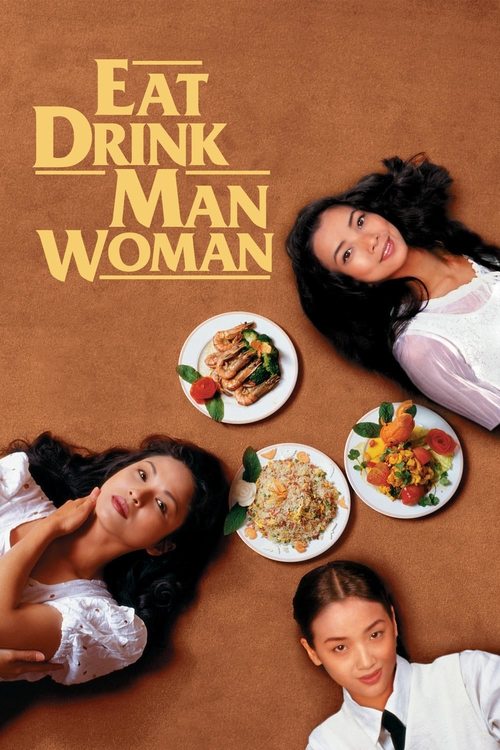
Eat Drink Man Woman
1994 · Ang Lee
For a cozy night in when you want to feel good about people again — ideally with dinner, because you will get hungry. Comfort viewing with real substance underneath.
What it's about
In modern Taipei, Chu, a widowed master chef whose palate is fading, cooks an elaborate banquet every Sunday for his three grown daughters — a repressed schoolteacher, an ambitious airline executive, and a student — even as the ritual strains under everything the family can't say aloud. One by one, new romances and life changes pull at the household, and the old man turns out to have surprises of his own.
The experience
Warm, funny, and quietly moving, paced like a long family meal — it sneaks up on you. The food scenes are genuinely mouthwatering, and underneath the comedy of dating and generational friction runs a gentle melancholy about time passing.
Performances
Sihung Lung anchors it beautifully as the father — dignified, wry, and heartbreaking in what he doesn't say, letting decades of feeling show in how he handles a cleaver or tastes a soup.
The craft
Ang Lee films the cooking like action choreography — knives, steam, and whole fish shot with loving precision — and uses food as the family's real language, every banquet a coded conversation. The screenwriting juggles four romantic storylines without dropping the emotional throughline.
Why it matters
An Oscar nominee for Best Foreign Language Film, it capped the trilogy of family comedies that launched Ang Lee internationally and set the template for the food-as-love film that countless movies have followed since.
Snapshot
Eat Drink Man Woman (飲食男女, Yǐnshí nánnǚ) is Ang Lee's third feature and the closing panel of what is commonly called his "Father Knows Best" trilogy — preceded by Pushing Hands (1991) and The Wedding Banquet (1993). Set in contemporary Taipei, it follows the widowed master chef Chu (Sihung Lung), who presides over an elaborate Sunday dinner ritual for his three grown daughters even as his own palate, and the family that the meals are meant to bind, quietly dissolves. The film braids three courtship plots — the repressed schoolteacher eldest, the ambitious airline-executive middle daughter, the youngest still in school — against the father's own unspoken late-life desires. Its governing conceit is culinary: food as the language a family speaks when it cannot speak directly. The picture earned an Academy Award nomination for Best Foreign Language Film (representing Taiwan) and consolidated Lee's standing as a director capable of fusing Chinese family melodrama with the rhythms of art-house comedy for international audiences. It is, with The Wedding Banquet, the film that made Lee bankable to Hollywood and set the stage for his English-language career.
Industry & production
The film was a Taiwan–United States co-production, financed principally through the Central Motion Picture Corporation (CMPC) of Taiwan and produced on the American side by Good Machine, the lean New York independent outfit run by Ted Hope and James Schamus. This is the same production architecture that had carried The Wedding Banquet: CMPC's institutional backing and Taipei infrastructure combined with Good Machine's low-budget, fiscally disciplined producing model — the company's half-joking in-house philosophy was "Good Machine no-budget filmmaking." Lee shot in Taipei with a largely Taiwanese cast and crew, working in Mandarin.
The screenplay was credited to Lee, James Schamus, and Hui-Ling Wang. The collaboration with Schamus — who could not read or speak Chinese — became one of the more discussed cross-cultural working methods in 1990s independent cinema: Schamus shaped dramatic structure and dialogue rhythm in English while Wang and Lee anchored the cultural and linguistic specificity, the script passing back and forth across translation. Sony Pictures Classics handled the U.S. release, the distributor that would become Lee's frequent American home. Beyond its festival exposure and Oscar nomination, the film's commercial profile is more reliably described in terms of its art-house success and the doors it opened than in hard figures; I would not want to assert specific box-office numbers, as those I could supply are not ones I can verify with confidence.
Technology
The film was shot and finished on 35mm photochemical film, the standard professional format of its moment, well before digital intermediate workflows or digital capture were available to a production of this scale. There is no notable use of special-effects or optical technology; the film's "technology," in the sense that matters, is culinary rather than cinematic. The kitchen sequences required functioning professional cooking — the dishes prepared on camera are real Chinese haute cuisine, executed by professional chefs working as consultants and hand-doubles, with the camera and editing organized around the actual timing of knife work, steaming, frying, and plating. The technical achievement lies in coordinating live food preparation with coverage tight enough to read as virtuosic, a problem of staging and continuity rather than post-production trickery.
Technique
Cinematography
Jong Lin (Lin Liang-chung), Lee's regular cinematographer through this early period, shot the film. The visual scheme is unshowy and observational, keyed to the domestic interior — the Chu house with its dining table as gravitational center, and the steam-and-steel theater of Chu's professional kitchen. Lin's most celebrated work here is the opening cooking sequence, a montage of Chu preparing the Sunday banquet that functions as overture: close, tactile inserts of cleaver, fish, fowl, and wok, cut to the precise tempo of the cooking. The camera treats food with the gravity usually reserved for faces. Elsewhere the lensing favors clean, legible compositions that keep the family's seating arrangement at the dinner table readable as a social map — who sits where, who looks at whom, who is absent.
Editing
Tim Squyres edited the film, beginning a long and central partnership with Lee that would run through Sense and Sensibility, Crouching Tiger, Hidden Dragon, and beyond. The editing is the film's most analyzable formal achievement. The opening culinary sequence is essentially a montage tour de force, building a portrait of competence and ritual entirely through the rhythm of cutting. Across the body of the film, Squyres and Lee use the recurring Sunday dinners as structural punctuation — a refrain that returns the dispersing family to one table and lets the audience measure change against a fixed form. The film's reputation for a late-act "reveal" depends on editing discipline: information is withheld and parceled through the meal structure, so that the comedy's reversals land at the table where the whole film has been pointing.
Mise-en-scène / staging
Staging is organized around two charged spaces: the table and the kitchen. The Chu family home, with its slightly faded mid-century furnishings, encodes the father's traditionalism and the daughters' restlessness within it. Lee blocks the Sunday dinners as ensemble set pieces — the daughters' announcements (each, in turn, declaring a departure or a new attachment) are staged as interruptions to ritual, the dramatic beat literally landing between courses. Food is the dominant prop and metaphor: Chu's declining sense of taste is staged as a quiet bodily fact, a man who can no longer savor what he can still produce, while the abundance of the meals contrasts with the family's emotional reticence. The title's four appetites — eating, drinking, man, woman, drawn from a phrase in the Confucian Book of Rites glossing the basic human desires — are made visible in the household's arrangement of plenty and want.
Sound
The score is by the German-born composer credited as Mader, who had also worked on The Wedding Banquet. The music is restrained, supporting rather than driving the comedy. The film's richest soundwork is diegetic and culinary: the chop of the cleaver, the hiss of oil, the clatter of the kitchen, the layered overlapping speech of a family talking past one another at table. Sound carries the sensory argument that the images make — that this is a film about appetite — by foregrounding the noise of cooking as something close to musical.
Performance
Sihung Lung anchors the film as Chu, his third role for Lee after playing patriarchs in both prior trilogy films; his performance is a study in dignified withholding, a man whose feeling is legible only in his cooking and his silences, which makes the film's late turn land. The three daughters are played by Yang Kuei-Mei (the devout, jilted-in-the-past eldest, Jia-Jen), Wu Chien-lien (the worldly, conflicted middle daughter Jia-Chien, the film's emotional center and the one most like her father), and Wang Yu-wen (the youngest, Jia-Ning). The ensemble playing is naturalistic and finely calibrated to the comedy of manners; Wu Chien-lien in particular carries the film's strongest dramatic line, the daughter whose career ambition and buried tenderness toward her father mirror his own contradictions.
Narrative & dramatic mode
The film operates as a domestic tragicomedy built on parallel-plot construction: three daughters' romantic arcs run concurrently with the father's concealed one, each thread advancing between the Sunday dinners that serve as the narrative's metronome. The dominant mode is the comedy of manners crossed with family melodrama — misdirection, mismatched expectations, and a structural fondness for the reversal. Lee withholds key information and lets it detonate at the table, so the plot's pleasures are those of revelation and recontextualization: characters (and viewers) repeatedly discover that the attachment they assumed was forming is not the one that was. The tone modulates between gentle irony and genuine pathos, and the film resists a tidy restoration of the traditional family; instead it ends on transformation and a small, pointed grace note about the father's recovered appetite.
Genre & cycle
Eat Drink Man Woman sits at the intersection of the family melodrama, the romantic comedy, and the "food film" — the loose cycle of early-1990s art-house pictures in which cuisine becomes the central sensory and metaphorical engine. It is frequently grouped with Babette's Feast (1987), Tampopo (1985), and Like Water for Chocolate (1992) as a defining example of the genre, and it arguably perfected the form's marriage of culinary spectacle to emotional narrative. Within Lee's own output it completes the trilogy cycle of films about Chinese fathers negotiating tradition and change, a cycle unified by Sihung Lung's recurring patriarch and by the theme of the family as a site of generational and cultural strain.
Authorship & method
The film is a touchstone for understanding Ang Lee's authorial method: emotional restraint, an interest in the gap between social ritual and private desire, and a fascination with characters who cannot say what they feel. His recurring collaborators define the period's house style — James Schamus as co-writer and producer (the trans-linguistic writing partnership being central to how Lee's "Chinese" films were also legible abroad), editor Tim Squyres, cinematographer Jong Lin, and screenwriter Hui-Ling Wang, who supplied cultural grounding. Lee's process here is notable for its rigor around the cooking: the food was treated as a performance requiring its own choreography and expert execution, an early instance of the meticulous craft-coordination that would later scale up to the wuxia action of Crouching Tiger, Hidden Dragon. The authorial signature is humanist and self-effacing — Lee subordinates visual flourish to performance and structure, trusting the screenplay's architecture and the actors' faces.
Movement / national cinema
The film belongs to the broader story of Taiwanese cinema's international visibility in the late 1980s and 1990s, the era of the Taiwan New Wave associated with Hou Hsiao-hsien and Edward Yang and supported institutionally by the Central Motion Picture Corporation. Lee, however, occupies a distinctive position: trained in the United States (at the University of Illinois and NYU) and operating through a U.S. independent producing base, he is a more diasporic, cross-cultural figure than the art-cinema modernists of the New Wave proper. His films of this period are better understood as transnational Chinese-language cinema — Taiwanese in production and language, but shaped by American independent filmmaking and pitched, successfully, to a global art-house audience. The film thus stands at a hinge between Taiwanese national cinema and the globalized, festival-circuit Chinese-language film of the 1990s.
Era / period
Made and set in the mid-1990s, the film registers a Taipei in transition — a modern, prosperous, internationally connected city in which traditional family structures and Confucian filial expectation are under visible pressure from women's careers, changing sexual mores, and individual self-determination. The middle daughter's corporate aviation career and apartment-buying ambitions, the casual dating of the youngest, the eldest's religiosity and romantic frustration: each maps a different vector of generational change. The film's contemporaneity is part of its argument; it deliberately sets the father's vanishing world of artisanal banquet cookery against a city moving on from it.
Themes
The title names the film's governing theme — basic human appetite, the desires for food and for the opposite sex that Confucian tradition placed at the root of human nature — and the film treats these appetites as continuous: eating and loving are the same hunger in different registers. Surrounding this are Lee's enduring concerns: the tension between filial duty and individual desire; communication and its failure within families (a family that expresses love through food precisely because it cannot say so in words); the obsolescence of the patriarch and the inversion of expectations about which generation needs caretaking; and the late-life reclamation of desire. Chu's lost sense of taste is the central symbol — a man who has lost his capacity for pleasure even as he produces it for others — and the film's final movement, restoring it, ties the recovery of appetite to the unexpected reconstitution of a life.
Reception, canon & influence
Critically, the film was warmly received in the West and became, with The Wedding Banquet, the work that established Lee internationally; its Academy Award nomination for Best Foreign Language Film (it was selected as Taiwan's submission) is the clearest institutional marker of its standing. Critics singled out the bravura cooking sequences, the warmth and intelligence of the ensemble, and Lee's deft tonal control. The film is now a fixture in discussions of the "food film" and in surveys of 1990s transnational Chinese cinema, and it remains a staple reference in writing on Lee's career as the culmination of the Father trilogy.
Looking backward, the film draws on Chinese family-melodrama traditions and on the Confucian framing announced in its title (the phrase derives from the Book of Rites), filtered through the comedy-of-manners structure and parallel-plotting that Lee and Schamus favored. Looking forward, its most direct legacy is the official Hollywood remake Tortilla Soup (2001, dir. María Ripoll), which transposed the premise to a Mexican-American family in Los Angeles, with Hector Elizondo in the chef role — a clear index of the original's portability and appeal. More broadly, the film helped cement the template of the culinary family drama and launched the international phase of Ang Lee's career, the credibility it built (alongside The Wedding Banquet) leading directly to his recruitment for Sense and Sensibility (1995) and his subsequent move between Chinese- and English-language cinema. Its collaborative through-lines — Squyres, Schamus, Lung — make it a foundational document for the working method that produced Crouching Tiger, Hidden Dragon at the decade's end.
A Deleuzian reading
Start with the cleaver.
The full Deleuzian reading of Eat Drink Man Woman →
Reception
A critical and arthouse-crossover hit in 1994 — Oscar-nominated for Best Foreign Language Film — it capped Ang Lee's 'Father Knows Best' trilogy before he went global; today it's less 'prestige foreign film' and more beloved comfort-food classic, the gateway Ang Lee for many cinephiles.
How Eat Drink Man Woman was received, from release to now →
Influences: the films it descends from and the films it influenced
- Late Spring (1949) — Supplies the core structural engine — a widowed father and the marrying-off of a daughter staged through recurring domestic meal scenes — and Ozu's framing of filial duty silently warring with private desire, which Lee transposes wholesale to a Taipei kitchen.
- An Autumn Afternoon (1962) — Refines the exact patriarch-loneliness Lee borrows: an aging father releasing his daughter into marriage, his feeling displaced into food-and-drink ritual rather than spoken, the gap between table decorum and interior grief held in the actor's face.
- Babette's Feast (1987) — Establishes the climactic meal as a real-time choreographed performance in which cooking becomes a near-sacramental expressive language — the model for Lee's wordless opening culinary overture as emotional statement.
- Tampopo (1985) — Codifies food-film grammar — loving close-up choreography of preparation and amplified diegetic culinary sound (chopping, sizzling, slurping) as a sensory track — that Lee deploys in his montage-overture and kitchen staging.
- Like Water for Chocolate (1992) — Pioneers cooking as the channel for feelings forbidden by family hierarchy and silence, making the kitchen the emotional center of a melodrama about appetite-as-language — Lee's premise of food carrying what characters cannot say.
- Pushing Hands (1991) — First of the Father trilogy; introduces Sihung Lung's displaced patriarch and the Schamus/Wang/Lung working method — restraint, ritual-versus-desire — that Eat Drink Man Woman brings to culmination.
- Sense and Sensibility (1995) — The international credibility Eat Drink Man Woman built recruited Lee for Austen, where he carries the identical method — emotional restraint and comedy-of-manners tension between social ritual and unspoken feeling — into English.
- Big Night (1996) — Extends the choreographed-meal-as-climax and the kitchen-and-table-as-stage, with the brothers' love and rivalry voiced through cooking rather than dialogue — the food-as-language structure Lee popularized.
- Soul Food (1997) — Adopts the recurring family meal (here Sunday dinner) as the structural anchor holding a fracturing multi-character family together — the meal-as-pulse device that organizes Eat Drink Man Woman's narrative.
- What's Cooking? (2000) — Builds a parallel multi-family ensemble around a single shared holiday meal, inheriting Lee's template of using the table to interlace separate plot strands of generational and cultural friction.
- Crouching Tiger, Hidden Dragon (2000) — Scales up the meticulous craft-coordination Lee developed choreographing the cooking sequences into wuxia action choreography, with Tim Squyres editing and the same restraint between coded duty and forbidden desire.
- Tortilla Soup (2001) — The official Hollywood remake, transposing the widower-chef-and-three-daughters premise and meal-structured plot to a Mexican-American Los Angeles family — direct proof of the original's portable architecture.
- Ratatouille (2007) — Carries forward the food-film grammar of preparation-as-performance and food as a language that crosses barriers, animating cooking choreography in the lineage of Babette's Feast and Lee's culinary set pieces.
- The Ice Storm (1997) — Lee's editing of familial duty through ritual (the family meal) and cross-cut parallel lives, observing foolish characters without contempt.
- Saving Face (2004) — Lee's device of using shared meals as the staging ground for a widowed patriarch's own concealed late-life romance mirroring his children's love lives — a structure Wu inverts onto a pregnant widowed matriarch.
- Little Forest (2018) — Its documentary-precise opening cooking montage — knife work, steam, plating shot with the rigor of a demonstration — established the tactile culinary realism Little Forest applies to farm-to-plate labor.
- The Farewell (2019) — Lee's use of the crowded banquet table as the primary staging device — generational tension displaced into food, seating, and toasts rather than confrontation — is the blueprint for Wang's restaurant and dinner scenes.
- How to Make Millions Before Grandma Dies (2024) — Routes Chinese family obligation and generational friction through food and the shared table as the recurring set-piece of care, a device the seed reuses around Grandma's cooking.
- The Wedding Banquet (1993) — Immediate Father-trilogy companion built on the same banquet-as-set-piece and comedy-of-manners architecture, where elaborate ritual conceals private desire and the same Schamus trans-linguistic co-writing keeps a 'Chinese' film legible abroad.
- The Scent of Green Papaya (1993) — Contemporary transnational-Asian art-cinema sibling that turns slow, attentive domestic food preparation into character, labor, and sensory texture — the same diegetic-culinary attention rendered as contemplation.
- The Joy Luck Club (1993) — Sibling in 1990s transnational Chinese cinema, using the gathering-around-the-table as a framing device for intergenerational, parallel storytelling about duty and desire across mothers and daughters.
- Yi Yi (2000) — Taiwan New Wave kin observing a multi-generational Taipei family through interwoven parallel plotlines amid the same urban social transition Lee's facets name — ensemble structure over visual flourish.
- Still Walking (2008) — Lee built an entire family drama around meal preparation and the table as the arena where parent and adult children negotiate love and disappointment — the same food-as-language craft Kore-eda foregrounds.
Similar films
- The Wedding Banquet (1993) — influence & lineage · same viewing thread
- Babette's Feast (1987) — influence & lineage
- Like Water for Chocolate (1992) — influence & lineage
- The Joy Luck Club (1993) — influence & lineage
- Tampopo (1985) — influence & lineage
- Big Night (1996) — influence & lineage
- Yi Yi (2000) — influence & lineage
- Sense and Sensibility (1995) — influence & lineage
All the films related to Eat Drink Man Woman →
Watch it with: curated runs of related films
- Love Against the Grain — A run of films where desire refuses the shape its world demands — opera stages, drought-struck Taipei, an honor-bound Lahore household, drenched Buenos Aires — and burns brighter, and more dangerously, for the refusal.