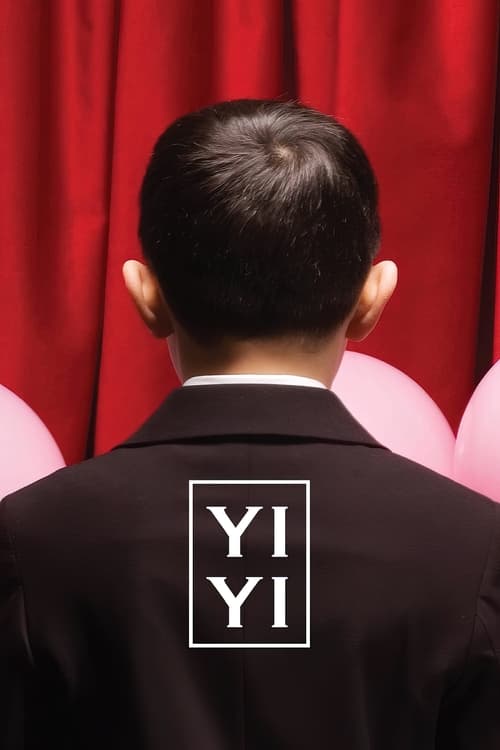
Yi Yi
2000 · Edward Yang
For when you want a film to live inside for an evening and chew on for days — contemplative rather than difficult, and one of those movies that seems to be about you no matter who you are. Save it for a night you can give it your full attention.
What it's about
A wedding opens it and a funeral closes it, and in between an ordinary Taipei family quietly comes apart and back together. When the grandmother falls into a coma, each relative is urged to speak to her — and discovers how little they can say for themselves: the father crosses paths with a lost love, the teenage daughter stumbles into first romance, and eight-year-old Yang-Yang photographs the backs of people's heads to show them the half of life they can't see.
The experience
Three hours that feel like a whole life passing gently through you — patient, tender, quietly funny, and cumulatively overwhelming. Nothing is rushed; everything lands.
The craft
Edward Yang composes through glass and reflection, the city's lights floating over his characters' faces so that intimacy and urban distance share a single frame. The framing is precise without ever feeling cold, and the long takes let scenes breathe until they reveal themselves.
Why it matters
It won Yang Best Director at Cannes in 2000 and stands as the crowning work of the Taiwanese New Cinema — routinely named among the greatest films of its era.
A wedding opens it, a funeral closes it, and in between Edward Yang holds an entire Taipei family — and something like the whole span of a life — in delicate suspension. Grandmother falls into a coma; each relative, urged to speak to her, discovers how little they have to say for themselves. The father meets a lost love in Tokyo; the daughter stumbles into first romance; and eight-year-old Yang-Yang photographs the backs of people's heads, showing them the half of life they cannot see — as clean a statement of what cinema is for as anyone has managed. Yang, the great architect of the Taiwanese New Cinema alongside Hou Hsiao-hsien, composes through glass and reflection, the city's lights floating over his characters' faces, intimacy and urban distance in a single frame. He won Best Director at Cannes in 2000; a long-gestating animation project and then cancer meant he never completed another feature, and he died in 2007. Three hours pass like an afternoon with people you love. Its Chinese title means, roughly, 'one one' — simple things, one by one.
A Deleuzian reading
An eight-year-old hands a grown man a photograph of the back of his own head.
The full Deleuzian reading of Yi Yi →
Reception
Won Yang Best Director at Cannes in 2000 and was acclaimed from day one, but its stature has only grown — topping best-of-the-2000s critics' lists and landing in the top ten of the BBC's 2016 poll of the century's greatest films. It's now routinely called the definitive film of the 21st century's first year.
How Yi Yi was received, from release to now →
Influences: the films it descends from and the films it influenced
- Tokyo Story (1953) — The multi-generational family ensemble in which a domestic occasion quietly turns to death, with the heaviest emotional beats left offscreen and carried by still, low, symmetrical framing — Yang's wedding-to-funeral scaffold inherits this ellipsis.
- The Rules of the Game (1939) — Deep-focus staging that runs several characters' dramas simultaneously inside one frame, treating the extended household as a cross-section of society — the ensemble-in-depth method Yang deploys across three generations of the Jian family.
- Playtime (1967) — Figures held at a distance through and against modern plate glass, with reflections layering interior office life over the exterior city — the precise optical grammar of Yang's Taipei tower and restaurant windows.
- L'Eclisse (1962) — Modernist urban alienation composed through reflective surfaces and hard architecture that hold characters at a cool geometric remove, the reflection-and-glass distance Yang adopts for corporate Taipei.
- Short Cuts (1993) — Interwoven multi-strand ensemble in which parallel domestic lives rhyme and glance off each other without fully converging — the braided structure behind Yang's parallel-generations design.
- A Brighter Summer Day (1991) — Yang's own earlier long-take, wide-frame ensemble grammar, nesting characters inside doorways, windows and courtyards so the city frames the family — the formal toolkit he refines in Yi Yi.
- Late Spring (1949) — Yang's multigenerational family epic uses static, symmetrically composed interiors and a calm observational ellipsis over weddings and funerals that extend Ozu's contemplative domestic framing into contemporary Taipei.
- Terrorizers (1986) — Yang's late masterwork returns to the photograph-as-motif through the boy who shoots the backs of people's heads to reveal what they cannot see — the camera-as-limited-witness idea seeded in Terrorizers.
- Dust in the Wind (1986) — Sustains TNC's deep-staged domestic long takes and offscreen handling of birth and death, closing the movement's decade-long project of undramatized everyday observation.
- Floating Clouds (1955) — Carries forward the tradition of undemonstrative, eye-level family observation in which private disappointment accumulates across small scenes without melodramatic release or authorial commentary.
- Taipei Story (1985) — Yang's own Cannes-winning culmination of the systemic method, its signature reflective-window frames superimposing city over face grown directly from the glass-surface staging of Taipei Story.
- That Day, on the Beach (1983) — Perfects framing-through-partitions with glass reflections layering interior and exterior life, the culmination of the debut's compositional device of shooting characters through windows and doorways.
- Still Walking (2008) — A single family memorial gathering expanded into a whole-life ensemble portrait, with everyday duration and domestic framing carrying grief the way Yi Yi does — direct inheritance of the Ozu-via-Yang line.
- Summer Hours (2008) — A family drama bracketed by a matriarch's death and generational dispersal, using rooms and objects as vessels of memory — the wedding-to-funeral frame recast around inheritance.
- Boyhood (2014) — The whole span of a life rendered through accumulated duration, parallel generations visibly aging, extending Yi Yi's ambition to hold childhood, adulthood and old age in one structure.
- Roma (2018) — Deep-focus single-frame staging of domestic life within the city, slow lateral pans that keep family and street in the same composition — Yang's urban-distance-in-single-frame at feature scale.
- Drive My Car (2021) — Patient everyday duration and ensemble intimacy in which self-reckoning surfaces through quiet conversation and the reflective glass of the modern city.
- Margaret (2011) — A sprawling urban ensemble in which one adolescent's moral reckoning ripples outward through many lives, with distanced crowd-and-architecture inserts treating the city as chorus — Yang's city-and-intimacy weave transposed to Manhattan.
- Sympathy for Mr. Vengeance (2002) — Frame-within-frame compositions — through glass panes, doorways, and walls — that architecturally enclose characters within their circumstances; the specific compositional method Kim Byeong-il applies throughout, trapping figures inside the geometry of their lives.
- Kaili Blues (2016) — Edward Yang's elliptical associative editing, which rhymes images and situations across temporal registers without conventional scene-setting transitions, and his treatment of the city as an archive of personal memory accessible only through structural juxtaposition, are the Chinese-language narrative precedents for Kaili Blues' non-linear memory structure.
- Past Lives (2023) — Model for the counterfactual-romance thread embedded in a diaspora-of-time drama — NJ's reunion with his first love mirrors Nora and Hae Sung — handled with controlled interiority and reflective-surface staging that refuses melodrama.
- House of Hummingbird (2019) — Uses composed middle-distance domestic tableaux and a child observer to map an entire family's emotional life through accumulated small incidents.
- The Farewell (2019) — Wang organizes grief and generational fracture around a single ceremonial gathering the way Yang stages his family drama between a wedding and a funeral, using frontal group tableaux where several relatives are held in one balanced, unmoving shot.
- Riceboy Sleeps (2023) — Generation- and time-spanning family portrait told through patient long-take observation of domestic space, a structural model for the decade-spanning, quietly-accreting family drama.
- A City of Sadness (1989) — The founding Taiwanese New Cinema method of the static, distant wide frame and long take observing a family across time, letting duration rather than cutting shape the drama.
- Vive L'Amour (1994) — Taipei-set slow-cinema duration and glass/reflection framing of urban solitude, the same New Cinema fixation on architecture as an emotional container.
- In the Mood for Love (2000) — Urban intimacy staged through doorways, mirrors and reflective surfaces that double and partition the frame, isolating lovers within the modern apartment-city.
- Platform (2000) — A wide-frame, slow-cinema chronicle tracking parallel lives across generational and social change, the ensemble-as-epoch approach carried onto the mainland.
- Millennium Mambo (2001) — Taiwan New Cinema's present-tense urban observation — naturalistic performance and patient framing turned on contemporary Taipei life.
- Eat Drink Man Woman (1994) — Taiwan New Wave kin observing a multi-generational Taipei family through interwoven parallel plotlines amid the same urban social transition Lee's facets name — ensemble structure over visual flourish.
- Goodbye, Dragon Inn (2003) — Architectural framing through glass, reflections and doorways that dwarfs figures in urban interiors — the same use of built space and layered surfaces to stage alienation.
- Happy Hour (2015) — Multi-strand middle-class ensemble observed in patient static framing across a long runtime, treating everyday life's rhythms as sufficient dramatic material.
- Like Someone in Love (2012) — Sibling in treating window glass as a compositional layer — figures framed behind panes where the reflected city doubles them — so that urban surfaces perform the psychological work a close-up would otherwise do.
Similar films
- A Brighter Summer Day (1991) — influence & lineage · same viewing thread
- Tokyo Story (1953) — influence & lineage
- In the Mood for Love (2000) — influence & lineage
- Summer Hours (2008) — influence & lineage
- Still Walking (2008) — influence & lineage
- Taipei Story (1985) — same viewing thread
- So Long, My Son (2019) — same viewing thread
- A Sun (2019) — same viewing thread
All the films related to Yi Yi →
Watch it with: curated runs of related films
- Sinophone Slow Cinema — A run of Chinese-language films — Taiwan's New Wave and its mainland and Bi Gan heirs — where time pools and city, family, and memory recur; watch them near each other, from A Brighter Summer Day to An Elephant Sitting Still, for how they rhyme on drift and the weight of the past.