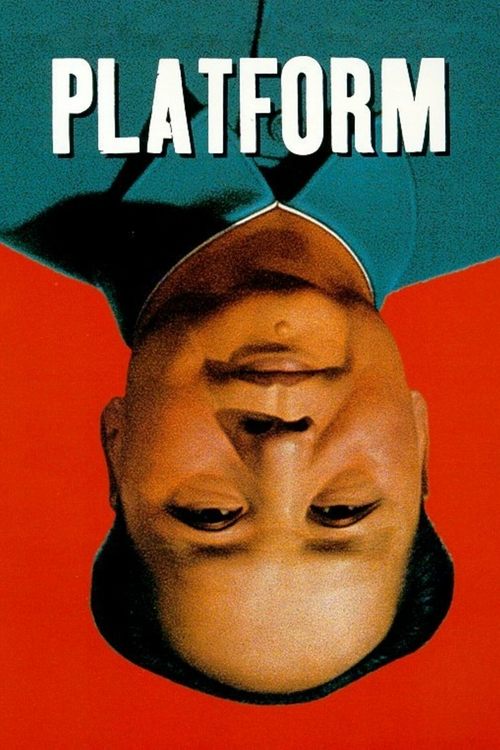
Platform
2001 · Jia Zhangke
Caught by the Tides, assembled from 20 years of footage, made him the definitive chronicler of China's transformation and the reference point for making art inside censorship constraints.
For a night when you have time and attention to give — when you want a film to sink into and chew on for days rather than a quick hit. Definitely challenge over comfort, and best with no phone in reach.
What it's about
A state-run song-and-dance troupe in a dusty provincial Chinese town starts the film performing Maoist anthems and ends it, a decade later, privatized into a ragtag touring rock-and-breakdance act. Through four young performers — their romances, ambitions, and slow drift — the film watches China's transformation from the late 1970s into the early 1990s as it actually felt on the ground: not in headlines, but in haircuts, pop songs, and passing trains.
The experience
Slow, spacious, and cumulative — long takes held at a distance, where whole relationships shift inside a single unbroken shot. It asks patience and repays it with a melancholy that builds until the ending lands with surprising force; you feel a decade pass through you.
Performances
Zhao Tao, in an early collaboration with Jia Zhangke, gives the film much of its quiet ache — her restraint makes the character's compromises feel like the country's.
The craft
Jia Zhangke composes in long, static wide shots that turn provincial streets and crumbling walls into a stage for history, and he uses period pop music as the film's real narrator — you can date every scene by what's playing on the radio. It's epic filmmaking made from small rooms and open landscapes, and the widescreen compositions reward the biggest screen you can find.
Why it matters
A cornerstone of Chinese independent cinema and the film that established Jia as the great chronicler of his country's economic transformation, influencing a generation of filmmakers documenting societies in fast-forward.
Snapshot
Platform (站台, Zhàntái) is Jia Zhangke's second feature and the centerpiece of what critics call his "Hometown Trilogy," bracketed by Xiao Wu (1997) and Unknown Pleasures (2002). It follows the members of the Fenyang Peasant Culture Group, a state-run song-and-dance troupe in provincial Shanxi, across roughly a decade—from the tail end of the Cultural Revolution around 1979 to the early 1990s—as economic liberalization transforms the country and the young performers along with it. The troupe begins the film singing Maoist agitprop ("The Train Heading for Shaoshan") and ends it, privatized and rebranded, as an itinerant "All-Star Rock and Breakdance Electronic Band." Through four principal figures—Cui Mingliang, Zhang Jun, Yin Ruijuan, and Zhong Ping—Jia charts an entire epoch of Chinese life as it registers not in headlines but in haircuts, pop songs, bell-bottoms, cigarette brands, and the slow erosion of collective idealism. The film premiered in competition at the Venice Film Festival in 2000, with wider international circulation in 2001, and quickly established Jia as the foremost chronicler of China's reform-era interior. Its title comes from a hugely popular 1980s Mandopop ballad about waiting on a railway platform—an image of longing, departure, and the yearning of the provinces for a modernity always arriving elsewhere.
Industry & production
Platform was made outside China's official film system. Like Xiao Wu, it was produced without approval from the state Film Bureau, which rendered it technically illegal to screen domestically and consigned it—along with Jia himself for several years—to "underground" or unofficial status inside China even as it circulated freely on the international festival circuit. The film's financing was transnational and characteristic of the ecosystem that sustained independent Asian art cinema at the turn of the millennium. The key producer was Shozo Ichiyama, working through Takeshi Kitano's Tokyo-based company (Office Kitano / T-Mark), with Hong Kong involvement via Hu Tong Communications and producer Chow Keung, and additional European backing (French and other sources typical of the era's co-production arrangements). This patchwork of Japanese, Hong Kong, and European money—rather than mainland state support—is itself part of the film's meaning: a portrait of China assembled from the outside looking in.
Production centered on Jia's actual hometown of Fenyang and other Shanxi locations, shot on location rather than on sets, with a mix of professional and non-professional performers. The film was made economically and patiently, in keeping with a working method that prized observation over spectacle. The wider release date of 2001 reflects the festival-then-distribution rhythm by which such films reached audiences.
Technology
Platform is a photochemical, 35mm production, and part of its texture derives from that materiality: grainy, muted, often overcast imagery well suited to the coal-country palette of Shanxi. (This distinguishes it from Jia's later, digitally shot work such as Unknown Pleasures and The World, which embraced early DV.) The film's relationship to technology is also thematic rather than merely instrumental. It is, in a real sense, a film about the arrival of technologies of modernity into the provincial interior: the transistor radio and cassette tape that smuggle Taiwanese and Hong Kong pop past official culture; the perm and the electric guitar; the television; and above all the railway. In one of its most celebrated passages, the troupe's members, riding in the back of a truck, spot a train for the first time and scramble up an embankment to chase and cheer it—technology as pure object of desire, the promise of elsewhere made briefly visible before it vanishes. The "platform" of the title is where one waits for such machines to carry one away.
Technique
Cinematography
The film was photographed by Yu Lik-wai (Nelson Yu), Jia's regular and defining cinematographer. His work here is foundational to the film's grammar: long, frequently static or very slowly reframing takes; wide and medium-wide compositions that hold figures within their environments rather than isolating them; deep staging that lets action unfold across multiple planes; and an insistence on natural light and the drab, dusty tonalities of the northern Chinese winter. Characters are often small within the frame, framed through doorways, windows, and courtyards, dwarfed by the walls of Fenyang and the vast flatness of the loess landscape. The camera rarely intervenes to underline emotion; it observes at a respectful, almost architectural distance, allowing duration itself to do expressive work.
Editing
Cut by Kong Jinglei, Platform is famously elliptical. It spans roughly a decade but proceeds by jumps and gaps, trusting the viewer to reconstruct the passage of years from changes in clothing, music, slang, and the characters' faces. Rather than conventional establishing signposts, transitions are marked by the accretion of period detail. The film exists in more than one length: a longer cut running well over three hours was screened in some contexts, while the standard international release is roughly 150–155 minutes. Even in its shorter form, the editing favors long-held shots over rapid découpage, so that the film's rhythm is one of patience punctuated by the sudden acceleration of history.
Mise-en-scène / staging
Staging is where Platform does much of its historical thinking. Jia dresses the world with meticulous specificity—propaganda banners giving way to advertising, Mao suits to bell-bottoms and leather jackets—so that the frame becomes a stratigraphy of the reform decade. Performances-within-the-film structure the whole: the troupe's evolving stage acts (revolutionary chorus, then Deng-era light entertainment, then rock and breakdance) function as a barometer of ideological change. Blocking tends toward the naturalistic and the oblique; conversations happen at angles, backs are turned, and crucial emotional beats are staged in the middle distance or partly offscreen.
Sound
The soundtrack is one of the film's great achievements and is dominated by diegetic period pop music, which serves as a precise historical index: revolutionary anthems, Teresa Teng's forbidden love songs seeping in from Taiwan, the disco novelty "Genghis Khan," and the title ballad "Platform" itself. Music is not decoration but the very medium through which the outside world and its promises reach Fenyang. Ambient sound—wind, loudspeakers, distant machinery—is dense and location-specific. An original score is credited to the Japanese composer Yoshihiro Hanno, a frequent Jia collaborator of the period, though the film's sonic identity rests overwhelmingly on the pop songs of the era.
Performance
Acting is naturalistic and restrained, favoring behavior over declamation. Wang Hongwei—the star of Xiao Wu—plays Cui Mingliang, the film's wry, drifting center. Platform is notable as the debut of Zhao Tao, who plays Yin Ruijuan and who would become Jia's most important on-screen collaborator (and, later, his wife), appearing in nearly all his subsequent films; her watchful reticence here already anchors the film's emotional undertow. Liang Jingdong (Zhang Jun) and Yang Tianyi (Zhong Ping) complete the quartet. Performances are pitched low, with feeling conveyed through posture, silence, and small gestures rather than dramatic outburst.
Narrative & dramatic mode
Platform is an anti-melodrama and a deliberately de-dramatized epic. It has the scope of a historical saga but refuses the shape of one: there is no single crisis, climax, or resolution, only the diffuse pressure of time on a group of ordinary people. The dramatic mode is observational and cumulative—a chronicle rather than a plot. Emotional stakes accrue through repetition and gap: relationships form, drift, and lapse across unmarked years; ambitions curdle quietly into compromise. Jia's structuring principle is the ellipsis, and his subject is less any individual fate than the collective experience of living through change too large to perceive from within. The effect is elegiac: by the end, youth has passed almost without anyone noticing, and the "platform" of departure has become a place of return and settling.
Genre & cycle
Nominally a drama and a historical film, Platform belongs to several overlapping cycles. It is a landmark of Chinese independent ("underground") cinema and of what scholars term the "Sixth Generation" or "Urban Generation" of mainland filmmakers who emerged in the 1990s. It is also a canonical work of what would come to be called "slow cinema," and a coming-of-age story reconceived at the scale of a nation. Within Jia's own output it forms the middle panel of the Fenyang / Hometown Trilogy. Its generational and thematic preoccupation—the periphery living the reform era through its popular culture—defines a whole strand of turn-of-the-millennium Chinese art film.
Authorship & method
Platform is a deeply personal, largely autobiographical work: Jia Zhangke grew up in Fenyang during exactly the years the film depicts, and the milieu of provincial performers, cassette-tape pop, and thwarted longing is drawn from lived memory. Jia wrote as well as directed, and his method is consistent across the trilogy: location shooting in his home region, a documentary-inflected observational style, long takes, natural light, ambient sound, and the mixing of professional and non-professional actors. His key collaborators here constitute the core creative team that would define his cinema for two decades: cinematographer Yu Lik-wai, whose distanced long-take framing is inseparable from Jia's authorship; producer Shozo Ichiyama, who anchored the transnational financing; editor Kong Jinglei; actors Wang Hongwei and, decisively, Zhao Tao; and composer Yoshihiro Hanno. Jia's authorship is defined by a Bazinian faith in duration and the recorded real, married to a historian's attention to the small material signs by which epochs change.
Movement / national cinema
The film sits at the heart of post-1989 mainland Chinese independent cinema. Jia positioned himself explicitly against the internationally celebrated Fifth Generation (Zhang Yimou, Chen Kaige), whose lush, allegorical historical epics he regarded as remote from ordinary Chinese experience. Against their mythologized rural China, Jia offered the drab, specific, unspectacular present-and-recent-past of the provinces, shot without official sanction. His cinema is thus doubly marginal—geographically (the interior rather than the coastal metropolises) and institutionally (outside the state studio system). Internationally, Platform is often read within a lineage of contemplative Asian art cinema, and its relationship to Taiwanese master Hou Hsiao-hsien is especially close.
Era / period
The film's period setting—roughly 1979 to the early 1990s—is not backdrop but subject. This is the decade of Deng Xiaoping's "reform and opening up," when the command economy gave way to market forces, the "iron rice bowl" of guaranteed state employment dissolved (the troupe is literally privatized), and Western and Taiwanese/Hong Kong consumer culture flooded in. Jia registers this vast transformation through its smallest sediments: the shift from revolutionary songs to disco, from collective enterprise to individual hustle, from Mao suits to perms and flared trousers. The film is, in this sense, a materialist social history of the Chinese 1980s written in the vernacular of pop.
Themes
The governing themes are time and its passage—how a decade slips away, how youth and idealism erode almost imperceptibly under the weight of ordinary life. Longing and waiting suffuse the film, crystallized in the title's railway platform and in the recurring motif of trains, roads, and departures that promise escape to a modernity always located elsewhere. Platform is preoccupied with the collision of collectivism and the market, and with disillusionment—the gap between the era's rhetoric of transformation and the muted, compromised lives that result. Mobility and stasis are held in tension: everyone wants to leave the provinces, yet the film's arc bends toward return and resignation. And popular culture functions throughout as both liberation and historical marker, the medium through which desire, memory, and the outside world enter the interior.
Reception, canon & influence
Critically, Platform was received internationally as a major work and confirmed Jia as one of world cinema's most important emerging voices; it competed for the Golden Lion at Venice in 2000 and won prizes on the subsequent festival circuit (the precise slate of awards is best verified against festival records rather than asserted from memory here). Over the following two decades it has been widely canonized, appearing on numerous critics' lists of the best films of the 2000s and of contemporary Chinese cinema, and it is routinely cited as one of Jia's finest achievements.
The influences on the film are legible and acknowledged. The long-take, deep-focus observational aesthetic descends from Italian neorealism and from André Bazin's realist theory; the elliptical historical chronicle and the distanced framing of memory owe a profound debt to Hou Hsiao-hsien and the Taiwanese New Wave (the resonance with A City of Sadness and Dust in the Wind is frequently noted), with the contemplative tradition of Ozu and the modernist ennui of Antonioni in the background. The film also builds directly on Jia's own Xiao Wu.
Its legacy, forward, is considerable. Platform helped establish Jia as the leading figure of Chinese art cinema; he would go on to win the Golden Lion at Venice for Still Life in 2006 and to become one of the most honored auteurs of his generation. The film is foundational to the international discourse around "slow cinema" and to the reputation of Sixth Generation / independent Chinese filmmaking. It launched Zhao Tao, now a major international actor, and cemented the Jia–Yu Lik-wai partnership. Its model—historical scale rendered through patient observation, period pop, and the textures of everyday provincial life—has shaped a generation of contemplative filmmakers in China and across Asia, and it remains a touchstone for cinema that seeks to write history from the margins rather than the center.
A Deleuzian reading
They are riding in the back of a truck when they see the train.
The full Deleuzian reading of Platform →
Reception
Made underground without state approval and unshowable in China, it premiered at Venice in 2000 to festival-critic acclaim — and within a decade was being ranked among the very best films of the 2000s, now routinely called Jia Zhangke's masterpiece.
How Platform was received, from release to now →
Influences: the films it descends from and the films it influenced
- Bicycle Thieves (1948) — Supplies the neorealist template Jia adopts wholesale — non-professional actors performing on real streets under available light, and the Bazinian faith in the recorded real over constructed drama.
- Tokyo Story (1953) — Models the elision of the 'big' events (deaths and partings happen off-screen or between scenes) and the patiently held static frame, which Platform echoes by refusing melodramatic climaxes and holding on emptied compositions.
- L'Avventura (1960) — Introduces the dead-time (temps morti) of characters drifting through landscape while plot dissolves — the modernist ennui Platform stretches across an entire decade of a troupe's aimlessness.
- The Travelling Players (1975) — The near-exact structural precedent: a wandering theatrical troupe carries a nation's history across years in elliptical sequence-shots, exactly Platform's device of a provincial performing troupe traversing the 1980s.
- Dust in the Wind (1986) — Hou's distanced long takes of departing youth and the rural-to-town passage, rendered as recollection, give Jia his framing of memory and the recurring motif of leaving home.
- A City of Sadness (1989) — Establishes writing national history through the quotidian of one group in deep-focus static tableaux, with epochal upheaval occurring at the frame's edges rather than center — Jia's own 'history from the margins' method.
- Xiao Wu (1997) — Jia's immediately prior film that fixed the Fenyang observational template — long-take portraiture of a marginal figure on home-region locations, with Wang Hongwei leading — which Platform expands from portrait to epic.
- Vive L'Amour (1995) — Static long-take framing of individuals dwarfed by a transforming urban/industrial China — the mainland extension of Tsai's held-shot observation of people small against modernization.
- A Brighter Summer Day (1991) — Carries forward the generational epic that indexes historical change through imported pop music and observes it from patient long-take distance.
- Farewell My Concubine (1993) — Transposes the performing-troupe-through-history structure into a realist register, using a state-then-privatized song-and-dance ensemble as the lens on the reform era — the performer-as-historical-barometer device stripped of operatic melodrama.
- To Live (1994) — Tracks ordinary provincial lives across shifting historical epochs through a state-sanctioned performance troupe, secularizing To Live's performance-frame-plus-generational-sweep into long-take realism.
- Ulysses' Gaze (1995) — Static long-take wide shots stage decades of national change through a wandering performance troupe — a direct echo of Angelopoulos's Travelling Players lineage, landscape as stage.
- The World (2004) — Directly extends the troupe-of-performers-in-a-bounded-space structure, diegetic pop, and Zhao Tao lead into the theme-park economy of globalized migrant labor.
- Still Life (2006) — Yu Lik-wai's long-take deep-staging turns to a landscape being physically erased (the Three Gorges), pushing Platform's stratigraphic 'material signs of a changing epoch' into demolition itself.
- Kaili Blues (2015) — Carries the provincial-memory-in-duration inheritance — small-town Guizhou time-and-passage rendered in extended long takes — into a younger generation's reworking of Jia's observational drift.
- An Elephant Sitting Still (2018) — A four-hour de-dramatized provincial epic that tracks marginal figures through a decaying town in long, following takes — the de-dramatized-chronicle-of-the-overlooked directly downstream of Platform.
- So Long, My Son (2019) — Tells reform-era China across decades through the elliptical, undramatic life of one ordinary family — the de-dramatized epic and 'history from the margins' scaled to the one-child-policy era.
- Ash Is Purest White (2018) — Reprises the exact Platform apparatus — Zhao Tao carried across a decade-plus of reform-era passage, diegetic period pop as time-stamp, Yu Lik-wai's distanced staging — as a late self-echo of the method.
- Suzhou River (2000) — A Sixth Generation contemporary made the same way — underground, outside the studio system, shot on real city locations with documentary-inflected immediacy — the shared independent production mode, though in a handheld subjective register.
- Beijing Bicycle (2001) — A parallel Sixth Generation neorealist quest built from location shooting and non-professional youth, extending the Bicycle Thieves lineage into contemporary Chinese urban space alongside Platform.
- Millennium Mambo (2001) — Hou's contemporaneous continuation of the long-take chronicle of adrift youth, where wall-to-wall diegetic pop marks an era's texture — the same use of period music as a dating device Jia deploys with cassette-tape hits.
- Springtime in a Small Town (2002) — A near-simultaneous exercise in restraint and duration — slow, deep-staged, contemplative framing that privileges stillness over incident, sharing Platform's slow-cinema patience within Chinese cinema.
- Bright Future (2003) — Jia's 35mm long-take observation of Chinese youth adrift in economic transformation — elliptical duration structured around the gap between aspiration and historical constraint — parallels Bright Future's formal and thematic treatment of generational loss under late capitalism.
- What Time Is It There? (2001) — Contemporary slow-cinema in Chinese: static wide long takes registering temporal drift and modernization, sharing Tsai's distance-and-duration approach to characters dwarfed by space.
- Yi Yi (2000) — A wide-frame, slow-cinema chronicle tracking parallel lives across generational and social change, the ensemble-as-epoch approach carried onto the mainland.
- Goodbye, Dragon Inn (2003) — Long-take static realism trained on decaying, about-to-vanish public spaces (troupes, theaters, walls) — a contemporaneous Chinese-language elegy for institutions dying in the frame.
- In the Heat of the Sun (1994) — Periodizes lived experience through the era's mass and pop songs on the soundtrack, measuring private lives against political upheaval much as the film uses Maoist anthems.
- Evolution of a Filipino Family (2004) — Jia's decade-spanning provincial chronicle keeps its actors small inside static wide shots and uses radio and loudspeaker broadcasts to date the political present — the same two devices, staging-in-depth and radio-as-history, that Diaz uses to timestamp his barrio.
Similar films
- Millennium Mambo (2001) — influence & lineage · same viewing thread
- An Elephant Sitting Still (2018) — influence & lineage · same viewing thread
- So Long, My Son (2019) — influence & lineage · same viewing thread
- Dust in the Wind (1986) — influence & lineage · same viewing thread
- The Travelling Players (1975) — influence & lineage
- Goodbye, Dragon Inn (2003) — same viewing thread
- Kaili Blues (2016) — same viewing thread
- What Time Is It There? (2001) — same viewing thread
All the films related to Platform →
Watch it with: curated runs of related films
- Sinophone Slow Cinema — A run of Chinese-language films — Taiwan's New Wave and its mainland and Bi Gan heirs — where time pools and city, family, and memory recur; watch them near each other, from A Brighter Summer Day to An Elephant Sitting Still, for how they rhyme on drift and the weight of the past.