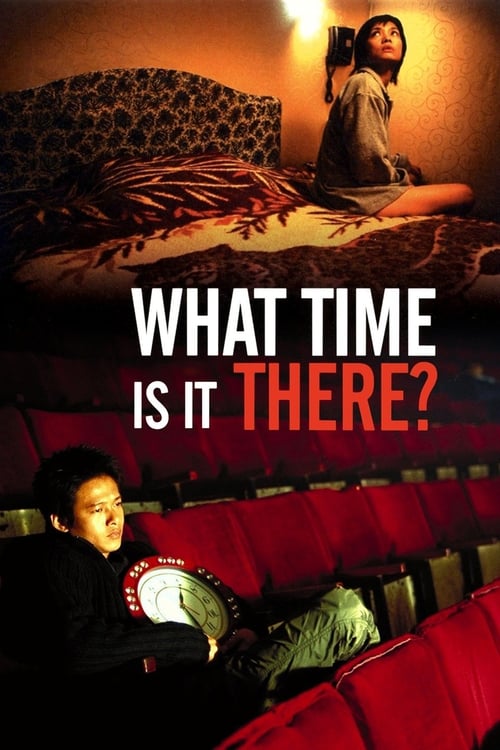
What Time Is It There?
2001 · Tsai Ming-liang
For a quiet, contemplative night when you're feeling a little lonely and want a film that keeps you company in it rather than cheering you up. A challenge for the restless, a balm for anyone willing to slow down.
What it's about
After his father dies, a Taipei street vendor who sells watches becomes fixated on a young woman who bought one from him before leaving for Paris — and starts compulsively resetting every clock he can reach to Paris time. The film follows him, his grieving mother, and the woman adrift in France, three lonely lives ticking along in time zones that never quite line up.
The experience
Slow, still, and nearly wordless — and then, unexpectedly, very funny, a deadpan comedy of ritual and compulsion where the absurdity circles back around to heartbreak. It asks for patience and repays it with a mood that lingers for days.
Performances
Lee Kang-sheng, Tsai Ming-liang's lifelong on-screen alter ego, does almost everything with stillness — a face that barely moves yet carries whole weather systems of grief and longing.
The craft
Tsai's method is unmistakable: fixed camera, long unbroken takes, almost no dialogue, every frame composed so precisely that a small gesture reads like an event. Its love of cinema is woven right in — the vendor watches a bootleg VHS of a French classic — and its hushed, held images are worth watching without distractions.
Why it matters
A defining work of Taiwan's second great cinematic wave and one of the films that fixed Tsai Ming-liang's reputation as world cinema's poet of urban loneliness.
After his father's death, a Taipei watch vendor becomes obsessed with resetting every clock he encounters to Paris time — the city where a young woman who briefly crossed his path has gone. From this fragile premise Tsai Ming-liang, the great solitary of Taiwan's second cinematic wave, composes a film about grief and longing as parallel time zones that never quite synchronize. His method is unmistakable: fixed camera, long unbroken takes, almost no dialogue, and his lifelong on-screen alter ego Lee Kang-sheng, whose stillness carries whole weather systems of feeling. What surprises newcomers is how funny it is — a deadpan comedy of ritual and compulsion, where loneliness expresses itself in behavior so absurd it circles back to heartbreaking. Cinephilia is woven into the fabric: the vendor watches The 400 Blows on bootleg VHS, and Jean-Pierre Léaud himself appears in a Paris cemetery, French New Wave past and Taiwanese present exchanging a glance across forty years. Tsai builds his films from water, clocks, and bodies in empty rooms, and this one distills the obsession most purely. Few filmmakers have made temporal and spatial distance — the sheer ache of elsewhere — so physical.
A Deleuzian reading
A man reaches up to a clock that isn't his and turns the hands back.
The full Deleuzian reading of What Time Is It There? →
Reception
Premiered in competition at Cannes in 2001 to strong reviews and landed high on critics' year-end polls; a quarter-century on it's settled in as one of Tsai Ming-liang's two or three most beloved films and a foundational text of what people now call slow cinema.
How What Time Is It There? was received, from release to now →
Influences: the films it descends from and the films it influenced
- The 400 Blows (1959) — Tsai literally splices the film into his own — Hsiao-kang watches the Léaud VHS — and casts the actual Jean-Pierre Léaud, importing the Antoine Doinel runaway-boy iconography as a diegetic ghost.
- Stolen Kisses (1968) — The aimless-adult Doinel persona that Tsai reactivates by casting the aged Léaud in the Père-Lachaise cemetery encounter, folding a real New Wave body into his frame.
- Late Spring (1949) — The low fixed-height camera and 'pillow-shot' empty rooms held after bodies exit — Tsai's static domestic geometry and vacated interiors descend directly from this.
- L'Eclisse (1962) — Temps morts and the closing montage of depopulated urban architecture; Tsai builds loneliness from held shots of emptied streets and apartments the same way.
- Jeanne Dielman, 23 quai du Commerce (1975) — Real-time durational long takes from a frontal fixed camera observing repetitive household ritual — the clock-watching mother's domestic tasks in WTIIT share this observational patience.
- Au Hasard Balthazar (1966) — The 'model' performance — Lee Kang-sheng's flat, undemonstrative, near-affectless acting is a direct extension of Bresson's anti-expressive direction of non-actors.
- A City of Sadness (1989) — Taiwanese New Wave stasis: wide static tableaux with crucial action pushed off-screen or into deep space, the long-take grammar Tsai inherited and stripped further.
- Good Morning (1959) — Static long-take framing of apartments and family meals, with objects (a clock, a fish) held in fixed compositions, descends directly from Ozu's immobile-camera domestic observation.
- Still Life (1974) — Builds entire scenes from immobile frontal long takes and silence-as-structure, letting characters perform repetitive routine within a fixed frame exactly as Shahid-Saless does.
- Rebels of the Neon God (1994) — Extends the street-commerce and payphone material of Rebels into a two-city parallel structure whose strands are guaranteed never to meet, with the watch and the clock replacing the arcade token as the object that stands in for contact.
- Goodbye, Dragon Inn (2003) — Extends WTIIT's cinephilia motif into a dying movie palace, holding long static takes of a near-empty auditorium watching an old film — the projected-image-as-mourning device pushed to feature length.
- Blissfully Yours (2002) — Durational stillness, minimal dialogue and a bifurcated structure that lets landscape/time absorb narrative — the post-Tsai Asian slow-cinema idiom of the held, unhurried take.
- Colossal Youth (2006) — Fixed-frame durational portraiture of marginal urban figures in emptied rooms — the composed-tableau-as-mourning-space that Tsai's empty-room grammar helped license.
- Stray Dogs (2013) — Late-Tsai pushes the held long take to durational extreme (the minutes-long staring shots) with Lee Kang-sheng again, the logical endpoint of WTIIT's stillness.
- The Wayward Cloud (2005) — Initiated the Hsiao-kang/Shiang-chyi serial continuity that The Wayward Cloud closes out, carrying the same actors' unexplained prior relation across films as narrative information the individual film declines to restate.
- A Brighter Summer Day (1991) — Sibling Taiwanese New Wave method — patient distanced framing of youth alienation rooted in a precisely observed Taipei, sharing the movement's refusal of coverage-style cutting.
- Vive L'Amour (1994) — Same craft system rehearsed: near-wordless Lee Kang-sheng, empty apartments as stages, culminating in the notorious static long-take of unexplained weeping.
- The Hole (1998) — Fixed-camera study of two isolated apartment-dwellers separated by architecture — the vertical/adjacent-space loneliness Tsai reworks into Taipei-vs-Paris separation.
- Café Lumière (2003) — A parallel homage-film built on trains, temporal displacement and Ozu emulation — sibling exercise in citing a master through static framing and quiet duration.
- Platform (2000) — Contemporary slow-cinema in Chinese: static wide long takes registering temporal drift and modernization, sharing Tsai's distance-and-duration approach to characters dwarfed by space.
- Sátántangó (1994) — The extended long take promoted to the governing formal unit; a fellow pillar of international slow cinema privileging duration and real time over cutting.
- Drive My Car (2021) — Affectless, minimally reactive performance as the formal register for grief; a dead father haunting the living through repetition of quotidian routines; static long-takes that observe rather than dramatize — the Taiwanese branch of the slow-cinema grammar Hamaguchi inhabits.
Similar films
- Goodbye, Dragon Inn (2003) — influence & lineage · same viewing thread · often watched together
- A City of Sadness (1989) — influence & lineage · same viewing thread
- A Brighter Summer Day (1991) — influence & lineage · same viewing thread · often watched together
- The Time to Live and the Time to Die (1985) — same viewing thread
- Millennium Mambo (2001) — same viewing thread
- Rebels of the Neon God (1994) — same viewing thread
- Taipei Story (1985) — same viewing thread
- Yi Yi (2000) — same viewing thread
All the films related to What Time Is It There? →
Watch it with: curated runs of related films
- Sinophone Slow Cinema — A run of Chinese-language films — Taiwan's New Wave and its mainland and Bi Gan heirs — where time pools and city, family, and memory recur; watch them near each other, from A Brighter Summer Day to An Elephant Sitting Still, for how they rhyme on drift and the weight of the past.