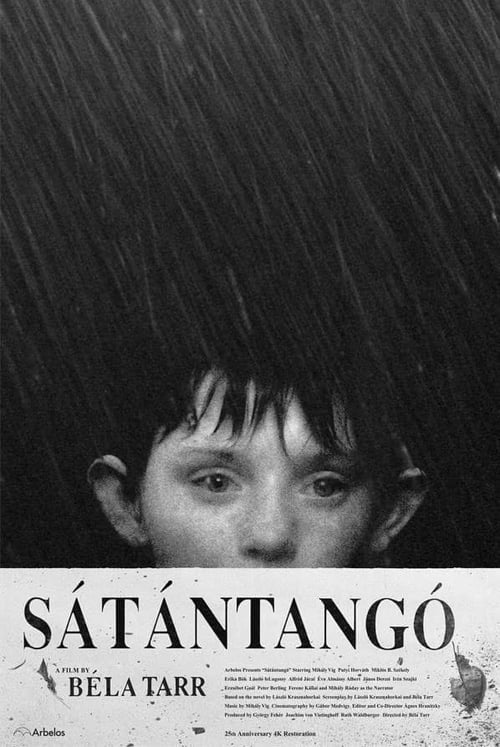
Satantango
1994 · Béla Tarr
For when you want cinema as an endurance event and a badge of honor — a full-day commitment (intermissions encouraged) for the patient, the curious, and anyone who wants to find out what seven hours of film can do to the mind. Pure challenge; zero comfort.
What it's about
On a rain-rotted collective farm in post-communist Hungary, a handful of villagers — a spying doctor, scheming couples, a barkeep — wait for a cash payout that might buy their escape from the mud. Then word comes that Irimias, a silver-tongued man everyone believed dead, is walking back down the road toward them, and hope, greed, and old fears start moving through the village like weather. It unfolds over roughly seven hours, in twelve chapters, in black and white.
The experience
Hypnotic is the honest word: shots last minutes, rain falls forever, cows and drunks and mud take on strange gravity, and time itself becomes the drama. It's demanding and bleakly funny in places, and if you surrender to its rhythm it becomes a trance — an experience closer to a pilgrimage than a movie night.
The craft
Tarr builds the film from monumental black-and-white long takes — the camera prowling through rain, mud, and peeling taverns for minutes at a stretch — and a chapter structure that doubles back to show the same events from different lives. The choreography of camera, weather, and bodies is staggering, and the sound of wind and drone-like accordion gets into your bones. See it big and loud if you ever can.
Why it matters
A monument of world cinema that made Béla Tarr an international figure and became the touchstone for 'slow cinema' — the film every conversation about duration, patience, and what movies can withstand eventually arrives at.
Snapshot
Sátántangó — running approximately seven hours and eighteen minutes across twelve chapters — is Béla Tarr's adaptation of László Krasznahorkai's debut novel of the same name, published in Hungary in 1985. Shot in black and white on 35mm, the film follows the inhabitants of a ruined agricultural collective in post-communist Hungary as they prepare to flee with their savings, only to be manipulated and dispersed by Irimias, a charismatic schemer believed dead who returns carrying a secret informant's commission. Among the longest fiction films ever completed by a single director working in continuous narrative form, it is widely regarded as one of the masterworks of world cinema — a monument of duration, formal severity, and moral weight that established Tarr as a figure of international consequence and furnished the founding example for what critics would later consolidate under the label of "slow cinema."
Industry & production
Sátántangó was produced under conditions that reflect the peculiar possibilities and privations of post-communist Hungarian filmmaking. Hungary had moved away from state-administered film production by the late 1980s, and Tarr — who had made his earlier features within the state system — navigated a transitional funding landscape that combined Hungarian Film Institute support with West German and Swiss co-production money. The shoot extended over several years in the early 1990s, with principal photography conducted in the Hungarian countryside, particularly in the deteriorating villages and abandoned collective-farm complexes of the Great Plain region. These locations were not fabricated sets but actual sites of post-socialist material decay: muddy fields, collapsing farmhouses, waterlogged roads. The choice to film in such environments was as much economic as aesthetic, but Tarr converted the constraint into a governing visual logic, making the landscape's ruin inseparable from the film's account of what becomes of a community abandoned by ideology.
Production was arduous. The multi-year schedule was partly a consequence of financing assembled in stages and partly of the physical demands of achieving the film's signature look — rain-soaked, fog-bound, shot in the high-contrast registers of black-and-white 35mm under characteristically overcast Central European skies. The cast blended professional actors with non-professionals recruited locally. Principal roles went to figures from Hungarian cultural life, most notably Mihály Víg — the musician who also composed the film's score — in the role of Irimias. Péter Berling, a German actor and producer known for his appearances in films by Werner Herzog and Rainer Werner Fassbinder, was cast as the doctor, a rare non-Hungarian principal.
Technology
The film was shot on 35mm black-and-white stock. Cinematographer Gábor Medvigy — Tarr's primary collaborator since Damnation (Kárhozat, 1988) — worked with lenses and exposure strategies designed to maximize depth of field and tonal range within a low-contrast, overcast, rain-heavy environment. The choice of black and white was both expressive and ideological: color would have introduced inflections of the picturesque or the naturalistic into a visual world Tarr wished to keep abstracted from any period tourism. Rain, functioning as an almost continuous environmental condition, interacts with the monochrome image to produce a surface that is hyper-real in its textural density yet remote from documentary immediacy.
The production employed no sophisticated motion-control rigs or digital post-production; the sustained tracking shots were achieved through conventional grip equipment — dolly tracks and carefully managed handheld passages — requiring intensive pre-planning of choreography between camera and figure. The technical apparatus is artisanal rather than industrial throughout, a practical limitation that the film translates into aesthetic doctrine.
Technique
Cinematography
Medvigy's cinematography deploys the extreme long take as its fundamental syntactic unit. Individual shots routinely extend for five, eight, and occasionally more than ten minutes; the film as a whole consists of comparatively few cuts for its running time — a strategy that shifts the viewer's temporal experience from montage-rhythm to something closer to the durée of habitation. Wide-angle lenses dominate throughout, yielding deep-focus fields in which multiple planes of action are legible simultaneously — a compositional approach that recalls the influence Tarr has acknowledged in the cinema of Andrei Tarkovsky and, more obliquely, the long-take landscape choreography of Miklós Jancsó's 1960s work.
The tracking shot is the film's signature figure. The camera follows figures through space — across muddy fields, down corridors, along rain-slicked roads — maintaining lateral or forward movement that refuses the cutting logic of conventional scene breakdown. The opening sequence, in which a herd of cattle wanders through and around the ruined farmhouse while the camera tracks alongside them in a single unbroken take of several minutes, establishes immediately that this is a cinema of time undergone rather than time compressed.
Editing
Editing credit belongs to Ágnes Hranitzky, who is also co-credited as co-director — a designation reflecting her function not merely as a cutter but as a structural co-architect of the work. Cuts, when they arrive, are frequently matches on movement or spatial ellipses rather than continuity splices; they are felt as events rather than conventions. The twelve-chapter structure divides the narrative into blocks of varying duration, with individual chapters returning to events already witnessed from shifted vantage points — a formal recursion enacting the "tango" of the title. Krasznahorkai's novel alternates chapters in a pattern of backward and forward movements; Tarr preserves the recursive perspective logic while adapting the internal rhythms for a durational cinema where the structural concept must be felt in the body rather than decoded on the page.
Mise-en-scène / staging
Staging in Sátántangó consistently subordinates human figures to the space they inhabit. Actors are frequently small within the frame, dwarfed by deteriorating architecture, open landscape, or the oppressive gray of an overcast sky. Movement is slow and often choreographed in relation to the camera's own movement — a practice demanding intensive rehearsal and producing, on screen, a quality of inexorable advance, as though characters are being conveyed rather than choosing to walk. The extended tavern sequence — a drunken communal dance accumulating across a sustained, hypnotic duration — shows this staging logic at its most concentrated: bodies circle the room, the camera circles with them, and time accumulates until the scene acquires the character of ritual.
The sequence involving the child Estike and the cat she torments and ultimately kills is staged with the same formal evenness applied to everything else. Nothing is sensationalized, the camera observes at patient distance, and the effect is far more devastating than any editorial emphasis could produce. The sequence has become one of the most discussed passages in the film precisely because the style refuses to discharge the moral pressure it generates.
Sound
Sound design is as rigidly controlled as the image. Mihály Víg's score — built around a single, circling accordion theme of obsessive simplicity — recurs throughout the film, establishing a tonal atmosphere of melancholic stasis from which there is no exit. The score's relationship to the image is frequently non-synchronous, arriving and departing by an interior logic rather than underlining narrative beats or emotional cues. Environmental sound — rain, wind, footsteps in mud, the ambient acoustics of ruined interiors — is rendered with great care, producing an audio landscape that is immersive without being naturalistic. The combination of Víg's circling theme and the persistent sonic texture of weather and ruin creates a totalizing aural world that reinforces the film's account of enclosure.
Performance
Acting in Sátántangó operates under a sign of radical restraint. Professional and non-professional performers alike are directed away from conventional expressive technique toward a mode of behavior calibrated to capture the weight of time passing through people rather than its dramatization. Mihály Víg's Irimias is the film's one exception to this affective flatness: a charismatic, articulate, preacherly figure whose speeches exert a rhetorical magnetism that the film diagnoses as the mechanism of political manipulation. His performance is the film's most conventionally "theatrical," and this legibility is itself analytical — charisma is readable precisely because it is performed, and the villagers' susceptibility to it is both psychologically coherent and politically damning.
Narrative & dramatic mode
The narrative of Sátántangó is organized as a twelve-part structure modeled on the tango form: in Krasznahorkai's novel, chapters alternate between steps forward and steps backward, revisiting events from shifted vantage points and constructing a temporal labyrinth rather than a sequential story. Tarr's adaptation preserves the chapter divisions and recursive perspective shifts while adapting their internal rhythms for a cinema that must produce these effects through duration and image rather than prose. The dramatic mode might be called tragic pastoral: the inhabitants of this collective are presented without sentimentality and without contempt, as human beings caught in a historical transition that has stripped them of coherent social purpose. Irimias's manipulation of the community into a fraudulent commune project reads simultaneously as political allegory — a false prophet gathering followers in the ruins of a collapsed ideology — and as a study in the perennial psychology of credulity and power. The film's narrative is entirely legible; what is withheld is not information but consolation.
Genre & cycle
Sátántangó belongs to no genre in the conventional sense. It inherits from the art-cinema tradition — specifically from the Eastern European and Soviet strands of that tradition — while extending the formal premises of the long take and durational composition to a degree unprecedented in narrative feature filmmaking. It is the foundational text, in practice if not in explicit theory, of what critics and programmers would subsequently identify as "slow cinema" or "contemplative cinema": a tendency in global art-house production from the mid-1990s onward whose practitioners include Apichatpong Weerasethakul, Tsai Ming-liang, Lisandro Alonso, Lav Diaz, Pedro Costa, and Carlos Reygadas, among others. The film also belongs to a loosely identifiable cycle of post-communist Eastern European cinema grappling with the aftermath of collective life — though its formal ambitions place it well outside any merely sociological grouping.
Authorship & method
Béla Tarr began his career in a naturalistic, quasi-documentary mode. His early features — Family Nest (Családi tűzfészek, 1977), The Outsider (Szabadgyalog, 1981), and The Prefab People (Panelkapcsolat, 1982) — were shot with handheld cameras in confined domestic spaces, drawing from Italian neorealism and the Hungarian social-realist tradition. The transformation that culminated in Sátántangó was gradual: Almanac of Fall (Őszi almanach, 1984) introduced more theatrical, formally controlled staging; Damnation (Kárhozat, 1988), the first sustained collaboration with Krasznahorkai, established the long-take, black-and-white, rain-soaked aesthetic in a form now readable as an extended rehearsal for the larger work to follow.
László Krasznahorkai's contribution is foundational. His prose — characterized by extended, serpentine sentences and an apocalyptic undertow — furnished not just narrative material but a tonal and structural ambition that appears to have licensed Tarr to extend his formal experiment past all conventional limits. Their collaboration continued after Sátántangó: Krasznahorkai co-scripted Werckmeister Harmonies (Werckmeister harmóniák, 2000), The Man from London (A londoni férfi, 2007), and The Turin Horse (A torinói ló, 2011), establishing one of the more significant director–novelist pairings in contemporary world cinema.
Ágnes Hranitzky's function as co-director and editor is not merely honorific. Her role in shaping the film's rhythm and managing its enormous duration — the precise placement of infrequent cuts, the calibration of chapter lengths, the overall architecture of the twelve-part form — is decisive, and she and Tarr were life partners as well as creative collaborators. Mihály Víg occupies an unusual position in the film's authorial ecology: his score and his performance of Irimias are both integral to the work's identity, and his accordion theme has become one of the most immediately recognizable musical signatures in late-twentieth-century art cinema.
Movement / national cinema
Sátántangó arrives at a complex juncture in Hungarian cinema. The national cinema had produced, under the state system of the 1960s and 1970s, figures of international standing — most notably Miklós Jancsó, whose long-take, choreographed-landscape films drew considerable Western critical attention, and István Szabó, whose work circulated widely in Europe. The late-communist and immediate post-communist period saw this infrastructure contract sharply as state subsidy diminished and the domestic market for Hungarian-language art cinema narrowed.
Tarr's work stands somewhat apart from any specifically national-cinema narrative. It is deeply rooted in Hungarian literary culture (through Krasznahorkai) and Hungarian landscape, but its formal ambitions are pan-European in orientation and its production financing is increasingly international. Sátántangó has been absorbed into a global art-cinema canon more readily than into any nationalist film-history account — a function of both its extreme formal ambition and the universalizing character of its themes.
Era / period
The film was made between approximately 1990 and 1994, during the period of post-communist transition in Hungary and across Central-Eastern Europe. The closing of the collective, the figures waiting for a cash settlement, the informant now operating as a freelance manipulator in an unpoliced transitional environment — these are legible as period allegory. Yet Krasznahorkai's source novel predates the actual fall of communism by four years, which suggests that the critique of Soviet-era collective life was always the primary target, and that the post-1989 context served to confirm rather than generate the work's political vision. In Tarr's film, the historical allegory is absorbed into something more fundamental: an image of human communities in a state of exhaustion and susceptibility that is not bounded by any particular political dispensation.
Themes
Entropy and decay are pervasive at every level: physical (the rotting farm, the mud, the incessant rain), social (the dissolution of collective bonds), and moral (the ready capitulation of the villagers to Irimias's scheme). The film proposes no redemptive counter-force; the final sequence, in which the doctor boards up his own window against the outside world, is among the bleakest closing images in the canon.
False messianism and the manipulation of the credulous constitute the film's political core. Irimias's return — he was believed dead, he arrives with authoritative bearing, he delivers a speech of messianic legibility — is a clinical analysis of how authority reconstitutes itself in ideological vacuums. The villagers' capitulation is rendered without contempt; they are not fools but people in need of a story, which Irimias supplies and immediately perverts.
Time as phenomenological burden is inseparable from the film's formal method. The long take does not merely depict time passing; it compels the viewer to undergo time at roughly the same rate as the characters. The film asks whether cinema can represent what it feels like to wait, to endure, to be trapped in a world that will not resolve — and answers by making the formal question and the thematic question identical.
The body under duress — cold, wet, drunk, sick, aging — recurs throughout. The doctor, marooned in his cottage and barely capable of movement, becomes a figure for the film's epistemological condition: observing through a window, recording in a journal, knowing everything and able to intervene in nothing.
Reception, canon & influence
Sátántangó had its public premiere at the Berlin International Film Festival in 1994, where it was presented in the Forum section and received significant critical attention from those prepared to engage with its demands. Its reception in the years immediately following was shaped by the practical difficulty of seeing it: special exhibition conditions (screenings typically proceed with structured intervals), limited print circulation, and the absence of major commercial distribution in Western markets through most of the 1990s meant the film traveled primarily through cinematheques, retrospectives, and specialist festival programming.
The decisive moment in its canonical consolidation in the English-language critical world came through the advocacy of Susan Sontag, who wrote and spoke about the film with unambiguous enthusiasm. She is widely reported to have said that she would be glad to see it every year for the rest of her life — though the exact wording of this frequently cited formulation has varied across different secondary accounts, and readers should seek the original source before direct quotation. Her championing helped establish the conditions for the film's eventual wider availability and its entry into serious critical discourse outside specialist circles.
Looking backward, the most important formal precedents are Tarkovsky — whose treatment of the shot as a unit of time rather than a unit of information is the single most visible stylistic antecedent — and Jancsó's long-take landscape cinema of the Hungarian 1960s, though Tarr has at times been ambivalent about the latter comparison. The naturalistic tradition of Tarr's own early work provides the social-realist substrate beneath the formal severity. The Brechtian distance from characters and the German co-production networks through which the film was partly financed suggest the residual influence of Fassbinder and New German Cinema, though the connection is structural rather than stylistic.
Looking forward, Sátántangó's influence on international art cinema from the late 1990s onward is substantial. The emergence of "slow cinema" as a critical and curatorial category — applied to Tsai Ming-liang, Apichatpong Weerasethakul, Lisandro Alonso, Lav Diaz, Pedro Costa, and Carlos Reygadas — owes much of its formal ambition and its sense of institutional permission to Tarr's example. Lav Diaz, whose own films regularly exceed eight, ten, and even sixteen hours, has cited Tarr's work as foundational. The film demonstrated that durational extremity was not a novelty gesture but could be structurally necessary — that certain kinds of knowledge about time, community, and political manipulation could be produced only by a cinema willing to make the viewer experience duration as the characters do.
In canonical rankings, Sátántangó now appears regularly among the greatest films ever made, featuring prominently in the Sight & Sound polls of 2012 and 2022. Its passage from festival curiosity to critical monument took approximately two decades — a trajectory that reflects both the material difficulty of access in its early years and the depth of its eventual assimilation into the core repertoire of world cinema.
A Deleuzian reading
The film opens on cows.
The full Deleuzian reading of Satantango →
Reception
Barely anyone could actually see it in 1994 — a 7-plus-hour Hungarian film that screened at a handful of festivals and cinematheques — so its reputation spread almost entirely by word of mouth and legend. Three decades on it's a fixture of greatest-films polls, and the 2019 4K restoration finally let people watch the myth for themselves.
How Satantango was received, from release to now →
Influences: the films it descends from and the films it influenced
- Stalker (1979) — Tarkovsky's method of treating the long take as a vessel for accumulated time rather than narrative information — the shot as duration experienced rather than information delivered — is the single most visible formal source Tarr absorbed into his own practice, transforming what Tarkovsky deployed episodically into Sátántangó's comprehensive structural principle.
- The Round-Up (1966) — Jancsó's practice of distributing figures across the open Hungarian plain in sustained wide-angle long takes, refusing emotional close-ups to force a dehumanizing distance, establishes the visual grammar of the landscape-as-political-trap that Tarr directly inherits and radicalizes.
- Red Psalm (1972) — Jancsó's choreographic long takes — the camera continuously tracking moving groups through open landscape without a single cut across 28 shots in 88 minutes — demonstrates to Tarr that the single unbroken shot could sustain complex spatial organization over many minutes, a direct precedent for Sátántangó's wandering multi-minute takes.
- Damnation (1988) — The first sustained Tarr–Krasznahorkai collaboration established black-and-white tracking-shot long takes, a rain-saturated industrial landscape, and Mihály Víg's circling accordion score as a unified formal system; Sátántangó is a direct amplification of every element Damnation rehearsed at shorter length.
- Almanac of Fall (1984) — Tarr's own transitional work between his neorealist handheld phase and the long-take method, introducing theatrically controlled camera movement and tableaux staging in claustrophobic interiors — the formal laboratory that prepared the kinetic apparatus deployed at landscape scale in Sátántangó.
- Germany Year Zero (1948) — The neorealist practice of filming in actual sites of devastation with non-professional performers as a mode of political witnessing provides the social-realist substrate beneath Sátántangó's formal severity — the documentary texture grounding the allegorical structure.
- The Travelling Players (1975) — Angelopoulos independently develops the long-take tracking shot as a vehicle for political-historical allegory, using chapter titles that fracture chronology in direct parallel to Sátántangó's recursive chapter structure; the two films constitute co-equal European poles of the long-take political-epic form.
- Jeanne Dielman, 23 Quai du Commerce, 1080 Bruxelles (1975) — Akerman demonstrates that radical screen duration — real time, minimal cutting, performance stripped to behavioral repetition — can itself constitute a political argument; the shared formal claim that duration is content rather than stylistic excess places both films as foundational texts of durational cinema.
- Andrei Rublev (1966) — Tarr's seven-hour episodic black-and-white chronicle, organized around rain and mud as constant active compositional elements, with extremely long takes refusing conventional editing rhythm and ambient sound suppressing non-diegetic score, represents the most systematic extension of Rublev's anti-Eisenstein durational grammar in post-Soviet cinema.
- The Silence (1963) — Tarr's extreme long takes, ambient diegetic sound without underscore, and relentless holding of faces and bodies in ordinary time without conventional dramatic punctuation develop the extended-duration editing principle The Silence helped establish into a seven-hour form in which duration itself becomes the subject.
- Heart of Glass (1976) — Tarr extends Heart of Glass's core formal propositions to their structural limit: a seven-and-a-half-hour commitment to duration as the primary dramatic agent, and a rural community's self-destruction staged as internal spiritual collapse rather than external catastrophe.
- Europa '51 (1952) — Tarr extends observational-continuity editing into multi-hour duration as structural principle, systematically refusing the cut that would editorialise a community's dissolution; the gray available-light cinematography in found village locations and ambient-social-register sound are the extreme elaboration of Rossellini's Bazinian faith in duration over expressive effect.
- Werckmeister Harmonies (2000) — The direct extension of the Tarr–Krasznahorkai–Vig formal system: refined to 39 unbroken shots across 145 minutes, with Ágnes Hranitzky's co-direction more explicitly credited, the film builds every structural lesson of Sátántangó into a tighter and more architecturally precise form.
- From What Is Before (2014) — Diaz explicitly cites Tarr as the foundational permission for durational cinema; his black-and-white five-and-a-half-hour long takes as post-Marcos Filipino allegory extend Sátántangó's structural argument that political manipulation can only be made legible by forcing the viewer to inhabit the duration the victims inhabited.
- Stray Dogs (2013) — Tsai's extreme long takes — single shots held motionless for five minutes or more — inherit directly from Tarr the formal permission that temporal extremity can be the primary content; the final two-shot sequence is unintelligible without Sátántangó as institutional precedent for the extreme static hold.
- Silent Light (2007) — Reygadas applies Tarr's deep-focus wide-angle cinematography and non-professional performance restraint to Mexican Mennonite flatlands — figures dwarfed by horizon lines in sustained long takes — with the opening and closing real-time dawn/dusk shots directly inheriting Tarr's practice of duration as cosmological argument.
- Los Muertos (2004) — Alonso's durational tracking of a near-mute figure through Argentine jungle — long takes without narrative explanation, figure absorbed into and dwarfed by landscape — extends Sátántangó's formal model of the dwarfed human form in hostile environment as the fundamental unit of slow cinema.
- Tropical Malady (2004) — Apichatpong inherits from Tarr the non-synchronous score and the long take as a vessel for offscreen sound that refuses to anchor its source, deploying extended duration to structurally rupture genre expectation in a way Sátántangó authorized — the film proceeds as though duration itself is the argument.
- Gerry (2002) — Van Sant's durational desert landscape film — two figures progressively dwarfed by arid terrain in extended takes with wide-angle deep focus — is the most direct American absorption of the Tarr-derived slow-cinema model, the wide lens reducing human figures to near-geometrical marks against the horizon in a compositional method drawn directly from Sátántangó.
- Dry Leaf (2026) — Tarr codified 'dead time' as narrative substance: the held, often unpopulated long take that lets duration itself become the event, the durational grammar Koberidze's static villages run on.
- Magellan (2025) — Source of Diaz's core grammar—extended black-and-white long takes, glacial lateral tracking and locked-off wides where narrative is paced by walking-time rather than cuts, with the director controlling tempo as the primary expressive instrument.
- 4 Months, 3 Weeks and 2 Days (2007) — Tarr's extended long takes in communist-era Eastern European locations — available and practical light, genuinely deteriorated environments, duration functioning as a form of moral witness — establish the aesthetic vocabulary of filmed endurance that Mungiu inherits for his 1987 Romania, particularly the nighttime exterior walks shot in authentic urban darkness.
- Kaili Blues (2016) — Tarr's deployment of multi-minute steadicam takes following characters through landscape as a philosophical declaration that shot-length is a moral stance — not a stylistic choice — is the structural precedent for Bi Gan's conception of the continuous take as a way of inhabiting duration rather than depicting it.
- Roma (2018) — Tarr's substitution of ambient environmental sound — wind, rain, footsteps on mud — for conventional musical score, and his insistence on extended real-time duration as the primary bearer of moral meaning rather than editing rhythm, is the slow-cinema precedent Cuarón most directly engages in Roma's soundscape design and unhurried editorial tempo.
- Nostalgia (1983) — Tarr and Ágnes Hranitzky extend the long-take minimal-cutting aesthetic into a near-monochromatic Hungarian extremity, with Mihály Víg's accordion compositions used as found-quality score that interrupts and counterpoints action without psychological underscore — a parallel and independent solution to the found-classical-score and duration-as-metaphysical-argument methodology Tarkovsky developed.
- Tokyo Story (1953) — Tarr extends the Ozuian principle that duration is a condition of meaning — the sustained single-shot observation as the basic formal unit — from domestic miniaturism to epic rural endurance, refusing shot-reaction cutting in favor of the same camera patience Ozu practiced at a tenth the scale.
- Elephant (2003) — Source of the extended-take walking grammar — minutes-long shots tracking figures across space in real time, an austerity Van Sant explicitly cited as license for Elephant's gliding corridor takes.
- Humanité (1999) — Extends the same wide-static, durational long-take grammar over a bleak regional terrain populated by weathered non-professional faces, refusing genre payoff in favor of held time.
- Landscape in the Mist (1988) — Inherits the punishing long take across rain-greyed flatland and the choreography of figures within unbroken duration, formalizing Angelopoulos's deframed-landscape grammar into the slow-cinema canon.
- Songs from the Second Floor (2000) — Parallel maximalist commitment to the extended take as the basic unit, with desaturated monochrome and a bleak provincial world built from held duration — though Tarr tracks where Andersson nails the camera down.
- What Time Is It There? (2001) — The extended long take promoted to the governing formal unit; a fellow pillar of international slow cinema privileging duration and real time over cutting.
- Goodbye, Dragon Inn (2003) — Extreme long-take duration tracking bodies walking through desolate, rain-soaked space, where the shot's length itself becomes the subject.
- The Meetings of Anna (1978) — Shares the slow-cinema wager that unhurried real-time long takes, not montage, are the primary expressive tool for rendering exhausted postwar European interiority.
- Flowers of Shanghai (1998) — A contemporaneous pole of the same slow-cinema movement, constructing meaning from extended long takes with no internal cutting and choreographed real-time staging rather than montage.
- A City of Sadness (1989) — Radicalizes duration as an expressive device, using extreme long takes and slow lateral movement to make the passage of time, rather than plot, the viewer's primary experience.
- Eternity and a Day (1998) — The signature slow-cinema descendant: extreme, self-effacing plan-sequences through mud and fog whose expressive duration and choreographed walking shots openly extend the Angelopoulos/Jancsó long-take lineage.
Similar films
- Damnation (1988) — influence & lineage
- The Travelling Players (1975) — influence & lineage
- Silent Light (2007) — influence & lineage
- From What Is Before (2014) — influence & lineage
- Magellan (2025) — influence & lineage · same viewing thread
- Evolution of a Filipino Family (2004) — same viewing thread
- Stalker (1979) — influence & lineage · often watched together
- Pather Panchali (1955) — often watched together
All the films related to Satantango →
Watch it with: curated runs of related films
- The Long Shadow of the Coup — A run of films tracing political violence from the mutiny and the massacre through martial law to the decades-long reckoning that follows — watch them near each other and the same machinery of power keeps rhyming across continents and eras.
Film essays and courses that include it
- Duration and Doubt: The Art Film from Dreyer to Kiarostami
- The Unblinking Camera: Social Realism from the Dardennes to the Romanian New Wave
- Radical Attention: A Century of Art Cinema
- The Unbroken Take: From Camera Liberation to Single-Shot Cinema
- Everything in Frame: Deep Focus from Renoir to Tarr
- No Comfort: Cinema's Grammar of Despair
- The Disappearing Self: A Cinema of Estrangement
- The Land Speaks: Rural Landscape as Moral Force
- When Slowness Got Big