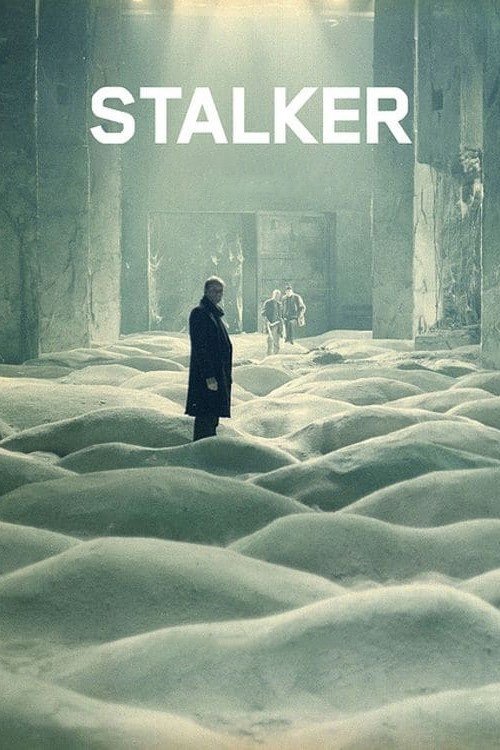
Stalker
1979 · Andrei Tarkovsky
For when you want to be swallowed by a film — a patient, meditative night when you're ready to sit with big questions about faith and what you actually want from life. This is a challenge, not comfort viewing, and it repays total surrender: lights off, phone away.
What it's about
Somewhere outside a gray, nameless city lies the Zone: a forbidden area sealed off by soldiers and barbed wire, where the ordinary rules of the world no longer quite hold. At its heart is said to be a room that grants your deepest, truest wish. A haunted guide called the Stalker smuggles two clients — a cynical writer and a rational scientist — past the guards and leads them toward it, through terrain where the greatest dangers may be inside the travelers themselves.
The experience
Slow, hypnotic, and heavy with dread and wonder — long drifting shots over water, rust, and ruin that put you into something close to a trance. It's less watched than undergone: demanding in the moment, and then it won't leave you alone for weeks.
Performances
Aleksandr Kaidanovsky's Stalker is unforgettable — gaunt, flinching, fervent, a holy fool whose desperation to believe carries the whole film.
The craft
The images are among the most beautiful ever shot: sepia industrial wastelands giving way to the poisoned green of the Zone, camera moves so gradual you barely notice them working on you, and a sound design of drips, wind, and eerie electronic tones that does as much as any image. Shot on real industrial ruins, it makes decay look sacred. See it big and loud if you ever get the chance.
Why it matters
A towering landmark of philosophical science fiction whose imagery has seeped into films, video games, and even the language used for real exclusion zones; it cemented Tarkovsky's reputation as one of cinema's great visionaries.
Snapshot
A philosopher's expedition into an off-limits wasteland called the Zone, led by a gaunt, convicted guide known only as the Stalker. Two unnamed passengers — a Writer and a Professor — are brought to a room at the Zone's heart said to grant the deepest, truest wish of whoever enters. No one enters. The journey is the destination. Shot in sepia and muted color on industrial ruins in Estonia, Stalker strips the science-fiction scaffolding of its source material down to a parable of faith, desire, and the unbearable weight of self-knowledge — one of the most formally rigorous and philosophically demanding films in the canon.
Industry & production
Stalker was produced by Mosfilm, the Soviet state studio, and reached screens after a production history that bordered on catastrophe. Tarkovsky had adapted Arkady and Boris Strugatsky's 1971 science-fiction novella Roadside Picnic, working with the authors through numerous screenplay drafts to translate their wry, materialist tale of alien-artifact scavengers into something closer to a spiritual allegory. The Strugatskys later acknowledged that Tarkovsky's final vision diverged substantially from their fiction but, after initial friction, came to regard the film as a legitimate work in its own right rather than an adaptation in any conventional sense.
Production began in 1977 with cinematographer Georgy Rerberg, who had shot Tarkovsky's Mirror (1975). After extensive location shooting in Estonia, the completed footage proved unusable — accounts differ as to whether the fault lay with the processing laboratory or with the film stock itself, and the precise circumstances remain a matter of disputed record. The loss was total. Tarkovsky parted ways with Rerberg and reassembled his crew for a full reshoot, this time with Alexander Knyazhinsky as director of photography. Locations in and around Tallinn — including stretches of the Jägala riverbed, derelict industrial plants, and a partially operational hydroelectric facility — were used for the Zone sequences. The production's toll on personnel has become part of the film's legend: Tarkovsky died of lung cancer in December 1986; his lead actor Anatoly Solonitsyn died of cancer in 1982; other cast and crew members suffered serious illness in the years following the shoot. The proximity of filming to chemically contaminated industrial sites in Soviet-era Estonia has been widely cited as a contributing factor, though direct causal attribution remains speculative. The finished film runs approximately 163 minutes.
Technology
Stalker was shot on 35mm film, using spherical lenses to produce a nearly full-frame image. Tarkovsky and Knyazhinsky developed a deliberate visual grammar built around extended single takes, with a camera mounted on a dolly or hand-held for specific sequences, capable of slow lateral tracking shots through deep spatial fields. A chromatic strategy anchors the film's two worlds: the city and the opening sequences are rendered in warm sepia tones, a near-monochrome palette that registers the everyday as dulled and evacuated of meaning. The moment the characters cross into the Zone, the film transitions to full — if muted and desaturated — color. This inversion of the expected registers (color for the "real" world, black-and-white for the fantastical) was a conscious philosophical choice: the Zone is more vividly real, more saturated with presence, than the gray quotidian world outside it.
The sound design was engineered with equal precision. Eduard Artemyev, who had collaborated with Tarkovsky on Solaris (1972) and Mirror, composed a score that fuses acoustic instruments with electronic synthesis, used sparingly against an intricate web of diegetic ambient sound: water, distant machinery, wind, birdsong. Tarkovsky was famously insistent on recorded silence as a compositional element, treating the soundtrack as a spatial and emotional architecture rather than an underlining device.
Technique
Cinematography
Knyazhinsky's camera moves with the patience and weight of geological time. The Zone sequences favor long tracking shots that glide through grass, flooded corridors, and rubble at a pace calibrated to force contemplation rather than observation. Depth of field is consistently exploited: foreground details — a glass of water, a syringe, sand — anchor the frame while action unfolds at middle or background distance, constructing images that reward sustained looking. The pervasive presence of water — puddles, streams, rain, flooding — generates reflective surfaces that double and destabilize the visible world.
Editing
Tarkovsky's editing tempo in Stalker is among the slowest in mainstream cinema. Shot lengths of one to several minutes are common; the film averages approximately 100 shots across its 163-minute runtime, a ratio that would be unremarkable in a stage-adaptation but functions as near-ascetic restraint in cinema. Cuts are often motivated by spatial necessity rather than dramatic punctuation, and Tarkovsky resists reaction shots and reverse angles almost entirely.
Mise-en-scène / staging
The Zone was built from found reality rather than constructed sets: genuine post-industrial ruin, thick vegetation reclaiming concrete, brackish standing water, the visual vocabulary of Soviet industrial abandonment. Tarkovsky's staging places his characters inside these environments rather than in front of them — figures are often half-submerged, framed by overgrowth, dwarfed by derelict infrastructure. Objects are granted ceremonial attention: the Stalker's ritual of throwing bolts wrapped in cloth to navigate the Zone's shifting dangers, the slow pan across debris lying in shallow water in one of the film's most famous sequences. These objects accrue meaning through duration and repetition rather than symbolic coding.
Sound
Artemyev's score emerges as if from the landscape itself — low drones, Hindu raga textures, choral fragments — and is used sparsely enough that its appearances carry enormous weight. The diegetic sound mix is unusually rich: water is omnipresent as a tonal base; ambient industrial sound bleeds in from off-screen space; the silence between sounds is as precisely managed as the sounds themselves. A Beethoven excerpt — the main theme from the Ode to Joy — appears in the film's final scene, rendered on a shortwave radio, a gesture of ambiguous transcendence.
Performance
Tarkovsky draws from his actors a quality of interior inhabitation rather than demonstrative expression. Alexander Kaidanovsky's Stalker — gaunt, shaved-headed, radically emotionally exposed — operates at the register of exposed nerve rather than performed feeling. Anatoly Solonitsyn's Writer, by contrast, is sardonic and guarded, a man who fears the Room because he suspects he has no authentic desires left. Nikolai Grinko's Professor, calm to the point of menace, carries a secret purpose that recontextualizes the journey. Alisa Freindlich appears briefly but memorably as the Stalker's wife, delivering a final monologue of devoted realism that anchors the film's emotional world.
Narrative & dramatic mode
Stalker is structured as a pilgrimage — or rather three competing versions of pilgrimage. The Stalker believes; the Writer doubts; the Professor is pragmatic until revealed otherwise. The Zone itself functions as a testing ground that amplifies rather than transforms: it holds a mirror to interiority and the characters find they cannot bear to look. The Room is never entered. This is not a narrative of withholding but of revelation: the approach to the threshold is the substance of the film.
Tarkovsky explicitly resists cause-and-effect plotting in favor of accumulation, juxtaposition, and what he called sculpting in time — the shaping of felt duration as the primary cinematic material. Dialogue is philosophical rather than expository, tending toward extended monologue. The dramatic mode is closer to meditation than suspense.
Genre & cycle
Stalker occupies an anomalous position within science fiction. It retains the genre's foundational premise — a scientifically inexplicable anomalous zone, presumably of extraterrestrial origin — but systematically evacuates the genre's conventional pleasures: spectacle, explanation, technological wonder, narrative resolution. Where Solaris (1972) maintained dialogue with the generic conventions of space cinema, Stalker abandons them almost entirely.
The film belongs more properly to a tradition of European art-cinema allegory with metaphysical concerns: it shares existential and formal DNA with Ingmar Bergman's journey films (The Seventh Seal, 1957), with the later work of Robert Bresson in its treatment of grace and suffering, and with Soviet literary tradition — Dostoevsky in particular, whose interrogative mode of staging philosophical positions against one another in extremis the film inherits.
Authorship & method
Tarkovsky's working process involved an unusual degree of collaborative philosophical development with writers and composers, combined with autocratic control over the visual and temporal dimensions of the film. His relationship with the Strugatsky brothers was characteristically complex: he valued their intellectual seriousness while fundamentally transforming their material, and the multiple screenplay drafts represent a sustained, often tense negotiation between literary and cinematic conception.
Eduard Artemyev's role as sound architect was formative across three Tarkovsky films; his contribution to Stalker helped codify what would become an identifiable sonic signature. Alexander Knyazhinsky, inheriting a production that had already collapsed once, brought precision and patience to Tarkovsky's visual demands. The film is also importantly a collaboration with its locations: Estonia's post-industrial landscape was not merely backdrop but active compositional material, chosen and shaped rather than simply found.
Movement / national cinema
Stalker was produced within the Soviet state film system, distributed by Mosfilm, and screened domestically with modest institutional support but little official enthusiasm. Tarkovsky occupied a characteristically ambiguous position within Soviet cinema: he was internationally celebrated in ways that made outright suppression undesirable for cultural-diplomatic reasons, but his films' spiritual preoccupations — Stalker is saturated with Orthodox Christian resonance, though never doctrinally explicit — were at best tolerated by Goskino, the state censorship apparatus. He emigrated in 1982 and never returned.
The film participates in the broader tradition of Soviet philosophical cinema that includes the work of Sergei Parajanov, though Tarkovsky's engagement with formal duration and metaphysical interiority is largely his own. Its use of found Soviet industrial landscape anticipates the aesthetic that would become globally associated with Chernobyl and late-Soviet imagery.
Era / period
Stalker belongs to the late Soviet period of the 1970s, a time of political stagnation under Brezhnev, pervasive institutional cynicism, and suppressed spiritual hunger in the Soviet intelligentsia. The film registers this cultural atmosphere with precision: the gray, exhausted city of the opening sequences is a portrait of late-socialist ennui; the Zone's ambiguous promise functions as a figure for any space of possible belief or meaning in a depleted world. Internationally, the late 1970s saw European art cinema consolidating its slow, reflexive mode in the work of Bergman, Wim Wenders, and Chantal Akerman, a context in which Stalker's formal extremity found sympathetic audiences.
Themes
The film's central inquiry is the relationship between belief and its object. The Stalker's faith in the Zone is fervent and self-annihilating; it has cost him his freedom, his health, his social standing. His passengers' skepticism is equally revealing: the Writer fears the Room because he suspects his deepest wish is trivial; the Professor plans to destroy it to protect humanity from its own desires.
Tarkovsky returns throughout to the possibility of grace in a material world — the question of whether anything can be genuinely sacred, genuinely other, in the face of human instrumentality. The Zone both demands and defeats interpretation; its apparent sentience is never explained, only inhabited. The film's epilogue, in which the Stalker's daughter Martishka — called Monkey, born with a disability possibly linked to her father's exposure to the Zone — appears to move glasses on a table with her mind, suggests that the Zone's influence propagates, that mutation and miracle may be the same phenomenon.
Reception, canon & influence
Backward influences. Beyond Bergman and Bresson, Stalker draws on Dostoevsky's dialogic structure of philosophical confrontation; on the Russian tradition of the yurodiviy, the holy fool, whose suffering is a form of witness; on the visual metaphysics of the Russian icon, with its use of spatial depth as spiritual register. The Strugatsky novella contributed the Zone's specific texture of alien residue and the idea of "stalkers" as a quasi-professional caste.
Reception. The film's initial critical reception was muted in the Soviet Union. International festival and art-house reception was more engaged, with Tarkovsky's reputation already established through Andrei Rublev (1966) and Solaris. The full scope of Stalker's canonical status emerged over subsequent decades: it appears regularly near the top of critical polls, including the Sight & Sound surveys, and has become a central text in film theory, particularly in discussions of cinematic time, the long take, and the relationship between space and spiritual experience.
Forward influence. The film's reach is exceptionally wide. Alex Garland has explicitly cited Stalker as the primary influence on Annihilation (2018), which transplants Tarkovsky's logic of a transformative anomalous zone into a more genre-functional form. Jeff VanderMeer, whose Southern Reach trilogy underlies Annihilation, has cited the Strugatsky novella as a direct influence, creating a triangular line of descent. The S.T.A.L.K.E.R. video game series (beginning 2007) takes its fiction, its visual grammar, and its atmosphere of post-industrial eerie directly from the film and its Chernobyl-adjacent setting. Béla Tarr's long-take aesthetic and attention to landscape as spiritual environment is in deep dialogue with Tarkovsky, though Tarr has emphasized his independence from direct influence.
The film's broader cultural effect is perhaps best measured not in explicit citations but in the diffusion of its visual vocabulary — the post-industrial ruin as a space of ambiguous transcendence, the slow lateral track through flooded ground, the figure of the guide who cannot himself enter the sanctuary he reveals to others — into the fabric of world cinema and visual art. Tarkovsky did not invent slow cinema, but Stalker remains its most discussed and formally sustained single monument.
A Deleuzian reading
Two-thirds of the way in, the camera lies down in shallow water and crawls.
The full Deleuzian reading of Stalker →
Reception
Soviet authorities were baffled by it and gave it a grudging, limited release, while early audiences split between rapture and walkouts; today it sits comfortably in the greatest-films-ever conversation and near the top of every 'films that changed me' list.
How Stalker was received, from release to now →
Influences: the films it descends from and the films it influenced
- Au hasard Balthazar (1966) — Bresson's model-actor discipline — stripping performance to bare comportment, evacuating expressive affect to reveal interior states — is the direct template for the Stalker's inward, self-evacuating delivery, which Tarkovsky studied closely before developing his own performance-as-inhabitation method.
- Winter Light (1963) — Bergman's structure of a journey toward a site of potential grace that delivers only the silence of God rather than transcendence supplies the exact theological armature Tarkovsky literalizes in the Zone's unanswered Room — a threshold that cannot be crossed without self-annihilation.
- Red Desert (1964) — Antonioni's color design — desaturating post-industrial landscape to externalize psychic alienation — gives Tarkovsky the direct formal precedent for Stalker's sepia-to-color inversion, where chromatic saturation marks the boundary between the deadened quotidian world and the vividly real Zone.
- Earth (1930) — Dovzhenko's pantheist cinematography — the camera dwelling on grass, soil, and water as sacred material rather than setting — establishes the Soviet poetic-cinema tradition of landscape-as-spiritual-terrain that Tarkovsky inherits and radicalizes in the Zone's long contemplative tracking shots.
- The Gospel According to St. Matthew (1964) — Pasolini's use of actual impoverished southern Italian locations and non-professional performers to render sacred narrative in documentary materiality is the direct precedent for Tarkovsky's method of staging transcendence inside genuine post-industrial ruin rather than constructed sets.
- Solaris (1972) — Eduard Artemyev's ANS-derived electronic score, the same lyric structure built around a psychologically charged forbidden zone, and the same duration-based editing rhythm developed in Solaris are all carried forward; the Zone's power to manifest desire mirrors the Solaris ocean's power to materialize guilt, extending the same formal-philosophical apparatus.
- Throne of Blood (1957) — Tarkovsky builds the Zone as a labyrinthine fate landscape traversed in extreme durational takes — a space that reshapes around interior states and resists linear navigation — directly extending Throne of Blood's Cobweb Forest as the formal model for landscape-as-subjective-doom.
- Woman in the Dunes (1964) — Tarkovsky inherits the enclosed inexplicable Zone as psychological trap — a space with its own rules that cannot be exited on the protagonist's terms — and extends Teshigahara's diegetic-environment sound design: ambient water, dripping, texture as score.
- Orpheus (1950) — A ruined liminal Zone with its own laws and prohibitions, descendant of Orphée's interzone staged as decayed, sacred-in-the-mundane terrain.
- Sátántangó (1994) — Tarr directly inherits Stalker's ultra-slow editing tempo and rain-saturated found-ruin locations: shot lengths regularly exceeding ten minutes in decayed Hungarian landscape, a near-total absence of non-diegetic music, and ambient diegetic sound as structural material make Sátántangó the most sustained formal extension of Tarkovsky's durational grammar in world cinema.
- The Return (2003) — Zvyagintsev's debut transposes Stalker's cinematographic grammar directly — slow lateral tracking shots, reflective water surfaces, a mysteriously purposive father-figure who arrives without explanation — into Russian paternal drama, an inheritance Zvyagintsev has explicitly acknowledged and that is legible in virtually every compositional choice.
- Gerry (2002) — Van Sant and cinematographer Harris Savides apply Tarkovsky's long-take pilgrimage tracking to American desert wilderness — two figures walking in sustained real time through inhospitable terrain, the camera observing at durational length — citing Stalker directly as the formal model for the film's editing tempo and spatial grammar.
- Tropical Malady (2004) — Apichatpong's second-half dissolution into jungle darkness — a soldier tracking a tiger-spirit through found forest — applies Tarkovsky's Zone-threshold logic to Thai animist space, using ambient diegetic sound design and a chromatic shift from social-realist daylight to nocturnal spiritual terrain as the structural boundary between worlds.
- Once Upon a Time in Anatolia (2011) — Ceylan's extended nocturnal tracking shots through Anatolian steppe — figures searching dark landscape, the camera dwelling in deep-focus on environmental texture for minutes at a time — apply Stalker's cinematographic grammar to Turkish social realism, with a comparable commitment to diegetic ambient sound over score.
- Colossal Youth (2006) — Costa shoots in actual Lisbon housing ruins with residents as performers, giving ceremonial attention to objects in poverty-stricken interiors through long fixed takes that refuse editorial emphasis — a direct extension of Stalker's method of placing figures inside found ruin rather than staging them in front of it.
- Hard to Be a God (2013) — German — a Soviet-era peer of Tarkovsky — pushes the durational immersive single-take cinematography of Soviet art cinema to its outer limit: cameras plunge through mud, medieval filth, and physical debris as if the Zone's found-location materiality had been stripped of transcendence entirely and left only its sensory extremity.
- Los Muertos (2004) — Alonso's fixed takes of four to seven minutes tracking a man through Argentine river jungle, combined with total absence of non-diegetic score and diegetic ambient sound as the sole acoustic architecture, apply Stalker's durational cinema method to South American landscape with near-programmatic formal fidelity.
- Sirāt (2025) — Structures a crossing through a zone of invisible lethal traps via subtractive mise-en-scène, the mortality-and-crossing logic literalized in Sirāt's minefield.
- Nostalgia (1983) — Tarkovsky and Rerberg's water-saturated, fog-threaded Zone sequences — long lateral pushes through degraded industrial space, available-light interiors where light sources function as near-sacred objects — establish the visual protocol that Lanci and Tarkovsky adapt directly for Nostalgia's thermal-pool environment and rain-soaked Tuscan interiors.
- The Thin Red Line (1998) — Tarkovsky's camera rests on grass, water, and industrial detritus as subjects equal in weight to human actors, refusing to subordinate the non-human world to narrative function — the exact logic Malick applies to kunai grass, parrots, and the Guadalcanal riverscape.
- Ghost in the Shell (1995) — The essayistic tracking shot through industrial ruin — philosophical argument embedded in procedural forward movement — is the specific formal precedent for GitS's boat montage; Oshii has cited Tarkovsky's method of suspending narrative for contemplative duration as the definitive model.
- The Travelling Players (1975) — Angelopoulos builds his film from single takes of five to ten minutes in which the camera tracks ceremonially through Greek landscape as his troupe journeys across history — the same durational long-take pilgrimage logic Tarkovsky develops independently in Stalker, with comparable editing tempos and choreographed figure-in-landscape staging.
- Jeanne Dielman, 23 quai du Commerce, 1080 Bruxelles (1975) — Akerman's fixed camera observing domestic ritual in extended real time, with an editing tempo calibrated to the actual duration of action rather than dramatic punctuation, develops the same formal commitment to ultra-slow cutting that defines Stalker's ascetic ~100-shot-per-163-minute rhythm, applied to domestic space.
- Aguirre, the Wrath of God (1972) — Herzog films his pilgrimage entirely inside actual Amazon terrain, using the physical duress of location as material the actors must submit to rather than perform around — the same principle by which Tarkovsky's cast and crew were subsumed into the Zone's genuine contaminated ruin, making environment a co-author of performance.
- Apocalypse Now (1979) — Tarkovsky and sound designer Eduard Artemyev constructed the Zone's acoustic environment as a continuous field in which ambient diegetic texture and scored music are indistinguishable—the identical sonic philosophy Murch realized through 5.1 Dolby multichannel technology the same year.
- Landscape in the Mist (1988) — Models the slow, dread-laden tracking shot through leached, drizzle-gray landscape as a spiritual quest, and the use of duration itself as the carrier of metaphysical weight that Angelopoulos secularizes into a children's journey.
- The Belly of an Architect (1987) — Sibling in slow, sculptural framing of monumental ruined architecture as a meditation on mortality and the will to permanence, a continental-modernist treatment of built space as metaphysics.
- The Man Who Fell to Earth (1976) — Mood-driven, effects-refusing SF that derives unease from texture, water, and decay rather than technology — the same anti-spectacular wager.
- On the Silver Globe (1989) — Recasts sci-fi as a dialogue-driven pilgrimage toward faith and meaning, pursuing the same spiritually extreme, philosophy-first register.
Similar films
- Satantango (1994) — influence & lineage · often watched together
- Alien (1979) — same viewing thread
- Come and See (1985) — often watched together
- Blade Runner (1982) — often watched together
- Vertigo (1958) — often watched together
- On the Silver Globe (1989) — often watched together
- Andrei Rublev (1966) — often watched together
- 2001: A Space Odyssey (1968) — often watched together
All the films related to Stalker →
Watch it with: curated runs of related films
- Crossing Into the Zone — A run of crews and expeditions that step across a threshold into a hostile unknown — a derelict, a shimmer, a forbidden Zone — that rewrites biology, sanity, and who comes back; watch them in sequence to feel the same dread deepen from pulp to the sublime.
Film essays and courses that include it
- Duration and Doubt: The Art Film from Dreyer to Kiarostami
- Andrei Tarkovsky
- After the Monolith: Science Fiction's Formal Inventions
- Dialectics of the Soul: Russian Cinema from Eisenstein to Zvyagintsev
- The Art of Duration: Slow Cinema from Dreyer to Tarr
- The Disappearing Self: A Cinema of Estrangement
- God Is Silent, Death Is Certain: Existentialism in World Cinema
- The Silence of God: Cinema's Argument with the Divine
- The Ones Who Stay to Watch: A Course in the Cinema of the Seer
- Sculpting in Time
- The Shot That Won't Cut
- The Space That Forgot What It Was For