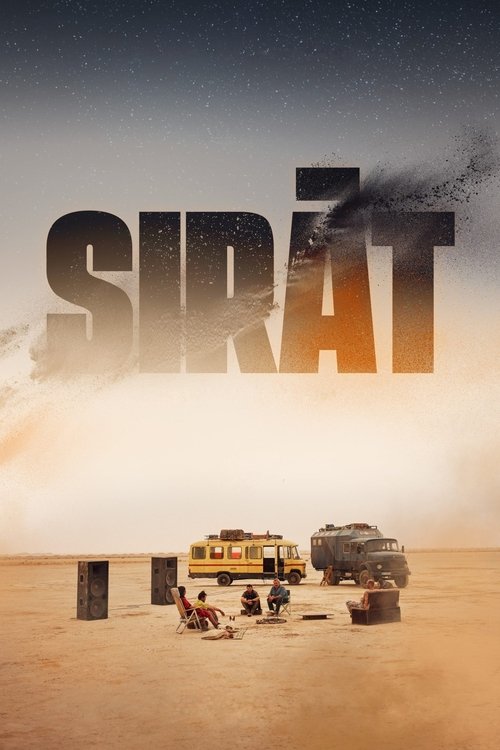
Sirāt
2025 · Oliver Laxe
For when you want to be taken somewhere you cannot predict and pinned to your seat — a challenge, not a comfort, best gone into knowing as little as possible. Ideal if you're craving pure, overwhelming cinema over tidy storytelling.
What it's about
A father and his teenage son turn up at an illegal rave in the Moroccan mountains, handing out flyers with a photograph: his daughter vanished months ago at a party like this one. When the gathering breaks up and a small convoy of hard-bitten ravers drives off into the desert toward one last rumored party, father and son follow. What begins as a missing-person search becomes a road journey into landscapes — and situations — far beyond anyone's control.
The experience
Hypnotic and then harrowing. The first stretch pulses with bass, dust, and strange found-family warmth; then the film shifts into something rawer and more merciless, and the tension becomes physical. It's the kind of movie you come out of shaken, unsure exactly what hit you.
Performances
Sergi López anchors it as the father — a heavy, ordinary, grieving man among the ravers, whose stubborn hope gives the film its aching human center.
The craft
Laxe shoots the Moroccan desert as both rapture and threat, and the sound design — sound-system bass rolling across empty land, engines, wind — is half the experience. See it on the biggest screen with the best speakers you can find; this one works on the body.
Why it matters
The film that carried Oliver Laxe from the festival margins to the center of European art cinema, and one of 2025's most fiercely debated sensations — reviewers reached for comparisons to the great desert ordeals and road epics.
Snapshot
Sirāt is the fourth feature by the French-born, Galician-raised director Oliver Laxe, and the work that carried him from the festival margins to the center of European art cinema. A father, Luis (Sergi López), and his teenage son Esteban arrive at a clandestine rave in the mountains of southern Morocco, distributing flyers in search of his daughter Mar, who vanished months earlier at another such gathering. When the party is broken up and a small convoy of ravers sets out across the desert toward one final, rumored event, Luis and Esteban follow — and the film, which begins as a missing-person search braided with a found-family road movie, detonates roughly midway into something far stranger and crueler: a journey across a minefield, a procession of sudden deaths, an ordeal that reviewers reached for The Wages of Fear, Mad Max, and Antonioni to describe. The title invokes as-Sirāt, the bridge of Islamic eschatology, thinner than a hair and sharper than a sword, that the dead must cross above hell. The film premiered in competition at the 78th Cannes Film Festival on 15 May 2025 and won the Jury Prize ex-aequo with Mascha Schilinski's Sound of Falling. Spain submitted it for the Academy Award for Best International Feature, where it earned nominations for both that prize and Best Sound at the 98th ceremony, and it swept six craft categories at the 40th Goya Awards.
Industry & production
Sirāt is a Spanish–French co-production built on a network of partners that signals Laxe's elevation within the Spanish industry. It was produced by Filmes da Ermida (Laxe's own Galician banner) together with El Deseo — the company of Pedro and Agustín Almodóvar — alongside Uri Films and France's 4A4 Productions, and mounted as a Movistar Plus+ Original with ARTE participation. The involvement of El Deseo is the headline fact: Spain's most prestigious production house, long associated with Almodóvar's authorship, lending its imprimatur to a director whose previous films were comparatively austere festival objects. The reported budget was around €6.5 million, modest by international standards but substantial for Laxe and enough to underwrite an extended desert shoot. International sales were handled by The Match Factory, which closed deals across numerous territories on the strength of the Cannes win.
The production shot across roughly two months in 2024: about a month in the Spanish provinces of Teruel and Zaragoza (notably the Rambla de Barrachina), then some four weeks in Morocco near Errachidia and Erfoud. The shoot was famously beset by a violent sandstorm that destroyed much of the camera equipment and lenses, forcing reshoots — an episode that befits a film so concerned with the desert's capacity to swallow human plans. The casting strategy paired a single established star, Sergi López, with a largely non-professional ensemble drawn from real rave and traveler subcultures, lending the convoy its weathered authenticity.
Technology
Laxe and cinematographer Mauro Herce shot Sirāt on Super 16mm film — a deliberate choice that runs against the digital default of contemporary production and gives the image its grain, its bloom in harsh sunlight, and a tactile fragility appropriate to a story about bodies and machines exposed to the elements. The format's smaller negative and reduced latitude demand careful exposure in the extreme contrast of desert light, and the celluloid registers dust, heat-haze, and the smoke and strobe of the rave as texture rather than clean information. On the sound side, the film is organized around an electronic score and a high-pressure sound design built to be felt physically; the techno drones that score the convoy are not incidental music but, in effect, the film's nervous system, designed for theatrical sub-bass reproduction. The vehicles, sound rigs, and generators of the ravers are themselves the film's signature technology — a portable, off-grid party infrastructure hauled into terrain that will destroy it.
Technique
Cinematography
Mauro Herce's photography is the film's most lauded element and the throughline of his long partnership with Laxe. Working in Super 16, Herce alternates between vast, depopulated wide shots that reduce the convoy to specks against canyon walls and ridgelines, and close, jolting handheld coverage inside the vans and amid the dancers. Critics repeatedly invoked the painterly desolation of late-1960s and 1970s landscape cinema — Antonioni's Zabriskie Point, the existential emptiness of Gus Van Sant's Gerry, the road-bound expanses of Nomadland — alongside the kinetic menace of Mad Max. The grandeur of the rock formations is matched against the human figure's smallness, so that the geography itself reads as an antagonist. The minefield sequences derive their terror precisely from the camera's restraint: the ground looks like any other ground, and the image withholds the threat until it erupts.
Editing
Cristóbal Fernández's cutting is structured around a single, decisive rupture. For its first movement the film accumulates rhythm patiently — the search, the dancing, the formation of an ad-hoc family — before a catastrophic event (a van rolling from a cliff) shatters the register and inaugurates a sequence of abrupt, unsignaled deaths. The editing thereafter refuses the consolations of conventional dramatic build-up; tragedies arrive without the usual cues, which is the source of much of the film's "we can't predict it" tension noted by reviewers. The rave passages, by contrast, are edited to the music's pulse, binding image to the techno's repetition. Fernández's work was among the six craft categories honored at the Goyas.
Mise-en-scène / staging
Laxe stages the film as a gradual stripping-away. The opening rave is dense with bodies, light, and noise; what follows progressively subtracts — people, vehicles, certainty — until the frame holds only sand, sky, and a dwindling number of survivors. The convoy's vans, sound equipment, and the dogs that travel with the group function as the staging's recurring motifs, and the desert is composed as a purgatorial in-between space rather than a documentary location. The minefield is the film's central piece of staging: an apparently featureless plain that the characters must read and cross, every step a wager, the geometry of safe passage improvised in real time with the vehicles.
Sound
Sound is arguably co-equal with image here. Beyond Kangding Ray's score, the design fuses the diegetic throb of the rave with environmental sound — wind, engines, silence — into a continuous pressure that critics described as matching the canyon walls in scale. The film's nomination for Best Sound at the Academy Awards and its Goya for Sound confirm how central the sonic architecture is to its effect; the techno is not a soundtrack laid over the picture but a force the characters live inside and that the audience is meant to endure.
Performance
Sergi López anchors the film as Luis, the father, and drew particular praise for a performance of grief and dogged endurance played largely through physical presence rather than dialogue. Around him, the predominantly non-professional cast — playing the ravers Stef, Jade, Tonin, Bigui, and Josh — brings a lived-in authenticity that professional actors might have smoothed away; their faces and bodies carry the texture of the subculture the film observes. The two dogs traveling with the group were collectively honored with the Palm Dog at Cannes, a small but telling index of the ensemble's documentary grain.
Narrative & dramatic mode
Sirāt operates as a bait-and-switch on genre expectation. It opens in the recognizable mode of the search narrative — a parent looking for a lost child — and the road movie, with its improvised kinship among strangers. That mode is then violently abandoned. The mid-film catastrophe converts the picture into something closer to an existential survival ordeal, in which the search for Mar recedes and the imperative becomes simply to cross alive. The dramatic engine is not plot resolution but attrition: the narrative advances by subtraction, each death reframing what kind of film this is. This refusal of the search-story's implied contract — that the lost will be found, that suffering will be redeemed — is the source of both the film's divisiveness and its power. The desert functions allegorically, the journey legible as a passage across the eschatological bridge of the title, with no guarantee of arrival.
Genre & cycle
The film resists single classification, which critics treated as a feature rather than a flaw, calling it an "unholy amalgam." It belongs at once to the festival art film, the desert road movie, the survival thriller, and a strain of apocalyptic cinema. Its closest cyclical companions are the existential ordeal-on-wheels films — The Wages of Fear and its remake Sorcerer — and the post-apocalyptic action of the Mad Max saga, fused with the contemplative landscape cinema of Antonioni and the modern American wanderer films Gerry and Nomadland. Within Spanish and European art cinema circa 2025, it reads as part of a turn toward genre-inflected auteur work that smuggles spectacle and dread into the festival arena.
Authorship & method
Oliver Laxe (b. 1982, Paris, to Galician parents) is the film's defining authorial intelligence, and Sirāt extends preoccupations visible across his earlier work: the encounter between Western seekers and North African landscape (Mimosas, 2016), the elemental and the spiritual (Fire Will Come / O que arde, 2019), and a method that blends professional and non-professional performers in real terrain. Each of Laxe's three prior features was honored at Cannes — You Are All Captains (2010) in Directors' Fortnight, Mimosas with the Critics' Week Grand Prize, Fire Will Come with the Un Certain Regard Jury Prize — so the main-competition Jury Prize for Sirāt reads as a culmination.
His key collaborators are central to the result. The screenplay is co-written by Santiago Fillol, Laxe's writing partner on Mimosas, whose shaping of the structural rupture is essential. Cinematographer Mauro Herce — himself a director (Dead Slow Ahead) — has shot Laxe's recent features and supplies the film's visual signature. Editor Cristóbal Fernández controls the film's lethal tonal pivot. And composer Kangding Ray, the project name of French electronic musician David Letellier, contributes a techno score that won the Cannes Soundtrack Award, was released by Invada Records in September 2025, and earned a Golden Globe nomination for Best Original Score — an unusually high honor for an electronic film score and a measure of how completely music defines the work.
Movement / national cinema
Sirāt sits within contemporary Spanish cinema while complicating its national label. Laxe's Galician roots and the film's Catalan and broader Spanish industrial base — together with the patronage of El Deseo — make it a Spanish film for awards purposes (it was Spain's official Oscar submission and a Goya juggernaut). Yet its French co-production financing, its French-born director, its Moroccan setting, and its multinational non-professional cast mark it as a transnational European art film in the truest sense. It belongs to a lineage of Iberian auteurs working at the boundary of documentary and fiction in non-domestic landscapes, and to the long European fascination with the Maghreb as a site of both spiritual quest and colonial unease.
Era / period
Made and released in the mid-2020s, Sirāt is contemporary in setting, and critics read its desert ordeal against a backdrop of generalized civilizational anxiety — the sense of a world tipping toward catastrophe that gives the ravers' pursuit of "one last party" its desperate charge. The film captures a specific present in which rave and traveler subcultures persist as forms of refusal, and in which apocalyptic dread has migrated from the speculative to the ambient. Its commitment to celluloid in a digital age further marks it as a deliberate period gesture, aligning its means with its elegiac temper.
Themes
The film's governing themes are mortality and the crossing between worlds, announced by its title. The desert is purgatory; the journey is a test; survival is neither earned nor explained. Around this core cluster several others: grief and the limits of a parent's search, the tension between the collective experience of the rave and the absolute solitude of each death, and the behavior of human beings under extreme duress. The rave itself is treated as a form of communion and escape, a fragile utopia hauled into a landscape that cannot sustain it. Running beneath is a meditation on fate and faith — the sense that the characters are "driven by fate," that the bridge must be crossed whether or not paradise waits on the far side.
Reception, canon & influence
Critical reception was strong and, in places, ecstatic. The film holds high aggregate scores and drew superlatives from major critics — Justin Chang of The New Yorker placed it first on his 2025 best-films list, calling it an experience of singular visceral power, while Jessica Kiang in Variety praised its "brilliantly bizarre, cult-ready vision," Herce's cinematography, and Kangding Ray's score. Its awards profile is substantial: the Cannes Jury Prize and Soundtrack Award; six Goyas; festival prizes at Chicago (Gold Hugo) and Palm Springs (FIPRESCI); a Toronto retrospective for Laxe; Spain's Oscar selection; and Academy nominations for Best International Feature and Best Sound, plus a Golden Globe nomination for the score.
Backward, the influences critics identified form a coherent map: the tension-thriller lineage of Clouzot's The Wages of Fear and Friedkin's Sorcerer; the post-apocalyptic kineticism of Mad Max; the alienated landscapes of Antonioni's Zabriskie Point, Van Sant's Gerry, and Nomadland; and the dread-logic of Lynch's Lost Highway. These sit atop Laxe's own North African and elemental preoccupations carried over from Mimosas and Fire Will Come. Forward, Sirāt's legacy is still forming, but its early canonization on year-end lists and its awards run position it as a touchstone for a genre-bending strand of European auteur cinema, and as the film that confirmed Laxe — and the pairing of art-film method with techno-scored, body-and-landscape spectacle — as a major force. As a recent release, claims about its longer-term influence remain necessarily provisional.
A Deleuzian reading
A father holds out a photograph.
The full Deleuzian reading of Sirāt →
Reception
It detonated at Cannes 2025 — Jury Prize (shared with Sound of Falling, from Juliette Binoche's jury) and instant 'shock of the festival' status — then, unusually for something this feral, the establishment kept nodding: Spain's Oscar pick, two Academy Award nominations (International Feature and Sound), two Golden Globe nods, and a Goya sweep of the craft categories.
How Sirāt was received, from release to now →
How to watch Sirāt: what to notice on a first viewing
- Watch the flyer of Mar's face pass from hand to hand. Luis repeats this gesture at every camp and van, offering the photo to strangers and scanning their faces for a flicker of recognition. The photograph stands in for a whole vanished situation the film never shows you directly.
- Notice how small the convoy looks against the canyon walls. Herce keeps cutting between vast depopulated wides, where the group is barely visible specks, and close handheld shots crammed inside the vans. The scale gap makes the landscape itself feel like something the people must survive, not travel through.
- Listen for how the rave's techno beat matches the cuts. During the party scenes, Fernández locks each edit to Kangding Ray's pulse, so the montage moves at the exact rhythm of the music. Sound stops decorating the image and starts driving it, which is why the score feels physical rather than added on.
- Watch Sergi López's hands and posture instead of his face. As Luis, López carries fatigue, worry, and grief through small physical details, standing, sitting, gripping, far more than through lines of dialogue. You are asked to read a father's state the way you'd read a stranger's, from the body alone.
The whole guide to watching Sirāt, with the keys for a rewatch →
Influences: the films it descends from and the films it influenced
- The Wages of Fear (1953) — Builds an attrition thriller from physical obstacles in the road — a doomed transport across lethal terrain whose set-piece tension is the direct template for Sirāt's minefield sequence.
- Sorcerer (1977) — Fuses near-abstract immersive sound design and a percussive electronic (Tangerine Dream) score to a doomed convoy through wilderness, modeling Sirāt's marriage of techno scoring and sensory dread.
- Mad Max 2: The Road Warrior (1981) — Establishes post-apocalyptic vehicular kineticism and engine-driven cutting across a desert convoy under threat, the action grammar Sirāt borrows for its caravan.
- Zabriskie Point (1970) — Stages depopulated desert wides and ends on a structural rupture — the climactic explosion — that detonates narrative expectation, the formal move Sirāt's mid-film pivot inherits.
- The Passenger (1975) — Renders the North African desert as an existential void in which identity dissolves through long depopulated takes, prefiguring Sirāt's landscape-as-antagonist framing.
- Aguirre, the Wrath of God (1972) — Drives obsessive bodies through real punishing terrain and winnows an expedition by attrition toward annihilation, the body-in-real-landscape ordeal Sirāt restages.
- Stalker (1979) — Structures a crossing through a zone of invisible lethal traps via subtractive mise-en-scène, the mortality-and-crossing logic literalized in Sirāt's minefield.
- Lost Highway (1997) — Runs on dread-logic and a mid-film narrative rupture that swaps the movie you thought you were watching, the structural-rupture engineering behind Sirāt's pivot.
- Fire Will Come (2019) — Laxe and DP Mauro Herce stage non-professional performers against an elemental Galician landscape shot on textured film stock, the author's prior elaboration of body-and-terrain craft.
- Mimosas (2016) — Sends Western seekers across a North African landscape with a professional/non-professional blend and Santiago Fillol's co-writing, the direct method and team Sirāt extends.
- Mad Max: Fury Road (2015) — Synchronizes image to a percussion-heavy score via cut-to-the-beat editing across a single desert-convoy line of motion, the same rhythmic image/sound lock Sirāt deploys.
- Gerry (2002) — Makes the landscape itself the antagonist as figures are attrited toward death across barren wides with near-zero dialogue and durational walking — Sirāt's subtractive, attrition method.
- Nomadland (2020) — Embeds a non-professional itinerant cast inside real desert communities and terrain, the docu-fiction casting-in-landscape method Laxe shares.
- Meek's Cutoff (2010) — Builds an attrition crossing in which a dwindling group is defeated by the terrain rather than a villain, the same antagonist-as-landscape dramaturgy.
- Under the Skin (2013) — Generates dread by welding an electronic score to alien landscape and casting non-professionals in unscripted encounters, paralleling Sirāt's score-driven non-pro method.
- Climax (2018) — Cuts bodies to a relentless techno/electronic score and pivots a communal scene into lethal chaos via structural rupture, the cut-to-the-beat tonal swerve Sirāt mirrors.
- Bacurau (2019) — Executes a genre bait-and-switch from ethnographic art-film into synth-scored survival violence, the same tonal trapdoor Sirāt springs on its audience.
Similar films
- Mad Max: Fury Road (2015) — influence & lineage
- Climax (2018) — influence & lineage
- It Was Just an Accident (2025) — shared sensibility
- Athena (2022) — shared sensibility
- Sound of Falling (2025) — shared sensibility
- The Secret Agent (2025) — shared sensibility
- Afternoons of Solitude (2025) — shared sensibility
- Hit the Road (2021) — shared sensibility
All the films related to Sirāt →
Watch it with: curated runs of related films
- Grief with Nowhere to Land — Watch these together when you can sit with loss — widows, addicts, and lost children drifting through worlds that refuse to hold still.