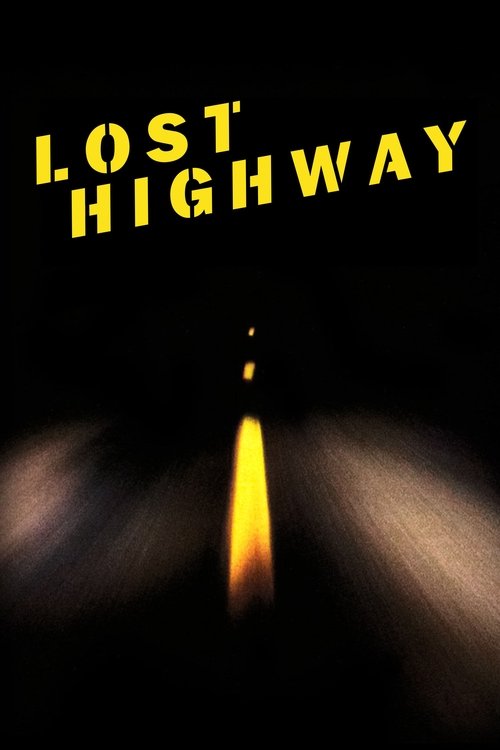
Lost Highway
1997 · David Lynch
His January 2025 death was a global grief event that revealed how central he'd become to young cinephile identity; "Fix your hearts or die" and the daily weather reports became memorial memes. The reference point for everything called "Lynchian."
For when you want to be genuinely unsettled and don't need answers — a late-night film for viewers who'd rather feel a mystery than solve one. Challenge, not comfort; go in willing to surrender.
What it's about
A Los Angeles jazz saxophonist starts finding videotapes on his doorstep — recordings of his own house, then of himself and his wife asleep. His marriage curdles into suspicion, a chalk-faced stranger at a party claims to be in two places at once, and the story fractures into murder, gangsters, and a second life that may or may not belong to the same man.
The experience
Pure dread, delivered slowly — long dark hallways, a soundtrack that growls, and a story that keeps sliding out from under you. It's less a puzzle to solve than a nightmare to inhabit; you leave rattled and turning it over for days.
Performances
Robert Blake's Mystery Man is one of the most frightening figures in nineties cinema, achieved with nothing but white makeup, stillness, and a smile; Patricia Arquette is quietly devastating in a slippery dual role.
The craft
David Lynch builds fear from architecture and sound: rooms swallowed by shadow, a house that feels hostile, a sound design of drones and industrial noise punctuated by a snarling rock soundtrack. Watch it loud and in the dark — the film works on your nervous system as much as your mind.
Why it matters
Divisive on release, it has grown into a touchstone of puzzle-box cinema, its Möbius-strip structure paving the way for Lynch's later Los Angeles nightmares and for two decades of identity-bending mind-benders.
Snapshot
Lost Highway is David Lynch's seventh feature, his first after the commercial and critical bruising of Twin Peaks: Fire Walk with Me (1992) and the canceled television experiments of the early 1990s. Co-written with novelist Barry Gifford, it follows Los Angeles jazz saxophonist Fred Madison (Bill Pullman), who is tormented by anonymous videotapes appearing on his doorstep, by suspicions about his wife Renee (Patricia Arquette), and by a chalk-faced "Mystery Man" (Robert Blake) who claims to be in two places at once. After Fred is convicted of Renee's murder, he inexplicably transforms in his prison cell into a young mechanic, Pete Dayton (Balthazar Getty), whose entanglement with a gangster's mistress — Alice, also Arquette — eventually folds the narrative back on itself. The film is the purest expression of Lynch's interest in what he called a "psychogenic fugue": a mind so unable to bear what it has done that it rewrites its own identity. Structurally a Möbius strip, tonally a noir nightmare, it stands as the hinge between Lynch's Twin Peaks period and the Los Angeles trilogy of dissociation that would continue with Mulholland Drive and Inland Empire.
Industry & production
Lost Highway was produced through Lynch's own Asymmetrical Productions and financed largely by the French company CiBy 2000 — a recurring backer of auteur cinema in the 1990s — with U.S. distribution handled by October Films. This financing structure was characteristic of Lynch's standing at the time: a director with enormous international cachet but, after Fire Walk with Me and the failure of his television ventures, diminished bankability in Hollywood's mainstream. European money buying American art cinema was the model that kept him working.
The production drew on Lynch's tight repertory ethos. Genesis lay in Lynch's fascination with the phrase "lost highway," which appears in Gifford's novel Night People; the two men, who had already collaborated when Lynch adapted Gifford's Wild at Heart (1990), built an original screenplay around the fugue concept rather than adapting a single source. Lynch shot key interiors in his own Los Angeles home on Senalda Road, the modernist house standing in for the Madison residence — a literalization of his recurring instinct to make the domestic space uncanny. The shoot is also notable for its valedictory casting: it was the final film of Jack Nance, Lynch's original Eraserhead lead and longtime talisman, who died in December 1996 before the film's release, and it featured a small, physically difficult performance from Richard Pryor, by then living with multiple sclerosis. The exact budget and box-office figures are not something I can state with confidence, but the film is generally understood to have underperformed in North America while sustaining Lynch's reputation abroad.
Technology
Technologically, Lost Highway is a 35mm photochemical film, made before Lynch's later, decisive turn to consumer digital video on Inland Empire (2006). Its innovations are not in capture format but in the manipulation of the image at its edges: the film leans heavily on extreme low-key lighting, pools of darkness that swallow whole sections of the frame, and slow, almost subliminal in-camera and optical effects — most famously the strobing, smeared transformation of Fred into Pete, and the corridor sequence in which the Mystery Man's intrusion is rendered through distortion and overexposure rather than conventional morphing. The opening title sequence — a yellow road line racing under headlights at night to David Bowie's "I'm Deranged" — is a piece of pure kinetic image-making that establishes velocity and disorientation before a word is spoken. Sound technology, discussed further below, is where the film's real engineering ambition lies; Lynch treated the mix as a primary expressive instrument.
Technique
Cinematography
Peter Deming, who would become one of Lynch's essential collaborators (and shoot Mulholland Drive), photographs the film in a register of engulfing darkness. The Madison house is a near-abstract space of shadow, its rooms defined by what cannot be seen; characters walk into blackness and dematerialize. Deming and Lynch oppose this murk against the bleached, sun-struck exteriors of the Pete Dayton sections, so that the film's two halves are distinguished as much by light as by plot. The camera tends toward stillness and slow, creeping movement — dollies that advance into hallways like a held breath — punctuated by sudden violence of framing. The visual grammar withholds: faces are kept partly in shadow, eyelines are uncertain, and space refuses to cohere into a reliable map.
Editing
Cut by Mary Sweeney — Lynch's editor, producer, and longtime creative partner — the film's structure is its most radical formal gesture. Rather than a twist revealed late, the narrative is built as a loop: it opens and closes on Fred at his own intercom hearing the words "Dick Laurent is dead," so that the ending feeds the beginning. The transformation at the midpoint is not explained but simply edited as fact, forcing the viewer to accept a discontinuity the film never resolves. Sweeney's cutting sustains long, dread-laden takes against abrupt ruptures, and it is the editing — the refusal to bridge the two protagonists with conventional connective tissue — that converts a noir plot into a closed circuit of dissociation.
Mise-en-scène / staging
Lynch's staging weaponizes domestic and institutional spaces. The Madison home is sparse, modern, and hostile; the prison cell is a box of unbearable enclosure; Mr. Eddy's world is one of cars, pornography, and sudden brutality. Recurring objects — the videotapes, the intercom, the cabin in the desert that bursts into flame in reverse — function as ritual motifs rather than plot props. The Mystery Man's appearance at a party, white-faced and gleeful, staging the impossible phone call in which he is simultaneously present and at Fred's house, is a set piece of pure unease constructed almost entirely through performance, framing, and the violation of spatial logic.
Sound
Sound is arguably the film's supreme achievement. Lynch, who takes a hands-on role in sound design, fills the Madison house with subsonic drones and amplified room tone, so that silence itself becomes oppressive — a low, almost physical hum of dread. Dialogue is often slowed, layered, or set against industrial noise. The score by Angelo Badalamenti supplies dark orchestral textures, while the soundtrack — supervised in collaboration with Trent Reznor of Nine Inch Nails — splices in aggressive contemporary music: Rammstein, Marilyn Manson, Nine Inch Nails' "The Perfect Drug," Lou Reed's cover of "This Magic Moment," Antônio Carlos Jobim, and Bowie. The collision of Badalamenti's romantic dread with industrial metal is itself a dramatization of the film's split between Fred's mournful world and Pete's adolescent, hormonal one.
Performance
The performances are tuned to Lynch's flattened, slightly heightened register. Bill Pullman plays Fred as a man of opaque, simmering jealousy, his line readings deliberately stilted; Patricia Arquette doubles as the languid, unreadable Renee and the more overtly sexual Alice, a Vertigo-like brunette/blonde split that keeps the audience guessing whether the two women are one. Robert Blake's Mystery Man is the film's indelible figure — affectless, grinning, and genuinely frightening — a performance whose menace was later given an uncomfortable real-world charge by Blake's own 2001 arrest and subsequent trial (he was acquitted in the criminal case in 2005). Robert Loggia is volcanic as the gangster Mr. Eddy / Dick Laurent, anchoring the film's eruptions of violence, while Balthazar Getty supplies Pete's blank, drifting passivity.
Narrative & dramatic mode
The film's dramatic mode is the puzzle as unsolvable experience rather than solvable riddle. Lynch and Gifford construct what one can read as a fugue state externalized: a guilty man invents a parallel self and a parallel story to escape an unbearable truth, only for the same figures (the wife as femme fatale, the rival lover, the omniscient Mystery Man) to reappear and the lie to collapse. The dominant scholarly reading frames the structure as a Möbius strip — a single surface with no inside or outside — and the film actively resists closure: the loop returns Fred to his own door, transformation incomplete, guilt unexpiated. Crucially, Lynch declines to provide the key. The film is designed to be inhabited as a mood of dread and recursion, not decoded.
Genre & cycle
Lost Highway belongs to the neo-noir lineage while detonating its conventions. It has the femme fatale, the cuckolded protagonist, the gangster, the murder, the surveillance, and the doom-laden Los Angeles setting; but it strips out the genre's reliance on motive, explanation, and detection. It sits within the 1990s cycle of stylized, music-video-inflected neo-noir, yet it pushes past genre into the avant-garde. In the longer view it is recognized as a foundational text of what scholars later termed the "mind-game film" or "puzzle film" — narratives organized around unreliable subjectivity, forked or looping timelines, and identities that split and merge.
Authorship & method
The film is unmistakably a Lynch work, and it crystallizes his method: intuition over explanation, atmosphere over plot mechanics, and a refusal to gloss his own symbols. Lynch has consistently declined to interpret the film, treating ambiguity as a value rather than a problem. His key collaborators here form the nucleus of his late career. Barry Gifford, the co-writer, brought a hard-boiled American-pulp sensibility that grounds Lynch's abstraction in noir genre furniture. Peter Deming established the visual language of shadow that would define Lynch's subsequent Los Angeles films. Mary Sweeney, editor and producer, shaped the loop structure and was at this point Lynch's most consistent creative partner. Angelo Badalamenti, Lynch's composer since Blue Velvet, supplied the orchestral dread, while the Trent Reznor–led music supervision brought a harder contemporary edge that marks the film as a product of the mid-1990s. The collaboration that recurs across these names — Lynch directing, Sweeney cutting, Deming shooting, Badalamenti scoring — is the engine of his mature authorship.
Movement / national cinema
As American cinema, Lost Highway occupies the space between Hollywood and the international art film — financed by French capital, distributed by an independent specialty label, and aesthetically aligned more with European modernism than with the American mainstream. Lynch's affinities here run to Continental antecedents: the identity-dissolution of Bergman's Persona, the looping, anti-narrative games of the French nouveau roman (Alain Robbe-Grillet), and the surrealist tradition Lynch had absorbed since Eraserhead. The film is best understood not as part of a contemporaneous American movement but as a node in Lynch's idiosyncratic, transnational authorship, sustained by the European art-cinema economy of the period.
Era / period
The film is deeply of the mid-1990s. Its preoccupation with surveillance videotape — the camera that watches the home from outside, the recording that knows more than its subject — resonates with a decade newly anxious about home video, voyeurism, and mediated reality. Lynch has connected the film's emotional logic to the contemporaneous O. J. Simpson case and the spectacle of a man who appears unable to confront his own act, and the film's fugue concept reads as a meditation on that cultural moment of denial and self-narration. Its industrial-metal soundtrack and music-video editing rhythms further root it in the texture of 1997.
Themes
The dossier's central themes recur with ritual insistence: guilt and its evasion (the fugue as a flight from the unbearable); identity as unstable and divisible (Fred/Pete, Renee/Alice, the Mystery Man's doubled presence); surveillance and the externalized gaze (the tapes that see what the self denies); jealousy and sexual dread; and time as a closed loop rather than a line. Beneath these runs Lynch's perennial subject — the violence and rot concealed beneath ordinary surfaces — here transposed from the small-town veneer of Blue Velvet to the anonymous interiors and freeways of Los Angeles. The desert, fire, and the recurring intercom message function as the film's metaphysical furniture, signs of a cosmology the film insists upon without ever spelling out.
Reception, canon & influence
On release in early 1997, Lost Highway sharply divided critics. Its opacity and refusal of resolution alienated many reviewers — most famously Siskel and Ebert, whose "two thumbs down" Lynch and October Films cheerfully repurposed into a poster line — while others recognized a major, uncompromising work. Over time the film's standing has risen considerably; it is now widely regarded as one of Lynch's essential films and a key statement of his late style, even if it has not attained the broad canonization of Blue Velvet or Mulholland Drive.
Its lines of influence run in both directions. Backward, the film draws on classic film noir and its doomed protagonists, on Hitchcock's Vertigo (the blonde/brunette double, the man remaking a woman and reality to his desire), on Bergman's Persona and the modernist cinema of identity-merger, on the Kafkaesque logic of impossible transformation, and on the recursive structures of the nouveau roman. Forward, Lost Highway is the clear precursor to Lynch's own Mulholland Drive (2001) and Inland Empire (2006), which extend its dissociative, looping architecture. More broadly it became a touchstone for the turn-of-the-millennium wave of nonlinear, unreliable-narrator cinema — the "puzzle" and "mind-game" films — and its fusion of avant-garde structure with genre noir has been widely cited by filmmakers and theorists alike. Its afterlife was also colored by extra-textual events, particularly the later legal ordeal of Robert Blake, which lent the Mystery Man a retrospective dread the filmmakers could not have intended. The film endures as Lynch's most rigorous experiment in narrative as a Möbius strip — a closed loop of guilt that the viewer, like Fred Madison, can travel endlessly without ever arriving anywhere.
A Deleuzian reading
A man stands at his own front door, indoors, and presses the intercom.
The full Deleuzian reading of Lost Highway →
Reception
Dismissed by many critics in 1997 as Lynch at his most willfully impenetrable, it's since been reclaimed as the start of his great late-period LA trilogy — the film that paved the road to Mulholland Drive.
How Lost Highway was received, from release to now →
Influences: the films it descends from and the films it influenced
- Vertigo (1958) — Supplies the blonde/brunette doubling and the male obsessive who remakes a woman to fit his fantasy, which Lynch literalizes through Renee/Alice played by one actress.
- Persona (1966) — Models the modernist dissolve of two identities into one unstable subject, the formal precedent for Fred's fugue-transformation into Pete.
- Last Year at Marienbad (1961) — Robbe-Grillet's nouveau-roman recursion — repeated, contradictory scenes with no stable chronology — is the structural grammar behind the film's Möbius loop.
- Detour (1945) — Poverty-row noir of a doomed narrator trapped in a closing circle of guilt, the genre furniture Gifford's pulp script grafts onto Lynch's abstraction.
- The Trial (1962) — Kafkaesque logic of an accused man undergoing impossible, unexplained transformation within a paranoid, juridical dream-space.
- Eraserhead (1977) — Lynch and Alan Splet's continuous subsonic industrial drone and uncanny domestic interior become the sonic and spatial template Lost Highway reactivates.
- Blue Velvet (1986) — Establishes the Lynch–Badalamenti scoring partnership and the low-key suburban-uncanny lighting that Deming extends into the Madison house.
- Jacob's Ladder (1990) — A psychogenic-fugue structure in which a guilty man's entire narrative is a dying or dissociative hallucination, anticipating Fred's loop of denial.
- Performance (1970) — Structures the film as a two-panel diptych in which one identity transforms into another at the hinge, the same diptych-of-the-double architecture Performance pioneered.
- Wild at Heart (1990) — Extends the highway-as-dream road motif and the Lynch–Gifford collaboration into full noir, deepening the associative, non-causal editing pioneered here.
- Mulholland Drive (2001) — Directly extends the dissociative loop architecture — a guilty dreamer reassembles reality into a wish-fulfillment double identity before collapse.
- Inland Empire (2006) — Pushes the looping, identity-bleeding structure to its limit, with the same doubled-casting device and surveillance-of-the-self dread.
- Lost Highway's (1999) — Fight Club inherits the dissociative split-protagonist reveal, withholding that two characters are one fractured psyche until the loop closes.
- Memento (2000) — A keystone of the same mind-game wave, using nonlinear editing and an unreliable narrator's amnesia to make narrative form enact a guilty man's self-deception.
- Caché (2005) — Builds its plot from anonymous surveillance videotapes of the protagonist's own home — the exact uncanny device that opens Lost Highway, weaponizing the surveillance gaze.
- Enemy (2013) — Uses one actor as two men and a closed dream-logic loop to dramatize identity instability, an explicit heir to the doubled-casting fugue.
- Mauvais Sang (2004) — The Machinist externalizes insomniac guilt as a doubled persecutor figure, extending the fugue-as-narrative-engine into noir-inflected psychological thriller.
- Sirāt (2025) — Runs on dread-logic and a mid-film narrative rupture that swaps the movie you thought you were watching, the structural-rupture engineering behind Sirāt's pivot.
- The Bride! (2026) — A single performer carrying two identities as load-bearing structure rather than gimmick (Arquette), with the film's spine snapping into a second mode at the midpoint over Badalamenti's sub-bass drone layered under distorted rock cues.
- Enemy (2013) — Lynch substitutes one man for another mid-film with no diegetic explanation, holding the seam together with low-frequency drone rather than plot — the license for Enemy's withholding cut and its refusal to confirm which man is left.
- Possession (1981) — Hysterical identity-splitting and doppelgängers staged inside an uncanny domestic apartment, sharing Lynch's marriage-as-horror register.
- Spider (2002) — Renders a disturbed man's reconstructed, unreliable memory as inhabited physical space, sharing the subjective-fugue staging of guilt.
- Un Chien Andalou (1929) — Builds its narrative on a Möbius dream-logic and unexplained associative transformations of identity, the feature-length apotheosis of the seed's montage that obeys association over continuity.
- The End of Violence (1997) — Parallel nocturnal-LA dread built around anonymous surveillance videotapes appearing at a private home, fusing Hollywood unease with the threat of being watched.
- Gozu (2003) — The mid-narrative identity dissolution and oneiric logic where a character is reborn as another body — directly echoed in Gozu's climactic rebirth of Ozaki out of a woman's vagina.
- Angel Heart (1987) — Descendant in the noir-occult identity-dissolve mode: a protagonist who becomes another man, a courtly demonic figure (the Mystery Man) who already knows the damning truth, and dread built from impossible subjective logic.
- Following (1999) — Fractures chronology around identity-doubling and a protagonist who slips into another's life, the splintered-time-plus-unstable-self construction Following renders in miniature.
- Twin Peaks: Fire Walk with Me (1992) — Directly extends FWWM's roaring industrial soundscapes and identity-dissolution editing, with Badalamenti's dread scoring pushed toward outright psychogenic fugue.
Similar films
- Blue Velvet (1986) — influence & lineage · same viewing thread · often watched together
- Eraserhead (1977) — influence & lineage · often watched together
- Jacob's Ladder (1990) — influence & lineage · often watched together
- Mulholland Drive (2001) — influence & lineage
- Inland Empire (2006) — influence & lineage
- Memento (2000) — influence & lineage
- Last Year at Marienbad (1961) — influence & lineage
- Sirāt (2025) — influence & lineage
All the films related to Lost Highway →
Watch it with: curated runs of related films
- The Killer You Can't Look Away From — A run of murder mysteries where obsession — the witness's, the investigator's, the killer's own — curdles into pure style, from the gloved-hand giallo that invented the look to the modern heirs still working the vein.