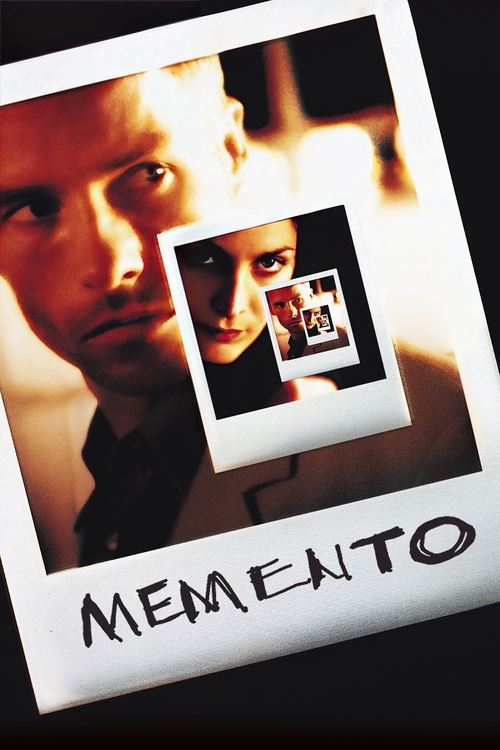
Memento
2000 · Christopher Nolan
For a night when you want your brain fully switched on — a thriller you solve rather than just watch. Not comfort viewing; it's the one you argue about afterward and rewatch to check your work.
What it's about
Leonard Shelby is hunting the man who raped and murdered his wife — but since the attack, he can't form new memories. Anything he learns evaporates within minutes, so he runs his investigation on Polaroids, scribbled notes, and facts tattooed onto his own skin. Around him circle a helpful cop and a sympathetic bartender whose motives he can never quite hold onto, and the film tells his story in reverse, each scene ending where the last one began.
The experience
It plays like a puzzle box that keeps resetting in your hands — you're as lost as Leonard is, piecing together who to trust from scraps, and the tension comes from knowing something he's already forgotten. Disorienting at first, then compulsive, and it snaps into focus in ways that make you want to start over immediately.
Performances
Guy Pearce carries nearly every frame as Leonard, playing a man who must perform confidence over total uncertainty — wary, wry, and quietly desperate. Carrie-Anne Moss and Joe Pantoliano keep you guessing about whether their characters are allies or predators.
The craft
The backward structure isn't a gimmick — it's the whole point, forcing you to experience Leonard's condition from the inside: every scene opens with you not knowing how he got there. Color sequences run in reverse chronological order while a black-and-white strand moves forward, and the editing stitches the two together with watchmaker precision. Pay close attention; it rewards an uninterrupted, distraction-free viewing more than a big screen.
Why it matters
The film that announced Christopher Nolan as a major filmmaker and became the modern touchstone for puzzle-narrative cinema — the movie every twisty indie thriller since has been measured against.
Snapshot
Memento is the film that announced Christopher Nolan as a major directorial intelligence and, two decades on, remains the cleanest demonstration of his central obsession: that narrative form can itself dramatize a subjective state. Adapted from a short story, "Memento Mori," by his brother Jonathan Nolan, the film follows Leonard Shelby, a former insurance investigator who, after the attack that killed his wife, can no longer form new memories. He hunts the man he believes responsible while relying on Polaroids, handwritten notes, and tattoos to substitute for a memory he no longer has. The film's notorious structural conceit is to present its story backward — color sequences run in reverse chronological order, each scene ending where the prior one began — interleaved with a black-and-white strand that runs forward, the two meeting at the film's pivot. The result is not a gimmick but an epistemological machine: the audience is placed inside Leonard's deficit, knowing only what he knows, arriving at each scene without the context that precedes it. Made on a modest budget and initially struggling to find a distributor, Memento became a critical sensation and an art-house commercial success, earning Academy Award nominations for its screenplay and editing, and establishing a template — puzzle structure, unreliable interiority, thematic preoccupation with memory and identity — that Nolan would scale up across his subsequent career.
Industry & production
Memento was produced by Newmarket Films, with Jennifer Todd and Suzanne Todd producing, on a budget widely reported in the rough range of $4–5 million; precise figures vary across sources, so the number should be treated as approximate rather than authoritative. The project's path to release became part of its legend: completed and well received on the festival circuit (it premiered at the Venice Film Festival in 2000 and screened at Toronto and Sundance), the film initially found American distributors wary of its inverted structure, and Newmarket ultimately self-distributed it theatrically in the United States in early 2001. That gamble paid off — the film performed strongly relative to its cost over a long platform release, becoming one of the defining independent successes of its moment.
The production was lean and fast, shot on a compressed schedule in and around Los Angeles. Nolan came to it off the back of his self-financed debut Following (1998), a black-and-white London-set neo-noir that already showed his appetite for fractured chronology. Memento was a substantial step up in resources but retained an independent ethos. The screenplay's provenance — Jonathan Nolan's concept, developed in parallel with the short story, and Christopher Nolan's screenplay — gave the film an unusually rigorous architecture, since the structure had to be engineered rather than merely written. The film's success functioned as Nolan's calling card to the studio system, leading directly to Insomnia (2002) for Warner Bros. and, soon after, the Batman franchise.
Technology
Memento was shot photochemically on 35mm film, and its technological signature lies less in any novel apparatus than in the deliberate use of two distinct visual registers — saturated color for the reverse-chronological strand and high-contrast black-and-white for the forward strand. The black-and-white material evokes the film-noir lineage the story draws on while also serving a purely functional, orienting purpose: it tells the viewer which timeline they are in. The use of Polaroid instant photography is the film's most resonant technological motif, the Polaroid serving as Leonard's externalized memory device — a physical object that fixes a moment he cannot retain. In one of the film's most quietly virtuosic touches, a Polaroid is shown un-developing, the image fading back into blankness, a practical effect achieved by reversing the footage that perfectly literalizes the reverse-flowing narrative.
The post-production technology was, by the standards of the era, conventional, but the editorial assembly demanded exceptional precision: stitching the two timelines so that the reverse strand's scenes dovetail seamlessly at their overlapping edges required exacting continuity management. The film predates the digital-intermediate workflows that would soon become standard, and its look is the product of on-set lighting and lab work rather than extensive grading.
Technique
Cinematography
Wally Pfister shot Memento, beginning a collaboration with Nolan that would run through the Dark Knight trilogy and Inception, for which Pfister won the Academy Award for Cinematography. Here his work is restrained and legible, prioritizing clarity over flourish — a wise choice given how much cognitive load the structure already places on the viewer. The color sequences favor a slightly desaturated, naturalistic palette appropriate to the anonymous motels and sun-bleached exurban California in which Leonard drifts. The black-and-white sequences are harder-edged, drawing explicitly on noir chiaroscuro: Leonard alone in a motel room, lit by lamp and shadow, narrating into a telephone. Pfister's camera tends toward stability and observation rather than the kinetic handheld common to the period's independent cinema, reinforcing the sense that we are watching a man trapped in repeating, bounded spaces. Close attention is paid to Leonard's body as a text — the tattoos that cover his torso are photographed as inscriptions to be read, the camera lingering on them as evidence.
Editing
Editing is the film's true authorial instrument, and Dody Dorn's work earned an Academy Award nomination. The achievement is twofold. First is the macro-structure: the interleaving of a backward color strand and a forward black-and-white strand, calibrated so that information is withheld and released at precisely the rate that sustains both suspense and comprehension. Each color scene opens in medias res, and only as it plays — and as the next (chronologically earlier) scene arrives — does the viewer understand what they have just seen. The cumulative effect inverts the usual mechanics of suspense: rather than wondering what happens next, we are made to ask what just happened and why. Second is the micro-level continuity discipline required to make the reverse-cut transitions feel inevitable rather than confusing. The two strands converge in the film's climactic hinge, where black-and-white tips into color, a formal resolution that doubles as the story's revelation. It is one of the most thoroughgoing demonstrations in modern narrative cinema that editing is not the servant of story but can be its primary author.
Mise-en-scène / staging
The film's world is a deliberately depthless one of motels, diners, derelict buildings, and parking lots — transient non-places that mirror Leonard's inability to accumulate a continuous life. Props carry enormous semantic weight: the Polaroids, the notes, the tattoos, the file of photocopied police reports Leonard hauls around. These objects are the film's connective tissue, the only continuity Leonard — and to a degree the viewer — can trust, which is precisely what makes their unreliability so devastating. Staging frequently isolates Leonard within the frame, underscoring his solitude inside his condition. The recurring tableau of Leonard studying his own annotated body in a mirror stages the film's central paradox — a man forced to read himself as a stranger reads a document.
Sound
David Julyan's score is spare and atmospheric, built from sustained synthesized textures rather than melodic theme, producing a mood of suspended dread suited to a protagonist with no forward momentum and no past he can hold. The sound design contributes to disorientation through Leonard's recurring auditory and visual flashes — the fragmentary impressions of the attack and of his wife — that punctuate the narrative. Leonard's first-person voiceover, threaded especially through the black-and-white sequences, is central to the film's address, granting access to a consciousness while simultaneously planting the seeds of doubt about that consciousness's reliability.
Performance
Guy Pearce's performance as Leonard is the film's anchor and one of the defining lead turns of its decade, though it went largely unrecognized by major awards at the time. Pearce plays Leonard with a coiled, watchful intensity, conveying both the rigidity of a man who has built a system of rules to survive and the flickers of grief and rage beneath it. The performance must register continuity of character across scenes that the audience encounters out of order, and Pearce calibrates Leonard's affect so precisely that the viewer can track his emotional state even when chronology is scrambled. Carrie-Anne Moss, as Natalie, and Joe Pantoliano, as Teddy, occupy the film's morally slippery middle ground; both performances are built on ambiguity, since the audience — like Leonard — cannot be sure whether either is ally or manipulator. Stephen Tobolowsky and Harriet Sansom Harris appear in the Sammy Jankis subplot, the film's haunting story-within-the-story whose function only resolves in the final movement.
Narrative & dramatic mode
Memento is the purest mainstream instance of what might be called subjective-deficit narration: the formal organization of the film reproduces the protagonist's cognitive condition, so that the audience is structurally deprived of the same continuity Leonard lacks. This is unreliable narration not at the level of a lying voice but at the level of architecture. The dramatic mode is investigative noir turned inward — the detective and the amnesiac and, ultimately, the suspect collapse into one figure. The film withholds the conventional pleasures of resolution; its climax delivers not clarity but a vertiginous reframing in which Leonard's entire project is revealed as something he may have constructed, and continues to construct, to give himself a purpose. The Sammy Jankis subplot operates as an interpretive key planted in plain sight, a parallel case whose true relation to Leonard reorganizes everything the viewer has assembled. The film thus belongs to a tradition of revelation-driven narrative, but it refuses the catharsis such narratives usually grant, leaving the protagonist — by design — unable to retain the truth he uncovers.
Genre & cycle
The film sits at the intersection of neo-noir and the turn-of-the-millennium "puzzle film" or "mind-game film," a cycle that includes works such as The Sixth Sense (1999), Fight Club (1999), Being John Malkovich (1999), and Mulholland Drive (2001). These films share a fascination with unstable identity, unreliable perception, and structures that demand a second viewing. Memento draws deeply on classic film noir — the doomed protagonist, the femme-fatale ambiguity, the voiceover, the chiaroscuro, the corrupt and contingent moral world — while updating noir's fatalism into a meditation on memory and self-deception. It also participates in a broader contemporaneous interest in nonlinear and fractured chronology, alongside films like Pulp Fiction (1994) and Run Lola Run (1998), though Memento is distinguished by making its structure inseparable from its theme rather than a stylistic choice laid over a conventional story.
Authorship & method
Memento is a foundational text for understanding Christopher Nolan as an author. The preoccupations visible here — fractured time, the unreliability of subjective experience, grief as an engine of obsession, the protagonist who constructs a comforting fiction (a lineage that runs through Insomnia, The Prestige, Inception, and Interstellar) — recur throughout his work. So does his method: writing structure as a first-order problem, building films as mechanisms whose form encodes their meaning. The collaboration with his brother Jonathan, whose concept seeded the film, would continue across major projects. The film also inaugurated key craft partnerships, most notably with cinematographer Wally Pfister. Editor Dody Dorn's contribution was decisive in realizing the structural design on screen, and composer David Julyan, who had scored Following, again provided the sonic atmosphere. Nolan's authorial signature here is the conviction that an audience can be trusted with difficulty — that withholding and rearrangement, rather than alienating viewers, can pull them deeper into a character's interior.
Movement / national cinema
Nolan is a British filmmaker working in an Anglo-American idiom, and Memento, though shot in California with American settings and largely American and Australian leads, is best understood not as part of a national movement but as a product of late-1990s/early-2000s independent and transnational filmmaking. It carries the imprint of British low-budget ingenuity — the lessons of Following — fused with American genre material. The film belongs less to a geographic movement than to the international art-house-inflected genre cinema of its moment, in which formally ambitious work could reach sizable audiences through the festival-to-platform-release pipeline.
Era / period
Released at the turn of the millennium, Memento is emblematic of a particular cultural and industrial moment. Industrially, it reflects the high-water mark of American independent cinema's commercial viability, when a structurally daring film could be self-distributed to genuine success. Culturally, it sits within a cycle of films preoccupied with the instability of reality, identity, and perception — anxieties that critics have linked to the period's media saturation and to a broader fin-de-siècle uncertainty. Technologically it stands just before the digital tide: shot on film, dependent on Polaroid instant photography as both prop and metaphor at the very moment such analog technologies were beginning their slide toward obsolescence, which lends the film an additional, unintended poignancy in retrospect.
Themes
The film's governing theme is memory — not merely as faculty but as the foundation of identity, agency, and moral continuity. Leonard's condition asks whether a self can exist without the capacity to accumulate experience, and the film's grim suggestion is that, deprived of memory, a person becomes a creature of systems, habits, and self-authored narratives. Closely bound to this is the theme of self-deception: the film's devastating final turn implies that memory's failure is not only Leonard's affliction but his refuge, that he uses his condition to sustain a purpose and absolve himself. The film also interrogates the nature of evidence and truth — the notes, photos, and tattoos that promise objectivity are shown to be authored, editable, and therefore corruptible, raising the question of whether any record is ever neutral. Grief and the structure of revenge run beneath all of this: Leonard's quest is a way of metabolizing loss that can never complete because he cannot remember its completion. Finally, the film meditates on the constructed nature of meaning itself — the human compulsion to impose narrative on a chaos of disconnected moments, which is precisely what both Leonard and the viewer are doing throughout.
Reception, canon & influence
Memento was met with strong critical acclaim upon release, widely praised for the audacity and coherence of its structure and for Pearce's performance, and it became a touchstone in critical conversations about narrative complexity in contemporary cinema. It earned Academy Award nominations for Best Original Screenplay (Christopher Nolan, from Jonathan Nolan's story) and Best Film Editing (Dody Dorn), and accumulated numerous critics'-association honors; readers should consult awards databases for the full ledger, but the screenplay and editing nominations are the canonical recognitions. Over time it has been frequently cited in lists of the best films of its decade and as a landmark of the puzzle-film cycle, and it is a fixture in film-studies discussions of narration, time, and unreliable perception.
Looking backward, the film's influences are legible: classic film noir supplies its mood, moral universe, and voiceover convention; the broader nonlinear experiments of 1990s cinema established an audience for fractured chronology; and the science-and-philosophy interest in anterograde amnesia gives the premise its clinical grounding (though the film dramatizes rather than documents the condition, and should not be read as a clinical account). Looking forward, Memento's legacy is substantial. It made Nolan's career and thereby shaped a strand of twenty-first-century blockbuster filmmaking that married spectacle to structural ambition. More broadly, it helped normalize demanding, rewind-and-rewatch narrative architecture in mainstream cinema and became a perennial reference point — sometimes a shorthand, sometimes a genuine model — for any film that organizes its story around memory loss, reverse chronology, or the dramatization of a damaged subjectivity. Its standing as the definitive memory-and-amnesia narrative of modern film remains, by general critical consensus, secure.
A Deleuzian reading
Watch the Polaroid fade.
The full Deleuzian reading of Memento →
Reception
Every US distributor passed on it — too confusing, they said — so Newmarket released it themselves, and it snowballed from indie sleeper to two Oscar nominations. It's since gone from 'clever indie puzzle' to the consensus pick for Nolan's tightest film, the one even his skeptics defend.
How Memento was received, from release to now →
Influences: the films it descends from and the films it influenced
- Double Indemnity (1944) — Establishes the noir confessional voiceover that narrates a story already lost, the first-person retrospective address Leonard's narration inherits and corrupts.
- Out of the Past (1947) — Supplies the chiaroscuro lighting grammar and the doomed protagonist whose own narrated past is the trap closing on him, the moral universe Memento transplants into neo-noir.
- Citizen Kane (1941) — Models structure as a first-order problem — a story deliberately assembled out of chronological order from fragmentary, partial accounts rather than told straight.
- Rashomon (1950) — Pioneers unreliable subjective narration in which each retelling reshapes the 'facts,' the engine Memento internalizes within a single damaged perceiver.
- Last Year at Marienbad (1961) — Treats memory as unstable, repeated and self-contradicting imagery, modeling the dual visual registers and prop-as-memory logic Memento renders concrete.
- The Killing (1956) — Builds a time-shuffled heist as a precision mechanism whose reordered form encodes its meaning — the structural-clockwork ethos Nolan adopts wholesale.
- Betrayal (1983) — Executes rigorous scene-by-scene reverse chronology from Pinter's play, the exact formal device — endings preceding causes — that Memento's color strand systematizes.
- Pulp Fiction (1994) — Normalized scrambled, achronological storytelling for a mainstream audience, building the viewer literacy in fractured chronology that Memento could presume.
- Following (1998) — Nolan's own debut interleaves a fractured timeline and debuts composer David Julyan's ambient synth atmosphere, the direct craft prototype reworked into Memento.
- Twelve Monkeys (1995) — Nolan extends the atemporal jump-cut editing strategy into a structural principle — the reversed scene order makes the audience's cognitive disorientation identical to the protagonist's — radicalizing the phenomenological device Mick Audsley used for Cole's temporal displacements into the film's entire organizing logic.
- Fight Club (1999) — Nolan extends Fight Club's use of temporal ellipsis and deceptive revelation into a fully systematic methodology: chronological inversion structuring editing itself as the instrument of unreliable narration, forcing the viewer to inhabit fragmented cognition rather than observe it.
- The Usual Suspects (1995) — Nolan externalizes Singer's unreliable-narrator device through structural editing inversion—running time fragments backwards to place the viewer inside a compromised POV—making explicit what Singer keeps implicit: that narrative constructed from testimony is always an act of misplaced trust.
- Irréversible (2002) — Extends Memento's reverse-cut continuity to an entire feature, ordering whole scenes backward so consequence is shown before cause.
- Eternal Sunshine of the Spotless Mind (2004) — Dramatizes a memory-deficit subjectivity from the inside, structuring the film around erasure so form encodes the protagonist's failing recall — Memento's subjective-deficit narration in a romantic key.
- Primer (2004) — Embodies the rewind-and-rewatch architecture Memento helped legitimize, withholding so much that comprehension requires repeated reconstruction.
- The Prestige (2006) — Nolan reuses Memento's method directly: nested, nonlinear narration via found documents (diaries) functioning as the film's mechanism, with the audience trusted to solve it.
- Inception (2010) — Scales Memento's conviction — that form should encode meaning and audiences can be trusted with difficulty — into blockbuster spectacle built on nested, time-layered structure.
- Insomnia (2002) — Editor Dody Dorn's system for representing disrupted consciousness — specifically the flash-cut intrusion technique that renders involuntary memory as violent insertion rather than smooth recollection — was developed here and carried directly forward as the formal mechanism for Dormer's sleep-deprived waking hallucinations.
- Arrival (2016) — Retrograde narrative architecture in which the audience discovers temporal inversion simultaneously with the protagonist, making form and theme inseparable; Arrival appropriates this device but grounds it in the Sapir-Whorf hypothesis rather than neurological disorder, giving the non-linearity metaphysical rather than procedural motivation.
- Memoir of a Murderer (2017) — Formalizes memory disorder (anterograde amnesia) as narrative structure through reverse chronology, making the viewer share the protagonist's incapacity to retain sequential knowledge — the founding text for the principle of cognitive-disorder-as-form that Memoir translates into Alzheimer's-inflected voiceover unreliability.
- Forgotten (2017) — Demonstrated that dual temporal logic — two timelines moving at different speeds toward a convergence point — can function as the primary formal architecture of a psychological thriller rather than merely a stylistic flourish.
- Tenet (2020) — Nolan's inversion of narrative chronology as an epistemological device—the viewer's temporal disorientation encoding the protagonist's cognitive condition—is the direct structural precursor to Tenet's inversion logic, scaling the same formal principle from subjective amnesia to objective thermodynamic physics.
- Oppenheimer (2023) — Nolan's foundational experiment in fragmented non-linear structure as formal correlative for damaged epistemology — the audience experiencing events through the protagonist's unreliable cognitive access — is the laboratory where the psychological architecture of Oppenheimer's testimony sequences was first developed.
- Batman Begins (2005) — Nolan's own fractured chronology and the weight of memory carried directly into Begins' non-linear flashback structuring of Bruce's trauma.
- 21 Grams (2003) — Shatters chronology into interleaved fragments the viewer must actively reassemble, deploying the same puzzle-film reconstruction demand on a multi-character canvas.
- Mulholland Drive (2001) — Organizes its narrative around a self-comforting fiction that the structure quietly exposes — the unreliable-narration puzzle built from a protagonist's denial.
- Mad Detective (2007) — Nolan externalizes the detective-protagonist's perceptual dysfunction through editing architecture (reversed chronology) that forces the viewer into an identical epistemological position to the investigator, achieving through temporal structure what Mad Detective achieves through simultaneous spatial staging.
- Point Blank (1967) — Descendant of the elliptical-revenge structure: a vengeance narrative whose fragmented, non-chronological assembly makes the act of reconstruction itself the film's subject.
- Shutter Island (2010) — Puzzle-film whose very structure dramatizes a man manufacturing a false narrative to escape his own guilt — the cognitive-trap form Shutter Island shares.
- Peppermint Candy (2000) — Released the same year, it independently weaponized reverse-ordered storytelling for dramatic irony, marking the moment the device crystallized in world cinema — though Nolan bends it to noir puzzle where Lee bends it to tragedy.
- The Pawnbroker (1965) — Nolan's fractured subjectivity, editing intrusive memory-fragments into the present until the cut itself carries the protagonist's broken consciousness, is the modern endpoint of the Pawnbroker grammar.
- Source Code (2011) — Uses controlled-revelation structure where editing withholds the explanatory frame until a late reveal retroactively reorganizes everything the audience thought it understood.
- A Beautiful Mind (2001) — Engineers structure itself to lock the audience inside a cognitively compromised protagonist's epistemics, so we share his unreliable subjectivity rather than observe it.
- Donnie Darko (2001) — Puzzle-film architecture that withholds its ordering principle and offloads reconstruction onto the viewer, seeding the online decode-the-timeline fan culture Darko shared.
- Identity (2003) — A contemporaneous puzzle-box that organizes its entire narrative around unreliable cognition and a withheld self-knowledge, the early-2000s structural-twist cycle Identity belongs to.
- The Limey (1999) — Contemporaneous reordering of a revenge thriller — its reversed structure making memory itself the plot mechanism — part of the same late-90s/2000 fractured-narrative moment The Limey crystallized.
Similar films
- Inception (2010) — influence & lineage
- Mulholland Drive (2001) — influence & lineage
- Eternal Sunshine of the Spotless Mind (2004) — influence & lineage
- Last Year at Marienbad (1961) — influence & lineage
- The Prestige (2006) — influence & lineage
- Pulp Fiction (1994) — influence & lineage
- Tenet (2020) — shared sensibility
- Following (1999) — shared sensibility
All the films related to Memento →
Film essays and courses that include it
- The Odyssey: A Viewer's Guide
- The Fractured Mind: Twelve Landmarks of the Psychological Thriller
- The Lying Eye: A Century of the Unreliable Narrator
- The Hidden Frame: A Century of the Cinematic Twist
- Out of Order: A Century of Fractured Time
- Blood Will Have Blood: Cinema's Long Reckoning with Revenge
- The Architecture of Forgetting
- No One Gets Away Clean: The Arc of Revenge Cinema
- The Crystal and the Trap
- The Screen That Thinks
- What Comes After the Time-Image?
- The Machine That Remembers
- The Watchmaker's Wager
- The Seven-and-a-Half Floor of the Self