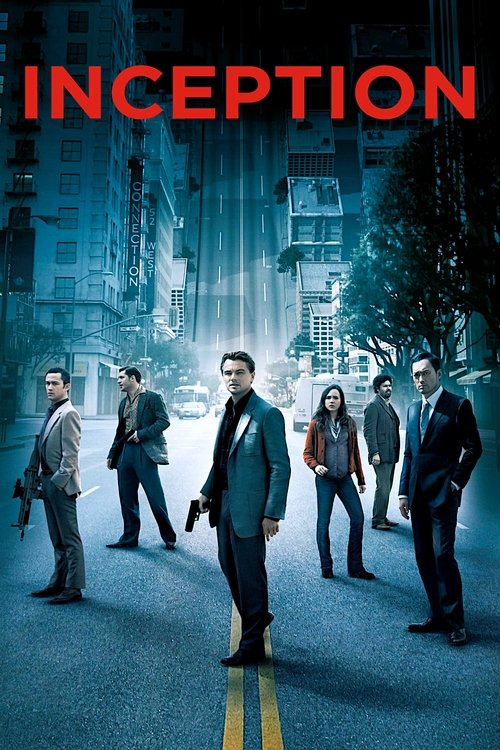
Inception
2010 · Christopher Nolan
The director whose every release is treated as a referendum on theatrical cinema itself: Oppenheimer's IMAX-70mm pilgrimage culture, the Barbenheimer phenomenon, and now The Odyssey selling out screenings a full year in advance. Naming him signals you believe in the big screen; arguing about him (cold characters, muddy sound mixing) is its own cottage industry.
For when you want a big, loud spectacle that also makes you think — a film to chew on for days and rewatch to check your theories. Challenge, but the fun kind.
What it's about
Cobb is a thief with a rare specialty: he breaks into people's dreams and steals the secrets hidden in their subconscious. Exiled from the life he wants back, he's offered one last job that would clear his slate — not stealing an idea this time, but planting one in the mind of a corporate heir, a feat everyone insists is impossible. He assembles a crew and builds a heist across nested layers of dreaming, while something from his own past keeps breaking into the plan.
The experience
It plays like a heist thriller running on three clocks at once — dense, propulsive, and demanding, with a hum of grief underneath the machinery. You're doing pleasurable mental work the whole time, and the last shot will have you arguing in the parking lot.
Performances
Leonardo DiCaprio anchors all the architecture with real grief and guilt, so the puzzle never turns cold, and Tom Hardy walks off with scenes as the crew's drily funny forger.
The craft
Much of the impossible imagery was done practically — a hotel corridor that literally rotates around fighting actors, a city folding over itself — which is why it still looks startling. Hans Zimmer's foghorn-heavy score became the sound of a whole decade of trailers. Absolutely a big-screen, good-speakers film.
Why it matters
The defining brainy blockbuster of its era — proof a studio tentpole could demand active interpretation from a mass audience — and its deliberately withheld final image became one of the most debated endings in mainstream cinema.
Snapshot
A corporate-espionage thriller set across layered dream states, Inception follows Dominic Cobb, an "extractor" who steals secrets from the unconscious minds of targets, tasked instead with planting an idea — inception — in the mind of a corporate heir. The film marries the mechanics of the heist genre to a sustained meditation on grief, guilt, and the architecture of memory, all rendered at blockbuster scale. By the time of its release, Inception had become the defining example of what critics would call the prestige or "brainy" blockbuster: a studio film that demanded active interpretive engagement from its audience without sacrificing spectacle. Its ending — a spinning top whose fate is deliberately withheld — became one of the most debated conclusions in mainstream cinema of its decade.
Industry & production
Inception was produced by Warner Bros. Pictures and Legendary Pictures, with Christopher Nolan and his producing partner Emma Thomas serving as producers. The project had a long gestation: Nolan reportedly worked on the screenplay's conceptual foundations for nearly a decade, beginning rough development in the early 2000s and deferring full production until after The Dark Knight (2008) had solidified his commercial standing. That leverage was significant — Nolan used the extraordinary success of The Dark Knight to negotiate near-total creative autonomy over Inception, an unusual arrangement for a film at this budget tier. The reported production budget was approximately $160 million, with Warner Bros. granting Nolan final cut.
Principal photography took place across multiple countries over roughly six months in 2009–2010, including locations in the United Kingdom, France, Japan, Canada, Morocco, and the United States. This globe-spanning production reflected both the narrative's structure — each dream level corresponding to a distinct environmental register — and the practical ambitions of the production design. Guy Hendrix Dyas served as production designer, tasked with making each nested level of reality visually coherent and distinctly legible.
Technology
The film's most-discussed technological achievement is the rotating hotel corridor sequence, in which Arthur (Joseph Gordon-Levitt) fights a dream-level adversary while gravity shifts continuously. Nolan and production designer Dyas built a full-scale hallway set — approximately one hundred feet long — mounted on a gimbal capable of rotating 360 degrees. Cameras were bolted into the rotating structure; Gordon-Levitt and the stunt team underwent weeks of physical training. The sequence was achieved predominantly through practical means rather than digital compositing, a philosophical commitment Nolan and visual effects supervisor Chris Corbould maintained throughout production: CGI was used to augment and extend practical work, not replace it.
Hans Zimmer's score introduced an element that reshaped the sonic language of mainstream film marketing. Zimmer built the score around a drastically time-stretched version of Édith Piaf's "Non, je ne regrette rien" — a choice with thematic doubling, given that Marion Cotillard, who had won an Academy Award for portraying Piaf in La Vie en Rose (2007), plays Mal in Inception. The manipulation of the Piaf recording produced the now-iconic low brass stab — often called the "BRAAAM" — which Zimmer developed into the score's central motif. This particular sound would be imitated to the point of ubiquity in film trailers and marketing materials throughout the following decade.
Inception won four Academy Awards: Cinematography (Wally Pfister), Visual Effects, Sound Editing, and Sound Mixing.
Technique
Cinematography
Wally Pfister, Nolan's regular director of photography since Memento (2000), shot the film on a combination of 35mm and 65mm film stock — Pfister and Nolan have consistently resisted the transition to digital acquisition. The 65mm elements were used for select large-format sequences, anticipating Nolan's later more systematic deployment of IMAX. Pfister's approach across the film favors a cool, desaturated palette that resists the warmth typical of Hollywood fantasy; the dreamscapes are rendered with the same matter-of-fact clarity as the real-world material, a choice that enforces the film's central epistemological uncertainty. Pfister's framing is typically classical — wide establishing shots that give the spectator visual orientation before complicating it — which makes the moments of spatial disruption (the Paris street folding back on itself; the Penrose staircase) structurally effective.
Editing
Lee Smith, who had edited Batman Begins (2005) and The Dark Knight for Nolan, cut Inception. The film's editing is essentially a masterclass in intercutting across temporally mismatched planes: as the narrative moves into deeper dream levels, external time expands (a few seconds in a higher level corresponds to hours below), and Smith's cut maintains rhythmic clarity across this expanding fugue structure. The climactic sequence intercuts between four simultaneous dream levels running at different temporal rates — a formally ambitious challenge that Smith resolves through tonal and musical cues rather than overt expository labeling.
Mise-en-scène / staging
Nolan's staging reflects a preoccupation with spatial legibility: actors are positioned so that sightlines and geography remain interpretable even as the architectural reality becomes impossible. The Paris sequence — in which Ariadne (Elliot Page, credited at the time under the name Ellen Page) learns to construct and fold dreamscapes — introduces the film's relationship to M.C. Escher's impossible geometries directly, with the Penrose staircase appearing as a practical staging device. The mise-en-scène across the film sustains a tension between architectural rationalism and dream-state instability: institutional corridors and modernist interiors are Nolan's chosen idiom, a visual grammar in which the eruption of the irrational is made more unsettling by its orderly surround.
Sound
Richard King's sound design and Lora Hirschberg's mixing work are integral to the film's effectiveness. The sonic landscape distinguishes dream levels through subtle shifts in ambient texture and reverb character; the deepening bass presence across levels creates a subliminal pressure that corresponds to narrative descent. The interplay between Zimmer's score and King's effects — particularly the integration of the time-stretched Piaf recording into both score and ambient dream-sound — is among the more sophisticated examples of composed-versus-designed integration in mainstream film of this period.
Performance
DiCaprio's performance as Cobb centers the film's emotional architecture: the ensemble cast (Gordon-Levitt, Tom Hardy, Ken Watanabe, Dileep Rao, Cillian Murphy, Tom Berenger, Marion Cotillard) largely operates at a register of controlled professionalism that would read as cool in another context but here functions as the film's emotional temperature. Hardy's Eames is a notable exception — sardonic, physically loose, and comedically knowing — establishing the performer's capacity for easy screen charisma that subsequent films would develop. Cotillard's Mal operates almost entirely in flashback and projection, a ghostly presence whose psychic weight the film asks the audience to credit almost entirely through DiCaprio's responses to her.
Narrative & dramatic mode
The film's narrative architecture borrows directly from the heist genre — assembling a team, assigning roles, casing the target, executing the plan against escalating complications — but transposes this structure into a framework where each "location" is a nested layer of subjective reality. Exposition is treated as a formal challenge; Ariadne's function as a newcomer who must be oriented to the dream-extraction premise provides the film with a natural expository mechanism, though the screenplay is careful not to allow tutorial sequences to bleed into the emotional core.
The dramatic mode is fundamentally one of withholding: the audience is asked to remain uncertain whether the framing reality is itself a dream. This ambiguity is maintained structurally rather than rhetorically — the film does not cue the audience toward a definitive reading but distributes visual evidence (the top's behavior, Cobb's wedding ring, the children's unchanging clothes and faces) that supports multiple interpretations. The emotional argument — Cobb's need to let go of guilt-constructed projection of Mal in order to return to his children — operates independently of the metaphysical question, which is perhaps the film's cleverest structural move: the emotional resolution is available regardless of whether the ending is "real."
Genre & cycle
Inception belongs most naturally to the heist film (its immediate genre antecedents include Rififi (1955), The Italian Job (1969), and Ocean's Eleven (2001)), which it reworks by making the target's interior mind the location to be penetrated. It sits within a cycle of early 2000s and 2010s films that applied speculative-fiction premises to psychological interiors: Eternal Sunshine of the Spotless Mind (2004), The Science of Sleep (2006), and Satoshi Kon's animated Paprika (2006) all occupy adjacent territory. The visual similarities between Paprika — in which a device allows entry into dreams, and cityscapes collapse into surreal montage — and Inception have been widely noted by critics and scholars. Nolan has been circumspect on this point in interviews, and the record of direct influence is not established. It is accurate to note the convergence without asserting derivation.
As an action film, Inception operates within the post-Matrix tradition of action sequences that carry philosophical weight — the physicality of a fight sequence doubles as an argument about the nature of the reality in which it occurs.
Authorship & method
Christopher Nolan wrote the screenplay himself, a practice consistent across his original projects. The script's architecture — nested dream levels with rigidly consistent internal logic — reflects a structural sensibility that runs throughout Nolan's work: Memento (2000) runs its timeline backward; The Prestige (2006) organizes its revelations as a triple-act magic trick; Dunkirk (2017) intercuts three temporal registers. Nolan's authorial signature is the deployment of formal structure as emotional argument — the film's architecture is not decorative complexity but the means by which its themes about memory, guilt, and subjective reality are made felt.
Wally Pfister's cinematographic contribution to the Nolan films of this period is substantial enough to constitute a genuine collaboration rather than subordinate execution; the decision to shoot on film, the specific palette choices, and the spatial grammar of Nolan's visual language are as much Pfister's as Nolan's. Hans Zimmer's collaboration similarly extends beyond score-to-picture: the Piaf conceit and the sonic vocabulary of the BRAAAM are compositional ideas that shaped the film's identity. Lee Smith's editing, as noted, is structurally indispensable. Emma Thomas's role as producer, across two decades of Nolan productions, represents an organizational and creative continuity that scholarship has generally underweighted.
Movement / national cinema
Nolan is British-born and trained at Cambridge, his early career rooted in British independent cinema (Following, 1998). His subsequent career has operated entirely within the Hollywood studio system, though his films retain traces of a British sensibility — a certain emotional restraint, a preference for period and architectural grandeur, a tendency toward the cerebral. Inception is a Hollywood blockbuster in all structural senses — star-led, globally distributed, franchise-infrastructure-adjacent — but its narrative mode and tonal register sit closer to European art cinema's tradition of unreliable interiority than to the kinetic populism of mainstream American action filmmaking. This cultural hybridity is part of what made Inception difficult to categorize and part of what made it commercially legible to international markets.
Era / period
Inception arrives at what might be identified as the mature phase of post-9/11 Hollywood reconfiguration: the period in which the blockbuster form, having absorbed the nihilism and moral ambiguity of the Dark Knight trilogy, began experimenting with cognitive complexity as a commercial proposition. The late 2000s and early 2010s saw a cluster of high-budget films — The Prestige, Watchmen (2009), Shutter Island (2010), Black Swan (2010) — that assumed audience tolerance for difficulty, ambiguity, and formal experimentation at a scale previously reserved for art cinema. Inception is the purest expression of this tendency: a film that requires active interpretation while delivering unambiguous spectacle.
Themes
The film's governing preoccupation is grief and the compulsive reconstruction of the lost beloved: Cobb's projection of Mal is not memory but a guilt-distorted simulation that threatens to destroy the mission precisely because it is more emotionally compelling than reality. This theme of destructive fidelity to a fixed image of the past — an inability to allow the dead to remain dead — links Inception to a tradition running from Vertigo (1958) through La Jetée (1962).
Nested within this are concerns about the ethics of manipulation and consent (the inception of an idea into an unconscious mind is figured as violation, however strategically necessary), the instability of memory as a foundation for identity, and the relationship between creative construction and reality — dream architects design spaces that must be convincing enough to deceive, a metaphor for filmmaking that Nolan has acknowledged without exhaustively explicating.
The totem — each dream-worker's personal object whose behavior in the real world only they know — functions as the film's central epistemological image: a private test of reality whose ultimate reliability is the film's closing question.
Reception, canon & influence
Critical reception at release was strongly positive. The film holds a high Rotten Tomatoes aggregate, and reviewers including Roger Ebert praised it as a rare case of a major studio film that trusted its audience's intelligence. Some critics, notably A.O. Scott and others writing from an art-cinema perspective, noted the film's tendency toward emotional coolness — a spectacular surface that withheld as much affect as it generated. This ambivalence became a strand of the critical literature: Inception as technically masterful but ultimately sealed off.
The film was nominated for eight Academy Awards and won four. Its worldwide gross exceeded $830 million, making it one of the highest-grossing films of 2010 and establishing Nolan as a filmmaker capable of delivering intellectual prestige at mass scale.
Backward (influences on the film): Beyond the heist genre, the film draws on surrealist cinema's logic-defying spatial grammar — Buñuel in particular — and on Philip K. Dick's sustained interrogation of reality's reliability. The Penrose staircase references Escher directly. The layered unreality of the dream-within-a-dream owes a diffuse debt to Jorge Luis Borges's narrative labyrinths. The James Bond franchise's globe-trotting ensemble action shapes the film's tonal range and pacing.
Forward (the film's legacy): Inception's most immediately audible legacy is sonic: the BRAAAM brass stab colonized film trailer culture within months of the film's release, becoming the dominant sonic signifier of "serious action cinema" across the first half of the 2010s, to the point of self-parody. More substantively, the film validated a market for complex-structure blockbusters and contributed to the conditions that made films like Interstellar (2014), Mad Max: Fury Road (2015), Tenet (2020), and Everything Everywhere All at Once (2022) commercially conceivable at studio scale. The spinning-top ending also established a template for deliberately unresolved ambiguous conclusions in mainstream cinema — a narrative move subsequently replicated widely, usually less deftly. Within Nolan's own filmography, Inception marks the full consolidation of his thematic preoccupations and formal methods; the films that follow are extensions and variations rather than departures.
A Deleuzian reading
There is a cage elevator in the middle of this film, and almost nobody talks about it.
The full Deleuzian reading of Inception →
Reception
A rare case of no reappraisal needed: it landed in summer 2010 as that unicorn — an original blockbuster treated as an event — and has basically held its spot since, though a vocal minority now files it under 'cold, over-explained Nolan'.
How Inception was received, from release to now →
Influences: the films it descends from and the films it influenced
- Paprika (2006) — Kon's visual grammar for dream-layer collision — camera movement and montage rhythm that shift syntactically as diegetic levels interpenetrate — is the direct formal template Nolan transposed into live action; the parade sequence's spatial invasion of waking reality anticipates every Inception level-collapse.
- Vertigo (1958) — Hitchcock's structural device of making the audience inhabit a grief-driven male protagonist's projection of a dead woman onto a living body — revealed as such only retrospectively — is the exact narrative mechanism Nolan deploys for Cobb and Mal; the technique of rendering subjective delusion as objective screen reality transfers directly.
- Solaris (1972) — Tarkovsky's choice to materialize a dead wife from the protagonist's guilt-memory as a physically present, increasingly autonomous entity — tactile projection rather than hallucination — is the specific craft precursor to Mal's manifestation; Nolan borrows the decision to render psychological guilt as diegetically real.
- 2001: A Space Odyssey (1968) — Kubrick's deployment of practical in-camera rotating sets to render impossible spatial environments as continuous physical space — the centrifuge filmed to register as real gravity — is the direct methodological ancestor of Nolan's rotating corridor; both reject composited illusion for physically constructed reality.
- Last Year at Marienbad (1961) — Resnais's sustained formal commitment to never adjudicating between competing versions of events — leaving the question of whether the past encounter occurred structurally unresolved — is the direct ancestor of Inception's spinning-top ending; both films refuse to assign ontological priority as a deliberate craft decision.
- The Discreet Charm of the Bourgeoisie (1972) — Buñuel's nested dream architecture — characters discovering themselves inside another character's dream, the spatial grammar shifting at each diegetic level — is the structural model Inception directly inherits; the specific device of a dreamer who does not know they are inside another dreamer's dream originates in Buñuel's formal repertoire.
- Rififi (1955) — Dassin's sustained silent heist sequence establishes the formal grammar Inception inherits: a meticulously staged spatial puzzle solved in real time by an ensemble whose coordinated expertise is itself the spectacle; Nolan transposes this device wholesale into the dream layer.
- Heat (1995) — Mann's precision ensemble heist as emotional container for male characters psychologically defined by professional mastery established the genre register Inception transposes; the specific craft of staging expert operators in a job that doubles as psychological autobiography is Mann's contribution to Nolan's template.
- The Matrix (1999) — The Wachowskis' grammar of action staged inside a constructed-reality layer whose physics are governed by that layer's rules — not the base world's — is the direct craft model for Inception's dream-level action sequences, and the film normalizes nested-ontology structure for mainstream action cinema at blockbuster scale.
- The Prestige (2006) — Shot by Pfister and edited by Smith, the film establishes the formal-structure-as-emotional-argument method Inception inherits: the triple-act magic-trick architecture is the direct precursor to the dream-level architecture, and the obsessive male protagonist destroying himself and others through fixation prefigures Cobb exactly.
- Shutter Island (2010) — Released the same year, Scorsese employs the identical unreliable-framing-reality structure in which a protagonist's guilt-projection constitutes the entire film's diegesis, revealed retrospectively; both films make the craft choice to sustain audience inhabitation of the constructed reality through genre conventions before the ontological reveal.
- Total Recall (1990) — Nolan's film promotes Total Recall's structural riddle — does the protagonist's subjective experience correspond to consensus reality? — from embedded ambiguity to the explicit engine of a blockbuster narrative, and the spinning top's unresolved final image directly inherits Total Recall's refusal to confirm or deny Quaid's reality, institutionalizing that ending as a prestige-cinema convention.
- Source Code (2011) — Jones applies Inception's structural grammar directly: a contained diegetic space entered and re-entered across iterations with compounding stakes, where the protagonist accrues knowledge across loops; the heist-transposition logic maps a surveillance-thriller onto a machine-generated memory using the same nested-level architecture.
- Interstellar (2014) — Retains the identical Nolan-Zimmer-Smith-Thomas production unit and large-format film stock methodology; extends Inception's temporal-intercutting across registers into relativistic time dilation, with the grief-projection device — the daughter as anchor across time — structurally transposed from Mal's role.
- Annihilation (2018) — Garland deploys the Shimmer as a nested diegetic space with Escher-impossible spatial grammar — the same path loops back to itself — and an unreliable-framing-reality structure interrogated through interview; the protagonist's grief-guilt manifesting as the physical environment she navigates is the Inception motif transposed into biological horror.
- Tenet (2020) — Extends Inception's temporal-intercutting device into literal time inversion with the same heist-transposition ensemble structure; the formal mechanism — entropy as diegetic grammar governing what characters can do in each register — is the same formal-structure-as-emotional-argument authorial method operating at equivalent scale with identical production methodology.
- Everything Everywhere All at Once (2022) — The Daniels deploy nested diegetic levels across multiverse registers as a formal vehicle for grief-guilt projection, borrowing Inception's structural grammar of simultaneous action across ontologically distinct levels converging at a single body; the film's commercial viability at studio-adjacent scale is a direct market consequence of Inception's validation of complex-structure spectacle.
- The Amazing Spider-Man 2 (2014) — Zimmer's practice of folding rock guitarists (Johnny Marr played on Inception) into orchestral scoring is scaled up into ASM2's 'Magnificent Six' ad hoc ensemble.
- Doctor Strange (2016) — The folding-city street-bend that Doctor Strange escalates into fractal, kaleidoscopic recursion descends directly from Nolan's Paris-folding effect, both grounding impossible geometry in grounded, weight-bearing urban surfaces.
- Spider-Man: Far From Home (2019) — Blueprint for the illusion sequence's recursive collapsing-dreamscape architecture — stable ground folding into successive false realities beneath a disoriented protagonist.
- Demon Slayer: Kimetsu no Yaiba Infinity Castle (2025) — Weaponized non-Euclidean folding architecture as a literal combat arena, the same conceit as the Infinity Castle's Escher-esque shifting rooms staged as fight space rather than mere set dressing.
- Black Swan (2010) — Aronofsky collapses the boundary between psychological projection and physical reality using the same camera grammar Nolan uses for dream-intrusion — handheld proximity that registers identically regardless of diegetic level — so the audience cannot adjudicate between performance and breakdown until the formal collapse.
- Edge of Tomorrow (2014) — Co-crystallizes the intelligent-blockbuster mode that EoT inhabits: narratively dense mainstream action cinema built around complex structural rules the audience must track; both films use compression editing to manage layered temporal logic within a studio format, establishing that high-concept structural formalism could survive the blockbuster release apparatus.
- Mission: Impossible (1996) — Inherits the high-tech ensemble-heist-as-architecture and the silence-dependent infiltration, scaling M:I's set-piece-engineering logic into nested, rules-based suspense machines.
- The Adjustment Bureau (2011) — The immediate commercial template — a star-driven, rule-bound metaphysical concept thriller with a city-as-labyrinth that folds and reconfigures around the protagonist.
- Looper (2012) — Defined the post-Inception template Looper works within: mid-to-high-budget original sci-fi that resolves on an emotional rather than mechanical beat, letting feeling override airtight rule-logic.
- Spectre (2015) — Models the modern blockbuster commitment to practical in-camera spectacle — real explosions and physical sets over CGI — that Spectre's record-setting Morocco detonation continues.
- Open Your Eyes (1997) — Descendant that systematizes the lucid-dream-with-rules and ambiguous-awakening structure, inheriting the layered virtual-reality puzzle and the 'is he still under?' open ending.
- The Garden of Sinners: Paradox Spiral (2008) — Treats architecture as a folding, rule-bound mental labyrinth to be navigated as a spatial puzzle — the same architecture-as-narrative-machine logic driving the chapter's tower.
Similar films
- Tenet (2020) — influence & lineage
- The Matrix (1999) — influence & lineage
- Interstellar (2014) — influence & lineage
- Shutter Island (2010) — influence & lineage
- The Prestige (2006) — influence & lineage
- 2001: A Space Odyssey (1968) — influence & lineage
- Ocean's Eleven (2001) — often watched together
- The Odyssey (2026) — often watched together
All the films related to Inception →