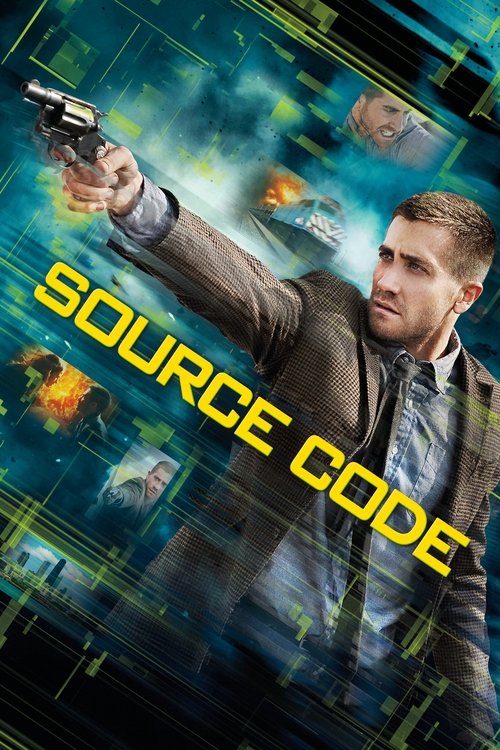
Source Code
2011 · Duncan Jones
For when you want a smart, twisty thriller that respects your intelligence but doesn't make you work for it — 90-odd minutes, no fat, with a real emotional payoff. Great when you're torn between wanting brains and wanting a ride.
What it's about
A U.S. Army helicopter pilot wakes up on a Chicago commuter train in another man's body, with no idea how he got there — minutes before a bomb destroys the train. He learns he's part of a military program that can send him back into the last eight minutes of a dead passenger's life, over and over, until he identifies the bomber and prevents a second, larger attack. Each pass through the loop he learns a little more about the passengers, the mission, and his own unsettling situation.
The experience
It moves like a bullet — a tight, propulsive thriller where every replay of the eight minutes raises the stakes and shifts what you thought you knew. Underneath the ticking clock there's a surprisingly tender, melancholy story about a soldier and his own mortality, so it leaves you moved as well as wound up.
Performances
Jake Gyllenhaal carries the whole machine, playing confusion, grief, and gathering resolve while essentially restarting the same scene dozens of times; Michelle Monaghan makes a fellow passenger warm and specific enough that the loop's repetitions hurt, and Vera Farmiga gives the mission's military handler a quiet, conflicted humanity.
The craft
Ben Ripley's screenplay is a small marvel of construction — each eight-minute loop repeats just enough to orient you and varies just enough to advance the mystery — and Duncan Jones directs it with the same character-first care he brought to his debut. The editing turns repetition into momentum rather than tedium, and the train-bound staging squeezes real scale out of a mid-sized budget.
Why it matters
Alongside Jones's Moon, it confirmed him as a director who could fuse intimate drama with high-concept machinery, and it stands as a touchstone of the early-2010s wave of cerebral, mid-budget puzzle-box science fiction.
Snapshot
Source Code is a 2011 science-fiction thriller directed by Duncan Jones from an original screenplay by Ben Ripley, starring Jake Gyllenhaal as Captain Colter Stevens, a U.S. Army helicopter pilot who is repeatedly inserted into the last eight minutes of another man's life aboard a Chicago commuter train in order to identify the bomber who destroyed it. The film fuses a high-concept time-loop premise with a ticking-clock investigation and a quietly devastating story about a wounded soldier's relationship to his own mortality. Arriving two years after Jones's debut Moon (2009), it confirmed him as a director capable of marrying intimate, character-first storytelling to genre machinery, and it remains a touchstone of the early-2010s cycle of cerebral, mid-budget "puzzle-box" science fiction.
Industry & production
Source Code occupies a now-rare niche: a studio-adjacent, mid-budget science-fiction film built around an original screenplay rather than existing intellectual property. The project originated with Ben Ripley's spec script, which circulated in development before Jones came aboard. It was produced by Vendôme Pictures and the Mark Gordon Company, with the Canadian outfit Original Film among the production partners, and distributed in North America by Summit Entertainment — then best known as the studio behind the Twilight franchise, here diversifying into adult-skewing genre fare.
For Jones the film was a deliberate scaling-up. Moon had been made for a famously small sum (in the single-digit millions) on a single soundstage; Source Code gave him a larger budget, a movie star, and a studio release while preserving the chamber-piece intimacy that had defined his debut. Principal photography took place largely in Montreal, whose rail infrastructure and stages stood in for Chicago and its Metra commuter lines; the train interiors were built as controlled sets to allow the repeated, choreographed restaging the premise demands. The film premiered at South by Southwest in Austin in March 2011 ahead of its spring theatrical release. It performed solidly at the box office relative to its modest cost and drew strong reviews, an outcome that materially strengthened Jones's standing and his ability to mount larger projects.
Technology
The film's central device is fictional but elaborated with enough pseudo-scientific scaffolding to function dramatically. "Source Code" is presented as an experimental military program that can access the residual electrical activity of a dead man's brain — the last eight minutes of memory imprinted before death — and allow a host consciousness, Colter's, to inhabit and re-experience that window. The film couches this in language drawn loosely from quantum mechanics, parabolic calculus, and brain science, with Jeffrey Wright's Dr. Rutledge as its expositor. Crucially, the screenplay keeps the mechanism ambiguous: whether Colter is merely reliving a recording or actually branching into parallel realities is left as the film's central interpretive question, and the technology's "rules" are deliberately unstable to permit the ending's metaphysical turn.
Behind the camera, the production used conventional 2010-era tools rather than novel ones. Visual effects — the train's fiery destruction, the digital extension of the rail environment, the cold capsule-like space Colter believes he occupies between missions — were executed by effects houses in service of a film whose spectacle is intentionally compact. The technological imagination here is conceptual, not pyrotechnic: the film is far more interested in the philosophical implications of its premise than in rendering it as set-piece spectacle.
Technique
Cinematography
The film was shot by veteran cinematographer Don Burgess, whose résumé (Forrest Gump, Cast Away, Spider-Man) reflects a polished mainstream classicism. That sensibility suits a film built on repetition. Within the cramped, recurring space of the train carriage, Burgess varies coverage so that each successive eight-minute loop reveals new information without feeling visually identical — shifting emphasis, tightening on faces, redirecting attention to objects and passengers that will prove significant. The warm, slightly nostalgic palette of the train sequences is set against the colder, desaturated steel of the capsule, giving the film two distinct visual registers that correspond to its two realities. Burgess favors clean, legible compositions, an approach that keeps a structurally complex film readable.
Editing
Editing is arguably the film's defining craft contribution, and it was overseen by Paul Hirsch, an editor of the first rank whose career stretches back to the original Star Wars (for which he shared an Academy Award). Source Code is fundamentally an editor's puzzle: its eight-minute loops must read as variations on a fixed sequence, accelerating and contracting as Colter — and the audience — internalize the layout of the train and the rhythm of the countdown. Hirsch calibrates how much of each pass to show, eliding the familiar and isolating the new, so that repetition builds momentum rather than tedium. The transitions between train and capsule, marked by jarring sensory rupture, structure the film's pulse.
Mise-en-scène / staging
The commuter carriage is the film's primary stage, and its dramaturgy is essentially theatrical: a fixed set, a fixed cast of passengers, and a protagonist who must rearrange his movements through it on each attempt. Production design loads the space with the bric-a-brac of ordinary transit — spilled coffee, a comedian, a conductor, a woman across the aisle — every detail a potential clue. The staging is built on blocking variation: the pleasure and tension come from watching Colter renavigate the same physical space with mounting knowledge, the recurring environment functioning like a chessboard. Against this, the capsule is staged as sensory deprivation — confined, instrumented, and increasingly revealed as something other than it first appears.
Sound
Sound design carries much of the film's disorientation, particularly in the violent audio-visual ruptures that punctuate the end of each loop and the slams between realities. The musical score is by Chris Bacon (Christopher Bacon), and critics frequently noted its lush, romantic, suspense-driven idiom — strings-forward writing in a tradition that consciously evokes the Bernard Herrmann school of Hitchcockian thriller scoring. The music does important emotional work, lending the love story between Colter and a fellow passenger a sweep the compressed runtime might otherwise deny it, and underlining the film's debt to classical suspense cinema.
Performance
Jake Gyllenhaal anchors the film with a performance that must register confusion, terror, tenderness, professional resolve, and existential grief — often within a single eight-minute cycle. He plays Colter as a man being remade by repetition, and the role's demand is to make the audience feel the accumulating weight of lives relived. Michelle Monaghan, as the passenger Christina, supplies the warmth that gives the loop its stakes, building a relationship that must deepen even as the situation resets. Vera Farmiga, as the military officer Colleen Goodwin who monitors Colter from the outside, delivers the film's other emotional through-line: her growing conscience about what is being asked of him gives the institutional frame a human face. Jeffrey Wright plays the program's architect with a chilly, self-justifying detachment that personifies the ethical cost of the technology.
Narrative & dramatic mode
The film operates in the iterative, loop-based mode that Groundhog Day (1993) made a recognizable genre form, but it bends that structure toward thriller suspense and tragedy rather than comedy. Its dramatic engine is dual: an external investigation (find the bomber before a larger attack) and an internal reckoning (Colter's discovery of his own true condition and the meaning of the missions he is being made to run). The screenplay practices controlled revelation, doling out information about Colter's real circumstances in increments that recontextualize everything preceding. Its most discussed feature is the ending, which pivots from procedural resolution to a metaphysical proposition about parallel realities and a consciousness persisting beyond its expected limit — a conclusion some read as affirming and others as sentimental over-reach, and which the film leaves productively open.
Genre & cycle
Source Code belongs to a distinct early-2010s cycle of intelligent, mid-budget, concept-driven science fiction aimed at adult audiences — a wave that includes Christopher Nolan's Inception (2010), Jones's own Moon, Looper (2012), and Edge of Tomorrow (2014), the last of which would later push the same eight-minutes-relived, soldier-in-a-loop premise toward blockbuster scale. Generically it is a hybrid: a time-loop fantasy, a bomb-on-a-train thriller in the lineage of Hitchcock and The Taking of Pelham One Two Three, a body-displacement story, and, in its final movement, a romance. This braiding of modes — the contained suspense thriller fused with speculative metaphysics — is precisely what marks it as part of the "puzzle-box" tendency of its moment.
Authorship & method
Duncan Jones directs as the film's organizing intelligence. Coming off Moon, he brought a consistent authorial signature: science fiction as a vehicle for questions about identity, isolation, and what it means to be a self that is used, copied, or constrained by institutions. Where Moon concerned a clone exploited by a corporation, Source Code concerns a soldier exploited by the military — both protagonists are men discovering the disturbing truth of their own existence and asserting dignity against the systems that instrumentalize them. Jones's method favors emotional clarity within conceptual complexity; he keeps the human story legible even as the premise multiplies.
His key collaborators shaped the result decisively. Screenwriter Ben Ripley supplied the original architecture and its metaphysical gamble. Cinematographer Don Burgess gave the repetition visual variety and classical polish. Editor Paul Hirsch, a master of rhythm, made the loop structure propulsive rather than repetitive. Composer Chris Bacon supplied the romantic-suspense register that connects the film to classical Hollywood thriller scoring. The ensemble — Gyllenhaal, Monaghan, Farmiga, Wright — grounds the speculation in recognizable feeling.
Movement / national cinema
The film is not the product of a defined film "movement" so much as of the transatlantic studio-genre ecosystem of its era: a British director, an American star, an original American screenplay, financing and production partners spanning the U.S., France, and Canada, and a shoot based in Montreal standing in for Chicago. Jones's British background and his apprenticeship in commercials and the independently financed Moon inform the film's restraint and its preference for ideas over scale, but Source Code is best understood within the international, English-language commercial cinema of intelligent genre filmmaking rather than any national school.
Era / period
Source Code is very much a film of the post-9/11, post-Iraq-War American imagination. Its premise — a wounded soldier kept functional by the state and deployed, again and again, into a scenario of mass-casualty terrorism — speaks directly to anxieties about homeland terror, surveillance, and the human cost borne by service members. Its bomb-on-a-commuter-train scenario evokes the era's transit attacks; its troubled relationship between a soldier's body and the institution that commands it reflects contemporary unease about veterans, trauma, and the ethics of how states use the people who serve them. Technologically and aesthetically it sits squarely in the early 2010s vogue for high-concept, idea-forward science fiction.
Themes
The film's richest theme is mortality and the meaning of a finite life: Colter is, in effect, repeatedly asked to die, and the drama turns on what a person owes to others and to himself in his last minutes. Closely related is the ethics of instrumentalizing human beings — the program treats Colter as a tool, and the film's moral arc is his and Goodwin's insistence on his humanity. It probes free will and determinism: can a fixed, recorded sequence be changed, and does the attempt to change it create a new reality or merely a private consolation? Identity and embodiment recur — the disorientation of inhabiting another man's body and life — as does the redemptive power of connection, the idea that even a doomed, repeating fragment of time can hold genuine love and meaning. Underneath runs a critique of how war and the security state consume individuals.
Reception, canon & influence
Source Code was warmly received by critics, who praised its inventive structure, Gyllenhaal's committed performance, and Jones's ability to sustain emotional and intellectual coherence across a tricky premise; the most common reservation concerned the ending, which divided viewers between those who found it moving and those who judged its final metaphysical flourish a softening of the story's harder implications. It performed well commercially against a modest budget, cementing Jones as a director of consequence.
Its influences run backward to several traditions. The iterative time-loop structure is unmistakably indebted to Groundhog Day; the body-leaping conceit recalls the television series Quantum Leap; the wounded-soldier-as-unreliable-consciousness motif echoes Jacob's Ladder (1990); the time-and-memory speculation belongs to a lineage running through La Jetée, 12 Monkeys, and the philosophical SF of the era; and the bomb-on-a-train suspense and the lush thriller scoring nod to Hitchcock and the Bernard Herrmann tradition. Within Jones's own filmography it is a clear companion piece to Moon.
Looking forward, the film helped sustain the early-2010s appetite for cerebral, mid-budget original science fiction and stands as a key text in the popularization of the loop-thriller hybrid; its eight-minutes-relived, soldier-trapped-in-a-cycle premise prefigures the structure of Edge of Tomorrow and the broader 2010s proliferation of time-loop narratives across film and television. For Duncan Jones personally it was the bridge from acclaimed newcomer to studio filmmaker. The film endures as a frequently cited example of how a contained, idea-driven genre picture can achieve both suspense and genuine feeling.
A Deleuzian reading
The woman across the aisle laughs at a joke he hasn't heard.
The full Deleuzian reading of Source Code →
Reception
In 2011 it was greeted with relief-tinged praise — proof that Moon was no fluke and Duncan Jones could handle a studio picture. Fifteen years on it's aged into a 'they don't make these anymore' object: the beloved mid-budget original sci-fi thriller Hollywood stopped green-lighting.
How Source Code was received, from release to now →
Influences: the films it descends from and the films it influenced
- Groundhog Day (1993) — Supplies the iterative-loop architecture in which a protagonist relives a fixed span of time, varying his actions each pass and accumulating knowledge until he can engineer the right outcome.
- Jacob's Ladder (1990) — Establishes the device of a mortally wounded soldier whose experienced 'reality' is a constructed projection of a dying consciousness — the structural gambit Source Code's coda depends on.
- La Jetée (1962) — Founds the time-and-memory SF mode that fixates on a single remembered moment relived as the hinge of fate, treating consciousness rather than hardware as the time machine.
- 12 Monkeys (1995) — Provides the investigative-time-travel armature: a coerced agent sent repeatedly back to gather forensic detail about a catastrophe he is told he cannot prevent.
- The Manchurian Candidate (1962) — Originates the instrumentalized-soldier figure whose mind is conscripted as a military tool, the institutional-exploitation theme Jones carries from Moon into this film.
- Vertigo (1958) — Bernard Herrmann's romantic-suspense scoring idiom — surging strings under dread and longing — is the register Chris Bacon deliberately channels.
- North by Northwest (1959) — Models the timed-detonation 'bomb under the table' suspense and the confined train-car staging that drive Source Code's recurring eight minutes.
- Moon (2009) — Jones's direct companion piece: a single-location, idea-driven SF built around a man discovering he has been copied/used by an institution and asserting dignity against it.
- Run Lola Run (1998) — Pioneers the propulsive editing of repeated runs through one compressed time span, cutting for forward momentum so repetition reads as acceleration rather than redundancy.
- Total Recall (1990) — Builds a speculative-neuroscience premise on an implanted/manipulated mental experience and refuses to confirm whether the climax is real — the ambiguous-ending strategy Source Code adopts.
- Inception (2010) — A contemporary puzzle-box of nested constructed realities that closes on a deliberately unresolved 'is this real' image, the same ambiguous emotional flourish that divided Source Code's viewers.
- Déjà Vu (2006) — Near-direct heir: an agent repeatedly re-enters a recent past to prevent a transit bombing and save a woman, inheriting Déjà Vu's loop-procedural premise and its emotional override of temporal logic.
- Edge of Tomorrow (2014) — Directly extends the soldier-trapped-in-a-combat-loop premise — die, reset, master the run — popularized in the wake of Source Code's loop-thriller hybrid.
- Looper (2012) — Sustains the early-2010s wave of mid-budget original cerebral time-travel SF that prioritizes a human/emotional through-line over spectacle, the niche Source Code helped revive.
- Predestination (2014) — A tightly contained time-loop puzzle box governed by controlled revelation, where a protagonist is gradually disclosed to be enmeshed in his own causal mechanism.
- Happy Death Day (2017) — Crystallizes the loop-thriller hybrid Source Code helped mainstream: each lethal reset is repurposed as an iterative investigation to identify and stop the killer.
- Palm Springs (2020) — Blooms a romance inside a compressed, endlessly repeated fixed interval, using match-cut re-entries to snap the protagonist back into the loop — the editing device Palm Springs echoes at each reset back to the wedding morning.
- Memento (2000) — Uses controlled-revelation structure where editing withholds the explanatory frame until a late reveal retroactively reorganizes everything the audience thought it understood.
- The Adjustment Bureau (2011) — Same-year post-Inception recursive-loop thriller threading a romance through a deterministic mechanism the everyman lead must outwit from inside the system.
- Carry-On (2024) — A countdown thriller built from iterated real-time problem-solving to locate and defuse a bomb on public transit, extending the countdown-structure-plus-hidden-device craft.
Similar films
- Looper (2012) — influence & lineage
- Edge of Tomorrow (2014) — influence & lineage
- Moon (2009) — influence & lineage
- Predestination (2014) — influence & lineage
- Memento (2000) — influence & lineage
- Body of Lies (2008) — same viewing thread
- Déjà Vu (2006) — same viewing thread
- Mission: Impossible - Ghost Protocol (2011) — same viewing thread
All the films related to Source Code →
Watch it with: curated runs of related films
- Inside the Security State — A run of modern espionage and national-security thrillers — globe-trotting spycraft, submarine brinkmanship, and the paper trail behind the black sites — where operatives and investigators race secretive institutions and catastrophic clocks.