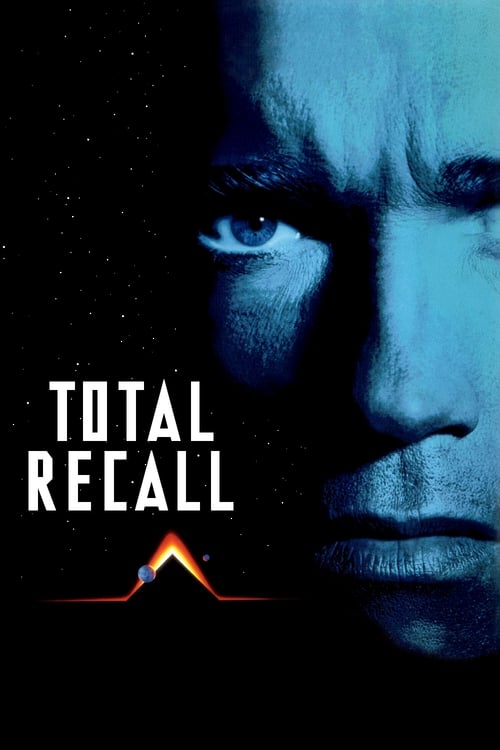
Total Recall
1990 · Paul Verhoeven
For when you want big dumb fun that turns out not to be dumb — an action night that leaves you arguing about what actually happened. Comfort viewing with a trapdoor in it.
What it's about
Douglas Quaid is a construction worker haunted by dreams of Mars, so he buys the next best thing to going: implanted memories of a vacation there. The procedure goes wrong, and suddenly his whole life — job, wife, identity — looks like it might be a fabrication, with killers on his trail and answers waiting on the red planet. Or maybe none of it is real, and he's still in the chair. The film keeps both possibilities live all the way through.
The experience
A muscular, violent, gleefully excessive action ride with a genuinely clever paranoid puzzle at its core. It's fast, loud, frequently outrageous, and smarter than it pretends to be — you're laughing at the mayhem one minute and questioning the whole story the next.
Performances
Arnold Schwarzenegger at his peak, and the everyman-who-might-be-a-superspy premise plays wittily against his larger-than-life presence; Sharon Stone makes a memorably lethal impression as his wife.
The craft
Paul Verhoeven directs American excess with a sly European eye, treating the ultraviolence and one-liners as both thrill and satire. The lavish practical effects, miniatures, and mutant makeup — Mars built by hand at enormous expense — give it a tactile grandeur that digital-era films rarely match.
Why it matters
A landmark of Philip K. Dick adaptation and one of the last great practical-effects blockbusters, its reality-or-implant ambiguity fed a whole lineage of mind-bending science fiction that followed.
Snapshot
Paul Verhoeven's Total Recall is a $65-million action-science-fiction spectacular built on a deceptively slender Philip K. Dick source story, inflated to Carolco-scale excess and delivered with a European director's cold, ironic gaze on American genre machinery. The film stars Arnold Schwarzenegger as Douglas Quaid, a construction worker whose visit to Rekall — a company that implants holiday memories — precipitates a psychic unwinding: he may be a sleeper agent whose entire domestic life is a fabrication, or he may be a Rekall client experiencing an elaborately malfunctioning fantasy. On that ambiguity, and on the brute kinetic pleasures of its Martian action, Total Recall built an enormous commercial and critical footprint in 1990, and it has only deepened in retrospect as a pivotal node in the Philip K. Dick adaptation cycle, in the career of Verhoeven, and in the wider history of science-fiction cinema's preoccupation with simulated consciousness.
Industry & production
Total Recall had one of the longer and more tortured development histories in 1980s Hollywood. Ronald Shusett and Dan O'Bannon — the team who had adapted H. R. Giger's concepts into the Alien screenplay (1979) — acquired the rights to Dick's story in the mid-1970s and spent years trying to get it made. The project passed through multiple studios and producers; Dino De Laurentiis held it at one point, and David Cronenberg spent a significant period developing a version that reportedly leaned further into the Dickian dissolution of self, before departing over creative differences. By the late 1980s the property had landed at Carolco Pictures, the independent powerhouse that had bankrolled the Rambo sequels and would go on to produce Terminator 2: Judgment Day (1991). Arnold Schwarzenegger, at the peak of his box-office authority following Predator (1987), was the engine that finally got the picture into production, and his commercial muscle was decisive in securing both the budget and Verhoeven's hire. The screenplay credit went to Shusett, O'Bannon, and Gary Goldman (a veteran of the Big Trouble in Little China script), though numerous drafts by other hands accumulated over the years. Principal photography took place largely at Estudios Churubusco in Mexico City — a practical choice that provided the scale of standing sets the Martian colony sequences required without the costs of California production.
Technology
Total Recall received a Special Achievement Academy Award for Visual Effects, presented to Eric Brevig, Rob Bottin, Tim McGovern, and Alex Funke — an acknowledgment of the genuinely inventive practical work that defines the film's look. Rob Bottin, who had pushed animatronic and prosthetic craft to an extreme on John Carpenter's The Thing (1982), supervised creature and makeup design. His contributions here range from the grotesque — Kuato, the psychic mutant leader who lives embedded in another man's torso, a writhing latex and cable construction operated by puppeteers — to the spectacularly absurd: the triple-breasted mutant prostitute, the inflating head prosthetics of the pressurization sequence in the finale. Alex Funke's optical effects and matte painting work established the Mars colony's geography and atmosphere, combining large-scale physical sets with painted extensions and in-camera optical compositing. The timing is worth noting: Total Recall arrived one year before Terminator 2 would inaugurate industrial-grade digital visual effects as the blockbuster norm, making it among the last major science-fiction spectaculars to rest entirely on photochemical and practical craft. This gives the film a distinctive tactile density that separates it visually from the post-CG generation.
Technique
Cinematography
Jost Vacano, the German cinematographer who had shot Das Boot (1981) and had collaborated with Verhoeven on RoboCop (1987), served as director of photography. Vacano's approach is less expressionistically grungy here than on RoboCop — the Carolco budget demanded a certain high-gloss finish — but he retains a restless, destabilising energy through sustained use of handheld work. The camera rarely settles into passive observation; it lunges into action sequences, tilts and reframes mid-shot, and maintains in the quieter scenes a subliminal unease consistent with the film's ontological premise. The palette shifts register across the film's geography: the gray-beige banality of Quaid's Earth apartment, the clinical white of the Rekall facility, the terracotta reds and industrial murk of Mars Colony. That chromatic organization is not incidental; it maps psychological states onto spatial territories.
Editing
The cutting is fleet and purposeful, calibrated to sustain Schwarzenegger's action sequences without sacrificing the film's structural riddles. The editing maintains a notable discipline around point of view, frequently anchoring cuts to Quaid's perspective in ways that leave the film's central ambiguity — is this real or implanted? — genuinely available rather than merely rhetorical. A scene midway through, in which a Rekall doctor attempts to convince Quaid he is trapped inside a psychotic episode and should accept a pill to "wake up," is structured so that the audience cannot determine with certainty whether the doctor is a planted fiction or a real emissary, because we share only Quaid's paranoid interiority.
Mise-en-scène / staging
Verhoeven's staging is maximalist in the tradition of his Dutch features — particularly Flesh+Blood (1985) and Spetters (1980) — transposed onto the Hollywood action idiom. Crowd scenes in the Mars Colony have genuine density and chaos; the geography of the tunnels and elevators is kept spatially coherent even as the action escalates. Verhoeven and production designer William Sandell built the Colony as a stratified space: the privileged surface, the tunnels and brothels of the proletarian interior, and the sealed off reactor chamber at the mountain's core. That spatial architecture does more than provide action geography; it literalises the film's class politics. The staging of violence is characteristically Verhoeven in its refusal of euphemism — bodies are destroyed with a specificity that courts the grotesque — but also, crucially, comic. The deadpan excess is part of the satirical register.
Sound
Jerry Goldsmith composed the score, a typically muscular late-career effort distinguished by its driving brass ostinatos and its unusual willingness to play the film's more absurdist moments straight rather than winkingly. The main theme has a martial grandeur that suits Schwarzenegger's physique while slightly undermining, through sheer bombast, the heroic conventions it invokes. Sound design is used aggressively in the pressurization and decompression sequences of the finale, where the absence of atmosphere is rendered through a disturbing aural distortion — screaming, pulping sounds — that reinforces the body-horror underpinning the spectacle.
Performance
Schwarzenegger gives one of his most controlled and, in a limited register, sophisticated performances. The film requires him to modulate between at least three states — everyman Quaid, trained operative Hauser, and a man genuinely unsure which he is — and while his range remains circumscribed, Verhoeven draws from him an intermittent bewilderment that serves the material. Sharon Stone, in a role that directly preceded and helped engineer her casting in Basic Instinct (1992), plays Lori — Quaid's wife, revealed as a handler — with a cold gymnastic precision, her beauty weaponized as narrative deception. Michael Ironside's Richter is a study in barely contained rage, and Ronny Cox, reprising the corporate-villain register he had used in RoboCop, gives Cohaagen a complacent menace.
Narrative & dramatic mode
The film operates on two simultaneous tracks that it never fully decouples. The first is the straightforward Schwarzenegger action plot: hero discovers he is something other than he believes, travels to Mars, leads the proletarian mutant uprising, defeats the oligarch, and terraforms the planet. The second is the Dickian epistemological trap: every plot development can be read as a beat in the "EgoTrip" Rekall implant package Quaid selected, complete with the specified femme fatale (Melina), the secret agent identity, and the world-saving climax. Verhoeven has noted that he deliberately arranged the film so that both readings are coherent and internally consistent. The ending — blue sky opening over Mars in the final shot, precisely the wish-fulfillment advertised by Rekall — is either triumphant reality or the last image of a man expiring inside a fantasy. The film does not choose. This structural ambiguity elevates Total Recall above the simple action vehicles that surrounded it and places it in a longer tradition of science-fiction narratives (from Dick himself backward through Borges and forward through The Matrix) organized around the instability of perceived reality.
Genre & cycle
Total Recall sits at the intersection of three contemporary genre formations. It is a Schwarzenegger star vehicle, deploying the bodybuilder-as-action-hero template established in The Terminator (1984) and Predator. It is a Philip K. Dick adaptation, the second major Hollywood rendering of Dick's work after Blade Runner (1982) and the most commercially successful until Minority Report (2002). And it is a Carolco-era event film, a late-1980s/early-1990s specimen of the oversized, R-rated, practical-effects blockbuster that Carolco briefly dominated before its bankruptcy. The film also shares DNA with a cycle of dystopian action-science-fictions concerned with corporate and political control of information and bodies — RoboCop (1987), The Running Man (1987), They Live (1988) — that constituted a notably politicized strain of mainstream genre entertainment in the Reagan-Bush years.
Authorship & method
Paul Verhoeven arrived in Hollywood with an unusual pedigree: a Dutch director whose European features — Turkish Delight (1973), Soldier of Orange (1977), The 4th Man (1983) — ranged from erotic melodrama to wartime thriller to Catholic psycho-horror, all distinguished by a clinical visual intelligence and a provocateur's delight in transgression. RoboCop had proven he could work inside the American studio system without surrendering this sensibility, embedding genuine satirical bile in the Orion action product. Total Recall extends that method. Verhoeven's stated interest in genre as a vehicle for ideas — specifically ideas about power, perception, and the body — gives the film an intellectual backbone that its visceral surface conceals or, more precisely, enacts. Jost Vacano's kinetic cinematography is the right instrument for this approach: it keeps the spectator off-balance precisely where the story requires ontological vertigo. Jerry Goldsmith provides bombastic cover that is simultaneously earnest and excessive. The script, whatever its troubled origins, ultimately serves Verhoeven's preoccupation with characters who cannot trust their own interiority.
Movement / national cinema
Total Recall is a Hollywood co-production in all formal respects — financed, distributed, and marketed through American industry channels — but its directorial intelligence is emphatically European. Verhoeven brings to it the detached, somewhat contemptuous observation of American genre conventions that characterizes several émigré directors who passed through Hollywood in this period. The film is not a national cinema document in any straightforward sense; it is a multinational production (Dutch director, Austrian-American star, Mexican shoot, American studio) that uses genre infrastructure to ask questions that American genre convention typically forecloses. The film's Martian colony, with its stratified class system, its exploited mutant workforce, and its oligarchic air monopoly, is analyzed from a position of external critique that owes something to the critical social realism of Dutch cinema and rather less to the frontier mythology that American science fiction typically projects onto Mars.
Era / period
1990 sits at a precise hinge in the history of effects-driven cinema. Total Recall is among the last major science-fiction blockbusters to rely entirely on practical craft — animatronics, prosthetics, optical compositing, matte paintings — before the digital revolution initiated (for popular purposes) by Terminator 2 the following year. Its production coincided with the final years of the Cold War's ideological infrastructure, and its corporate dystopia — Cohaagen's privatized monopoly on breathable air — reads as a post-Reaganite updating of earlier technocratic-totalitarian science fiction, replacing the state with the corporation as the dominant form of political terror. The film's fixation on memory as a commodity, on identity as a data set that can be overwritten, anticipates by a decade the anxieties about digital identity and virtual experience that would become central cultural preoccupations.
Themes
Memory and identity are the film's organizing obsessions, both directly Dickian in origin. If memory constitutes selfhood — as Locke and a long subsequent philosophical tradition assert — then the ability to manufacture and implant memories dismantles personal identity at its foundation. Quaid's crisis is not simply about not knowing the facts of his past; it is about not knowing whether "Quaid" exists at all, or whether he is Hauser, or whether both are constructs in a failing simulation. The film treats this with unusual seriousness given its genre context. Alongside this runs a fairly explicit political allegory: the Mars Colony is a resource-extraction economy in which a corporate governor controls access to the necessities of biological survival (air) as a tool of political domination. The mutants — deformed by sub-standard radiation shielding, economically marginalized, physically marked — constitute a proletariat whose disfigurement is the direct consequence of the exploitation they suffer. Verhoeven makes no effort to disguise this class schema; it is stated rather than implied.
Reception, canon & influence
Backward influences. Philip K. Dick's 1966 short story "We Can Remember It for You Wholesale" provides the premise and the central epistemological gambit, though the film vastly expands its political and action dimensions. Fritz Lang's Metropolis (1927) is a detectable precursor in the vertically stratified urban geography dividing surface-dwelling elites from tunnel-bound workers. The Chandlerian noir tradition informs the structure of revealed identity and the unreliable retrospective, though here the femme fatale is the domestic sphere itself. Verhoeven's own Dutch work, particularly The 4th Man, had already explored the protagonist who cannot distinguish fantasy from reality, and that thematic preoccupation migrates intact.
Critical reception. The film was substantially well-reviewed on release, though critical opinion divided along lines that would become familiar with Verhoeven's American work: those who read the excess as purposeful found it a bracing genre subversion, while those who did not found it loud and crude. Roger Ebert was broadly positive, recognizing the Dickian structure beneath the action spectacle. The film's commercial performance was enormous; it was among the highest-grossing films of 1990.
Forward influence. Total Recall sits near the headwaters of a significant stream in late-twentieth and early-twenty-first century science fiction concerned with the simulacrum of consciousness. Dark City (1998), The Matrix (1999), and Inception (2010) all engage, in varying registers of explicitness, with the premise that perceived reality may be an engineered fiction indistinguishable from the genuine. The Wachowskis have acknowledged the broader PKD influence that Total Recall also inherits; whether direct influence can be traced is a matter for careful record, but Total Recall was certainly one of the highest-profile vehicles through which that Dickian problematic entered popular cinema in the decade before The Matrix. Sharon Stone's performance here had a demonstrable industry effect, contributing directly to her casting in Basic Instinct (1992) and reshaping the 1990s erotic thriller as a commercially serious genre. For Verhoeven, the film consolidated the American career that RoboCop had opened, providing the platform for Basic Instinct and Starship Troopers (1997). In the PKD adaptation sequence it marks the genre's commercial coming-of-age: where Blade Runner had been a qualified box-office disappointment that gained its stature through years of reappraisal, Total Recall demonstrated that Dick's metaphysical obsessions, properly inflated and star-packaged, could anchor mainstream event cinema. A 2012 remake directed by Len Wiseman, with Colin Farrell, largely confirmed the original's canonical authority by failing, despite greater technical resource, to replicate either its visceral energy or its structural intelligence.
A Deleuzian reading
Picture the red pill.
The full Deleuzian reading of Total Recall →
Reception
Landed in 1990 as one of the most expensive movies ever made and a massive hit, though many critics wrote it off as an ultra-violent Arnie vehicle; it's since been reappraised as peak Verhoeven — a sly, self-aware mindbender hiding inside a blockbuster, mentioned in the same breath as RoboCop.
How Total Recall was received, from release to now →
Influences: the films it descends from and the films it influenced
- Das Boot (1981) — Jost Vacano developed his signature handheld-destabilization technique in Das Boot's submarine corridors — the same restless, lunging camera style he carried directly into Total Recall's Martian tunnel chase sequences and Rekall facility interiors.
- Alien (1979) — Dan O'Bannon and Ronald Shusett wrote both scripts; Alien's template — a space-labor protagonist exploited by an off-screen corporate power, existential threat delivered through Rob Bottin-lineage practical creature design — is the direct screenwriting and production-design DNA transplanted into Total Recall's Rekall corporation and Martian grotesquerie.
- Blade Runner (1982) — Scott established chromatic geography as epistemological mapping — neon street-level versus corporate penthouse — and the Dickian dual-track ambiguity (is he human/real?) as a structural engine; Total Recall inherits both the visual grammar of color-coded social strata and the narrative discipline of sustaining two irreconcilable explanations simultaneously.
- The Thing (1982) — Rob Bottin pushed animatronic cable-puppet craft and prosthetic body-shock effects to their limit on The Thing and brought the identical toolkit to Total Recall — Kuato's writhing latex torso operated by concealed puppeteers and the pressurization-sequence inflating-head prosthetics are direct continuations of The Thing's bio-horror effects methodology.
- Videodrome (1983) — Cronenberg — who developed an early Total Recall screenplay — built the structural model of a protagonist whose perceptual experiences may be real or media-induced hallucination, using body horror sound design and visceral imagery to externalize epistemological crisis; Total Recall's Rekall mechanism and its mid-film doctor-with-a-pill scene inherit this template directly.
- Brazil (1985) — Gilliam's maximalist production design of a bureaucratic dystopia with vertically stratified architecture — privileged surface above, laboring underclass below — and his embedding of grotesque physical comedy inside genuine menace is the formal ancestor of Verhoeven's Mars Colony spatial logic and the tonal register in which mutant prosthetics and corporate villainy coexist with broad satirical humor.
- RoboCop (1987) — The Verhoeven-Vacano Hollywood partnership's first outing established the precise template Total Recall expands: Vacano's restless handheld energy inside the Carolco action idiom, satirical corporate villain embedded in the genre machinery, stratified class-space architecture coded through production design, and R-rated grotesquerie deployed as black comedy.
- The 4th Man (1983) — Extends the 'is any of this real?' unreliable-narrator architecture — visions indistinguishable from events — from Catholic thriller into science fiction.
- Scanners (1981) — Rob Bottin's cranial-pressure appliances — heads visibly distending and rupturing as practical prosthetics held in shot rather than cut around — descend directly from the Smith/Walas gag, attached to a memory-implant corporate conspiracy of the same pharmaceutical shape.
- Dark City (1998) — Proyas transplants Total Recall's core mechanism — an entire population's memories surgically implanted and cyclically rearranged by a controlling power — into a noir architectural space, executing city-wide transformations through elaborate physical set construction and in-camera optical work that continues the pre-CG practical tradition rather than reaching for digital shortcuts.
- The Matrix (1999) — The Wachowskis build their entire narrative architecture on Total Recall's dual-track epistemological premise — is the protagonist's experienced reality simulated or actual? — and their specific red-pill/blue-pill scene directly rewrites Total Recall's pivotal doctor-with-a-pill sequence, inheriting its structural ambiguity as the foundational myth of their trilogy.
- eXistenZ (1999) — Cronenberg extends Total Recall's unreliable-reality-ending to its most unresolvable formal limit — no stable exit from the nested game-worlds — while his body-horror interface design (organic ports, flesh-molded controllers, viscous connectors) descends directly from Bottin's prosthetic grotesque that defined Total Recall's tactile register.
- Minority Report (2002) — Spielberg's PKD adaptation transplants Total Recall's corporate-monopoly-over-a-vital-resource structure (air versus pre-emptive justice), applies chromatic geography to social strata (scrubbed white PreCrime corridors versus the brown murk of the underground), and casts its protagonist across multiple identity-states — detective, fugitive, suspect — in direct structural echo of Total Recall's multi-state epistemological staging.
- A Scanner Darkly (2006) — Linklater's PKD adaptation inherits the multi-state protagonist split across identities without self-knowledge — Arctor surveilling himself — and uses rotoscoped visual instability to literalize the perceptual unreliability that Total Recall achieved through Vacano's handheld unease and POV-anchored editing ambiguity.
- Inception (2010) — Nolan's film promotes Total Recall's structural riddle — does the protagonist's subjective experience correspond to consensus reality? — from embedded ambiguity to the explicit engine of a blockbuster narrative, and the spinning top's unresolved final image directly inherits Total Recall's refusal to confirm or deny Quaid's reality, institutionalizing that ending as a prestige-cinema convention.
- The Fifth Element (1997) — Verhoeven demonstrates that a satirically self-aware genre blockbuster can sustain hybrid practical/digital effects at studio scale, and his vertical future-city action sequences — executed with similar miniature-plus-composite methodology — constitute a direct parallel prior art for Besson's approach.
- Alita: Battle Angel (2019) — The amnesiac protagonist whose true identity erupts through combat skill they cannot consciously explain is a Verhoeven/Dick structural device; Alita extends it by making Panzerkunst the specific trigger — fighting style as suppressed biography.
- Mickey 17 (2025) — Verhoeven's PKD adaptation centers identity instability in a disposable laborer protagonist and builds its social argument out of genre mechanics rather than around them — the formal strategy Mickey 17 extends to the Expendable-clone narrative and its question of which self owns the moral claim.
- Source Code (2011) — Builds a speculative-neuroscience premise on an implanted/manipulated mental experience and refuses to confirm whether the climax is real — the ambiguous-ending strategy Source Code adopts.
- Johnny Mnemonic (1995) — Established the memory-as-commodity / implanted-data premise wrapped in a ticking-clock corporate-conspiracy structure that Johnny reuses.
- Vanilla Sky (2001) — Introduces purchased, implanted artificial experience and the unresolved 'is this real or the fantasy I paid for?' ambiguity that becomes Vanilla Sky's third-act engine.
- Terminator 2: Judgment Day (1991) — Carolco Pictures produced both films with Schwarzenegger as star in consecutive years; T2's industrial-scale deployment of digital compositing marks the precise threshold Total Recall stands just before with its all-practical approach, making the two films bookends of the practical-effects-to-CGI transition in Hollywood science-fiction spectacle.
- Strange Days (1995) — Strange Days' SQUID technology — first-person sensory memories recorded and sold as a commercial commodity — extends Total Recall's Rekall premise to its logical market endpoint, and Bigelow applies the same POV-anchored editing discipline to destabilize whose lived experience the audience is inhabiting, preserving an identical epistemological instability around recorded versus real consciousness.
- Starship Troopers (1997) — Verhoeven deploys the identical satirical-genre toolkit established in Total Recall — maximalist grotesque body violence played as dark comedy, stratified class-space staging distinguishing privileged officers from expendable grunts, propaganda aesthetics embedded in the film's own visual grammar — as a direct continuation of his Hollywood satirical cycle.
- Open Your Eyes (1997) — Ancestor from the Dick lineage built on an implanted-memory vacation that may be the whole film, the commercial 'paid dream you cannot distinguish from life' premise underlying Open Your Eyes' contract reveal.
- Basic Instinct (1992) — Shares the Verhoeven–de Bont mobile-camera spectacle and the undecidable-reality structure that refuses to confirm whether what we watched was 'real,' anticipating the unresolved final image.
Similar films
- Dark City (1998) — influence & lineage · same viewing thread
- RoboCop (1987) — influence & lineage
- The Matrix (1999) — influence & lineage
- Terminator 2: Judgment Day (1991) — influence & lineage
- Inception (2010) — influence & lineage
- Blade Runner (1982) — influence & lineage
- Minority Report (2002) — influence & lineage
- Videodrome (1983) — influence & lineage
All the films related to Total Recall →
Watch it with: curated runs of related films
- Waking Up Inside the Illusion — Watch these in a run when you want the same jolt over and over — an ordinary man realizing the calm reality around him was built, dreamed, or erased, and clawing his way toward waking up.