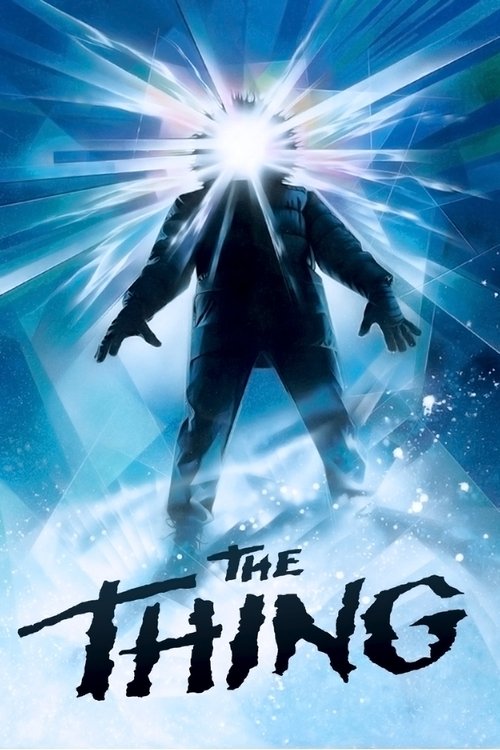
The Thing
1982 · John Carpenter
For when you're craving a real scare — not jump-scare junk food but deep, existential horror that makes you eye your friends suspiciously. Best watched late, in the dark, ideally in winter.
What it's about
Twelve men at a remote Antarctic research station take in a dog fleeing across the ice — and something comes in with it. The creature they're soon fighting can absorb and perfectly imitate any living thing, which means the monster isn't just out in the snowstorm: it might be sitting across the table. With no way out and winter closing in, the crew turns on itself, because trusting the wrong man is fatal.
The experience
Slow-burn dread punctuated by some of the most jaw-dropping monster scenes ever put on film — clammy, paranoid, and genuinely frightening even now. The isolation gets under your skin long before the creature does.
Performances
Kurt Russell anchors it as the helicopter pilot MacReady — laconic, wary, and increasingly ruthless — the kind of grounded lead that lets the paranoia around him feel real.
The craft
Rob Bottin's practical creature effects are still unmatched — wet, grotesque transformations done entirely in-camera that CGI has never bettered. Ennio Morricone's throbbing, minimal score and the widescreen Antarctic photography make it a stunner on a big screen with the sound up.
Why it matters
A flop on release that was later fully rehabilitated as one of the great American horror films — a cornerstone of body horror and the gold standard for practical effects, endlessly studied and imitated.
Snapshot
John Carpenter's The Thing is a claustrophobic science-fiction horror film set at a remote American research station in Antarctica, where a twelve-man crew discovers — and is slowly consumed by — an extraterrestrial organism capable of perfectly imitating any biological life-form it assimilates. Released in the summer of 1982, it was dismissed by many critics and overshadowed commercially by the season's warmer-toned alien visitor, Steven Spielberg's E.T. the Extra-Terrestrial. In subsequent decades it has been entirely rehabilitated: now regarded as one of the great American horror films, a masterwork of practical-effects cinema, and a defining text in the body-horror subgenre. Its central nightmare — that any member of the group could already be the monster — remains one of the most elegantly sustained dramatic conceits in genre filmmaking.
Industry & production
The Thing originated as an adaptation of John W. Campbell Jr.'s 1938 novella Who Goes There?, the same source text that had furnished Howard Hawks and Christian Nyby's The Thing from Another World (1951). Universal Pictures mounted a new adaptation in the late 1970s and early 1980s, and the project came to Carpenter following his commercial successes with Halloween (1978) and The Fog (1980). Bill Lancaster — son of actor Burt Lancaster — wrote the screenplay, which returned far more faithfully to Campbell's shapeshifting premise than the 1951 film had done; the Hawks-Nyby version had essentially discarded the imitation conceit in favour of a conventional monster-on-the-loose picture.
Production was headquartered largely in British Columbia, Canada, with additional location work done in Alaska, the combined effect simulating Antarctic conditions without the logistical impossibility of sustained polar filming. The production's central challenge was the elaborate practical creature work assigned to Rob Bottin, a young special-effects artist who had collaborated with Carpenter on The Fog. Bottin was given extraordinary latitude and an extended production timeline to develop the film's creature sequences — a commitment reflecting the production's understanding that the effects would need to be genuinely unprecedented to carry the story's central conceit. Bottin worked himself into a state of physical collapse before the film's completion and was reportedly hospitalized for exhaustion near the end of the shoot. Stan Winston, brought in mid-production to assist, designed and executed the dog-kennel transformation sequence — the film's first major creature reveal — which is often discussed separately as a landmark of practical puppeteering.
The Thing was released on June 25, 1982, into an exceptionally competitive summer marketplace dominated by E.T. and also featuring Blade Runner, both released earlier in the same season. Its domestic performance was well below studio expectations, and Universal treated it as a disappointment. The commercial failure contributed to a period of professional difficulty for Carpenter, who had staked considerable artistic capital on the picture.
Technology
The Thing's principal technological achievement is Bottin's practical special effects, executed before the era of computer-generated imagery and representing an apex of the analog creature-effects tradition. Bottin and his team devised a range of materials and mechanisms — foam latex prosthetics, cable-actuated rigs, hydraulics, and what the crew described as an arsenal of unconventional substances appropriated from commercial and industrial sectors — to produce transformations of startling biological plausibility. The chest-defibrillation sequence and the "head-spider" emergence were designed as setpiece revelations, moments where the threat becomes visible in forms that prior genre effects had not managed. Whether the results constitute art in the conventional sense or artisanal engineering at an extraordinary level of sophistication is a distinction the film declines to observe.
Dean Cundey photographed the film in anamorphic Panavision (2.35:1), a format choice that served the Antarctic setting's horizontal vastness while also enabling the film's more claustrophobic interior compositions, where the widescreen frame could hold multiple figures simultaneously — which was, for a film about suspicion, a dramatic necessity rather than a merely aesthetic one.
Technique
Cinematography
Dean Cundey, who had been Carpenter's principal cinematographer since Halloween, brought to The Thing a command of deep-focus anamorphic composition that served the film's paranoid logic with precision. The wide frame keeps multiple characters in sharp focus simultaneously, denying the audience a single reliable point of view and implicitly placing viewers in the same epistemological difficulty as the characters: everyone is visible, and no one is trustworthy. The color palette is deliberately de-saturated — grays, institutional browns, and pallid oranges render the Antarctic station as a sealed, febrile environment. Lighting draws heavily on practical sources within the set, the fluorescent fixtures of the station producing a flat clinical brightness that, counterintuitively, makes the creature sequences more disturbing: there are no convenient shadows, no Gothic darkness to absorb the aberrant.
Editing
Todd Ramsay edited the film with a deliberate, measured pace unusual for horror cinema of the period. Where the slasher cycle favoured shock-cut rhythms, The Thing allows tension to accumulate through duration — extended scenes of conversation and observation in which nothing overtly terrible occurs but in which every gesture becomes potential evidence. The blood-test sequence is the paradigm case: a group of men seated in a circle, waiting for a result. The cutting here attends to the spatial arrangement of suspects and potential monsters without resolving the question of who is which; restraint produces greater suspense than acceleration would.
Mise-en-scène / staging
Carpenter stages the film with an architect's attention to the research station's geography. The layout of rooms, corridors, and external grounds is established clearly enough that the audience maintains a mental map of who is where in relation to whom — and, crucially, where each character might have been unobserved. Group scenes are staged as ensemble compositions rather than as shot-reverse-shot exchanges, keeping the social formation intact and readable even under stress. The late confrontations return repeatedly to a specific spatial arrangement — men at gunpoint in a room from which no exit is available — that echoes without exactly repeating, giving the film's structure a formal circularity that rhymes with its narrative premise.
Sound
Ennio Morricone composed the score, delivering something far removed from the lush orchestral work associated with his Italian-cinema and spaghetti-western output. The Thing's music is a collection of low, pulsing synthesizer drones, percussive thumps, and extended ambient passages that function less as emotional signposting than as environmental condition — the score is the station's atmosphere rather than a commentary on what happens within it. The result is closer in idiom to the minimalist electronic scores Carpenter had been composing for his own films than to mainstream Hollywood orchestral horror, and has occasionally been mistaken for one. Whether this convergence represented deliberate artistic alignment, a miscommunication about expectations, or Morricone simply calibrating to the film's needs is not clearly documented in the production record.
The sound design exploits the Antarctic environment's specific acoustic properties: the howl of polar wind, the structural groan of cold-stressed metal, the abnormal biological sounds of transformation. These are deployed as counterpoint to the score's electronic torpor.
Performance
Kurt Russell leads as R.J. MacReady, helicopter pilot and reluctant pragmatist, in a performance calibrated to avoid the genre's customary heroic register. MacReady's authority is provisional and contested; he acts not because he is the bravest or most capable man in the room but because circumstances eliminate alternatives. Russell conveys this through restraint — MacReady is watchful, economical with speech, and visibly frightened when the situation warrants it. The performance anchors the film's claim to be taken seriously.
The ensemble — including Wilford Brimley, Keith David, Donald Moffat, Richard Masur, Charles Hallahan, and others — is unusually naturalistic for genre cinema of the period. Individuality is established through observable behavior in shared space rather than expository backstory. Keith David's Childs, one of two characters present at the film's ending, maintains an adversarial energy toward MacReady that functions simultaneously as realistic character friction and as narratively functional ambiguity: we never learn which of them, if either, is still human.
Narrative & dramatic mode
The Thing operates as a closed-system paranoid thriller: a group isolated from rescue and external communication, in which any member might already be the monster. The structure borrows from the detective genre (a sealed circle of suspects from which the culprit cannot escape) and the wartime infiltration narrative (the enemy already among us), and gives both a body-horror inflection. The central dramatic mechanism is the systematic withholding of verifiable knowledge — the audience never learns with certainty who has been assimilated at any given moment, because Carpenter gives each character plausible innocent behavior alongside equally plausible guilty behavior.
The film is notable for refusing a redemptive resolution. The final scene — MacReady and Childs facing each other in the ruins of the burning station, both possibly human, either possibly the Thing, neither able to confirm the other — offers no catharsis, only continued suspension. This ending was contentious with preview audiences and studio executives; Carpenter defended it as the only honest conclusion available to the story's own logic.
Genre & cycle
The Thing sits at the intersection of several genre traditions. As a monster film it descends from the creature features of 1950s science fiction, including its direct predecessor. As body horror it belongs to a cycle associated prominently with David Cronenberg (Shivers, 1975; Rabid, 1977; Videodrome, 1983), in which the biological integrity of the human body is the primary site of horror. As paranoid thriller it participates in a post-Watergate American mode — also visible in Invasion of the Body Snatchers (1978) and The Parallax View (1974) — in which institutions and individuals cannot be trusted.
Within the science-fiction horror hybrid, The Thing represents a pointed departure from the optimistic alien-contact narratives that had dominated popular cinema in the immediate years prior. Its extraterrestrial is not a vehicle for wonder or spiritual transformation but an indifferent biological process with no apparent motive beyond replication — Lovecraftian in its cosmic inscrutability even if that debt is generic rather than textual.
Authorship & method
John Carpenter came to The Thing with a decade of genre craftsmanship behind him and a declared, sustained admiration for Howard Hawks, whose models of male-group dynamics — the professional ensemble united by competence and mutual respect under pressure — are legible throughout the film's ensemble staging. The 1982 film is, among other things, an argument with its 1951 predecessor: a demonstration of what the Campbell story becomes when its shapeshifting premise is taken seriously rather than displaced onto a conventional monster design. Carpenter has spoken publicly and extensively about Hawks as his primary directorial model; the inversion of Hawksian group solidarity is one of The Thing's structural conceits.
Cundey's collaboration with Carpenter across Halloween, The Fog, The Thing, and Christine (1983) represents one of the productive director-cinematographer partnerships of the period. Bill Lancaster's screenplay is taut and functionally spare, building character through behavior rather than exposition — which is consistent with the film's epistemological theme: you know what you see, and what you see can be fabricated.
Rob Bottin's contribution to the film as a creative force substantially exceeds the conventional role of a special-effects supervisor. His creature designs are not illustrations of a story conceived independently of them; they are constitutive of the film's central horror, and the camera's movement in creature sequences is in dialogue with the effects rather than imposed upon them.
Movement / national cinema
The Thing is an American studio production with no meaningful connection to a national cinema movement. Its aesthetic affiliations are with the genre traditions of Hollywood science fiction and horror; its thematic concerns — isolation, Cold War distrust, the failure of American institutional rationality — are generically American without being nationally distinctive in a way that produces formal consequence. It is more productively situated within a genre cycle than within any national frame.
Era / period
The Thing was made at the junction of two eras in Hollywood. The late 1970s had produced a wave of paranoid, downbeat genre films in the aftermath of Vietnam and Watergate; by 1982 the mainstream was tilting decisively toward the affirmative science-fiction blockbuster model consolidated by Lucas and Spielberg. The Thing sits awkwardly between these moments: produced with the resources and formal ambition of the blockbuster era but in the nihilistic key of the preceding decade. Its failure in the summer of 1982 can be read in part as a mismatch between the film's sensibility and the audience that particular cultural moment was assembling.
It also stands at the cusp of the practical-effects era. The 1980s would prove the final decade in which photochemical and mechanical effects constituted the primary vocabulary of spectacular cinema. The Thing is among the most significant achievements of that tradition, and its canonical status is inseparable from this historical position.
Themes
Paranoia and the epistemological limits of trust are the film's dominant preoccupation. The Thing proposes that identity itself is unreliable — that biological embodiment, the evidence of selfhood, can be fabricated — and then asks what social life is possible when this premise is accepted. The crew's disintegration follows not only from fear of the creature but from the rational impossibility of maintaining trust once the imitation conceit is established.
The Cold War is present in the film's subtext, though not through the schematic allegory of 1950s science fiction. MacReady's blood test is structurally a verification procedure — an arms inspection conducted in miniature — and the film's conclusion, in which neither party can confirm the other's humanity but mutual destruction has been at least partially achieved, maps onto the logic of deterrence with uncomfortable precision.
The film is also concerned with masculine solidarity under impossible conditions. The all-male ensemble is not incidentally configured: The Thing is interested in what happens to the Hawksian male group when the conditions of its coherence are removed one by one. What remains at the end is two men who cannot trust each other, sharing a bottle in the ruins of the station they could not defend.
Reception, canon & influence
Critical reception. On initial release, The Thing was received coldly — at times hostilely — by mainstream American critics, a number of whom objected to the graphic effects on aesthetic and moral grounds and found the film's nihilism unearned or gratuitous. The contrast with E.T., released a fortnight earlier in the same summer, was drawn explicitly and unfavourably by multiple reviewers. Rehabilitation began through home video, which gave audiences access to the film outside the competitive marketplace and allowed genre-focused criticism to develop a serious account of it. By the 1990s the reassessment was underway; by the 2000s The Thing appeared regularly at the top of horror and science-fiction retrospective lists. It is now firmly canonical: studied in academic contexts, cited by working filmmakers, and present in any serious account of the genre.
Influences on the film (backward). Campbell's novella is the primary literary source. The Thing from Another World (1951) is a structural predecessor — an object of argument more than emulation, though the Hawks-Nyby film's ensemble staging leaves traces. The paranoid political thrillers of the 1970s, and particularly Philip Kaufman's Invasion of the Body Snatchers (1978), furnish the dominant affective key. Cronenberg's body-horror cycle defines the broader generic space. Lovecraftian cosmic horror — with its emphasis on extraterrestrial indifference and the failure of human rationality to comprehend alien forces — is a relevant antecedent, though the connection is diffuse rather than traceable to specific textual influence.
Legacy (forward). The Thing's influence on subsequent horror and science-fiction cinema has been substantial and traceable. The paranoid-ensemble structure — a sealed group in which any member might be the threat — has become a recurrent template across films, television, and interactive media; the "social deduction" game genre, from Mafia to Among Us, shares structural DNA with the film's central premise. The practical-effects tradition Bottin advanced is treated retrospectively as a benchmark against which digital work is evaluated, a standard the field has not universally surpassed in the relevant respects. The 2011 prequel, also titled The Thing, attempted to match Bottin's work using digital augmentation with practical underpinning; the comparison proved unflattering to the newer film and served to reinforce the original's reputation. Carpenter's career was retrospectively revalued through the 1990s and 2000s, and The Thing has become central to the auteurist account of his work — a film that arrived ahead of the cultural conditions required to receive it.
A Deleuzian reading
Heat a copper wire.
The full Deleuzian reading of The Thing →
Reception
A notorious 1982 flop — savaged by critics as repellent nihilism and buried at the box office in the summer of E.T. — it's now routinely called one of the greatest horror films ever made, and the definitive Carpenter.
How The Thing was received, from release to now →
Influences: the films it descends from and the films it influenced
- The Thing from Another World (1951) — Carpenter systematically inverts Hawks' group-competence model — where the 1951 ensemble succeeds through professional hierarchy and masculine solidarity, Carpenter dismantles those same Hawksian structures so that their failure is the horror.
- Night of the Living Dead (1968) — Romero's structural innovation of centering the horror on internal group trust-collapse rather than the external threat — farmhouse occupants destroying themselves through paranoia and bad decisions — is the direct architectural template for the Antarctic station's social disintegration.
- 2001: A Space Odyssey (1968) — Kubrick's use of flat functional fluorescent lighting to render technological environments as cold and hostile rather than reassuring, and the wide anamorphic frame that dwarfs crewmembers in institutional space, is the direct compositional ancestor of Cundey's lighting scheme for the Antarctic station.
- The Andromeda Strain (1971) — Wise established the de-saturated clinical palette and the scientific-procedure-as-irony structure — quarantine protocols that fail to contain the threat, tests that produce uninterpretable results — which Carpenter inherits directly for the station's visual grammar and the blood-test sequence's logic of defeated certainty.
- Invasion of the Body Snatchers (1978) — Kaufman's remake codified the biological-replacement paranoia grammar in a visually mundane contemporary setting — normal-looking faces that may already be enemy — which Carpenter intensifies into an epistemologically sealed system where the camera itself becomes an unreliable witness.
- Halloween (1978) — Carpenter and Dean Cundey's development of deep-focus anamorphic compositions that hold multiple figures in simultaneous sharp resolution originated here; those same formal principles are transported directly into The Thing's paranoid wide-frame multi-character staging where visibility is itself the threat.
- Alien (1979) — Scott established the industrial-workplace ensemble horror template where creature-effects sequences carry narrative duration rather than shock-cut brevity, and the discipline of shooting the creature in controlled practical light rather than concealing it in darkness — a production philosophy Bottin's team extends and radicalizes.
- Rio Bravo (1959) — Carpenter's second Hawks tribute, remaking the Hawks-produced The Thing from Another World through Rio Bravo's confined-space professional-ensemble siege structure: the Antarctic station replaces the jail, and paranoia's systematic destruction of the group's fellowship is the horrific inversion of Hawks's professional optimism while retaining his spatial logic of specialists trapped together under external threat.
- Jaws (1975) — Ennio Morricone's score uses a bass ostinato figure structurally analogous to Williams' shark motif—a minimal, low-register pulse that signals threat without describing it—while Carpenter inverts Jaws' withholding strategy: the Thing is perpetually present and visible but visually unknowable through shape-shifting, replacing withheld visibility with withheld identity as the engine of dread.
- Invasion of the Body Snatchers (1956) — Inherits the 'anyone beside you may already be one of them' paranoid-investigative structure, swapping seed pods for practical body-horror effects as the replacement mechanism.
- Only Angels Have Wings (1939) — Extends the Hawksian isolated-professional-crew facing lethal danger (Hawks produced the 1951 original), with survival hinging on group competence and terse behavioral trust.
- El Dorado (1966) — Extends the Hawksian group-under-siege into paranoid horror — an isolated crew of specialists defending a perimeter where survival hinges on professional competence and mutual trust, the ethos Carpenter absorbed from El Dorado's lineage.
- The Fly (1986) — Cronenberg extends The Thing's equation of bodily transformation with identity dissolution into an explicit psychosexual register, with Chris Walas's practical-effects program deliberately escalating Bottin's foam-latex and hydraulic techniques to document the body's betrayal from within as progressive biological overwrite.
- Leviathan (1989) — Cosmatos relocates The Thing's Antarctic-station template to an underwater mining facility and commissions practical body-horror transformation sequences from effects artists who explicitly benchmarked Bottin's foam-latex and cable-actuated rigs as the target standard for biological-assimilation reveals.
- The Mist (2007) — Darabont applies The Thing's structural logic almost architecturally — sealed civilian space, unknowable biological threat outside, fatal internal-group-dynamics collapse as the primary killer — transplanting the Carpenter-Romero formula of paranoia-as-more-dangerous-than-the-monster into a contemporary supermarket siege.
- Slither (2006) — Gunn inherits The Thing's specific device of biological assimilation that preserves fragmented personality traces of consumed hosts while erasing autonomy, and commissions practical-effects transformation sequences in direct visual reference to Bottin's telescoping anatomy and hydraulic-mechanism creature reveals.
- The Hateful Eight (2015) — Tarantino explicitly modeled the film on The Thing's blood-test sequence grammar — a confined group seated in a circle, unable to trust the evidence before them — extending the paranoid closed-system into Ultra Panavision 70 widescreen that frames ensemble suspicion as a formal spectacle of mutual surveillance.
- It Follows (2014) — Mitchell inherits Carpenter's slow-accumulation tension grammar — sustained wide-frame deep-focus compositions that hold potential threat and protagonist in the same focal plane simultaneously — scored with a Disasterpeace synthesizer drone that directly extends Carpenter's minimalist keyboard-pulse approach as the primary architecture of dread.
- Annihilation (2018) — Garland inherits The Thing's device of withholding definitive biological explanation while staging the alien threat as gradual bodily and cognitive alteration, and extends the ambiguous ending into a formally bifurcated finale where the question of replacement is structurally undecidable rather than narratively deferred.
- The Void (2016) — Gillespie and Kostanski staged their entire creature-effects program using analog foam-latex, cable-actuated rigs, and mechanical fabrication in conscious refusal of digital compositing, positioning the film as a direct technical continuation of Bottin's practical-effects tradition rather than a nostalgic approximation of it.
- Terminator 2: Judgment Day (1991) — Rob Bottin's practical bladder-and-cable body-transformation effects established the aesthetic and conceptual vocabulary for a creature that assumes any humanoid form — the staging problem T2 translates from prosthetics into CGI space, inheriting both the spatial dread of imitation and the narrative logic of the undetectable infiltrator.
- Aliens (1986) — Rob Bottin's multi-operator hydraulic creature construction on this film established the practical-effects standard Stan Winston's team directly extended to engineer the alien queen — both productions treat the creature as a physical mechanism operated by specialists rather than a photographic trick, giving the queen the same performance weight as Bottin's organism.
- Total Recall (1990) — Rob Bottin pushed animatronic cable-puppet craft and prosthetic body-shock effects to their limit on The Thing and brought the identical toolkit to Total Recall — Kuato's writhing latex torso operated by concealed puppeteers and the pressurization-sequence inflating-head prosthetics are direct continuations of The Thing's bio-horror effects methodology.
- A Quiet Place Part II (2021) — Carpenter's siege-survival model — isolated group in confined space, threat defined by its unpredictable movement through rooms, editing that withholds visual confirmation of creature location — directly shapes the structural approach to creature fear in both AQP films; the farmhouse and bunker sequences inherit Carpenter's rhythm of silence, sound, and sudden violence.
- Prince of Darkness (1987) — Carpenter applies The Thing's paranoid closed-system architecture — no protagonist hero, ensemble dissolution, a resolution that leaves the threat undefeated — to a theological horror register, with identical staging practice of holding multiple characters in simultaneous deep-focus compositions that refuse the audience a single trustworthy vantage point.
- Alien: Romulus (2024) — Shares the practical-effects creature-horror tradition — Rob Bottin-style tactile body-horror transformation — and isolated-crew paranoia that Romulus's pathogen mutations and synthetic-loyalty doubts echo.
- Videodrome (1983) — Rob Bottin's biomechanical practical effects reorganize flesh into impossible living apparatus, the contemporaneous peak of the same latex-and-pneumatics body-horror craft Videodrome deploys.
- Escape from New York (1981) — Immediate reunion of the same repertory company (Russell, Cundey, the synth-score method) reapplying the besieged-perimeter structure and anti-heroic loner to a single isolated outpost.
- Day of the Dead (1985) — The same wager on practical effects as argument: a paranoid chamber drama in a sealed installation where the creature work (Bottin there, Savini here) is staged in sustained, adequately lit takes so the audience must watch flesh behave impossibly, with synth minimalism holding the dead air.
Similar films
- Alien (1979) — influence & lineage
- Leviathan (1989) — influence & lineage
- Invasion of the Body Snatchers (1978) — influence & lineage
- Annihilation (2018) — influence & lineage
- Predator (1987) — same viewing thread
- Mandy (2018) — same viewing thread
- 2001: A Space Odyssey (1968) — influence & lineage · often watched together
- The Shining (1980) — often watched together
All the films related to The Thing →
Watch it with: curated runs of related films
- Into the Heart of Darkness — A run of grueling journeys into hostile country — jungle, ice, desert, occupied forest — where the ordeal strips men down to something primal, hallucinatory, and often unrecoverable.