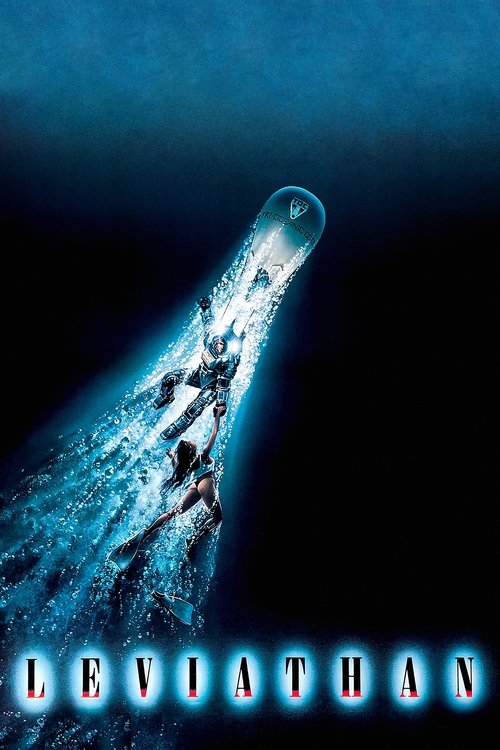
Leviathan
1989 · George P. Cosmatos
For a popcorn night when you're craving an old-school creature feature — blue-collar crew, dark corridors, something wet in the vents. Comfort-food horror for genre fans, not a film to chew on.
What it's about
A crew of deep-sea miners, grinding out the last stretch of a long shift on the ocean floor for a faceless corporation, salvages the wreck of a scuttled Soviet ship. What they bring back into their pressurized base isn't cargo — it's a contaminant, and once it gets into the crew, something starts hunting them through the corridors with the crushing ocean sealing off every exit.
The experience
A tense, claustrophobic monster movie that plays like a haunted house at the bottom of the sea — jump scares, body-horror grossness, and a ticking sense that there's nowhere to run. It's pulpy rather than profound, and it moves.
The craft
This is the glossy, well-financed end of its genre: the practical creature effects come from the Stan Winston shop, and the mutating monster is a parade of latex, slime, and mechanical grotesquerie that CGI-era films can't quite replicate. The underwater base is a convincingly grimy industrial set, and Jerry Goldsmith's score gives the schlock a surprisingly classy pulse.
Why it matters
One of a strange cluster of underwater horror films that all surfaced in 1989, it's remembered as the slickest of the imitators — a time capsule of late-'80s studio genre filmmaking and practical-effects craft.
Snapshot
Leviathan is a deep-sea creature feature that arrived at the crest of a peculiar late-1980s vogue for undersea horror and science fiction, and it is best understood as a high-gloss, well-financed entry in a derivative cycle rather than as an original. The premise is a near-undisguised transposition of the Alien/The Thing template to the ocean floor: a crew of commercial deep-sea miners working a months-long shift for a faceless corporation discovers the wreck of a scuttled Soviet vessel, the Leviathan, and unwittingly brings aboard a contaminant — a genetically engineered agent that infects the body, mutates it, and assembles its victims into a single ravenous, ever-changing creature that hunts the survivors through the corridors of their pressurized habitat. What distinguishes the film from its cheaper siblings is the caliber of talent assembled around a frankly second-hand idea: a screenplay credited to two writers of real standing (David Webb Peoples and Jeb Stuart), a cinematographer of pedigree (Alex Thomson), a composer of the first rank (Jerry Goldsmith), production design by Ron Cobb, and creature effects from Stan Winston's studio, all marshaled by George P. Cosmatos, a director then at the commercial height of a career built on muscular studio action. The result is a glossy, professional, and largely unloved picture — competent in its craft, conventional in its scares, and inescapably overshadowed by the films it borrows from and by James Cameron's far more ambitious The Abyss, released the same year. It survives today chiefly as a case study in Hollywood's habit of cloning a successful formula and as a showcase for the artisans who elevated its surfaces.
Industry & production
Leviathan was a Dino De Laurentiis–world production, made under the aegis of the De Laurentiis family's operations and shot largely at Cinecittà Studios in Rome, with Italian craft labor and European facilities standing in for an entirely American-set story — a characteristic arrangement of the period in which De Laurentiis financed and physically produced ostensibly Hollywood genre pictures on the Continent. It was released in the United States in the spring of 1989 by Metro-Goldwyn-Mayer. The film belongs to the brief but distinct cluster of underwater science-fiction and horror films that all reached screens in 1989–1990 — alongside Sean S. Cunningham's DeepStar Six, Roger Corman's Lords of the Deep, James Cameron's prestige effort The Abyss, and the Spanish-produced The Rift (Endless Descent). That so many submarine monster movies surfaced at once is the kind of coincidence the industry periodically produces, and contemporary commentary treated the films as competitors in a single, suddenly crowded subgenre; Leviathan and DeepStar Six in particular were routinely paired as the more formulaic, Alien-derived pair set against Cameron's grander undertaking.
The production's signal feature is the unusual quality of its hired hands. The screenplay carries the names of David Webb Peoples — co-writer of Blade Runner (1982) and, a few years later, the writer of Unforgiven (1992) — and Jeb Stuart, who had just co-written Die Hard (1988). The presence of two writers of that weight on a genre clone is itself a comment on how the project was assembled: a marketable premise built out by skilled professionals into a serviceable, fast-moving studio vehicle. The cast was likewise stronger than the material strictly required, anchored by Peter Weller — fresh from RoboCop (1987) — as the mining-crew foreman, with Richard Crenna (who had worked with Cosmatos on Rambo: First Blood Part II) as the crew's doctor, and an ensemble including Amanda Pays, Daniel Stern, Ernie Hudson, Hector Elizondo, Michael Carmine, and Lisa Eilbacher, with Meg Foster as the cold corporate executive monitoring the disaster from the surface.
Technology
Leviathan is a practical-effects picture made on the eve of the digital revolution, and almost everything frightening or fantastical in it was achieved physically. The creature and its transformations were the work of Stan Winston's studio, executed through the prosthetics, animatronics, and mechanical puppetry that defined high-end monster work of the late 1980s — the same artisanal tradition Winston had brought to The Terminator and Aliens. The film's environments — the cramped, riveted, steam-and-coolant interiors of the mining habitat and the abandoned Soviet wreck — were built as physical sets at Cinecittà, and the undersea exteriors were realized through miniatures and tank work rather than computer imagery. This places the film firmly within the pre-CGI paradigm: its illusions are made of latex, motors, models, and water. The contrast with The Abyss, released months later and remembered precisely for its pioneering computer-generated "pseudopod," is instructive — Leviathan represents the mature end of the practical-effects era just as the ground was shifting beneath it. Where the record is silent on specific rigs and shooting apparatus, it would be invention to elaborate; what is certain is that the film's craft is hand-built rather than digital.
Technique
Cinematography
The cinematography is by Alex Thomson, BSC, a distinguished British cameraman whose credits include John Boorman's Excalibur (1981) and Ridley Scott's Legend (1985), and who would later shoot Alien³ (1992). Thomson gives Leviathan a far more handsome surface than its budget tier would suggest: the interiors are lit in the cool industrial palette the Alien tradition had codified — pools of hard light against deep shadow, steam and haze catching the beams, metal surfaces rendered with a tactile, sweated grime. The claustrophobia of the habitat is sustained through tight framing and the exploitation of the sets' low ceilings and tangled machinery. Thomson's work is the most consistently praised element of the film, supplying an atmosphere of pressurized menace that the script's mechanics do not always earn.
Editing
The editing, by Roberto Silvi — a cutter long associated with John Huston's late films — organizes the picture along the well-worn lines of the trapped-crew horror film: a deliberate first act establishing the habitat, the crew, and the discovery of the wreck, followed by an accelerating sequence of infections, deaths, and confrontations as the survivors are picked off and the creature grows. The cutting is functional and brisk in the set pieces, favoring the standard grammar of the monster movie — the build of suspense, the shock reveal, the kinetic chase. It does not attempt the kind of point-of-view sophistication that distinguishes the genre's best examples; its job is momentum and clarity, and within those limits it is competent.
Mise-en-scène / staging
The film's most genuinely impressive contribution is its production design, by Ron Cobb — the artist and designer whose work had helped shape the visual worlds of Alien (1979), Conan the Barbarian, and Aliens, and who designed the DeLorean time machine of Back to the Future. Cobb's mining habitat is a convincing piece of industrial-future imagining: a lived-in warren of pipes, gauges, bulkheads, and utilitarian crew quarters that grounds the fantasy in plausible blue-collar labor. The staging leans on the architecture, herding characters through narrow passages and flooding compartments, and the design of the derelict Soviet ship — with its implied backstory of secret bio-engineering — supplies the film's most evocative spaces. The creature itself, as staged, is a grotesque composite that incorporates the bodies and faces of the crew it has absorbed, a body-horror conceit that gives the monster's appearances a queasy, personal charge when it wears the features of the recently dead.
Sound
The score is by Jerry Goldsmith, one of the most accomplished composers in American film and — pointedly — the composer of Ridley Scott's Alien a decade earlier. Goldsmith's music for Leviathan works in the idiom of orchestral suspense and shock he had long mastered, underscoring the dread of the habitat and punctuating the creature's attacks; his involvement lends the film a sonic seriousness disproportionate to its reputation. The sound design otherwise trades in the genre's reliable vocabulary — groaning metal, the hiss of pressure, alarms, the muffled acoustics of an environment surrounded by crushing water — to reinforce the sense of fragile human enclosure against a hostile deep.
Performance
The performances are professional and largely unshowy, constrained by archetypal roles. Peter Weller brings his characteristic dry, clipped intelligence to the reluctant foreman, functioning as the film's competent everyman-leader; Richard Crenna lends gravity to the doctor whose growing comprehension of the contagion drives much of the exposition. The ensemble — Daniel Stern, Ernie Hudson, Amanda Pays, Hector Elizondo, and the others — fills out the familiar slots of the trapped-crew formula (the joker, the pragmatist, the company go-between), each essentially defined by the order and manner of their dispatch. Meg Foster's brief turn as the unfeeling corporate executive on the surface gives the film its sharpest note of menace from the human side, embodying the "the company is the real monster" theme inherited wholesale from Alien. The playing is solid throughout, but the roles offer little room for the kind of characterization that might have lifted the film above its template.
Narrative & dramatic mode
The dramatic mode is the survival-horror "bottle" thriller: an isolated group, cut off from rescue in a hostile and enclosing environment, is reduced one by one by a threat that turns their own refuge into a trap. The structure is the genre's standard descending spiral — discovery, infection, dawning realization, escalating death, and a final desperate bid for the surface by the dwindling survivors. The narrative grafts a body-horror premise (a mutagen that transforms and merges the infected, recalling The Thing) onto a corporate-dread frame (a profit-driven company that has placed expendable workers in danger and will sacrifice them, recalling Alien). Tension is generated less by mystery — the audience grasps the situation well ahead of the characters — than by the mechanics of attrition and the question of who, if anyone, will reach the surface alive. It is a film of incident rather than of theme or character development; its dramatic interest lies in execution of a known form, not in the surprise of its turns.
Genre & cycle
Leviathan sits at the intersection of science fiction and horror, in the specific subgenre of the claustrophobic creature feature, and it belongs unmistakably to the lineage that Alien founded in 1979: working-class crew, isolated installation, corporate indifference, and an implacable, mutating organism. Its more immediate context is the 1989–1990 underwater cycle, in which it competed directly with DeepStar Six, The Abyss, Lords of the Deep, and The Rift. Within that cluster it occupies the middle ground — more lavishly resourced than the Corman-tier productions, but conceptually thinner and less ambitious than The Abyss, with which it shares only a setting and from which it differs entirely in aim. It also fuses the Alien template with the body-horror of John Carpenter's The Thing (1982): the creature's assimilation and mutation of its victims, and the resulting paranoia about who has been infected, are lifted from Carpenter's film. Leviathan is thus a hybrid clone, drawing on two of the most influential genre films of the preceding decade and combining their iconography into a single, frankly synthetic package.
Authorship & method
The film is least legible as the work of an auteur and most legible as a producer's assembly of high-grade components around a formula. George P. Cosmatos — a Greek-Italian director who had made the disaster thriller The Cassandra Crossing (1976), the rat-horror film Of Unknown Origin (1983), and, most lucratively, the Sylvester Stallone vehicles Rambo: First Blood Part II (1985) and Cobra (1986) — was by 1989 a reliable manager of muscular studio entertainment rather than a director of distinctive personal vision. (His subsequent career would be marked by the well-known controversy over Tombstone, on which star Kurt Russell later claimed substantial directorial authorship — a reminder that Cosmatos's credited films are not always straightforwardly his.) Of Unknown Origin, an effective single-location creature-siege picture, is the most relevant precursor in his filmography, sharing Leviathan's premise of a confined space invaded by a relentless animal threat.
The film's true authorship is diffused across its specialists. The screenplay by David Webb Peoples (story and screenplay) and Jeb Stuart supplies the architecture; cinematographer Alex Thomson supplies the look; production designer Ron Cobb supplies the world; composer Jerry Goldsmith supplies the dread; and Stan Winston's studio supplies the monster. It is a film made by its department heads — several of them among the best in their fields — executing a brief, and its competence is the competence of expert craft applied to a derivative concept. To claim a unifying directorial signature would overstate the record; the more honest account is of a skillful collective execution of a commercial formula.
Movement / national cinema
Leviathan is an American studio genre film in its content and aim, but a transnational artifact in its making: financed and physically produced within the De Laurentiis orbit and shot at Cinecittà in Rome with Italian crews, it exemplifies the runaway, cross-Atlantic production model by which European money and facilities served Hollywood genre output in the 1980s. It belongs to no artistic movement; it is a commercial product of the mainstream American entertainment industry, executed offshore. Its director's own Greek-Italian background and European base, and the Italian production milieu, give it a faint continental lineage, but the film's idiom, language, and market are wholly Hollywood. As such it is more useful as evidence of the period's industrial geography than as an expression of any national cinema.
Era / period
The film is a precise product of the late 1980s, both in its anxieties and in its craft. Its Soviet derelict and the buried suggestion of clandestine Cold War bio-engineering locate it in the final years of the Cold War, mobilizing a still-current fear of secret Soviet weapons programs just before the geopolitical order that animated such fears dissolved. Its corporate villainy — expendable laborers exploited by a profit-maximizing company that values its investment over its workers' lives — reflects a recurring 1980s genre theme of distrust toward faceless corporate power. And technologically it sits at the hinge between two eras of effects: a fully practical, hand-built monster picture released in the same season as The Abyss, whose digital water-creature pointed toward the computer-generated future that would soon reshape the genre. Leviathan is, in that sense, a late flowering of the analog creature feature.
Themes
The film's thematic content is largely inherited rather than developed, but several strands are legible. Foremost is the body-horror theme of bodily violation and loss of self: the mutagen does not merely kill but transforms and absorbs, dissolving individual identity into a composite monster that wears its victims' faces — a horror of contamination and assimilation drawn from The Thing. Second is the theme of corporate expendability: the workers are isolated, surveilled, and ultimately sacrificed by a company that treats human life as a cost line, a critique of profit-driven indifference that the film states baldly through its surface executive. Third is the survival theme common to the bottle-horror form — solidarity, sacrifice, and the reduction of a group to its most resourceful members under lethal pressure. Beneath these runs a period-specific dread of secret scientific overreach, embodied in the Soviet experiment whose hubris created the contaminant. The film does not pursue these ideas with any great originality or depth; it deploys them as the reliable thematic furniture of its genre.
Reception, canon & influence
Leviathan met a generally cool-to-negative critical reception on release and is not regarded as a commercial or artistic success; the dominant critical verdict, then and since, has been that it is a slickly made but transparently derivative monster movie, an "Alien underwater" assembled from superior films. Reviewers routinely noted the gap between the quality of its craftsmen — Thomson, Cobb, Goldsmith, Winston, and the well-regarded writers — and the unoriginality of the result, and the film was widely judged inferior to The Abyss and roughly interchangeable with DeepStar Six. Precise box-office figures are not something this account will assert; the consensus record describes the film as a disappointment rather than a hit, and it did not enter the genre canon.
Influences on the film run backward, transparently, to Alien (1979) — for its corporate frame, isolated working crew, and organism-loose-in-the-habitat structure — and to John Carpenter's The Thing (1982) — for its assimilating, mutating body-horror creature and the paranoia of infection. Cosmatos's own Of Unknown Origin (1983) anticipates the confined-siege scenario, and the broader tradition of the submarine and disaster thriller informs its enclosed setting. The notable concentration of major talent — including a composer and effects house with direct lineage to Alien itself — makes the film almost a self-conscious recombination of the genre's established parts.
Its influence forward is slight. Leviathan shaped no significant subsequent body of work and founded no cycle; if anything, it stands as a marker of the moment when the Alien-derived underwater monster movie had exhausted its novelty, and as one of the cluster of 1989 films whose collective failure to match The Abyss effectively closed the brief vogue for deep-sea horror. Its lasting interest is largely retrospective and curatorial: as a well-crafted artifact of the late practical-effects era, as a footnote in the careers of the considerable artists who made it, and as a textbook example of how the Hollywood system manufactures a competent, forgettable clone by hiring excellent people to execute a borrowed idea. Among genre enthusiasts it retains a modest cult affection precisely for that glossy professionalism, but it occupies the margins rather than the center of the science-fiction-horror canon.
A Deleuzian reading
The thing you remember from *Leviathan* is a face.
The full Deleuzian reading of Leviathan →
Reception
Dismissed in 1989 as the also-ran of that year's bizarre underwater-movie glut — arriving after DeepStar Six and months before The Abyss — it's since been reclaimed by creature-feature fans as a cozy, well-cast B-movie that plays great at midnight.
How Leviathan was received, from release to now →
Influences: the films it descends from and the films it influenced
- Alien (1979) — Supplies the template Leviathan copies wholesale — the working-crew-versus-corporation frame and the single-organism-loose-in-the-habitat stalk structure — with direct personnel inheritance: Jerry Goldsmith's orchestral-dread scoring and Ron Cobb's lived-in industrial production design carry over from the Nostromo to the mining station.
- The Thing (1982) — Donates the assimilating, mutating creature that absorbs and reconstitutes its victims and the infection-paranoia of not knowing who is already contaminated, realized through full practical transformation effects that Stan Winston's shop reprises.
- Of Unknown Origin (1983) — Cosmatos's own dry run: a single-location siege in which a relentless animal intruder picks at a trapped protagonist, establishing the confined-creature staging vocabulary he reuses underwater.
- The Cassandra Crossing (1976) — Cosmatos's disaster-ensemble method — a cross-section of professional types sealed in a single conveyance and culled by an escalating threat on a descending clock — reused as Leviathan's crew architecture.
- It! The Terror from Beyond Space (1958) — The urtext of the sealed-vessel monster hunt — a crew trapped in their own craft reduced one by one by a stowaway organism — the structural skeleton Leviathan inherits at second hand through Alien.
- The Andromeda Strain (1971) — Establishes the clinical contamination-and-quarantine procedural and antiseptic high-tech set design that Leviathan adapts for its undersea station's medical-bay infection dread.
- Das Boot (1981) — Models the submarine pressure-thriller's claustrophobic craft — sweat-slicked crew in cramped steel, creaking hull strain, and depth as an external clock — that underwrites Leviathan's bottle-thriller tension.
- Sphere (1998) — Extends the deep-sea-habitat-under-corporate-mandate scenario into psychological territory while keeping the pressurized-station bottle-thriller staging and descending-spiral paranoia Leviathan typifies.
- Deep Rising (1998) — Carries forward the creature-loose-aboard-an-isolated-vessel stalk into tentacled set-piece spectacle, retaining the pick-off-the-crew attrition editing and practical/CG hybrid monster reveals.
- Virus (1999) — Reprises the hostile-organism-plus-greedy-salvage-crew frame on a derelict vessel, a near-decade-later iteration of Leviathan's corporate-dread creature siege staged by an effects-supervisor-turned-director.
- Life (2017) — Inherits the Alien-via-Leviathan organism-loose-in-a-sealed-station structure and one-by-one crew attrition, restaged in orbit with the same corporate-specimen-greed framing and assimilating creature.
- Underwater (2020) — The cycle's modern descendant — a deep-sea drilling crew on a collapsing seabed rig stalked by an emergent creature — reviving Leviathan's low-key industrial undersea claustrophobia and pressure-clock dread.
- The Abyss (1989) — Direct sibling in the 1989 deep-sea cycle, sharing the underwater-installation setting and crew-under-pressure premise, executed with the technical ambition against which Leviathan was measured and found derivative.
- DeepStar Six (1989) — Near-simultaneous twin — an undersea-base crew besieged by a deep-water creature, released within weeks — the two films effectively interchangeable products of the same brief vogue and shared practical-creature attrition staging.
- Lords of the Deep (1989) — Corman's quickie entry in the same 1989 underwater-monster glut, racing the majors to exploit the deep-sea-horror premise with miniature-tank submersible work on a fraction of the budget.
- Endless Descent (1990) — Spanish-produced coda to the cycle, recycling the trapped-submersible-crew-versus-mutating-organism formula with the same miniature tank-work and low-key industrial interiors.
Similar films
- The Abyss (1989) — influence & lineage
- The Thing (1982) — influence & lineage
- Alien (1979) — influence & lineage
- Das Boot (1981) — influence & lineage
- Alien: Romulus (2024) — shared sensibility
- Aliens (1986) — shared sensibility
- Annihilation (2018) — shared sensibility
- Day of the Dead (1985) — shared sensibility