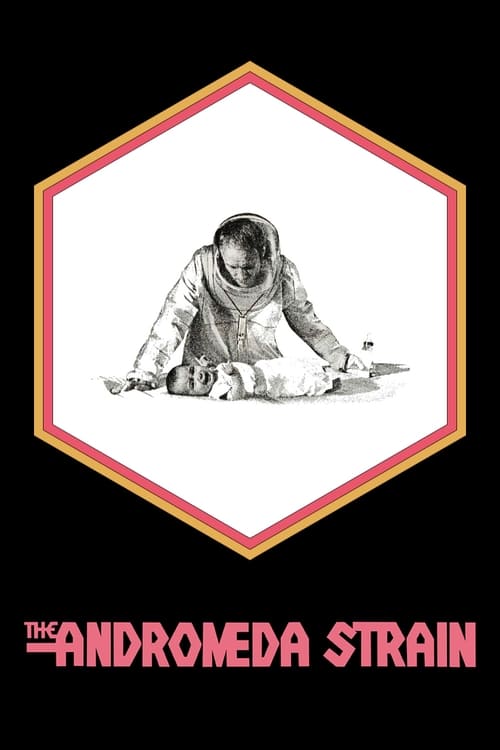
The Andromeda Strain
1971 · Robert Wise
For when you want a smart, sober thriller instead of jump scares — the kind of night where a slowly tightening scientific puzzle is more gripping than any monster. More challenge than comfort, but a hypnotic one.
What it's about
A satellite falls back to Earth near a tiny New Mexico town, and within hours nearly everyone there is dead. A hand-picked team of scientists is sealed inside a secret underground laboratory to isolate the microorganism responsible before it spreads — and to figure out why two wildly different survivors, an old drunk and a crying infant, are still alive.
The experience
Cool, methodical, and quietly nerve-shredding — the tension comes from watching careful people follow protocol against a clock they can't see. It's slow-burn suspense that treats lab work like a bomb defusal, and it leaves you with a lingering unease about how thin our defenses really are.
The craft
Robert Wise directs with clinical patience: split screens, scrolling computer readouts, and the ritual of decontamination all played straight-faced and real. The sterile, futuristic lab design and eerie electronic score make the invisible threat feel physically present. It rewards close attention more than a big screen — this is a film you lean into.
Why it matters
It set the template for the modern outbreak thriller and proved audiences would sit rapt through actual scientific process; decades of pandemic and contagion films descend from its procedure-as-suspense playbook.
Snapshot
Robert Wise's adaptation of Michael Crichton's debut techno-thriller is among the most rigorous pieces of procedural filmmaking in the American science fiction canon. Where most films of its genre traffic in spectacle or menace, The Andromeda Strain traffics in methodology: suits donned in sequence, cultures plated under microscopes, computer readouts scrolled with the patience of a journal article. The danger is invisible, the enemy is not malevolent but merely incomprehensible, and the dramatic tension derives almost entirely from the race between scientific protocol and biological reality. It remains the closest Hollywood has come to dramatizing what actual emergency research science looks like — unhurriedly, and with real unease about whether procedure can ever be fast enough.
Industry & production
Universal Pictures acquired the rights to Crichton's novel shortly after its 1969 publication, when the book was already a bestseller riding public fascination with space medicine, the Apollo quarantine protocols, and growing Cold War anxieties about biological weapons. The studio offered the project to Wise, who had demonstrated both commercial range (winning back-to-back Best Picture Oscars for West Side Story and The Sound of Music) and a specific credibility with serious science fiction dating to The Day the Earth Stood Still (1951). Wise accepted, drawn to the novel's unusually grounded epistemology — its insistence that the scientists would work, step by step, the way scientists actually work.
The production was given an above-average budget for a science fiction film of the era. The principal practical challenge was the construction of the Wildfire underground containment facility, which required elaborate multi-level laboratory sets that had to read as genuine research environments rather than science fiction props. The art direction aimed for an antiseptic, functional aesthetic that deliberately refused the gleaming futurism of most contemporary genre design. Wise and his collaborators built out the facility's interconnected levels with functional-looking equipment, much of it actual scientific hardware either rented or acquired from research supply companies, giving costume and set dressers source material grounded in reality rather than imagination.
Wise made a deliberate casting decision to populate the film almost entirely with character actors rather than stars — Arthur Hill, David Wayne, James Olson, and Kate Reid were all accomplished screen and stage performers with strong reputations but without the kind of marquee names that would orient audience expectation toward conventional heroics. The effect is of watching specialists at work rather than watching movie stars save the world.
Technology
The film's technology is Janus-faced: it depicts contemporaneous research technology with unusual fidelity while simultaneously deploying the most advanced cinematic technology Wise and his crew could marshal. On the diegetic side, the Wildfire computers, readout screens, and laboratory instruments were carefully researched; the film's visual language of printouts, oscilloscope traces, and specimen displays predates by decades the genre conventions that would eventually make such imagery clichéd, and in 1971 it was recognizable to technically literate viewers as plausible rather than fantastic.
On the production side, the most significant technological choice was the extensive use of anamorphic Panavision photography combined with optically composited split-screen and multi-panel image design. The multi-panel sequences — in which the widescreen frame is divided into as many as half a dozen simultaneous images — drew on the graphic vocabulary of experimental multi-screen cinema that had gained prominence through Expo 67 installations and Norman Jewison's The Thomas Crown Affair (1968), but Wise and his collaborators pushed the technique further toward information density, using it less as a stylistic flourish and more as a documentary strategy: when several things are happening simultaneously in different parts of the facility, you see them simultaneously.
Gil Mellé's electronic score was composed and synthesized using early electronic instruments at a time when the vocabulary of synthesis was still being invented in real time. Mellé — a jazz musician who had moved into the emerging field of electronic composition — created tones and textures that had no precedent in classical film scoring, reinforcing the film's claim to represent a genuinely new kind of threat.
Technique
Cinematography
Richard H. Kline's photography solves a difficult problem: how do you make scientific procedure visually interesting without sensationalizing it? The answer, developed in close collaboration with Wise, is to let the visual grammar evolve with the space. The exterior sequences — the hazmat-suited scientists descending on the dead town of Piedmont, the military cordon — are shot with cool, observational naturalism. Once the action moves underground into Wildfire, the frame becomes increasingly controlled, dominated by straight lines, clinical whites, and the geometry of corridors and airlocks. Kline uses focal length and rack focus to pick out specific instruments or specimens within the visual clutter of the laboratory, guiding the eye through information as a documentary cinematographer might guide attention through a complex environment. The film systematically avoids visual drama in favor of visual clarity — a choice that turns out to be its own kind of tension.
Editing
Stuart Gilmore's editing is the formal engine of the film. The procedural sequences — the five-stage decontamination process, the systematic analysis of the alien organism — are cut on information rather than emotion: the next cut arrives when you have processed the previous image and need the next piece of data. This rhythm is slow by genre standards but not by the standards of scientific demonstration; Gilmore's cut points often land at exactly the moment the spoken scientific explanation catches up to the visual evidence, creating a dense synchrony between image and language. The multi-panel sequences required complex optical work at the printing stage and represent some of the most technically demanding editing in the studio's output at that moment.
Mise-en-scène / staging
Wise stages the Wildfire sequences with the spatial coherence of someone who has studied blueprints. The audience accumulates a clear mental map of the facility's levels and their relationship to one another, which pays off in the climactic deactivation sequence when the need to physically reach a specific location under pressure finally converts the procedural geography into suspense. The staging of the scientific protocols — the blood draws, the electron microscope work, the crystallography — is unhurried and detailed; Wise trusted the audience to find the procedure itself compelling, which is the film's most radical dramatic wager. Characters are staged in relation to their equipment as often as in relation to each other.
Sound
The sound design works in close partnership with Mellé's score to estrange the audience from familiar sonic references. The ambient sounds of the facility — ventilation systems, terminal keystrokes, the hum of refrigeration — are present with unusual specificity, grounding the action in a particular kind of engineered environment. Mellé's score intrudes and recedes rather than swelling conventionally; it often arrives as texture rather than melody, providing unease without melodrama. The silence used to punctuate key discoveries is strategic.
Performance
The ensemble resists the temptation to provide emotional release. Hill's Dr. Stone is the commanding authority figure but Wise keeps him from becoming conventionally heroic; he is competent and sometimes wrong. Kate Reid's Dr. Leavitt brings the sharpest characterization — acerbic, occasionally abrasive, concealing a medical condition that becomes plot-critical — and Reid grounds the role in professional frustration that reads as psychologically specific rather than expository. The performances collectively enact the culture of a research team under pressure: status negotiations, institutional loyalties, the difficulty of communicating urgency without undermining credibility. There is almost no sentiment.
Narrative & dramatic mode
The Andromeda Strain operates in the mode of the scientific procedural — a form more common to nonfiction literature and documentary film than to fiction narrative. The dramatic structure is organized around the progressive elimination of hypotheses: the scientists proceed not toward a predetermined revelation but toward an understanding that keeps revising itself. The two survivors — an elderly alcoholic and a six-month-old infant — constitute the puzzle's generative anomaly, and the work of the film is hypothesis-formation and hypothesis-testing. Crisis arrives not through escalating violence but through the discovery that a previous understanding was incomplete.
The film's narrative differs from the thriller norm in that the threat is not defeated so much as survived by luck and partial understanding. The alien organism mutates, crosses a pH threshold the scientists did not predict, and escapes the facility's containment before the self-destruct device can be triggered — the climax is the protagonist climbing a missile shaft to manually abort a nuclear detonation that would have fed the organism. The resolution is equivocal: the crisis passes, but it passes because the organism evolved away from danger rather than because science fully mastered it. This is an unusually honest narrative stance for a Hollywood genre film.
Genre & cycle
The film belongs to the cycle of "hard science fiction" that 2001: A Space Odyssey (1968) had legitimized as a commercially and critically viable form — films willing to observe scientific plausibility as a constraint and to take seriously the cognitive experience of scientists and engineers. Planet of the Apes (1968) and 2001 had demonstrated that genre audiences would accept intellectual ambition; The Andromeda Strain pushed that permission into territory more austere than either predecessor.
It also founded, in effect, the modern biohazard thriller — a subgenre that would remain commercially dormant for two decades before returning in force with Outbreak (1995) and finding further elaboration in films such as Contagion (2011). Crichton would go on to develop the techno-thriller as a publishing form through the 1970s and 1980s, and the film's procedural template — threat identified, team assembled, laboratory sequence, escalating discovery, narrow escape — became the genre's structural DNA.
Authorship & method
Robert Wise came to directing through editing, cutting Citizen Kane (1941) and The Magnificent Ambersons (1942) for Orson Welles before moving to the director's chair at RKO in the mid-1940s. His career is defined by genre fluency rather than a consistent personal style: The Set-Up (1949), The Day the Earth Stood Still (1951), Executive Suite (1954), I Want to Live! (1958), West Side Story (1961), The Haunting (1963), The Sound of Music (1965), The Andromeda Strain (1971). What Wise brought to each project was intelligence about form — what formal choices would serve this material — rather than an auteurist signature. For The Andromeda Strain, that meant subordinating directorial presence to scientific credibility, making his most prominent formal choices (the split-screen, the deliberate pacing) instruments of the film's documentary ambitions.
Nelson Gidding, the screenwriter, had collaborated with Wise on I Want to Live! and The Haunting, and understood Wise's preference for material-specific craft over imported stylistic convention. Gidding's adaptation compressed and reorganized Crichton's novel — which is structured partly as a retrospective government report — into a linear narrative while preserving the novel's investment in technical exposition. The screenplay makes the exposition itself dramatic rather than explaining around it.
Richard H. Kline (cinematographer) was a veteran studio cinematographer with a particular facility for controlled, artificial environments. His work on the Wildfire interiors is among the most disciplined work of his career.
Gil Mellé's score deserves particular attention as an early milestone in the electronic film score. Mellé came from jazz (he had recorded extensively for Blue Note in the 1950s) and brought a musician's structural thinking to synthesis. The Andromeda score operates through timbre and texture rather than theme, anticipating the ambient film scoring strategies that would become widespread in the 1980s.
Movement / national cinema
The film is firmly within the tradition of American studio science fiction, but it engages with a specifically Cold War-American institutional anxiety: the fear that the scientific and military apparatus designed to protect the population might be inadequate to, or even complicit in, catastrophic threat. The Wildfire facility is both the solution and the potential disaster — its nuclear self-destruct system, installed to prevent contamination, nearly destroys the scientists and would have accelerated the organism's spread. This ambivalence about institutional technology is a recurring preoccupation in American genre cinema of the late 1960s and early 1970s, visible across very different films from Dr. Strangelove (1964) through Silent Running (1972).
Era / period
The Andromeda Strain opens in 1971, the year of Apollo 14 and 15, when space medicine and planetary quarantine were active research concerns and the US military's relationship with biological weapons research was a live political controversy. The film registers all of these anxieties without addressing any of them directly. Its extraterrestrial organism serves simultaneously as a Cold War biological weapon manqué, a post-Apollo contamination anxiety, and a straightforward alien threat. The procedural solemnity of the film mirrors the procedural solemnity of the space program itself — and implicitly asks what happens when the program introduces something back into the biosphere that the procedures are insufficient to contain.
Themes
The film's dominant theme is the adequacy of method. Science as depicted here is not inspired genius or heroic intuition but protocol — and the central dramatic question is whether protocol can move fast enough when reality refuses to stay still. The mutation of the organism is the film's most pointed thematic statement: the scientific method generates understanding, but the object of study does not wait for understanding to catch up.
Subsidiary themes include the relationship between individual judgment and institutional mandate (the "Odd Man Hypothesis," by which a single unmarried male scientist is designated sole authority to abort the self-destruct); the concealment of vulnerability within professional competence (Leavitt's undisclosed epilepsy, which makes her specifically susceptible to one of the organism's signals); and the question of what "contamination" means when the contaminant is not malicious but simply foreign. The film declines to anthropomorphize the organism at any point — it is never a monster, only a fact.
Reception, canon & influence
Influences on the film: The shadow of 2001: A Space Odyssey (1968) is present throughout — both films share a commitment to scientific plausibility, a willingness to make cognitive process rather than action the subject of extended sequences, and an interest in space hardware as drama. Wise was also working in the tradition of American semi-documentary thrillers stretching back through his own I Want to Live! and the procedural crime films of the late 1940s. Crichton's novel itself drew heavily on the rhetoric of Cold War scientific literature and was partly structured as a parody of the government report, a form Gidding's screenplay had to translate back into conventional narrative.
Critical reception: The film was received respectably rather than rapturously. Critics noted its unusual formal discipline and its willingness to bet on scientific procedure as drama, and several pointed to the electronic score as an innovation. The film did not achieve blockbuster status and was seen in some quarters as cold — which was, of course, the point. Over time, critical reassessment has been more generous, and the film's position as a foundational text of the biohazard thriller is now secure.
Legacy: The film's most immediate industry influence was on the development of the techno-thriller as a Hollywood genre form — Crichton would return to filmmaking with Westworld (1973), and his subsequent novels (The Great Train Robbery, Congo, Sphere, Jurassic Park) follow the template of the specialized team confronting a systemic threat through rigorous methodology, always asking whether the procedure is adequate. The biohazard lineage runs directly forward to Outbreak and Contagion, both of which borrow the procedural structure, the epidemiological detective work, and the CDC-style institutional setting that The Andromeda Strain established. The film was remade as a television miniseries in 2008, a testament to the durability of the premise even if the remake substantially altered the novel's tone. Among filmmakers, the film has a quiet reputation as a master class in making science cinematically active — a problem that remains difficult and that Wise solved it as well as anyone has.
A Deleuzian reading
The first bodies are in the street.
The full Deleuzian reading of The Andromeda Strain →
Reception
A solid hit in 1971 — Oscar-nominated for its editing and art direction — but often dinged as cold and clinical next to flashier sci-fi. Fifty years on, that clinical coldness is exactly why it's revered, and it got a whole second life in 2020 when pandemic-anxious viewers rediscovered it alongside Contagion and Outbreak.
How The Andromeda Strain was received, from release to now →
Influences: the films it descends from and the films it influenced
- Citizen Kane (1941) — Wise cut this film under Welles, absorbing the practice of montage-as-information — consecutive images that force the viewer to synthesize meaning rather than receive it — which becomes the editorial logic of Andromeda Strain's procedural sequences.
- The Day the Earth Stood Still (1951) — Wise's earlier hard science fiction establishes his template of treating the unknown threat as intellectual rather than spectacular; Bernard Herrmann's Theremin-based score is the direct formal ancestor of Gil Mellé's synthesized electronic textures.
- Forbidden Planet (1956) — The first Hollywood feature with an entirely electronic score — Louis and Bebe Barron's synthesized tones — inaugurates the lineage of texture-over-melody electronic sound design in genre film that Mellé extends.
- Fail Safe (1964) — The institutional-systems-failure procedural with an ensemble of functional specialists replacing star heroes, editing driven by information exchange rather than emotional escalation, and containment-space blocking organized around the geometry of consoles and screens.
- Grand Prix (1966) — An early Hollywood experiment in dynamic multi-screen Panavision composition — multiple simultaneous image cells within the widescreen frame — that established the technical and perceptual vocabulary Wise would redirect toward scientific information density.
- The Thomas Crown Affair (1968) — The optically composited multi-panel split-screen sequences dividing the anamorphic frame into simultaneous image cells are directly adopted by Wise; where Jewison uses the device for kinetic style, Wise converts it into a documentary simultaneity tool — multiple facility zones visible at once.
- 2001: A Space Odyssey (1968) — Established that anamorphic widescreen science fiction could proceed at the pace of actual scientific operation, refusing narrative shortcuts; Wise inherits this permission for procedural patience but replaces Kubrick's visual lyricism with a documentary-observational camera grammar.
- Alien (1979) — The Nostromo's deck-plan spatial coherence is as rigorously maintained as Wildfire's level-by-level grammar; the crew's procedural response to a biologically unknown organism — quarantine protocols, specimen isolation, containment breach — extends the biohazard-thriller genre grammar Wise established.
- The Thing (1982) — The blood-testing sequence is a direct formal descendant of Andromeda Strain's systematic culture-and-specimen methodology: a hypothesis-elimination procedure conducted by an ensemble of specialists, each test narrowing the field of possibility, cutting on information rather than suspense.
- Outbreak (1995) — The USAMRIID containment-facility staging, Level-4 biosafety protocol sequences, and military-institutional ambivalence all derive from the genre template Wise constructed; the film is Andromeda Strain domesticated for 1990s thriller pacing, trading equivocal resolution for melodramatic closure.
- Contagion (2011) — The most rigorous direct heir: CDC/WHO institutional framings, a procedural ensemble of specialists over stars, hypothesis-elimination narrative in which the dramatic engine is research methodology, electronic-textural score design, and an equivocal resolution that refuses to fully reassure about institutional competence.
- The Martian (2015) — Hypothesis-elimination structure applied to solo survival science — each problem Watney solves narrows the field of possible deaths — and the NASA procedural sequences inherit Andromeda Strain's dramatization of actual scientific method, not scientific intuition, as the engine of narrative.
- Leviathan (1989) — Establishes the clinical contamination-and-quarantine procedural and antiseptic high-tech set design that Leviathan adapts for its undersea station's medical-bay infection dread.
- Silent Running (1972) — Trumbull's own optical and split-screen effects work here, plus its procedural-realist treatment of functional lab/spacecraft hardware, feeds directly into Silent Running's clinical, instrument-dense interiors.
- Resident Evil (2002) — The sterile descending-levels underground lab with an automated sterilization countdown supplies the self-destruct purge apparatus and its color-coded containment architecture.
- White Noise (2022) — Codifies the containment procedural as a visual idiom — anonymous figures in hazmat suits, decontamination corridors, readouts and clipboards shot with clinical flatness — which White Noise reproduces and satirizes in the SIMUVAC and quarantine-barracks passages.
- Colony (2026) — Stages outbreak as pure procedure: the Wildfire lab's descending sterile levels are named and numbered in dialogue before anyone is threatened, and the self-destruct protocol converts the facility's own safety architecture into the film's clock.
- Close Encounters of the Third Kind (1977) — The government containment facility at Devils Tower — decontamination airlocks, institutional scale of the specialist response, a hierarchical ensemble of technicians — echoes Wildfire's spatial organization and blueprint-coherence blocking, even as Spielberg inverts Wise's institutional ambivalence into wonder.
- All the President's Men (1976) — Pakula builds a procedural investigation from hypothesis-elimination editing — each cut to a new source or document arrives when the viewer has exhausted the previous datum — and refuses a triumphant resolution, sharing Andromeda Strain's structural logic and equivocal institutional conclusion.
- Silkwood (1983) — Equipment-centered blocking and procedural staging of industrial scientific environments; the decontamination sequences share a visual and affective grammar with Wise's five-stage cleansing protocol, both treating mandatory procedure as its own sustained register of dread.
- Zodiac (2007) — Fincher's procedural cutting rhythm — the edit arrives when the viewer has processed the previous data point and requires the next — is a direct formal parallel to Stuart Gilmore's information-driven editorial logic, relocating the same epistemological structure from virology to criminal investigation.
Similar films
- Alien (1979) — influence & lineage · same viewing thread
- Forbidden Planet (1956) — influence & lineage · same viewing thread
- Contagion (2011) — influence & lineage
- The Day the Earth Stood Still (1951) — influence & lineage
- Outbreak (1995) — influence & lineage
- Fail Safe (1964) — influence & lineage
- The Thing (1982) — influence & lineage
- The Martian (2015) — influence & lineage
All the films related to The Andromeda Strain →
Watch it with: curated runs of related films
- Crossing Into the Zone — A run of crews and expeditions that step across a threshold into a hostile unknown — a derelict, a shimmer, a forbidden Zone — that rewrites biology, sanity, and who comes back; watch them in sequence to feel the same dread deepen from pulp to the sublime.