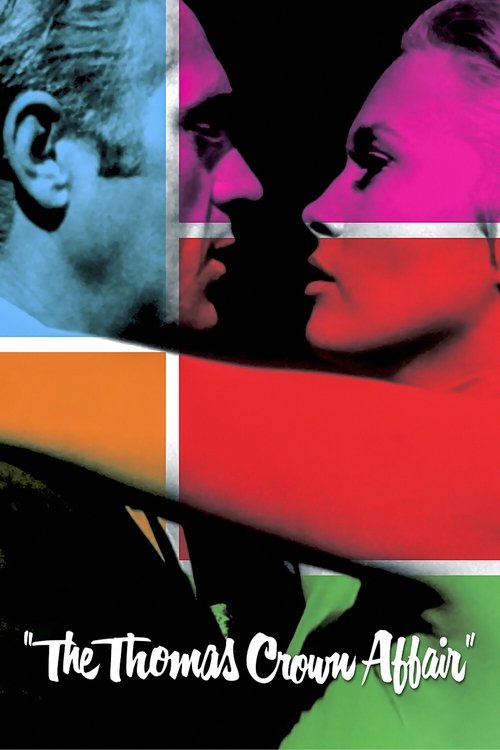
The Thomas Crown Affair
1968 · Norman Jewison
For a sleek, grown-up date night when you want glamour, flirtation, and zero stress — pure sixties cool you can sink into with a cocktail. Comfort viewing with a sharp wardrobe.
What it's about
A bored Boston millionaire masterminds a multi-million dollar bank robbery purely for the thrill of it, engineered so that the five men who pull it off never meet him or each other. The crime looks perfect until the insurance company sends in a glamorous, ruthless investigator who quickly zeroes in on him — and the case becomes a flirtation. What follows is less a manhunt than a chess match between two people who may be enjoying the game more than they should.
The experience
Cool, playful, and unhurried — the tension comes not from whether the heist works but from watching two supremely confident people circle each other. It's all style and simmer: glances, banter, and set pieces (a chess game, a glider, a dune buggy) that feel like foreplay.
Performances
Steve McQueen, cast against type as a three-piece-suit financier, makes boredom itself magnetic, and Faye Dunaway matches him move for move as the investigator — their chess scene is one of the most charged seduction scenes ever played without a word of romance.
The craft
Norman Jewison turns the film into an exercise in pure tempo and surface: Pablo Ferro's multi-panel split screens fracture the heist into a kinetic mosaic, Haskell Wexler shoots Boston like a fashion spread, and Michel Legrand's dreamy, circling score gives the whole thing its wistful undertow. It's a film to watch on the biggest screen you have, for the tailoring alone.
Why it matters
It became one of the defining style objects of late-1960s Hollywood — proof the heist film could run on charisma and design rather than suspense — and its split-screen razzle influenced how thrillers and title sequences looked for years, eventually inspiring a lavish 1999 remake.
Snapshot
The Thomas Crown Affair is a heist picture that withholds the usual pleasures of the heist picture. The robbery — a meticulously planned Boston bank job executed by five strangers who never meet — is dispatched in the first reel, leaving the film free to become what it really is: a stylized duel of seduction between a bored millionaire thief and the insurance investigator hired to catch him. Norman Jewison, fresh from the Best Picture triumph of In the Heat of the Night (1967), used the project as an exercise in pure surface and tempo, marrying the cool of Steve McQueen to a mod, European-inflected visual register built around Pablo Ferro's multi-panel split screens, Haskell Wexler's glamorous location photography, and Michel Legrand's score. The result is one of the defining objects of late-1960s American studio chic — a film remembered less for its plot than for its chess game, its glider, its dune buggy, and "The Windmills of Your Mind." It is a caper reconceived as a romance, and a romance reconceived as a game whose stakes are temperament rather than money.
Industry & production
The film arrived at a transitional moment for Hollywood, when the old studio system had collapsed and a new generation of stylistically adventurous, internationally aware filmmakers was being given room to experiment within mainstream genre frames. Jewison, a Canadian who had moved from television into features, formed his own production company (Mirisch-affiliated Solar/Simkoe arrangements were in flux at the time) and shepherded the picture for United Artists release through the Mirisch Corporation, the independent outfit responsible for much of his best work. The screenplay came from Alan Trustman, a Boston attorney writing his first produced script; in the same period Trustman also wrote Bullitt (1968), and the two films together did much to crystallize the McQueen persona at its commercial peak.
Production centered on Boston and its surroundings — a deliberate choice that grounded the film's fantasy of patrician wealth in real Brahmin geography rather than the more familiar New York or Los Angeles. McQueen, then among the biggest stars in the world and typically cast in action and outsider roles, took the part specifically to play against type as a polished, Ivy-educated financier; the casting gamble is part of the film's texture, the tension between McQueen's coiled physicality and the three-piece-suit milieu generating much of its charge. Faye Dunaway, cast as investigator Vicki Anderson, came directly off Bonnie and Clyde (1967) and brought with her that film's association with a newly modern, sexually frank screen femininity. The precise financial performance is best left uncited here; the film was a notable commercial success and a cultural touchstone, but I will not attach specific box-office figures I cannot verify.
Technology
Technically, the film is most significant for its embrace of the multi-screen, multi-image aesthetic that was very much in the air in 1967–68. The immediate catalyst was Expo 67 in Montreal, where multi-projector and split-frame films — Christopher Chapman's "A Place to Stand" prominent among them — demonstrated the expressive possibilities of simultaneous imagery. Jewison and designer Pablo Ferro adapted that fairground spectacle to narrative cinema, using optical printing to compose frames-within-the-frame: grids of panels that multiply, slide, and recombine. This was painstaking, pre-digital work, assembled photochemically on the optical bench, and it represented one of the most ambitious uses of the technique in a major studio feature of its era.
Beyond the split screen, the production exploited then-fashionable location and aerial technologies: sailplane (glider) photography for the sequence in which Crown soars over the New England landscape, and beach photography of the Meyers Manx dune buggy, a fiberglass kit car that became one of the film's enduring fetish objects. The picture was shot for widescreen presentation, and Wexler's use of long lenses, available light, and reflective surfaces — glass, water, polished interiors — reflects the increasingly mobile, naturalistic shooting style that location-driven late-'60s production made possible.
Technique
Cinematography
Haskell Wexler, soon to direct his own landmark Medium Cool (1969), photographs the film as a catalog of affluent surfaces. His camera is at once documentary-alert to Boston light and frankly luxuriating in texture: leather, tweed, sand, the sheen of the polo field. Wexler favors long lenses that compress and isolate, telephoto glimpses that turn surveillance into voyeurism — appropriate for a film about watching and being watched. The eroticism is built optically as much as performatively; the famous chess sequence is constructed from extreme close-ups of fingers, lips, and eyes, the shallow focus dissolving the room into a field of charged detail.
Editing
The editing is the film's signature. Credited to Hal Ashby — who had just won the Academy Award for editing In the Heat of the Night and who would shortly become a major director in his own right — together with Ralph E. Winters and Byron Brandt, and with the multi-image montage designed by Pablo Ferro, the cutting alternates between two registers. In the split-screen set pieces (the assembling of the heist team, the polo match) the film fragments time and space into simultaneous panels, producing a kind of cubist suspense in which cause and effect are spread across the frame. In the intimate scenes the editing slows to a near-tactile crawl. The juxtaposition — manic multiplicity against held, fetishistic stillness — is the film's central formal idea.
Mise-en-scène / staging
Jewison stages the film as an inventory of upper-class leisure: the boardroom, the polo grounds, the golf course, the auction house, the sailplane, the beach. Crown's world is a sequence of expensive games, and the staging insists that the heist is simply another one. Production and costume design lean hard into 1968 modernity — sharp tailoring, mod interiors, the dune buggy as sculpture — so that the film doubles as a near-documentary of a particular moment's idea of glamour.
Sound
Michel Legrand's score is inseparable from the film's identity, alternating jazzy propulsion with the melancholy, circling theme of "The Windmills of Your Mind" (lyrics by Alan and Marilyn Bergman, sung over the glider sequence by Noel Harrison). The song's spiraling, question-without-answer structure mirrors the film's themes of restlessness and unfinished desire, and it won the Academy Award for Best Original Song. Legrand's music does much of the work of binding the film's deliberately cool, affectless drama into something that registers as romantic.
Performance
McQueen's performance is an exercise in withheld minimalism — a star trading his usual kineticism for stillness, communicating boredom, appetite, and amusement through small adjustments of the eyes and mouth. The role asks him to suggest interior life behind an opaque, well-bred mask, and the film's fascination depends on our never being entirely sure how much is there. Dunaway matches him with a performance of polished, predatory poise; Vicki Anderson is one of the era's more interesting screen professionals, a woman whose job and whose desire are deliberately entangled. Their scenes are less about dialogue than about the choreography of approach and retreat.
Narrative & dramatic mode
The film's dramatic mode is duel rather than quest. By front-loading the robbery, the script discards conventional heist suspense (will they pull it off?) in favor of a two-hander of mutual investigation: Vicki knows almost at once that Crown is guilty, and the drama becomes whether she can prove it, whether she will fall for him, and whether he will let her. The mode is cool, elliptical, and ironic — closer to a continental art film's tone than to a Hollywood thriller's — and it culminates in a famously bittersweet reversal in which Crown outmaneuvers Vicki emotionally as well as legally, escaping by decoy and leaving her behind. The ending refuses the romance it has been promising, converting seduction into a final, melancholy move in the game.
Genre & cycle
The Thomas Crown Affair belongs to the stylish international caper cycle of the mid-to-late 1960s, alongside such films as Topkapi (1964), Gambit (1966), and How to Steal a Million (1966) — pictures in which theft is treated as elegant play, the thieves are charming rather than desperate, and the real subject is style. Within that cycle Crown is distinctive for its near-total dissolution of the heist into romance, and for its modernist formal ambition. It also sits at the intersection of the caper film and the "gentleman thief" tradition that runs from Raffles through Cary Grant in To Catch a Thief (1955), McQueen's Crown updating the type for an age of corporate finance and existential boredom.
Authorship & method
The film is best understood as a producer-director's orchestration of strong specialist collaborators. Jewison's method here is curatorial: he assembles a team of formal innovators and lets their contributions define the texture. The decisive collaborators are Wexler, whose photography supplies the surfaces; Hal Ashby and the editorial team, whose cutting supplies the rhythm; Pablo Ferro, whose multi-image design supplies the film's most copied idea and whose distinctive hand-lettered title work is part of its identity; Michel Legrand, whose score supplies the feeling; and writer Alan Trustman, whose screenplay supplies the cool, dialogue-light architecture. Jewison's own authorship is less a matter of personal signature than of taste and tempo — the ability to fuse these elements into a coherent mood. It is worth noting that several of these figures (Ashby, Wexler, Ferro) were themselves restless innovators who would shape the New Hollywood of the following decade.
Movement / national cinema
Though an American studio production, the film is conspicuously porous to European art-cinema influence — the elliptical narration, the privileging of mood over mechanics, the eroticized formalism all reflect the impact of the French and Italian new waves on American filmmakers of the period. Jewison's Canadian background and the direct debt to Expo 67's Canadian multi-screen experiments give the film a specifically transnational lineage. It is a characteristic artifact of the brief late-1960s moment when Hollywood, its old certainties gone, was openly absorbing international techniques into commercial genre filmmaking.
Era / period
The film is saturated in 1968 — not the year's political upheaval, which it pointedly ignores, but its consumer modernity and its faith in surface. It is an artifact of affluent, apolitical 1960s glamour, made in the same year as McQueen's Bullitt and as the broader collapse of the Production Code's grip, and it shares the era's new sexual frankness (the chess scene) and its appetite for formal experiment. Set against the turbulence of 1968, its cool detachment now reads as both escapism and a kind of period self-portrait of a leisure class at play.
Themes
At its center is boredom — specifically the boredom of a man who has won every conventional game and steals for the sensation of risk rather than for need. Theft here is existential, a search for stakes in a life without them. Around this revolve the film's other concerns: the eroticism of adversarial pursuit, in which surveillance and desire become indistinguishable; the game as the highest form of human relation, structuring everything from chess to polo to courtship to the heist itself; and the impossibility of trust between two players who are each trying to win. The ending's romantic betrayal insists that for Crown the game cannot be abandoned even for love — that the move always outranks the feeling.
Reception, canon & influence
Contemporary critical reception was mixed in a characteristic way: many reviewers found the film glossy and emotionally cold, a triumph of style over substance, while acknowledging its visual sophistication and the charisma of its leads. That very reputation — gorgeous, hollow, supremely stylish — has hardened over time into the basis of its enduring appeal; it is now a touchstone of 1960s cool and a perennial reference for fashion, design, and advertising. Its single most concrete honor was the Academy Award for Best Original Song for "The Windmills of Your Mind."
Looking backward, the film draws on the gentleman-thief and stylish-caper traditions noted above, on the European art cinema's narrative cool, and most directly on the Expo 67 multi-screen experiments that gave it its visual method. Looking forward, its influence runs along two channels. Formally, its multi-dynamic split-screen montage, designed by Ferro, became one of the most imitated techniques of its moment, feeding into the split-screen vogue of late-'60s and early-'70s cinema and television. Iconographically, the chess scene, the glider, the Meyers Manx, and the McQueen-in-three-piece-suit image have been endlessly cited. The clearest measure of its standing is its 1999 remake, directed by John McTiernan with Pierce Brosnan and Rene Russo, which relocated the story to the art world and softened the original's chilly ending — a tribute that, by contrast, underlined how singular the 1968 film's detachment had been.
A Deleuzian reading
She reaches for the bishop.
The full Deleuzian reading of The Thomas Crown Affair →
Reception
Critics in 1968 largely shrugged it off as glossy style over substance — a fashion shoot with a heist attached. Decades on, that 'all surface' quality is exactly why it's adored: it's now treasured as the ultimate artifact of late-'60s cool.
How The Thomas Crown Affair was received, from release to now →
Influences: the films it descends from and the films it influenced
- A Place to Stand (1967) — Premiered at Expo 67, it pioneered the 'multi-dynamic image technique' of multiple moving panels within one frame — the literal source method Pablo Ferro adapted into Crown's split-screen montage.
- Dr. Strangelove (1964) — Established Pablo Ferro's signature kinetic quick-cut design and hand-lettered title work, the exact visual vocabulary he carried into Crown's titles and image-grids.
- Grand Prix (1966) — Saul Bass's multi-panel split-screen organized racing action into simultaneous frames, the immediate narrative-montage ancestor of Crown's polo and heist multi-image sequences.
- Rififi (1955) — Its near-silent, dialogue-free robbery set piece is the procedural model for Crown's front-loaded, wordless heist staged as pure choreography.
- Bob le flambeur (1956) — Codified the elegantly detached gentleman-gambler whose criminal cool is an aesthetic pose — the European art-cinema register of withheld emotion Crown adopts wholesale.
- To Catch a Thief (1955) — Built the glamorous gentleman-thief romance as erotic cat-and-mouse between thief and the woman pursuing him, the precise relational architecture of Crown and Vicki Anderson.
- The Umbrellas of Cherbourg (1964) — Michel Legrand's wall-to-wall melodic scoring established the lyrical, recurring-theme method that produced 'The Windmills of Your Mind' and Crown's emotional surface.
- Breathless (1960) — Its elliptical New Wave cutting and narrative cool model the art-cinema detachment and dialogue-light, mood-over-plot architecture of Trustman's screenplay.
- Topkapi (1964) — Defined the glossy jet-set caper cycle — international glamour wrapped around an elaborate theft — that Crown elevates from comedy to chilly chic.
- Charade (1963) — Cat-and-mouse romantic thriller in which neither lead can determine the other's true motive or allegiance; sustained epistemic uncertainty functions as erotic charge in the same structural register as Charade, with Faye Dunaway's investigator occupying the Hepburn position of the woman who cannot trust what she desires.
- A Man and a Woman (1966) — The glider sequence cut whole to Legrand's 'Windmills of Your Mind' — image edited to fit a finished song — inside a film shot with the gloss, telephoto compression and product-lit surfaces of late-1960s advertising, the commercial idiom Lelouch had already proved could carry a romance.
- How to Steal a Million (1966) — Converts the alarm-defeat into open erotic duel — the chess scene is the flirtation-through-security-system transposed to a board — and keeps the Wyler moral arrangement in which nobody is hurt, nobody is punished, and the wrong party retains the money.
- The Boston Strangler (1968) — Deployed multi-panel split-screen across an entire feature, the most direct and immediate adoption of Ferro's Crown technique in mainstream narrative cinema.
- The Italian Job (1969) — Extends the stylish-caper cycle with mod gloss and a front-loaded mechanized heist, inheriting Crown's fusion of design-object fetishism and theft-as-spectacle.
- Woodstock (1970) — Scaled Ferro-style multi-dynamic split-screen to documentary, using simultaneous panels as the organizing montage logic Crown made fashionable.
- The Andromeda Strain (1971) — Uses split-screen montage to convey procedural information density, squarely within the early-'70s split-screen vogue Crown catalyzed.
- The Thomas Crown Affair (1999) — A direct remake that relocates the heist to the art world and softens the bittersweet reversal, measuring itself explicitly against the original's detachment.
- Out of Sight (1998) — Rebuilds the cop-and-thief erotic standoff through withheld-minimalist performance and freeze-frame editing, directly extending Crown's romance-as-surveillance dynamic.
- Ocean's Eleven (2001) — Revives the gentleman-thief caper as a curatorial orchestration of specialist collaborators with split-screen flourishes — Jewison's producer-director method as house style.
- Ruben Brandt, Collector (2018) — The suave art-theft caper fused with graphic mod split-screen design and a cool jazz score prefigures the film's genre-plus-graphic-design register.
- Sisters (1973) — The Pablo Ferro multi-panel montage that made optical-printer split screen a mainstream 1960s flourish — the decorative usage Sisters deliberately answers by tying each panel to a distinct character's knowledge and running the two in real time under one continuous suspense clock.
- In the Heat of the Night (1967) — The season-prior assembly of the same Jewison–Wexler–Ashby team, where Wexler's telephoto compression and shallow-focus surfaces and Ashby's rhythmic cutting were first forged.
- Ocean's Twelve (2004) — Establishes the cool, design-forward gentleman-thief heist — jazzy scoring and style-as-subject — that Twelve treats as its mode rather than as suspense.
- The Man from U.N.C.L.E. (2015) — Its Pablo Ferro multi-panel split-screen montages are the direct template for Ritchie's grid-frame simultaneity, treating the heist as a design problem staged across the frame.
Similar films
- The Thomas Crown Affair (1999) — influence & lineage
- Rififi (1955) — influence & lineage
- Bob le Flambeur (1956) — influence & lineage
- Ocean's Eleven (2001) — influence & lineage
- Charade (1963) — shared sensibility
- Le Samouraï (1967) — shared sensibility
- The Mastermind (2025) — shared sensibility
- Bonnie and Clyde (1967) — shared sensibility
All the films related to The Thomas Crown Affair →