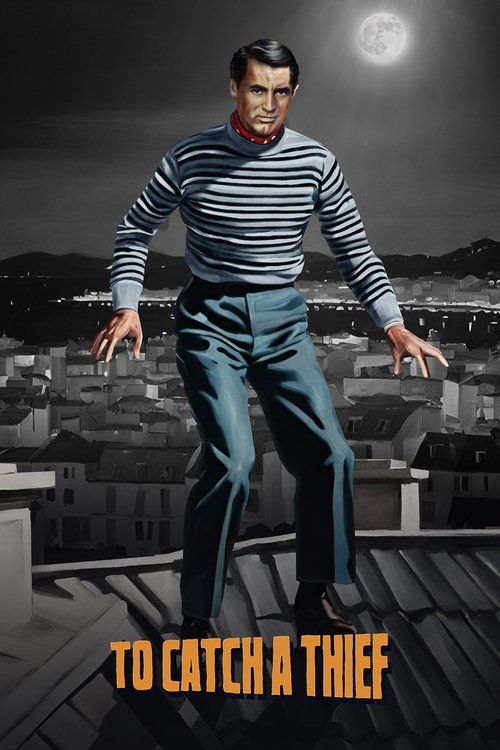
To Catch a Thief
1955 · Alfred Hitchcock
For a stylish, cozy night in when you want wit, beauty, and old-Hollywood glamour — falling in love on the Riviera without leaving the couch. Total comfort viewing.
What it's about
John 'The Cat' Robie, a retired jewel thief living quietly above Nice, becomes the prime suspect when a copycat starts robbing the wealthy along the French Riviera. To clear his name he must catch the imitator himself — a scheme that entangles him with a rich American widow and her cool, beguiling daughter Frances, who suspects he's still the Cat and is thrilled by the idea.
The experience
Pure pleasure — sun, glamour, champagne-dry flirtation, and suspense worn as lightly as a silk scarf. The romance crackles with innuendo, the danger stays playful, and the whole thing glides by like a vacation you don't want to end.
Performances
Cary Grant and Grace Kelly are two of the most magnetic stars ever paired on screen, and their verbal fencing — cool on the surface, electric underneath — is the entire engine of the film. Kelly in particular has rarely been more luminous or more in command.
The craft
Hitchcock shot the Riviera in widescreen VistaVision Technicolor, and it shows: sweeping coastal drives, a masked costume ball, and a famous fireworks scene where the editing does the flirting. This is a film about surfaces — clothes, jewels, light on water — and every surface gleams. It positively begs for the biggest, brightest screen you have.
Why it matters
It fixed the template for the glamorous caper-romance — the charming thief, the gorgeous location, the sparring couple — and its imagery of Grace Kelly on the Riviera became inseparable from her real-life legend there.
Snapshot
To Catch a Thief is Alfred Hitchcock's most unabashedly hedonistic film: a sun-drenched romantic thriller set on the French Riviera in which the suspense is almost an afterthought and the pleasure almost everything. Cary Grant plays John "The Cat" Robie, a reformed jewel thief living in semi-retirement among the vineyards above Nice, who is forced back into the game when a copycat begins targeting the Riviera's wealthy tourist class and Robie becomes the prime suspect. His path to exoneration runs through Frances Stevens (Grace Kelly), a cool, supremely confident American heiress who suspects Robie is still the Cat—and who is clearly thrilled by the possibility. The film is light by Hitchcock's own admission, a souffle built around two of the most physically charismatic performers in Hollywood, spectacular VistaVision location photography of the Côte d'Azur, and a series of set pieces in which romantic desire is treated as the only thriller worth staging. It won the Academy Award for Best Cinematography (Color) and remains an essential document of Hollywood's mid-decade infatuation with European glamour, widescreen spectacle, and the vanishing figure of Grace Kelly.
Industry & production
Paramount Pictures produced the film under Hitchcock's own unit, continuing the arrangement that had governed his work at the studio since 1953. By 1955 Hitchcock was among the most commercially and critically powerful directors in Hollywood, and To Catch a Thief reflected his capacity to greenlight productions that merged prestige location work with genre entertainment. The screenplay was written by John Michael Hayes, who had adapted Rear Window (1954) for Hitchcock the previous year and brought a similar wit and sexual frankness to David Dodge's 1952 source novel. Dodge, primarily known as a travel writer and mystery novelist, had set his story on the Riviera with knowledge born of personal familiarity, and the novel's sense of postwar European leisure—accessible to Americans with dollars, stratified by old European money—carries directly into the film.
The production secured permission for extensive location shooting around Nice, Cannes, Monaco, and the Corniche roads that wind above the sea, a logistical undertaking of considerable complexity for a Hollywood unit in 1954. Interiors and controlled scenes were completed at Paramount's studios in Hollywood, with rear-projection work extensively employed to marry the actors to the Riviera backgrounds. The film was released in August 1955 and was commercially successful, though its standing as a Hitchcock picture was debated by critics who expected the darker registers he had explored in Rear Window and Strangers on a Train (1951). It was Grace Kelly's third and final film with Hitchcock before her marriage to Prince Rainier III of Monaco in April 1956 ended her career; the production thus occupies a unique biographical position in the Kelly legend.
Technology
To Catch a Thief was shot in VistaVision, Paramount's proprietary widescreen format introduced commercially in 1954 with White Christmas. VistaVision ran the film horizontally through the camera rather than vertically, exposing a frame approximately twice the area of standard 35mm and producing a significantly sharper image with finer grain. The format was Paramount's competitive answer to 20th Century Fox's CinemaScope and was particularly suited to location material where resolution and depth mattered enormously. Combined with Technicolor's three-strip dye-transfer process, VistaVision delivered a chromatic richness—the blue of the Mediterranean, the ochre of the Riviera villages, the jewel-toned gowns and fireworks—that remains vivid. The aspect ratio in exhibition typically ran around 1.66:1 to 1.85:1, giving cinematographer Robert Burks a wide horizontal canvas that he used compositionally rather than merely for spectacle.
The rear-projection technology deserves separate acknowledgment. Much of what appears to be live action in the car chase and driving sequences was achieved through a combination of location plate photography and studio projection, a standard technique of the period that Hitchcock and Burks were exceptionally skilled at integrating. The result is occasionally visible to modern eyes but would have passed seamlessly in 1955 roadshow projection.
Technique
Cinematography
Robert Burks had been Hitchcock's primary cinematographer since Strangers on a Train (1951), and To Catch a Thief represents perhaps the most unconstrained expression of their collaboration. Where Rear Window demanded Burks work within the formal discipline of a single apartment courtyard and Vertigo (1958) would require deep psychological color coding, To Catch a Thief gave him the entire Riviera in summer light. Burks's Oscar-winning work here capitalizes on the VistaVision frame to compose depth-rich shots in which the sea and sky function as active pictorial elements: backgrounds are not merely backdrops but presences. His color palette is warm but precise—the brightness of the exterior sequences is calibrated rather than overexposed, and interiors at the Carlton Hotel and the château masked ball are lit to preserve the luxury-world atmosphere without sacrificing definition. The fireworks sequence late in the film—in which the bursts outside the hotel window are intercut with close-ups of Grant and Kelly—is formally simple but chromatic in its dazzle, using color itself as erotic language.
Editing
George Tomasini edited To Catch a Thief, as he would edit all of Hitchcock's subsequent Paramount films through Psycho (1960). Tomasini's contribution to the Hitchcock method has been understated relative to Burks's more visually legible work, but his editing throughout this period is notable for its control of rhythm rather than its assertiveness. The fireworks sequence demonstrates his approach: the cuts are unhurried, never mechanical, allowing the charge between Grant and Kelly to accumulate rather than be imposed. The Corniche car chase, by contrast, uses tighter pacing to generate momentum while the rear-projection seams are partially hidden in the rapid cutting. The film's overall tempo is leisurely for a thriller, which is a considered editorial choice in keeping with Hitchcock's tonal ambitions.
Mise-en-scène / staging
Hitchcock's staging in To Catch a Thief treats the Riviera as a theater of surfaces—everything glittering, everything potentially false. Robie's hillside villa positions him above and apart from the world he once preyed upon, a spatial figure of the reformed outlaw. The hotel sequences are staged in corridors and balconies, architectures of surveillance and encounter in which seeing and being seen are continuous social acts, anticipating the formal concerns of Vertigo and Rear Window in a lighter register. The masked ball climax—an elaborate gold-and-silver costume affair in a château—concentrates the film's themes of disguise and identity into a theatrical mise-en-scène where everyone is costumed and therefore no one is definitively themselves. Hitchcock's placement of cameras within these set pieces is consistently motivated by character desire rather than spectacle for its own sake; even the wide Riviera vistas are aligned with Robie's point of view, his nostalgia and wariness.
Sound
The score was composed by Lyn Murray, who provides a work in the French popular mode—accordion-inflected, Mediterranean-flavored—that supports the film's tonal register without aspiring to the psychological elaboration Bernard Herrmann would bring to later Hitchcock productions. The diegetic sound design is more pointed: the crackling of the fireworks during the seduction scene, the grinding gears of Kelly's sports car on the Corniche, the ambient noise of the flower market at Nice's Cours Saleya that opens the film in a burst of Mediterranean vernacular life. Hitchcock uses these ambient textures as geography, grounding the studio-shot sequences in a Riviera soundscape built from location recordings.
Performance
Cary Grant at fifty-one brings to Robie a quality that younger leading men could not have managed: the ease of the man who has already won, slightly fatigued by it, performing charm as a habit rather than an effort. His discomfort in the car scenes—Grant notoriously disliked fast driving, a fact Hitchcock exploited for comic effect with Kelly handling the wheel and Grant gripping the door—reads as genuine, which gives his vulnerability a credibility the role requires. Grace Kelly's performance is remarkable for its aggression. Frances Stevens is the pursuer in this relationship, the one who applies pressure; Kelly plays her with an amused, appraising confidence that never tips into parody. The scene in which she presents Robie with a string of her mother's jewels as bait is one of the period's great erotic performances in code, operating entirely through tone and implication. Jessie Royce Landis as Jessie Stevens, Frances's cheerfully vulgar mother, provides comic counterweight with a timing that matches Grant's. John Williams as the insurance agent Hughson is precise and dry, the character actor as functional comic mechanism.
Narrative & dramatic mode
The narrative borrows the structure of the caper thriller but subordinates its mechanics to the romantic comedy of pursuit. The central question—who is the copycat Cat?—is relatively underpowered as mystery; Hitchcock is less interested in the solution than in the game of revelation and concealment that the question enables between Robie and Frances. The film operates on parallel tracks of deception: Robie concealing his identity and plan from the police and the criminal; Frances concealing from Robie how fully she has already decided. Hayes's screenplay is notably frank about Frances's desire—she is not waiting to be won but actively choosing—which gives the film an unusual gender dynamic for the period. The climax at the château resolves both the criminal plot and the romantic one in tight succession, the unmasking of the real Cat releasing the love story from its pretextual suspense. The MacGuffin here—the stolen jewels—barely registers as such; what is actually at stake is whether two people of equivalent intelligence and style can stop performing long enough to admit what they want.
Genre & cycle
To Catch a Thief belongs to the gentleman-thief tradition with roots in the Raffles stories (E.W. Hornung, late nineteenth century) and the Arsène Lupin cycle (Maurice Leblanc, early twentieth century), which had generated numerous film adaptations across Hollywood and European cinema. The retired thief forced back into action is a durable genre figure, and the film draws on its audience's familiarity with this archetype to permit Robie's moral ambiguity to pass without extended justification. The film also participates in what might be called the Riviera cycle of the mid-1950s: a cluster of Hollywood productions that used the Côte d'Azur as a setting for stories about American wealth encountering European sophistication, often with romantic or criminal inflection. The contemporaneous appeal of Monaco and its aristocratic social world—Kelly herself would join it within a year—gives the film a particular cultural resonance. The caper mechanics would be elaborated more fully in subsequent Hollywood productions, and while To Catch a Thief is not strictly a caper film in the Ocean's Eleven mode (the theft is retrospective rather than planned), it contributed to the genre's growing respectability as light entertainment for adult audiences.
Authorship & method
The film consolidates what might be called Hitchcock's Paramount unit: himself as producer-director, Hayes as writer, Burks as cinematographer, Tomasini as editor, with Grant as a preferred leading man (this was their fourth collaboration after Suspicion [1941], Notorious [1946], and I Confess was not Grant—correcting myself, their work together at this period). Hitchcock had worked with Grant on Suspicion (1941) and Notorious (1946), and To Catch a Thief preceded their final collaboration on North by Northwest (1959). With Hayes, Hitchcock was exploring a more verbally sophisticated and sexually suggestive mode of screenplay than he had typically employed, one in which the dialogue itself carries erotic charge. Hayes has spoken of Hitchcock's precise control of the script during development, his insistence on the architecture of scenes before any production question was raised. Burks's collaboration with Hitchcock is one of the most consequential director-cinematographer partnerships of the decade; To Catch a Thief is the most chromatic and spatially expansive demonstration of their shared visual intelligence. Hitchcock's method on this production was reportedly relaxed relative to his more disciplined suspense films—he was, by multiple accounts, enjoying the Riviera as much as filming it—but the precision of the set pieces indicates that the lightness of tone was chosen rather than defaulted into.
Movement / national cinema
The film sits at an interesting junction in Hollywood's postwar internationalism. American studios in the early 1950s discovered that shooting in Europe served multiple functions simultaneously: it spent frozen foreign currency earnings, it provided authentic locations unavailable on backlots, and it lent productions a prestige that purely studio-made films could not replicate. To Catch a Thief is an American film in Europe, not a European co-production, and it treats France as a spectacle for American consumption rather than as a cultural milieu requiring indigenous understanding. The French characters are largely marginal; the Riviera is backdrop rather than subject. This is not a criticism of Hitchcock so much as a description of the production mode: the film participates in the American romanticization of postwar European leisure culture, a romanticization that French New Wave critics would begin systematically interrogating within a few years. That Hitchcock was himself European by birth and maintained complex feelings about America and Hollywood adds a layer of irony that the film does not explicitly address.
Era / period
Released in the summer of 1955, To Catch a Thief belongs to the high-prosperity phase of Eisenhower-era American culture, when the affluent consumer class was discovering jet travel, the Riviera, and a European sophistication that promised something beyond the domestic comforts of the postwar suburb. The film reflects and flatters this aspiration: Frances and Jessie Stevens are rich Americans who can afford the Carlton Hotel at Cannes, who travel with steamer trunks of jewelry, who move through a world of leisured pleasure that the film renders with total conviction and no satire. The Cold War context is completely absent; the war itself is present only as the background from which Robie's Resistance service (which forms part of his moral rehabilitation) is drawn. The mid-1950s were also the peak period of Hollywood's widescreen format wars, and To Catch a Thief's VistaVision deployment was partly a statement about Paramount's technical capabilities relative to the CinemaScope Fox films then dominating the market.
Themes
Identity and its performance are the film's deepest concerns, rendered lightly. Robie has spent his life being someone he is not—a cat, a Resistance fighter, a gentleman farmer—and is now being misidentified as someone he used to be. Frances performs a certain knowing innocence that is itself a kind of disguise. The masked ball literalizes what the film has been doing all along: everyone in costume, everyone acting. The question the film asks beneath its breezy surface is whether authentic identity is recoverable once performance becomes habitual, or whether the stylish construction of self is all there is. Hitchcock's answer is characteristically ambiguous—the ending delivers romantic resolution without resolving the ontological question—but the film's warmth toward its characters suggests an affectionate acceptance of surfaces. Desire and class mobility intersect productively: Frances is attracted partly by the transgression Robie represents, the man outside legitimate society whose skill and nerve exceed the social order that contains her. The jewels function as condensed symbols of this tension—portable wealth, concentrated value, the thing the leisure class displays and the thief redistributes.
Reception, canon & influence
Influences on the film (backward): The gentleman-thief literary tradition (Raffles, Lupin) is the most direct antecedent. Hitchcock's own earlier comedic thrillers, particularly The 39 Steps (1935) and Young and Innocent (1937), established the template of the wrongly accused man whose pursuit of vindication doubles as romantic comedy. The glamorous location thrillers of the late 1940s, including Notorious (1946)—Hitchcock's own—provided the template for deploying European settings as both backdrop and psychological atmosphere. The screwball comedy tradition, particularly in its use of the aggressive female pursuer, informs Hayes's screenplay.
Critical reception: The film was received warmly if not ecstatically on release; reviewers noted its visual beauty and the chemistry of its leads while acknowledging that it was minor Hitchcock by the standards of Rear Window. François Truffaut, in his celebrated interview book, treated the film as an example of Hitchcock's mastery of pure cinema while implicitly ranking it below his major works—an assessment that has broadly held. The Academy's recognition of Burks's cinematography, however, acknowledged that the film's accomplishments were real even if the dramatic ambitions were modest.
Legacy and forward influence: To Catch a Thief helped consolidate the romantic thriller as a commercially viable form in which genre suspense and erotic comedy of manners could coexist without embarrassment, a mode that the James Bond franchise would industrialize beginning in 1962. The caper film as a genre of elegant, adult entertainment—The Pink Panther (1963), the Cary Grant vehicle Charade (1963), which is substantially a love letter to this film—draws directly on the template Hitchcock established here. Stanley Donen's Charade, starring Grant with Audrey Hepburn in Paris, is almost unimaginable without To Catch a Thief's demonstration that Grant could anchor a romantic thriller that was primarily a pleasure vehicle rather than a psychological study. The film also belongs to the history of Grace Kelly's image: it is the last document of her as working actress, and the retrospective knowledge of her impending departure for Monaco gives every scene a valedictory quality that has shaped its reception ever since. Within Hitchcock's own filmography, the film's relative lightness makes it an important contrast to the darker and more formally demanding works that bracket it—Rear Window before, The Wrong Man and Vertigo immediately after—demonstrating the full range of tonal register available to him at the height of his powers.
A Deleuzian reading
Start with the window.
The full Deleuzian reading of To Catch a Thief →
Reception
Dismissed on release — by critics and by Hitchcock himself — as a lightweight soufflé between masterpieces, it's since been reclaimed as peak glamour cinema: the Riviera, the clothes, and Grant/Kelly chemistry now read as the whole point, not a weakness.
How To Catch a Thief was received, from release to now →
Influences: the films it descends from and the films it influenced
- Trouble in Paradise (1932) — Lubitsch codified the European luxury-hotel jewel-thief comedy as a genre arena for erotic play—two criminals posing as legitimate guests, theft as seduction, deception as consummation—providing the formal template Hitchcock inherits for the Riviera milieu, the complicit couple, and the romantic double-cross structure.
- The 39 Steps (1935) — Hitchcock's own prototype for the McGuffin-subordinated thriller in which the object of pursuit recedes behind the romantic chase: the wrongly-accused man using improvised disguise alongside a hostile woman who becomes an ally is the structural core To Catch a Thief refines into Riviera glamour.
- Raffles (1939) — David Niven's Raffles established the Hollywood grammar of the gentleman thief—the criminal who moves unsuspected among victims of his own social class, requiring sustained identity performance—directly modeling Robie's position as a respectable Riviera resident suspected of crimes he did not commit.
- Notorious (1946) — Hitchcock's precedent for encoding erotic desire through the criminal-investigation frame: Alicia Huberman as sexual aggressor whose desirability is instrumentalized by surveillance, anticipating Kelly's Frances Stevens who stage-manages her own romantic pursuit of a suspect and deploys her body as investigative leverage.
- Strangers on a Train (1951) — Robert Burks's debut as Hitchcock's cinematographer, establishing the compositional vocabulary—deep focus, reflective surfaces, figure-ground staging—that Burks would translate from high-contrast black-and-white into the color-saturated VistaVision grammar of To Catch a Thief.
- Roman Holiday (1953) — Wyler's Paramount production established the Hollywood-internationalism logistical and aesthetic template To Catch a Thief directly deploys: marquee stars photographed against authenticated European architecture, with Continental location treated as aspirational spectacle and as the studio model for major-unit location production in postwar Europe.
- Rear Window (1954) — John Michael Hayes's screenplay method of encoding sexual desire in coded dialogue and double entendres, and George Tomasini's editing rhythm of controlled tension accumulation rather than assertive cutting, were developed in this immediately prior collaboration and carried intact into To Catch a Thief.
- The Man Who Knew Too Much (1956) — Produced under the same Hitchcock-Paramount unit with the same rear-projection methodology for integrating studio actors against Mediterranean location plates, and sharing the compositional strategy of embedding local musical culture in the thriller score to generate ambient geographical presence.
- Vertigo (1958) — Robert Burks directly extends the color-as-erotic-language grammar: Madeleine's gray suit transforming into Judy's green gown uses costume color as psychological-erotic notation, escalating the fireworks-as-intercourse equation Burks first coded in the Carlton Hotel window sequence.
- North by Northwest (1959) — The summation of the Hitchcock-Paramount romantic thriller formula: Cary Grant again as wrongly-accused man navigating spectacular widescreen geography photographed by Burks, with the female character as simultaneous deceiver and aggressor, and the McGuffin entirely subordinated to the romantic chase.
- Charade (1963) — Donen's deliberate Hitchcock citation reprises Cary Grant as a charming ambiguous criminal opposite a female aggressor who initiates romantic pursuit, sets the thriller in European luxury locations, and uses Henry Mancini's score to absorb Parisian ambient geography as romantic atmosphere—the most structurally direct descendant of the Riviera formula.
- The Pink Panther (1963) — Edwards inherits the gentleman-thief milieu: David Niven's Phantom operates among European luxury hotel guests using aristocratic social cover as disguise, and a masked costume ball functions as the central set piece—the staging grammar of To Catch a Thief's Château ball transposed into a comic-thriller register.
- The Thomas Crown Affair (1968) — Jewison extends the erotic cat-and-mouse structure: the female investigator (Faye Dunaway) is an explicit sexual aggressor who uses surveillance of the gentleman criminal as romantic architecture, with parallel deception as the structural engine—both parties performing awareness of the other's deception, the game supplanting the criminal stakes.
- The Thomas Crown Affair (1999) — The template for the retired gentleman thief and the glamorous woman whose flirtation is also an interrogation, shot in sun-lacquered surfaces where suspicion functions as foreplay.
- The Castle of Cagliostro (1979) — The suave gentleman-thief heist-caper template, rooftop pursuits, and glamorous continental setting supply the swashbuckling tonal register Cagliostro adopts.
- The Great Muppet Caper (1981) — The glamorous jewel-heist architecture and cat-burglar rooftop set piece supply Caper's caper-plot mechanics and its climactic break-in staging.
- How to Steal a Million (1966) — Hitchcock establishes the glamour caper in which seduction is conducted as a technical interview about burglary method, and in which widescreen luxury display — clothes, rooms, coastline — is itself the suspense delivery system.
- Three Coins in the Fountain (1954) — Negulesco's Fox production competed in the same Hollywood-internationalism widescreen color cycle, winning the Academy Award for Best Color Cinematography the year before Burks won it for To Catch a Thief; both films formally treat European location geography as a primary romantic text, establishing the convention that CinemaScope or VistaVision landscapes are themselves erotic objects.
Similar films
- Charade (1963) — influence & lineage
- Rear Window (1954) — influence & lineage
- Notorious (1946) — influence & lineage
- The 39 Steps (1935) — influence & lineage
- Trouble in Paradise (1932) — influence & lineage
- North by Northwest (1959) — influence & lineage
- Strangers on a Train (1951) — influence & lineage
- Roman Holiday (1953) — influence & lineage