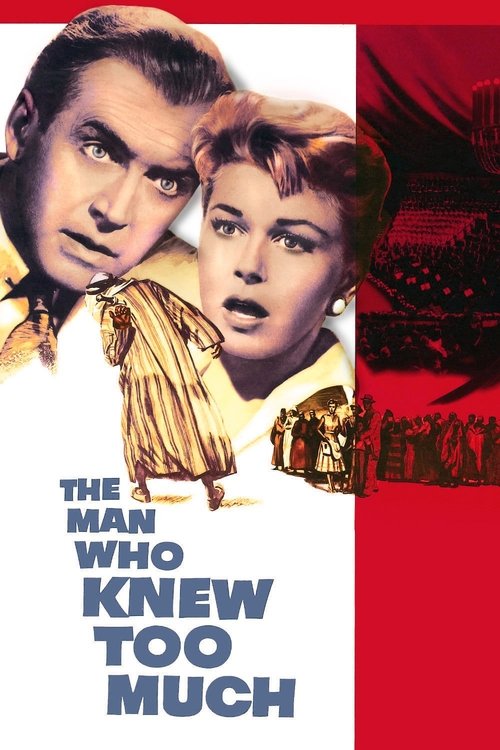
The Man Who Knew Too Much
1956 · Alfred Hitchcock
For a night when you want old-fashioned, expertly engineered suspense — dressed-up, globe-trotting, and satisfying. A comfort-zone thriller with real craft under the glamour, great for introducing someone to classic Hollywood.
What it's about
An American doctor and his wife — a famous singer who gave up the stage — are vacationing in Morocco with their young son when a dying stranger whispers a secret to them: an assassination is planned in London. Before they can act on it, their boy is kidnapped to buy their silence, and the couple must chase the plot across two continents themselves, unable to trust the authorities with what they know.
The experience
Classic slow-tightening suspense — you often know exactly what's coming and can do nothing but watch the clock run down, especially in the celebrated concert-hall climax where everything hangs on a single moment in the music. Tense but polished and pleasurable, the kind of thriller that grips without bruising.
Performances
James Stewart brings his trademark decency fraying under pressure, but the surprise is Doris Day, cast against her sunny image: her reaction to the news of her son's kidnapping is one of the rawest scenes Hitchcock ever filmed, and her singing becomes part of the plot itself rather than decoration.
The craft
Hitchcock remade his own 1934 thriller at lavish Technicolor scale, and the Albert Hall sequence is a masterclass in pure suspense: minutes of live orchestral music, no dialogue, the camera cutting between an assassin, a cymbal player, and a mother who must choose whether to scream. It won the Oscar for 'Que Sera, Sera,' a song the film weaves into its story with real ingenuity.
Why it matters
A cornerstone of Hitchcock's great 1950s run and the rare case of a director remaking himself — its concert-hall climax remains one of the most imitated suspense sequences ever staged.
Snapshot
Alfred Hitchcock's self-remake of his own 1934 British thriller transforms a lean, sardonic 75-minute picture into a 120-minute Technicolor spectacle anchored by two of Hollywood's most bankable stars. Set across Morocco and London, the film follows Dr. Ben McKenna (James Stewart) and his wife Jo (Doris Day), a retired Broadway singer, whose son Hank is kidnapped to prevent them from reporting an assassination plot they have inadvertently witnessed. The film culminates in one of Hitchcock's most celebrated set pieces: a prolonged suspense sequence in London's Royal Albert Hall, synchronized to a live orchestral cantata, in which the entire weight of narrative tension is resolved by a single human scream. Winner of the Academy Award for Best Original Song ("Que Sera, Sera"), the film sits at the intersection of Hitchcock's commercial and formal ambitions — at once a glossy Paramount entertainment and a rigorous exercise in genre mechanics, domestic anxiety, and the manipulation of audience knowledge.
Industry & Production
The 1956 Man Who Knew Too Much was produced by Hitchcock's own Filwite Productions and released through Paramount Pictures, where Hitchcock had been working since 1953. The Paramount years represent the director's most commercially stable period in Hollywood, supported by the studio's willingness to fund location shoots and large-scale production values. The film was shot partly on location in Marrakech, Morocco — a rare logistical undertaking for a studio feature of the period — and in London, where the Royal Albert Hall and the Ambrose Chapel provided authentic backdrops that Hitchcock exploited with characteristic precision. The production was one of the more expensive in Hitchcock's career to that point, though reliable box-office figures from primary archival sources are not uniformly documented in the scholarly literature; the film performed respectably and cemented Day's crossover from musical comedy into dramatic territory.
Hitchcock's decision to remake his own work was commercially logical and artistically deliberate. The 1934 original, made at Gaumont-British with Leslie Banks, Edna Best, and a menacing Peter Lorre, was a product of the British quota-quickie system — energetic but constrained. By the mid-1950s, Hitchcock had the resources, the craft, and the stars to revisit the premise with considerably more control. The casting of James Stewart — midway through his four-picture collaboration with Hitchcock spanning Rope (1948), Rear Window (1954), and Vertigo (1958) — brought psychological weight to a role that had previously been more straightforwardly heroic. Doris Day, cast against type as a woman whose operatic lung capacity becomes the literal instrument of rescue, proved a cannily counterintuitive choice.
The screenplay was written by John Michael Hayes, who had collaborated with Hitchcock on Rear Window (1954), To Catch a Thief (1955), and The Trouble with Harry (1955). This was the final film of their collaboration; the professional relationship ended acrimoniously thereafter, with a dispute over screen credit for Vertigo that Hayes pursued through the Writers Guild. The original story was credited to Charles Bennett and D.B. Wyndham-Lewis, the authors of the 1934 source material.
Technology
The film was photographed in VistaVision, Paramount's proprietary large-frame widescreen process introduced in 1954. VistaVision ran 35mm film horizontally through the camera rather than vertically, capturing a frame roughly twice the area of standard 35mm. The resulting negative offered exceptional sharpness and grain structure that could sustain large theatrical prints without the optical degradation common to anamorphic widescreen competitors. Hitchcock had adopted VistaVision with To Catch a Thief (1955), and the format suited his preference for crisp, information-dense compositions; the process allowed long shots of the Djemaa el-Fna square in Marrakech to retain legible spatial clarity while the Royal Albert Hall's interior could be rendered in full architectural depth.
The film was printed in Technicolor, whose three-strip dye-transfer process yielded the saturated, film-stable color palette that distinguishes Paramount's prestige productions of this era. Combined with VistaVision, the image has a dimensional solidity uncommon to competing anamorphic formats, which traded resolution for aspect ratio.
Technique
Cinematography
Robert Burks served as director of photography, his sixth collaboration with Hitchcock in six years. Burks's approach under Hitchcock was characteristically subordinate — precise, unobtrusive, functional — yet he was capable of striking pictorial work when the material demanded it. The Moroccan sequences are lit with a bleached, high-key harshness appropriate to equatorial sun; faces are often filmed in close-up against a churning, unfamiliar background of market crowds, generating a mild but persistent visual disorientation in the American protagonists. The Albert Hall sequence alternates between intimate close-ups of Jo's face registering anguish and knowledge, wide establishing shots of the hall's tiered galleries, and insert shots of the armed assassin in his box — a grammar of cross-cutting that Hitchcock controlled at the storyboard stage long before production.
Editing
George Tomasini edited the film, as he would nearly all of Hitchcock's Paramount and early Universal work through to Marnie (1964). The editing in The Man Who Knew Too Much is predominantly classical in the Hitchcockian sense: information is withheld from characters while being disclosed to the audience, and the cutting rhythm during suspense sequences is carefully decelerated rather than accelerated. The Albert Hall passage famously unfolds at a pace close to real time, synchronized against the twelve-minute performance of the Storm Clouds Cantata; Hitchcock uses duration as a torture device, allowing the audience to suffer the gap between knowing and being able to act.
Mise-en-Scène / Staging
Hitchcock's staging in the Moroccan restaurant — where Jo and Ben first observe the enigmatic Louis Bernard (Daniel Gélin) and the sinister Draytons — establishes the film's spatial paranoia: a domestic couple marooned in an illegible environment, unable to correctly read the behavior or motives of those around them. The Ambrose Chapel sequence demonstrates Hitchcock's lifelong appreciation for the theatricality of ordinary locations; what appears to be an innocuous taxidermist's shop is reframed as a conspirators' church through a gradual accumulation of visual details. The Albert Hall set piece represents perhaps the purest instance of Hitchcock's mise-en-scène as information control: the staging of musicians, audience, assassin, and tormented mother within a single architectural space manages several simultaneous lines of dramatic tension without recourse to dialogue.
Sound
Sound design is the film's formal core. The Storm Clouds Cantata, composed by Arthur Benjamin for the 1934 original and here re-recorded under the baton of Bernard Herrmann (who appears on screen conducting the Albert Hall orchestra), functions not merely as accompaniment but as the plot's structural armature. The assassination is timed to the climactic cymbal crash — a moment of sanctioned loud noise that will mask the gunshot — and Jo's knowledge of this temporal countdown is the engine of the Albert Hall sequence's unbearable suspense. Hitchcock renders the score as narrative rather than atmosphere: the audience reads the printed program over characters' shoulders, tracks the approaching page-turn, and experiences the cantata as a countdown.
"Que Sera, Sera (Whatever Will Be, Will Be)," written by Jay Livingston and Ray Evans, is deployed with similar structural intelligence. Introduced diegetically as a children's bedtime song early in the film, it recurs when Jo, trapped in the foreign embassy, sings it loudly enough for Hank — hidden somewhere in the building — to hear and respond. The song thus transforms from emotional texture into a literal rescue mechanism, a feat of narrative economy that won Livingston and Evans the Academy Award for Best Original Song.
Performance
James Stewart's performance belongs to the loosened, psychologically ambivalent register he developed in Rear Window and would deepen in Vertigo. Ben McKenna is not simply a capable hero; he is a professionally confident man whose authority over his wife — he administers sedatives before delivering news of their son's kidnapping; the film does not let this pass unexamined — is part of what the film places under pressure. Stewart carries the role's latent anxiety without ever fully acknowledging it, which gives his competence an uneasy quality.
Doris Day's Jo McKenna is among the more interesting supporting-female performances in the Hitchcock canon, precisely because the film extends her agency in the climax rather than neutralizing it. Her scream in the Albert Hall — involuntary, instinctive, terrifyingly human — is the act that saves both her son's life and the assassination target's. The performance is of a piece with Day's strengths: naturalistic vocal register, timing schooled in musical performance, and an emotional directness that Hitchcock channels rather than subdues.
Narrative & Dramatic Mode
The film operates on what Hitchcock theorized as the "bomb under the table" principle: the audience knows information the characters do not, and is condemned to watch events unfold in light of that knowledge. The MacGuffin is the kidnapped child, but the film's real subject is the structure of suspense itself — the gap between knowing and doing, between screaming and staying silent. The narrative places Jo in a position where acting on her knowledge (screaming) saves her son but marks her as the agent who disrupts the assassination; not acting preserves the political assassination but abandons Hank. The film resolves this through biological reflex: the scream is involuntary, and Hitchcock thus sidesteps the moral calculation while staging the tension of its impossibility.
Genre & Cycle
The Man Who Knew Too Much belongs to the espionage-thriller cycle that had shaped Hitchcock's British career (the "Hitchcock blondes" pictures, the 39 Steps model) and which he repatriated to Hollywood in the Cold War era. The film is generically adjacent to North by Northwest (1959), which would carry the innocent-American-enmeshed-in-spy-intrigue formula to its most virtuosic expression. It is also part of the mid-1950s cycle of American films engaging with Europe and the postcolonial world as zones of danger and illegibility — the exotic location as threat, the American tourist as hapless protagonist in someone else's geopolitical drama. The Morocco sequences anticipate the disorienting foreign-location aesthetics that would inflect films from The Sheltering Sky (1990) to the Bourne franchise.
Authorship & Method
Hitchcock's directorial method by 1956 was thoroughgoing pre-visualization: the film was extensively storyboarded before principal photography, reducing the shooting period to largely mechanical execution of pre-planned images. This approach was enabled by his stable production team — Burks, Tomasini, and at various points production designer Hal Pereira and Henry Bumstead — and by his long collaboration with composers of Bernard Herrmann's caliber. Herrmann's contribution to the Albert Hall sequence was not merely performative (appearing on screen) but compositional-curatorial: overseeing the new recording of Benjamin's cantata and integrating it into the film's formal architecture.
John Michael Hayes's contribution to the screenplay, particularly the dialogue exchanges between Jo and Ben that expose the power dynamics of their marriage, was significant; Hitchcock's own recollection minimized his writers' contributions, as was characteristic, but Hayes's voice is audible in the film's comedic and domestic registers.
Movement / National Cinema
The film occupies an anomalous position within national cinema frameworks: it is a Hollywood product directed by a transplanted Englishman, set in Morocco and Britain, featuring American stars, and partly financed and distributed by a major American studio. Its Moroccan sequences reflect a specifically mid-century American tourist imaginary of North Africa — picturesque, threatening, impenetrable — that sits uncomfortably within postcolonial critical frameworks. The London sequences, by contrast, exhibit Hitchcock's affection for the geography of his native city and his characteristic use of monumental public spaces (the Albert Hall, the foreign embassy) as theaters of private crisis.
Era / Period
The film belongs to the American cinema's postwar prestige phase: the period between the collapse of the studio system's vertical integration (the 1948 Paramount Decree) and the industry restructuring of the 1960s. It is also of its Cold War moment: the assassination plot has the characteristic Cold War thriller's diplomatic opacity, with a vaguely continental European target and unnamed foreign powers; the film takes no interest in ideological content but inherits the espionage genre's Cold War-era geography of menace.
Themes
The film's central preoccupation is parental terror and marital tension as the real content beneath the espionage machinery. The McKennas' marriage is already strained before Hank is taken: Ben's assumption that Jo retired from performing when they married, his unilateral decision to sedate her rather than permit her adult response to crisis, the film's repeated alignment of Jo's competence with her pre-marital performing life — all register a domestic anxiety that the thriller plot both displaces and finally resolves. The child's return restores the family unit; the film does not interrogate what preconditions that unit imposes.
The "Que Sera, Sera" motif introduces a fatalist undercurrent that the film ultimately refuses: whatever will be is not, in fact, accepted by Jo McKenna, whose refusal of passivity — however instinctive — is what drives the ending. The song is a lullaby until it becomes a weapon.
Reception, Canon & Influence
Backward (influences on the film): The most immediate source is Hitchcock's own 1934 version, which established the premise and bequeathed the Albert Hall assassination set piece and the Storm Clouds Cantata. The 1934 film had itself drawn on the conventions of the British "thriller" novel tradition (Buchan, Sapper) and on the rhythms of Gaumont-British sound-era production. The Albert Hall sequence's integration of live orchestral performance with cinema suspense descends from a theatrical tradition Hitchcock absorbed in his Gaumont years, and its specific mechanics — synchronized timing, the audience as unwitting participant — are refinements of technique already visible in the original.
Reception: Contemporary critical response was respectful rather than rapturous. The film was recognized as major Hitchcock, though some critics noted the expanded running time did not uniformly serve the material; the film's pace in its first Moroccan act was occasionally cited as deliberate to the point of sluggishness. The Academy recognized "Que Sera, Sera" alone among the film's achievements. Hitchcock himself offered an assessment, reported in the François Truffaut interviews of 1962 (published as Hitchcock/Truffaut in 1967), characterizing the two versions in terms that acknowledged the remake's greater professional command — though scholars should note that the precise phrasing of this comparison, which circulates widely, derives from Truffaut's edited transcription rather than verbatim quotation.
Forward (legacy): The film's influence operates on several registers. The Albert Hall sequence became a canonical example in film pedagogy of Hitchcockian suspense construction and is extensively analyzed in Peter Wollen's and Robin Wood's work on Hitchcock. The device of music as both formal structure and plot mechanism — the cantata as countdown — anticipates the scored-suspense logic that would define Bernard Herrmann's subsequent Hitchcock collaborations (Vertigo, North by Northwest, Psycho) and, through those films, a vast downstream influence on Hollywood thriller scoring. "Que Sera, Sera" entered popular culture in ways that entirely escaped the film, becoming a standard; its structural use within the film as a narrative device has been cited by screenwriting scholars as an elegant instance of Chekhov's Gun executed through song. The film's treatment of the American tourist in an alien geopolitical landscape — competent at home, helpless abroad, rescued ultimately by domestic rather than professional resources — prefigures the template of the American-abroad thriller that remains commercially durable into the present. Hitchcock's own willingness to remake himself established a precedent for auteur self-revision that later filmmakers (Michael Haneke with Funny Games being the most explicit inheritor) have engaged with consciously.
A Deleuzian reading
Watch the program change hands.
The full Deleuzian reading of The Man Who Knew Too Much →
Reception
A solid hit in 1956, it spent decades as 'mid-tier Hitchcock' — sandwiched between Rear Window and Vertigo in his imperial run — but the Albert Hall sequence has kept pulling it back into set-piece-of-all-time conversations.
How The Man Who Knew Too Much was received, from release to now →
Influences: the films it descends from and the films it influenced
- The Man Who Knew Too Much (1934) — The 1934 original establishes every structural load-bearing element the 1956 film rebuilds at scale: the diegetic concert hall assassination plot, the parent-couple endangered by unwanted knowledge, and the device of a performing woman's vocal act as the literal instrument of a child's rescue — Hitchcock's self-remake is a scene-by-scene expansion of a template he already owned.
- The 39 Steps (1935) — Establishes Hitchcock's MacGuffin-driven British espionage chase in its canonical form — a piece of classified information the protagonist cannot disclose without endangering himself, pursued across an unfamiliar geography that reads as hostile — providing the narrative skeleton the 1956 film redresses in Moroccan location photography and VistaVision.
- Sabotage (1936) — The bomb-under-table suspense mechanic receives its most concentrated deployment here — the audience watches a child unknowingly carry an explosive onto a London bus while characters remain ignorant, generating anguish through radical information asymmetry — the precise device the 1956 film extends structurally across its entire second act with Hank's kidnap.
- Notorious (1946) — The espionage thriller in which a woman's specific physical capability — her access, her social performance, her body under surveillance — is simultaneously the instrument of danger and the means of narrative resolution; the McKenna couple's structure, in which Jo's trained singing voice becomes the literal rescue mechanism, directly inherits this gender-specific agency template.
- The Third Man (1949) — The foreign city as a labyrinth of spatial paranoia — unfamiliar architecture, disorienting crowd scenes, an innocent abroad who cannot read the geography — and Anton Karas's diegetic-inflected zither score as an emotional anchor to the thriller's geography establish the template Hitchcock deploys in Marrakech, where the Djemaa el-Fna market functions as the same instrument of American disorientation.
- Rear Window (1954) — The immediate predecessor in the Stewart-Burks-Tomasini-Hitchcock collaboration; its spatial paranoia staging — a protagonist who observes dangerous knowledge but cannot act on it without risk to himself and others — is the direct formal template for the McKennas' predicament, and Burks's approach of isolating figures against an unfamiliar, crowded background is reprised in every Marrakech exterior.
- To Catch a Thief (1955) — The first Hitchcock-Burks VistaVision location shoot in Mediterranean color; Burks's high-key exterior lighting approach for a saturated, bleached-light foreign landscape directly establishes the photographic grammar the Morocco sequences inherit, including the compositional strategy of embedding protagonists in dense, visually overwhelming location backgrounds that retain legible depth at VistaVision resolution.
- Psycho (1960) — Herrmann's string writing and Tomasini's editing return from the Albert Hall sequence, but the decelerated cross-cut build is violently punctuated rather than sustained: the shower sequence converts the 1956 film's real-time restraint into a montage of rapid percussion, inverting the formal principle by which the Albert Hall maximizes dread through withheld cutting speed.
- Blow-Up (1966) — Extends the 1956 film's information-control staging into ontological uncertainty: the protagonist possesses photographic evidence of a murder but cannot act on it as the evidence literally dissolves, formalizing the Hitchcock device of paralytic knowledge — a protagonist who knows something they cannot prove or use — into the central philosophical and structural problem of the film rather than a genre-suspense mechanism.
- The Conversation (1974) — Harry Caul possesses a surveillance recording he believes documents a murder plot but cannot prevent the violence without exposing both his subjects and himself; the staging of dangerous knowledge as a burden that paralyzes rather than empowers, and the spatial paranoia of a protagonist who cannot trust any enclosed space, directly extends the McKennas' structural predicament into a post-Watergate register.
- Obsession (1976) — Bernard Herrmann's score — his penultimate dramatic work — reprises the swooping, repetition-based orchestral suspense vocabulary of his Hitchcock collaborations, applying the Vertigo harmonic grammar to a kidnap-and-obsession plot that reconfigures the 1956 film's missing-child leverage mechanism; De Palma's staging of information withheld from the protagonist while disclosed to the audience is a direct methodological inheritance.
- Dressed to Kill (1980) — The museum sequence explicitly re-choreographs the Albert Hall's decelerated cross-cutting: a woman in a large public space, the camera cutting between her figure and an unseen threat at near-real-time duration, with Pino Donaggio's score substituting for Herrmann's cantata as the rhythmic spine — De Palma's most precise formal quotation of the 1956 film's suspense grammar.
- Blow Out (1981) — Directly inverts the 1956 film's diegetic-sound-as-rescue device: where Jo McKenna's scream saves her son by revealing her location, De Palma's protagonist records a woman's scream for use in a slasher film while she is simultaneously murdered, converting the Hitchcock climax's vocal rescue into an instrument of destruction — the inversion is structural, not merely thematic.
- The Untouchables (1987) — The Union Station staircase sequence explicitly borrows the Albert Hall's formal mechanics — a prolonged cross-cutting passage synchronized to an Ennio Morricone orchestral cue, held in near-real-time while an innocent bystander (the baby carriage) is endangered — transposing the 1956 film's concert hall suspense grammar into a gangster-film set piece with the cantata replaced by Morricone's period pastiche.
- Quantum of Solace (2008) — Provides the template of an assassination choreographed against a live musical performance (the Albert Hall cymbal-crash) that QoS extends in its Tosca set-piece.
- Andhadhun (2018) — Diegetic music as the suspense clock — the performance that must be completed becomes the timer against which the crime resolves — the principle Andhadhun industrializes by making the protagonist's occupation, the score and the plot mechanism the same object.
- Vertigo (1958) — The next film in the identical Stewart-Herrmann-Burks-Tomasini production cluster; Herrmann's score migrates from the Albert Hall cantata's sustained-tension orchestral writing into a Wagnerian romantic obsession grammar, while Tomasini's decelerated editing — held back from conventional rhythm to maximize audience anguish over withheld information — is pushed from a single set piece into the film's entire structural principle.
- North by Northwest (1959) — Inherits and scales the MacGuffin espionage thriller as a pure formal exercise; the crop-duster and Mount Rushmore finales are both cross-cutting suspense set pieces built on the Albert Hall grammar — an innocent figure in a dangerous landscape, cut against the approaching threat at a rhythm calibrated by Herrmann's score — with the MacGuffin (microfilm in a pre-Columbian statue) functioning as the same category of arbitrary classified object.
Similar films
- The 39 Steps (1935) — influence & lineage
- North by Northwest (1959) — influence & lineage
- Notorious (1946) — influence & lineage
- Rear Window (1954) — influence & lineage
- Psycho (1960) — influence & lineage
- Vertigo (1958) — influence & lineage
- To Catch a Thief (1955) — influence & lineage
- The Third Man (1949) — influence & lineage
All the films related to The Man Who Knew Too Much →