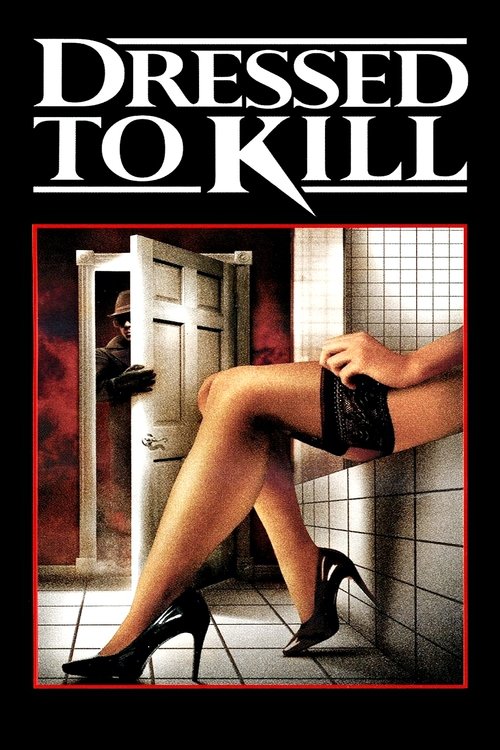
Dressed to Kill
1980 · Brian De Palma
For a late-night thriller fix when you want style, suspense, and a little sleaze — popcorn with a razor's edge. Comfort viewing for genre fans, though its provocations are very much of 1980 and it plays rough.
What it's about
A Manhattan housewife's restless day takes a brutal turn, and Liz Blake — a sharp, unflappable call girl — becomes the only witness to a razor murder committed by a mysterious blonde figure. With the police treating her as the prime suspect and the killer now hunting her, Liz teams up with the victim's teenage son, a gadget whiz, to catch the murderer themselves — while the dead woman's psychiatrist seems to know more than he's saying.
The experience
Sleek, lurid, and nail-bitingly tense — a thriller that moves like a guilty pleasure and keeps springing elaborate set-piece traps. It's sexy and shameless and knows exactly what it's doing; you're meant to squirm and grin at the same time.
Performances
Angie Dickinson makes an entire inner life legible with barely a word of dialogue in the film's celebrated early stretch, and Michael Caine brings smooth, ambiguous authority to the psychiatrist at the story's center.
The craft
Brian De Palma directs like a showman: split screens, long wordless sequences carried purely by camera movement, a museum pursuit that's justly famous as pure visual storytelling, and a swooning Pino Donaggio score. It's a movie about watching, built to be watched — the bigger the screen, the better the set pieces play.
Why it matters
A lightning rod on release — protested, debated, and hugely influential — it stands as the peak of De Palma's run of style-first thrillers and a key bridge between classic suspense cinema and the erotic thrillers of the decade that followed.
Snapshot
Dressed to Kill is Brian De Palma's most concentrated exercise in Hitchcockian pastiche, a glossy, sexually charged thriller that fuses the structural shock of Psycho with the voyeuristic obsessions and split identities that defined De Palma's late-1970s and early-1980s work. Released in the summer of 1980, it follows a sexually frustrated Manhattan housewife, Kate Miller (Angie Dickinson), who is murdered roughly a third of the way through the film by a razor-wielding figure in dark glasses and a blonde wig; the narrative then transfers to Liz Blake (Nancy Allen), a call girl who witnesses the killing, and Peter Miller (Keith Gordon), Kate's gadget-obsessed teenage son, as the two pursue the killer while Kate's psychiatrist, Dr. Robert Elliott (Michael Caine), hovers at the center of the mystery. The film is celebrated and criticized in roughly equal measure for the same qualities: its lush, almost operatic visual style, its bravura set pieces built around long wordless stretches, and its frank, provocative treatment of sex, desire, and gendered violence. It stands as a key document of the American thriller's commercial-arthouse hybrid moment, and as the film that most clearly crystallized — for admirers and detractors alike — the question of whether De Palma was a master stylist or a cold imitator.
Industry & production
Dressed to Kill was produced in the independent-financing, studio-distribution mode characteristic of its moment. The film was financed and produced by Filmways and George Litto, De Palma's producer and agent, who had also shepherded Obsession and Blow Out; it was distributed in the United States by Filmways (the company that had absorbed American International Pictures). The budget was modest by major-studio standards — generally reported in the few-million-dollar range, though specific figures in the historical record vary and should be treated cautiously. The picture became one of De Palma's strongest commercial performers, a summer success that consolidated his bankability after the hit of Carrie (1976), and its commercial profile is part of why it drew such intense attention from censors and critics.
Two industrial battles shaped the film's release. The first was with the ratings board: the picture was initially threatened with an X rating, and De Palma trimmed material — particularly in the opening shower sequence and the elevator murder — to secure an R. The second, more lasting controversy was political. Feminist groups, most visibly Women Against Pornography, picketed the film and condemned it as an aestheticization of violence against women, part of a broader early-1980s argument about the relationship between sexualized imagery and real-world misogyny. That protest became inseparable from the film's reputation and anticipated the even sharper reception of Body Double four years later.
Technology
The film is, by its own admission, partly a film about technology and looking. Within the fiction, the teenage Peter is an amateur scientist and tinkerer who builds his own surveillance rig — a time-lapse camera setup used to stake out the psychiatrist's office — making the apparatus of observation a literal plot engine. In production terms, Dressed to Kill was shot photochemically on 35mm in the anamorphic widescreen format that De Palma favored for its capacity to stage action across a wide frame and to exploit shallow focus and split-diopter compositions. The film makes conspicuous use of the split-diopter lens, which allows two planes at very different distances to remain in sharp focus simultaneously, producing the characteristic De Palma image in which a foreground object and a distant figure are equally crisp. The famous museum sequence and the film's stalking passages depend on Steadicam and fluid dolly work to sustain unbroken movement, technology that by 1980 had become central to the choreographed long take in American cinema.
Technique
Cinematography
The photography is by Ralf D. Bode, working in widescreen, and it is among the most discussed aspects of the film. The visual program is voluptuous and deliberate: slow, gliding camera movements; saturated, warm interiors; mirrors and reflective surfaces that double and fragment the human figure; and the recurring split-diopter shot that keeps near and far in simultaneous focus, visually literalizing the film's themes of divided attention and split identity. The camera is relentlessly subjective and voyeuristic, frequently adopting the literal point of view of the watcher — Kate scanning the gallery, the killer tracking a victim, Peter surveilling a doorway. De Palma and Bode treat the camera as an instrument of desire, lingering on bodies and faces in a way that is both seductive and, by design, implicating: the viewer is repeatedly made complicit in the act of looking.
Editing
Edited by Jerry Greenberg — a major figure of 1970s American editing whose credits include The French Connection and Apocalypse Now — the film alternates between two registers. Long passages unfold almost wordlessly, sustained by camera movement rather than cutting: the extended museum sequence, in which Kate and a stranger pursue and elude each other through galleries and cabs, runs for minutes with little or no dialogue. Against these the film deploys De Palma's signature accelerated, fragmented montage at moments of violence and revelation, and his much-used slow motion, which stretches and ritualizes the shocks. The most overtly Hitchcockian structural decision is editorial in spirit: the abrupt killing of the apparent protagonist roughly a third of the way through, a Psycho-derived rug-pull that forces the audience to transfer its identification midstream.
Mise-en-scène / staging
De Palma stages the film as a series of self-contained set pieces, each built around a controlling location and a controlling idea: the shower and the marital bedroom (frustrated domestic desire), the art museum (the wordless seduction and pursuit), the elevator (the murder), the subway and the police station (Liz's pursuit and peril). The art museum sequence is the most celebrated, a near-silent ballet of glances, near-misses, and spatial geometry in which the gallery's architecture becomes a maze of desire and surveillance. Mirrors, glass, and doorways structure the compositions throughout, and the staging consistently foregrounds the divide between watcher and watched.
Sound
Pino Donaggio — De Palma's most important musical collaborator from Carrie onward — composed the score, and it is essential to the film's effect. The music is lush, romantic, and Herrmann-indebted, swelling with melodrama in the wordless sequences and supplying the suspense grammar (sustained strings, stingers) at the moments of shock. In the long dialogue-free passages, Donaggio's score effectively carries the narrative, replacing speech with melody and turning suspense into something closer to opera. The sound design more broadly emphasizes subjective acoustics and the heightened ambient detail of De Palma's set pieces.
Performance
The performances are pitched to the film's stylized register. Angie Dickinson, in the role that anchors the first act, gives Kate a genuine pathos — a middle-aged woman's loneliness and reawakened desire — that grounds the film's most sympathetic stretch before her abrupt death; a body double was used for the most explicit material in the opening shower sequence, a fact that became part of the film's public discussion. Michael Caine plays the psychiatrist with a controlled, deliberately opaque calm that the plot requires. Nancy Allen — then married to De Palma and a fixture of his films of the period — brings a streetwise warmth and humor to Liz that humanizes the call-girl-as-amateur-detective and gives the second half its emotional center. Keith Gordon's earnest, technically minded teenager supplies both the investigative engine and a note of adolescent tenderness.
Narrative & dramatic mode
The film's dramatic mode is suspense in the Hitchcockian sense — built on dread, dramatic irony, and the spectator's privileged or withheld knowledge rather than on mystery-puzzle deduction alone. Its boldest structural move is the transfer of protagonist: the film invites deep identification with Kate, then kills her, then reassembles itself around Liz and Peter. This Psycho maneuver destabilizes the audience and converts the film into a pursuit narrative in which an innocent witness is hunted while the police suspect her. The storytelling privileges sustained, wordless visual sequences over expository dialogue, trusting image and music to carry meaning; explanation, when it finally arrives, comes in the form of a clinical psychiatric monologue that — in another direct echo of Psycho's closing — verbalizes the killer's pathology. The film also closes on a nightmare-coda, refusing tidy reassurance.
Genre & cycle
Dressed to Kill sits at the intersection of several cycles. It is a late entry in the tradition of the Hitchcockian psychological thriller, and simultaneously an American cousin of the Italian giallo — the gloved, masked killer, the stylized murder set pieces, the eroticized violence, and the amateur-investigator structure all align it with Argento and the giallo lineage. It arrived as the American slasher cycle was consolidating in the wake of Halloween (1978) and ahead of the early-1980s wave, and it shares the slasher's interest in stalking and in the punished/imperiled woman, while remaining more upmarket, more psychosexual, and more formally ambitious than most slashers. Within De Palma's own work it forms the heart of his "Hitchcockian" cycle alongside Sisters, Obsession, Body Double, and the later Raising Cain — films organized around doubles, voyeurism, and split or disguised identity.
Authorship & method
Dressed to Kill is a near-pure auteur object: De Palma wrote the screenplay himself as well as directing, and the film is saturated with the obsessions, techniques, and citation-practices that define his cinema. His method here is the controlled set piece — the film is conceived as a sequence of bravura passages, each engineered for maximum formal effect, with plot serving as connective tissue between them. Central to that method is open, deliberate homage: the film borrows Psycho's structure (the early death of the star, the psychiatric explanation, the shower) and its broader Hitchcockian grammar of voyeurism and suspense, treating quotation not as theft to be hidden but as a self-conscious authorial signature — the move that earned him both the "American Hitchcock" praise and the "mere imitator" charge.
His key collaborators were, by 1980, a stable team. Cinematographer Ralf D. Bode realized the gliding, voyeuristic widescreen look. Editor Jerry Greenberg shaped the rhythm of long take against shock-montage. Composer Pino Donaggio supplied the lush, Herrmann-descended score that is arguably the film's emotional spine. Producer George Litto provided the independent financing structure that gave De Palma creative latitude. And actress Nancy Allen, his then-wife, served as a recurring on-screen presence across this stretch of his filmography.
Movement / national cinema
The film belongs to American cinema's "New Hollywood" generation as it transitioned into the more commercial 1980s. De Palma emerged from the same cohort as Scorsese, Coppola, Spielberg, and Lucas — the film-school-literate, cinephile directors who reshaped Hollywood in the 1970s — but he occupied a distinctive position within it as the group's most overt formalist and its most committed student of Hitchcock and of European art cinema. Dressed to Kill exemplifies the early-1980s American thriller's absorption of European influences (the giallo, Hitchcock's own British and American work, the eroticism of continental cinema) into a glossy, commercially pitched domestic product.
Era / period
Released in 1980, the film is a hinge object between the auteur-driven 1970s and the high-concept, genre-cycle 1980s. It carries the formal ambition and adult sexual frankness of the prior decade while anticipating the slasher-saturated, ratings-contested commercial landscape of the years that followed. Its censorship struggle (the X-to-R recut) and the organized feminist protest against it locate it precisely in the early-1980s American culture wars over sexually explicit and violent imagery — debates about pornography, representation, and the responsibilities of popular art that would intensify across the decade.
Themes
The film's governing themes are voyeurism and the implicating power of the gaze; the camera makes watching pleasurable and then makes the viewer aware of that pleasure. Closely bound to this are sexual desire and repression — Kate's frustration and guilt-shadowed yearning in the first act establish desire as something dangerous and punished, a linkage between sex and death that runs through the whole film. The motif of the double and the divided self is pervasive, both formally (mirrors, split-diopter shots, doubled women) and in the plot's concern with split and disguised identity, which the film grounds in a psychiatric explanation that frames identity itself as unstable. The film also foregrounds surveillance and detection — the amateur investigators, the homemade camera rig — and, more uncomfortably, the spectacle of gendered violence, the very theme that made it a lightning rod. The film's treatment of psychiatry and of identity drew specific, lasting criticism for its handling of its killer's psychology, an aspect later viewed as both dated and harmful in its conflation of identity and pathology.
Reception, canon & influence
Critical reception in 1980 was sharply divided, and that division is itself the film's historical signature. Influential admirers — Pauline Kael prominent among them — championed De Palma's virtuosity and treated the film as serious, even exhilarating, filmmaking; Kael's enthusiasm for De Palma in this period is a well-documented part of the critical record. Detractors attacked the film on two fronts: as derivative Hitchcock pastiche, and as misogynist spectacle, the latter charge amplified by the organized feminist protests at the time of release. The film received Razzie attention as well, reflecting the polarized response. Over time, critical opinion has warmed considerably, and Dressed to Kill is now widely regarded as one of De Palma's finest and most representative films, a touchstone for arguments about homage, style, and the ethics of the gaze.
Looking backward, the film's influences are explicit and acknowledged: above all Hitchcock — Psycho most directly (the early death of the protagonist, the shower, the explanatory psychiatry), but also the broader Hitchcockian repertoire of voyeurism, suspense, and the wrong-person-pursued. The Italian giallo, particularly the work of Dario Argento, stands behind its stylized murders and gloved killer, and Bernard Herrmann's scoring tradition is audible throughout Donaggio's music. The film is also continuous with De Palma's own earlier Sisters and Obsession.
Looking forward, Dressed to Kill shaped the erotic thriller that flourished in the late 1980s and 1990s — a genre of glossy, sexually explicit suspense that owes a clear debt to its template — and it fed directly into De Palma's own Body Double (1984), which intensified the same preoccupations and provocations. Its set-piece method, its split-diopter aesthetic, and its self-conscious homage have made it a perennial reference point in scholarship and criticism on voyeurism, authorship, and pastiche, and a foundational text in the ongoing debate over De Palma's standing as either Hitchcock's most accomplished heir or his most conspicuous imitator. A 2012 television remake attempt and recurring revival screenings attest to its durability, but its primary legacy is critical and stylistic: it remains the clearest single statement of what a De Palma thriller is.
A Deleuzian reading
Kate Miller sits on a gallery bench with one glove off, writing out a grocery list, and then her pen stops.
The full Deleuzian reading of Dressed to Kill →
Reception
In 1980 it was a scandal — picketed by feminist groups, trimmed to dodge an X rating, and split critics down the middle even as Pauline Kael championed it. Today it's canonized as peak De Palma, complete with a Criterion edition and regular 'best thrillers of the 80s' placements.
How Dressed to Kill was received, from release to now →
Influences: the films it descends from and the films it influenced
- Psycho (1960) — Supplies the structural template De Palma openly transplants — the marquee star killed off early in a bathroom set piece, followed by a clinical psychiatric voice-over that 'explains' the killer's split identity.
- Vertigo (1958) — Model for the wordless museum-stalking sequence and its dolly-driven, music-over-dialogue grammar of erotic pursuit, plus the Herrmann scoring tradition Donaggio extends.
- Rear Window (1954) — Origin of the implicated-spectator structure De Palma weaponizes: subjective voyeuristic POV that makes the audience complicit in looking before violence arrives.
- Peeping Tom (1960) — Establishes the camera/gaze-as-murder-weapon and first-person killer-POV that De Palma's voyeuristic optics and razor attacks descend from directly.
- Blood and Black Lace (1964) — Foundational giallo grammar De Palma borrows — the anonymous black-gloved killer stalking glamorous women through mirrored, fashion-world interiors with the murder staged as designed spectacle.
- The Bird with the Crystal Plumage (1970) — Source of the witness-who-saw-too-much structure and glass-partition staging: a bystander trapped behind plate glass watching a stylized assault they cannot stop.
- Deep Red (1975) — Argento's set-piece method of the elaborately choreographed, fetish-object murder and lurid color/mirror design that De Palma anglicizes into his razor killings.
- Sisters (1973) — De Palma's own prototype for the divided-self killer, split-screen/voyeur surveillance, and the first deployment of the Herrmann-then-Donaggio scoring axis.
- Obsession (1976) — His direct Vertigo rewrite with Paul Schrader, locking in the lush romantic-suspense register and Bernard Herrmann's actual score that Donaggio inherits.
- Marnie (1964) — De Palma's systematic technical homage deploys Burks-style long-lens surveillance framing in the museum sequence, Pino Donaggio's Herrmann-derived romantic-dissonant scoring, the opening-withholding device (Angie Dickinson's identity and fate withheld), and an on-screen psychiatrist to literalize the psychoanalytic case study.
- Frenzy (1972) — De Palma replicates Frenzy's specific formal combination—explicit sexual violence in static unflinching take, early victim death, killer's seamless social integration in plain sight, wrong-man framing of an innocent male under investigation—most precisely in the museum stalking sequence and the elevator murder's held, uncut duration.
- The Man Who Knew Too Much (1956) — The museum sequence explicitly re-choreographs the Albert Hall's decelerated cross-cutting: a woman in a large public space, the camera cutting between her figure and an unseen threat at near-real-time duration, with Pino Donaggio's score substituting for Herrmann's cantata as the rhythmic spine — De Palma's most precise formal quotation of the 1956 film's suspense grammar.
- Blow Out (1981) — Immediate continuation of the split-diopter aesthetic and bravura wordless set-piece construction, foregrounding the technology-of-perception theme latent in DtK's surveillance.
- Body Double (1984) — The explicit doubling-down on DtK's program — Rear Window/Vertigo pastiche, voyeuristic POV, and sex-and-death set pieces pushed to deliberately provocative extremes.
- Basic Instinct (1992) — Apex of the glossy erotic thriller DtK templated: Herrmann-pastiche Goldsmith score, ice-pick set-piece murders, and suspense organized around sexual spectacle and the deceiving gaze.
- Jade (1995) — Late erotic-thriller offspring carrying forward the De Palma formula of voyeuristic camera, set-piece chase staging, and lurid sexual-identity mystery.
- Primal Fear (1996) — De Palma codifies dissociative identity disorder as the twist-mechanism of the American genre thriller — the seemingly innocent subject revealed as the actual threat through a final psychiatric explanation — establishing the DID-thriller subgenre grammar that Primal Fear directly inherits, including the strategy of presenting the alternate identity as physically distinct in affect and bearing.
- Mission: Impossible (1996) — The dialogue-free, pure-image suspense set piece (the museum stalk) is the editorial method Paul Hirsch carries directly into M:I's montage-driven sequences.
- MaXXXine (2024) — Fuses split-diopter deep-focus staging with a gloved slasher and a voyeuristic tracking camera — the exact De Palma toolkit MaXXXine's split-diopter compositions quote.
- Ferris Bueller's Day Off (1986) — Hirsch cut De Palma's near-wordless Met museum sequence as a long dialogue-free movement carried by score and eyeline alone; the Art Institute montage — including the push-in that dissolves the Seurat into pure pigment — is the same editor applying that syntax to a child's gaze at a painting.
- Carrie (1976) — Same-period showcase of his split-diopter deep-focus framing and slow-motion-driven dread building to a single engineered shock set piece.
- Halloween (1978) — Parallel application of Steadicam killer-POV long takes and stalking subjectivity, the slasher current De Palma's giallo-inflected attacks run alongside.
- The Eyes of Laura Mars (1978) — Carpenter-scripted American giallo built on the same first-person killer-vision device and fashion-world voyeurism that DtK refines a year later.
- Cruising (1980) — Contemporaneous gloved-killer thriller working the same sexual-underworld-and-transgressive-identity terrain that drew identical feminist/queer protest over its gaze.
- The 4th Man (1983) — Parallel Hitchcock-descended erotic thriller that fuses explicit sexuality with elaborate suspense set-pieces and guilt/doubling, the American twin of Verhoeven's project.
Similar films
- The Bird with the Crystal Plumage (1970) — influence & lineage · same viewing thread
- Blood and Black Lace (1964) — influence & lineage · same viewing thread
- Basic Instinct (1992) — influence & lineage
- Sisters (1973) — influence & lineage
- Body Double (1984) — influence & lineage
- Psycho (1960) — influence & lineage
- Blow Out (1981) — influence & lineage
- Deep Red (1975) — influence & lineage · same viewing thread
All the films related to Dressed to Kill →
Watch it with: curated runs of related films
- The Killer You Can't Look Away From — A run of murder mysteries where obsession — the witness's, the investigator's, the killer's own — curdles into pure style, from the gloved-hand giallo that invented the look to the modern heirs still working the vein.