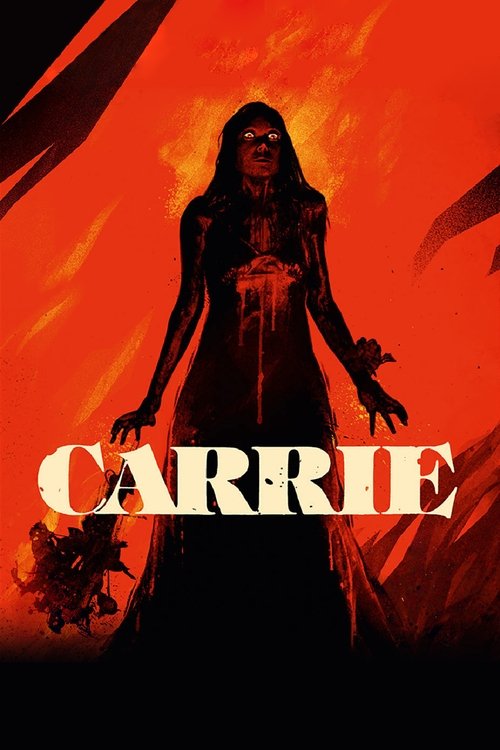
Carrie
1976 · Brian De Palma
When you're craving a real scare with a soul — a horror night where you want to feel devastated as much as frightened. Not one for a light evening; it's a wound as much as a thrill.
What it's about
Carrie White is the girl her high school has chosen to torment — shy, strange, and raised by a fanatically religious mother whose home is its own kind of prison. When Carrie discovers she can move things with her mind, the power grows alongside every humiliation, and the story tightens toward prom night, where a cruel prank and an act of kindness are set on a collision course.
The experience
Heartbreaking before it's horrifying — you spend most of the film aching for Carrie, which is exactly why the horror, when it comes, feels less like a scare than a reckoning. It's lurid, operatic, and emotionally brutal in a way few horror films attempt.
Performances
Sissy Spacek is astonishing — translucent, raw, veering from hope to terror within a single scene — and Piper Laurie matches her as the mother, monstrous and pitiable at once. Both earned Oscar nominations, almost unheard of for horror.
The craft
Brian De Palma directs it like an opera: split screens, dreamy slow motion, a prom sequence engineered with almost sadistic patience. The camera work turns teenage cruelty into something mythic, and Pino Donaggio's score keeps switching between lullaby and alarm.
Why it matters
The first Stephen King adaptation ever filmed, it opened the floodgates for decades of King on screen, made De Palma a mainstream force, and turned its prom into one of the most iconic sequences in horror.
Snapshot
Carrie is the film that turned Brian De Palma from a cult provocateur into a commercially viable Hollywood director, and the first feature adaptation of a Stephen King novel — the foundation stone of what would become one of the most lucrative author-to-screen pipelines in cinema history. Adapted from King's 1974 debut, it is a horror film built on the cruelest of premises: that the supernatural cataclysm at its center is not an external invasion but the inevitable detonation of accumulated human cruelty. Carrie White (Sissy Spacek), a withdrawn high-school senior tormented by her classmates and imprisoned at home by a fanatically religious mother (Piper Laurie), discovers a telekinetic power that grows in step with her humiliation. The film moves with terrible patience toward a senior prom that has been engineered as an elaborate act of public sadism, and from there to a conflagration that consumes the tormentors and the tormented alike. De Palma fuses the social realism of the American high-school picture with operatic Hitchcockian suspense and a final-act eruption of split-screen horror, producing a work that is at once a tender portrait of adolescent agony and a baroque revenge fantasy. It earned Spacek and Laurie Academy Award nominations — a rarity for the horror genre — and its prom sequence remains one of the most analyzed set pieces in American cinema.
Industry & production
Carrie was produced by Paul Monash for United Artists on a modest budget, and its origins lie in the unlikely intersection of a first-time novelist and a director still regarded by the studios as a risk. Stephen King's Carrie had been published in 1974 by Doubleday; the paperback rights sale gave King his first financial security, and the property was acquired for the screen while King was still an unknown quantity. Lawrence D. Cohen wrote the screenplay, condensing King's epistolary structure — the novel is assembled from fragments of reports, news accounts, and testimony — into a linear, dread-building dramatic narrative. The film was made for a reported budget in the region of under two million dollars and returned many multiples of it, becoming one of the more profitable releases of its year and decisively establishing both King and De Palma as bankable.
The casting process has passed into Hollywood legend because of its overlap with George Lucas's Star Wars, then in pre-production: De Palma and Lucas are widely reported to have held joint auditions, sharing actors between the two projects. The young ensemble that resulted is extraordinary in retrospect — Sissy Spacek, John Travolta (then known chiefly from television's Welcome Back, Kotter), Nancy Allen, William Katt, Amy Irving, and P.J. Soles. Spacek, married to the film's art director Jack Fisk, reportedly committed to the role with unusual intensity, isolating herself from the other cast members to deepen Carrie's estrangement. Piper Laurie, a major star of the 1950s who had largely retired from film after The Hustler (1961), returned to the screen after a long absence to play Margaret White; she has said she initially understood the material as comedy, an instinct that gives her performance its uncanny, heightened register. The production thus brought together a faded star in a comeback role, a stable of unknowns on the verge of fame, and a director hungry to prove himself within the studio system.
Technology
Carrie is a 35mm studio production of the mid-1970s, and its technical achievement lies less in any single innovation than in the integration of in-camera optical technique with practical effects. The film makes conspicuous, sustained use of split-screen — a device De Palma had explored in earlier work — which during the prom climax divides the frame to show Carrie's telekinetic devastation simultaneously with its effects on the gymnasium around her, a technique requiring careful optical compositing on the era's photochemical equipment. The film also relies on slow-motion photography, variable-speed shooting, and elaborate camera mountings, including the celebrated 360-degree circling shots achieved with a rotating camera-and-actor rig. The telekinetic effects themselves were achieved practically — wires, hidden mechanisms, reverse-motion photography for shattering glass and slamming objects — rather than through any optical-electronic process, situating the film firmly in the pre-digital tradition of physical effects craft. There is no reliable record of Carrie pioneering new hardware; its distinction is the bravura deployment of existing tools toward an unprecedentedly operatic end.
Technique
Cinematography
The cinematography is by Mario Tosi, whose work modulates deliberately between registers to mirror Carrie's divided existence. The high-school and domestic scenes carry a soft, sometimes hazy realism, while the film escalates into stylization as the supernatural asserts itself. The most discussed visual passages are the prom sequence's slow, sustained crane and dolly movements — the camera gliding through the decorated gymnasium with a dreamlike smoothness that builds an almost unbearable suspense as it tracks the rigged bucket of pig's blood above the stage — and the dizzying circling shot of Carrie and Tommy dancing, the camera revolving around the couple at accelerating speed to convey Carrie's vertiginous, doomed happiness. The opening locker-room sequence is shot in a dreamy, voyeuristic slow motion that abruptly curdles into horror with the onset of Carrie's menstruation, establishing the film's strategy of using a seductive, lyrical camera as a trap. Tosi's lighting grows progressively more expressionist, climaxing in the hellish red glow that bathes Carrie after the blood falls, transforming the gymnasium into an infernal stage.
Editing
The editing, by Paul Hirsch — one of De Palma's most important recurring collaborators — is fundamental to the film's suspense architecture. The prom climax is a masterclass in the Hitchcockian principle of giving the audience information the characters lack: Hirsch's cutting methodically establishes the geography of the prank — the bucket, the rope, the hands that will pull it — and then stretches the moment of detonation across an excruciating expanse of screen time, intercutting Carrie's oblivious joy with the mechanics of her betrayal. The split-screen passages, which Hirsch helped orchestrate, fracture the climax into simultaneous planes of action, multiplying the chaos. Equally celebrated is the film's coda — the false-calm graveside scene that erupts into one of the most influential jump-scares in horror history, a shock so effective it established a template imitated for decades. The editing's control of rhythm, its patient withholding and sudden release, is as responsible for the film's power as any other element.
Mise-en-scène / staging
De Palma's staging organizes the film around two oppressive interiors and one fatal public space. The White house is a gothic prison of religious kitsch — its centerpiece a closet-shrine dominated by a grotesque, arrow-pierced figure of Saint Sebastian before which Margaret forces Carrie to pray, the iconography of martyrdom and bodily penetration thrumming beneath the film's anxieties about sex and punishment. The high school, by contrast, is rendered with sun-washed Southern-Californian normalcy that makes its cruelties more shocking. The prom gymnasium is the film's great stage, dressed in a glittering, almost celestial decor that De Palma deliberately constructs as a site of transcendence so that its desecration lands as blasphemy. Costume and color carry meaning throughout: Carrie's progress from drab concealment to the soft pink of her self-made prom dress marks her brief flowering, and the dress's subsequent saturation in blood completes a visual argument the whole film has been building — that her body and its emergence into womanhood are the terrain on which the catastrophe is fought.
Sound
The score is by Pino Donaggio, the Italian composer whose collaboration with De Palma began here and would define the sonic identity of the director's subsequent thrillers. Donaggio's music is unabashedly Herrmannesque, drawing on the lush, anxious romanticism of Bernard Herrmann's scores for Hitchcock — soaring strings for Carrie's moments of hope, shrieking stabs for the eruptions of violence. The score deliberately courts tenderness, scoring Carrie's romance with a sincerity that makes the betrayal more devastating. The sound design also exploits silence and amplified diegetic detail — the slosh of the blood bucket, the snap of breaking objects, the rising hum that accompanies telekinetic strain — and the recurring, distorted echo of taunting voices ("Plug it up… plug it up…") that lodges the film's central act of cruelty in the soundtrack itself.
Performance
Performance is the film's foundation, and its two Oscar-nominated turns anchor everything around them. Sissy Spacek's Carrie is a study in physical eloquence: hunched, flinching, peering through a curtain of hair in the early scenes, then opening — tentatively, heartbreakingly — into a posture of hope at the prom, before the final transformation into a blood-drenched, blank-eyed instrument of destruction. Spacek renders the telekinetic trance through stillness and the fixed intensity of her eyes, refusing histrionics. Piper Laurie's Margaret White is its operatic counterweight, a performance pitched at the edge of the grotesque that somehow never tips into mere camp: her religious ecstasy and erotic terror are fused into a single hysterical register, and her death — pierced by flying kitchen implements into a grotesque echo of the Saint Sebastian icon, her face contorting toward something like rapture — is among the most disturbing images in the film. The young ensemble fills out the social world with sharp economy: Nancy Allen and John Travolta as the gleering architects of the prank, Amy Irving as the conscience-stricken Sue, William Katt as the decent Tommy, P.J. Soles as a gum-snapping tormentor, and Betty Buckley as the sympathetic gym teacher.
Narrative & dramatic mode
Carrie's dramatic mode is tragedy structured as suspense — a fusion of the social-realist coming-of-age drama with the mechanics of the Hitchcockian thriller. The narrative is a slow, dread-laden ascent toward a catastrophe the audience is allowed to see coming long before its victims do. De Palma and Cohen build the film on dramatic irony: we know the prom is a trap, we know the blood is waiting above the stage, and the film's terrible suspense derives from watching Carrie achieve a happiness we know is engineered to be destroyed. The structure is essentially that of a fuse burning toward a bomb, with Carrie's growing telekinesis as the charge and her humiliations as the lengthening fuse. Crucially, the film withholds easy catharsis: the destruction at the prom kills the cruel and the kind indiscriminately, and Carrie herself does not survive her revenge. The mode is thus genuinely tragic rather than triumphant — the supernatural eruption is not empowerment but annihilation, the only possible end for a figure the world has comprehensively failed. The framing of Sue Snell's guilt-haunted memory, and the film's coda, cast the whole as a kind of traumatic recollection, a nightmare that cannot be laid to rest.
Genre & cycle
Carrie sits at the convergence of several genre currents of the 1970s. It is a horror film, but one that arrives at a transitional moment — after the demonic-possession cycle inaugurated by Rosemary's Baby (1968) and The Exorcist (1973), with their shared anxieties about religion, female bodies, and adolescence, and just before the slasher cycle that Halloween (1978) would crystallize. Carrie belongs to a distinct sub-strain of "telekinetic" or psychic horror, and it is the founding text of the screen-Stephen-King phenomenon, the first of dozens of adaptations. It is also, importantly, a high-school film — a teen-cruelty drama whose social observation of cliques, humiliation, and the savagery of adolescence is acute enough that the film functions as social realism before it functions as horror. The fusion of the menstrual-horror and "monstrous-feminine" tradition with the revenge narrative makes it a key text in feminist film criticism, and its DNA is visible in a long subsequent line of films about bullied outsiders whose suppressed power turns lethal. Within De Palma's filmography it belongs to his Hitchcock-inflected suspense cycle, alongside Sisters (1973), Obsession (1976), Dressed to Kill (1980), and Blow Out (1981).
Authorship & method
Carrie is unmistakably a Brian De Palma film, and it consolidated the method that would define his career: the appropriation and intensification of Alfred Hitchcock's grammar of suspense in the service of lurid, emotionally extravagant material. De Palma's signatures are all present and developed to a new pitch — the split-screen, the slow-motion, the prolonged set-piece governed by shared audience knowledge, the voyeuristic camera, the operatic violence. His method is one of orchestration: the building of elaborate visual systems whose payoff is the manipulation of the audience's anxiety, executed with a self-conscious virtuosity that has divided critics throughout his career between those who see empty technique and those who see a genuine cinematic intelligence about looking, complicity, and dread. Here the formalism is grounded by the emotional sincerity of the central performances and the genuine pathos of King's premise, producing what many regard as the most fully achieved balance of feeling and technique in his body of work.
Among the key collaborators, several relationships either began or deepened on Carrie and proved durable. Composer Pino Donaggio's first De Palma score launched a long partnership; editor Paul Hirsch was already central to De Palma's process and would, the following year, win an Oscar for cutting Star Wars — a film whose casting overlapped with Carrie's. Screenwriter Lawrence D. Cohen would return to King's Carrie world decades later and to other King adaptations, becoming a recurring figure in that pipeline. Cinematographer Mario Tosi supplied the film's modulated, increasingly expressionist look. The film also stands as a meeting of director and lead: Spacek's near-total identification with Carrie, supported by her own and her husband Jack Fisk's design contributions to the White household, makes the performance a form of co-authorship.
Movement / national cinema
Carrie is a product of the "New Hollywood" — the period from the late 1960s through the 1970s in which a generation of young, often film-school-trained directors was granted unusual creative latitude by a studio system in flux. De Palma belonged to the loose fraternity of this generation alongside Martin Scorsese, Francis Ford Coppola, Steven Spielberg, and George Lucas, with whom he was personally and professionally entangled. Carrie exemplifies a characteristic New Hollywood maneuver: the elevation of a disreputable genre — here, horror — through auteurist ambition and formal sophistication, much as Coppola and Scorsese had done with the gangster film. It is American national cinema at a moment of generational handover, made within the studio system (United Artists) but bearing the personal stamp of a director steeped in European art cinema and Hitchcockian technique. Its arrival in 1976 — the same broad moment as Taxi Driver — places it within the genre's mid-decade renaissance, when American horror was being remade as a vehicle for serious anxieties about family, religion, the body, and a fraying social order.
Era / period
The film is a precise artifact of mid-1970s America. Its high school is a recognizably post-counterculture environment of feathered hair, bell-bottoms, and casual cruelty, and its anxieties are those of its moment: the place of repressive religion in American family life, the terrors and politics of female puberty, and the savagery lurking within ostensibly ordinary suburban adolescence. Margaret White's brand of fundamentalist Christianity registers a contemporary unease about religious extremism and its domestic violence, while the film's frank treatment of menstruation as both biological fact and source of horror reflects a 1970s willingness — shaped in part by the era's feminist discourse — to make the female body explicit subject matter in ways earlier Hollywood could not. The film's vision of high-school social order as a brutal hierarchy of popularity and exclusion speaks to a period increasingly attentive to the psychology of adolescence. At the same time, its gothic strain — the shrine, the prayer closet, the apocalyptic finale — connects it to a longer American tradition of Puritan guilt and retribution, here transposed into the idiom of the modern teen picture.
Reception, canon & influence
Carrie was a critical and commercial success on its November 1976 release, and it is widely credited with rescuing De Palma's standing and launching the screen career of Stephen King. The most significant marker of its reception was the Academy's recognition of its two lead performances: Sissy Spacek was nominated for Best Actress and Piper Laurie for Best Supporting Actress, an exceedingly rare honor for a horror film and a sign that the picture had transcended genre dismissal. Contemporary critics, including influential voices of the period, praised De Palma's technical command and the emotional force of the performances, even as some recoiled from the film's manipulations — a critical division that has shadowed De Palma throughout his career. Over time the film's standing has only risen; it is now firmly canonical, routinely cited among the finest American horror films and the strongest of all Stephen King adaptations.
Influences on the film run backward most importantly to Alfred Hitchcock, whose suspense architecture, voyeurism, and Bernard Herrmann–scored emotional extravagance De Palma openly emulates — the film even nods to Psycho in its final shock and in its very setting (Bates High School). It draws on the early-1970s cycle of religious and possession horror (Rosemary's Baby, The Exorcist) and, of course, on Stephen King's source novel, whose structure Cohen reshaped. The Saint Sebastian iconography ties it to a long tradition of Catholic martyrological imagery.
Its influence forward is vast. Carrie inaugurated the Stephen King adaptation industry that has run continuously for half a century. Its graveyard coda established the now-ubiquitous horror convention of the false-ending jump-scare, imitated in Friday the 13th and countless successors. The prom-disaster climax and the figure of the bullied outsider whose suppressed power turns apocalyptic became archetypes echoed across teen and horror cinema for decades. The film generated its own franchise of returns — a sequel, a stage musical, and multiple remakes — and remains a central text in academic film studies, particularly in feminist criticism's theorizing of the "monstrous-feminine" and the horror genre's preoccupation with the female body. For Spacek it was a career-making role; for De Palma it was the commercial validation that secured his subsequent run of major studio thrillers. Carrie endures as the rare horror film that is simultaneously a virtuoso formal exercise, a wrenching human tragedy, and a foundational influence on everything the genre did next.
A Deleuzian reading
Start with the bucket.
The full Deleuzian reading of Carrie →
Reception
Carrie was that rare horror film taken seriously on arrival — a sleeper hit in 1976 that earned Oscar nominations for Sissy Spacek and Piper Laurie, almost unheard of for the genre. Fifty years on it's only climbed: from De Palma's breakthrough to undisputed horror canon and the gold standard for Stephen King adaptations.
How Carrie was received, from release to now →
Influences: the films it descends from and the films it influenced
- Psycho (1960) — De Palma lifts the structural shock of a sudden hand bursting from the grave straight from Psycho's climactic reversals, even naming the high school 'Bates' and ending on a tactile assault that punishes audience relief.
- Vertigo (1958) — The vertiginous 360-degree circling crane-dolly around Carrie and Tommy at the prom directly quotes Hitchcock's rotating embrace, weaponizing romantic ecstasy as a premonition of doom.
- Les Diaboliques (1955) — Clouzot's bathtub resurrection set the template for the 'false death, sudden return' coda that Carrie's graveyard hand crystallizes into a horror convention.
- Rosemary's Baby (1968) — Supplies the early-70s religious-horror grammar of domestic Catholic dread and a woman's body as the site of monstrous transformation that Carrie inherits and literalizes.
- The Exorcist (1973) — Establishes the possessed-adolescent-female body as spectacle and the collision of suburban normality with religious terror that Carrie reroutes from demonic invasion to telekinetic puberty.
- Don't Look Now (1973) — Roeg's premonitory cross-cutting and slow-motion fragments of foreseen catastrophe model the dramatic-irony editing De Palma uses to make the prom's horror feel fated before it arrives.
- Sisters (1972) — De Palma's own prior film where he first fused split-screen, Herrmann's actual score, and voyeuristic suspense into a method he refines and emotionally deepens in Carrie.
- Carnival of Souls (1962) — Its dreamlike, organ-scored expressionist alienation of a young woman from her community prefigures Carrie's lighting and the heroine's drift between belonging and damnation.
- Halloween (1978) — Inherits De Palma's roving subjective/voyeuristic camera and suspense architecture built on the audience seeing the threat before the victim, applied to the bullied-outsider-turned-killer logic inverted.
- Friday the 13th (1980) — Directly imitates Carrie's graveyard jump-scare in its final-shot lake ambush, codifying the false-ending shock De Palma popularized into a slasher requirement.
- Prom Night (1980) — Transposes Carrie's prom-as-apocalypse climax and the bullied outsider's delayed vengeance into the burgeoning slasher cycle as a ready-made archetype.
- The Dead Zone (1983) — Part of the Stephen King adaptation industry Carrie inaugurated, extending the cinematic vocabulary of psychic-vision dramatic irony into restrained, melancholic tragedy.
- The Craft (1996) — Rebuilds the persecuted-teenage-girl-discovers-telekinetic-power-then-turns-it-on-her-tormentors structure, complete with the suppressed-outsider-to-apocalyptic-avenger arc Carrie archetyped.
- Ginger Snaps (2000) — Advances Carrie's monstrous-feminine fusion of menarche and body-horror—the onset of female puberty rendered as literal monstrous transformation and social rupture.
- Jennifer's Body (2009) — Extends the monstrous-feminine and the high-school-as-arena-of-female-power-and-punishment lineage, weaponizing adolescent female sexuality and grievance as supernatural horror.
- The Green Mile (1999) — De Palma's King adaptation established the film language for rendering King's supernatural gifts within a naturalistic dramatic frame—making telekinesis cinematically legible without horror-genre stylization—through practical staging combined with optical effects that Darabont's visual effects team inherits for Coffey's healing exhalations.
- The Substance (2024) — Split-diopter compositions that hold the watching gaze and the watched female body in simultaneous focus, implicating the camera apparatus in the voyeuristic logic it depicts; the cataclysmic finale that destroys without providing cathartic release.
- Hereditary (2018) — Religious-domestic mother-daughter horror that locates dread in the maternal figure and climaxes in telekinetic familial destruction, prefiguring Hereditary's matrilineal curse.
- Saint Maud (2020) — De Palma's fusion of fanatical religiosity, a repressed young woman, and an ecstatic immolating climax prefigures Maud's final fiery transfiguration staged as both martyrdom and horror payoff.
- Donnie Darko (2001) — The telekinetic high-school outcast with a religious household, fusing supernatural power, adolescent humiliation and suburban-gothic violence into a single doomed teen.
- The Fury (1978) — De Palma's immediate follow-up extends the telekinesis-as-bloody-spectacle premise with the same slow-motion, split-diopter staging and operatic destruction of bodies by psychic force.
- Dressed to Kill (1980) — Carries forward the Hitchcock-appropriation method—split-screen, prolonged voyeuristic set-pieces governed by superior audience knowledge, and Pino Donaggio's lush score—into the erotic-thriller register.
- Suspiria (1977) — A contemporaneous experiment in horror as virtuoso formal exercise, matching Carrie's expressionist saturated lighting and operatic prog-rock score deployed as emotional excess over a young woman's ordeal.
- Phantom of the Paradise (1974) — Extends the Phantom split-screen and split-diopter craft to its refined telekinetic-prom climax, the technique matured one film later.
- Final Destination 3 (2006) — The prom catastrophe is built through slow crosscut dread and object-focused inserts (the rope, the bucket rigged overhead) — the 'lethal apparatus assembled in plain sight' staging FD3's trap sequences inherit wholesale.
Similar films
- The Exorcist (1973) — influence & lineage
- Halloween (1978) — influence & lineage
- Suspiria (1977) — influence & lineage
- Rosemary's Baby (1968) — influence & lineage
- The Craft (1996) — influence & lineage
- Psycho (1960) — influence & lineage
- Suspiria (2018) — often watched together
- Scream (1996) — shared sensibility
All the films related to Carrie →