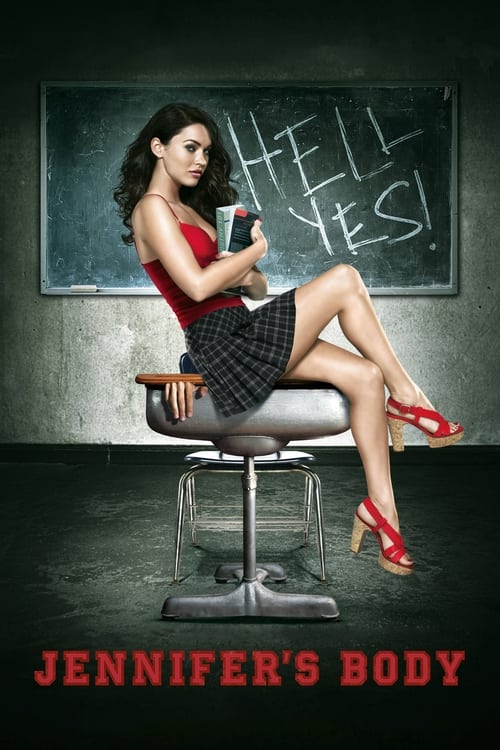
Jennifer's Body
2009 · Karyn Kusama
For a Halloween-season night when you want horror that's more wicked fun than genuinely terrifying — great with friends, snacks, and a taste for sharp dialogue. Reach for it when you want to laugh and wince in equal measure.
What it's about
In a small Minnesota town, cheerleader Jennifer — the girl everyone wants — comes back wrong after a night out with a sleazy touring rock band, and boys start disappearing. Her mousy best friend Needy is the only one who sees what Jennifer has become, and the film is really about their friendship: intense, poisonous, and harder to kill than any demon. Part possession horror, part high-school comedy, all told in razor-edged teen-speak.
The experience
Funny and gory in the same breath, with a mean streak that keeps curdling into something sadder — underneath the one-liners it's a story about a friendship rotting from the inside. It's a hangout movie until it suddenly isn't.
Performances
Megan Fox is far better than the marketing ever let anyone admit, playing Jennifer's monstrousness as an extension of teenage cruelty, and Amanda Seyfried grounds the whole film as Needy — anxious, loyal, and slowly steeling herself.
The craft
Diablo Cody's script, written right after her Oscar for Juno, runs on hyper-quotable slang and turns the genre's usual punishment of pretty girls inside out; Karyn Kusama directs the horror beats with real style while keeping the girls' friendship the emotional center. The needle-drops and mid-2000s texture have aged into a feature, not a bug.
Why it matters
A famous flop turned vindicated cult classic: mis-marketed to teenage boys in 2009, it was rediscovered a decade later as a feminist horror landmark and is now a staple of conversations about how women-made genre films get sold and dismissed.
Horror · Horror comedy & camp · Possession & occult · Teen horror. A possessed cheerleader feeds on boys in a sharp, gory horror comedy, a feminist cult classic that turns into a sad story of friendship.
Snapshot
Jennifer's Body is a horror-comedy about the ferocious, corrosive bond between two teenage girls in the fictional Minnesota town of Devil's Kettle. When a callow touring rock band, Low Shoulder, sacrifices cheerleader Jennifer Check (Megan Fox) to Satan in exchange for fame—botching the ritual because she is not the virgin they assume—she returns as a succubus who devours boys to sustain herself, while her bookish best friend Anita "Needy" Lesnicki (Amanda Seyfried) tries to stop her. Written by Diablo Cody in the immediate wake of her Oscar-winning Juno (2007) and directed by Karyn Kusama, the film was conceived as a feminist inversion of the horror genre's habit of punishing female sexuality. It arrived, however, as a commercial and critical disappointment—famously mis-marketed to teenage boys on the strength of Fox's tabloid stardom—before undergoing one of the more decisive critical reappraisals of its era, re-emerging in the 2010s as a canonical feminist cult film. It is best understood as a text about the violence young women do to one another and the violence done to them, dressed in the ornate, self-aware vernacular of late-2000s American teen culture.
Industry & production
The film is a product of a specific, brief moment in studio filmmaking. It was released by Fox Atomic, 20th Century Fox's short-lived genre and youth-oriented label, which folded around the time of the film's 2009 release—leaving Jennifer's Body somewhat orphaned within the parent studio's release apparatus. It was produced by Jason Reitman and Daniel Dubiecki, Cody's collaborators from Juno, making the project an expectation-laden follow-up: Cody's script was one of the more coveted post-Juno properties, and her voice was the primary commercial asset.
The production's central and much-documented problem was a mismatch between authorial intent and marketing. Cody and Kusama understood the film as a story about female friendship and predation told through horror; Fox's campaign foregrounded Megan Fox—then at the peak of her Transformers-driven fame and heavily sexualized in the press—as an object of male desire, selling the film to the demographic it was partly critiquing. The result satisfied neither the horror audience nor the teen-comedy audience. Precise box-office figures are best left to the trade record, but the consensus, repeatedly affirmed by Kusama and Cody in later interviews, is that the film underperformed relative to expectations and was widely written off as a failure at the time.
Technology
There is little to overstate here, and the honest account is that Jennifer's Body is not a technologically innovative film. It was shot photochemically on 35mm, in keeping with mid-budget studio practice of the period, and its effects are largely practical and prosthetic—Jennifer's distended demonic maw, her regenerative wounds, the gore of the feeding scenes—supplemented by conventional digital work. The film's interest lies in craft and idiom rather than in any technical advance, and the record does not support claims of methodological novelty in its production technology.
Technique
Cinematography
Cinematographer M. David Mullen (later Emmy-recognized for The Marvelous Mrs. Maisel) gives the film a polished, saturated look that deliberately courts the gloss of teen media before curdling it. The palette leans into the reds and blacks of its horror lineage, and the imaging of Jennifer is knowingly complicit: she is frequently lit and framed as an object of desire, a strategy the film weaponizes so that beauty and threat become inseparable. Set-pieces—the burning roadhouse, the moonlit lake where Jennifer bathes in a boy's blood—are staged for a lush, almost storybook clarity that heightens the dissonance with the violence.
Editing
Cut by Plummy Tucker, the film uses a framing device: Needy narrates from a psychiatric institution, and the story unfolds as flashback bracketed by that present tense. The editing has to hold two registers—Cody's rapid comic banter and the slower dread of the horror sequences—and it modulates between them rather than blending them, which contributes to the tonal instability some early viewers found alienating and later admirers read as the point.
Mise-en-scène / staging
Kusama and her collaborators build Devil's Kettle as a recognizable American small-town landscape—high school, roadhouse bar, suburban bedrooms—rendered with enough specificity to ground the supernatural. The film's most discussed staging is its refusal to sanitize the sacrifice: the ritual killing of Jennifer in the band's van is shot as something close to a gang assault, an allegorical charge the mise-en-scène makes unmistakable. Needy's pink-and-cluttered adolescent world is contrasted with Jennifer's sleeker self-presentation, so that the production design maps the friendship's power imbalance.
Sound
The soundtrack is integral to the film's identity and to its marketing. It was curated as a compilation of late-2000s indie, emo, and pop-punk acts reflecting the characters' milieu, with Panic! at the Disco's "New Perspective" serving as the lead single. Cody was closely involved in the music selection, favoring female-fronted and emo-adjacent bands consonant with the film's teen-cultural moment. The original score is credited to Theodore Shapiro and Stephen Barton; it works in a more conventional horror-suspense idiom beneath the needle-drops. Sound design in the feeding and possession scenes—wet, guttural, animalistic—is a key vehicle for the horror the glossy imagery otherwise softens.
Performance
The performances are the film's most reappraised element. Megan Fox delivers a genuinely double-edged turn: she plays Jennifer's mean-girl surface with confident deadpan while letting the demonic hollowness show through, a knowing performance that its initial reception, distracted by her offscreen image, largely refused to credit. Amanda Seyfried anchors the film emotionally as Needy, charting a girl's move from adoration to horror to a kind of contaminated empowerment. Adam Brody is memorable as Nikolai, the band's oily frontman, playing predatory ambition as casual banality. Johnny Simmons plays Needy's boyfriend Chip. The chemistry—and antagonism—between Fox and Seyfried carries the film's central relationship.
Narrative & dramatic mode
The film operates as horror-comedy with a confessional, retrospective narrative frame. Its dramatic engine is not primarily the monster plot but the disintegration of a female friendship that was always freighted with envy, dependence, and desire. Cody structures the story so that Jennifer's literal predation on boys runs parallel to the two girls' predation on each other—Jennifer's casual cruelty long predates her possession. The mode is arch and self-aware, with dialogue that continually calls attention to its own stylization; the horror is real and bloody, but the film keeps ironic distance, refusing the straightforward catharsis of the slasher. The famous, tender-and-hostile kiss between Jennifer and Needy crystallizes the ambivalence at the film's core: intimacy and threat are never separable.
Genre & cycle
Jennifer's Body sits at the intersection of the teen movie and the horror film, drawing on a specific female-centered horror lineage. Its clearest ancestors are *Brian De Palma's Carrie (1976), with its high-school setting and its linkage of female bodily change to monstrous power; the Canadian werewolf-as-puberty allegory Ginger Snaps (2000); the Fairuza Balk vehicle The Craft (1996); and the acid teen satire of Heathers (1988), whose caustic vernacular Cody's dialogue echoes. The influence of Joss Whedon's Buffy the Vampire Slayer*—teen horror as a vehicle for female interiority and stylized speech—is also legible. The film belongs to a small cycle of female-authored or female-directed horror concerned with turning the genre's traditional victimization of women into a source of monstrous agency.
Authorship & method
The film is a genuinely co-authored work, its identity shaped by two women at a formative career stage.
Diablo Cody (writer) brings the same hyper-stylized, neologism-laden dialogue that defined Juno—invented teen slang ("salty," "freaktarded," "move-in-day fresh") that some find grating and others read as a deliberate rendering of adolescent performance and self-mythologizing. Cody conceived the film explicitly as a feminist genre piece and has spoken candidly in the years since about her ambitions for it and her frustration with its reception.
Karyn Kusama (director) approaches the material as a serious genre filmmaker. Coming off her acclaimed debut Girlfight (2000) and the studio experience of Æon Flux (2005), she directs Jennifer's Body with a control that later became clearer in retrospect; the film is now often read as continuous with her subsequent, highly regarded work in The Invitation (2015) and Destroyer (2018), and her segment of the horror anthology XX (2017). Kusama has described the film as central to conversations about how women's genre work is received and dismissed.
Key collaborators—cinematographer M. David Mullen, editor Plummy Tucker, and composers Theodore Shapiro and Stephen Barton—execute a house style that is glossy on the surface and unstable underneath, matching the script's method of using teen-media sheen as camouflage for its darker argument.
Movement / national cinema
The film is a work of American studio cinema, but it is most productively located within a loose, transnational current of women-directed horror that gained visibility across the 2000s and 2010s—alongside the aforementioned Ginger Snaps (Canada) and later figures such as Jennifer Kent and Julia Ducournau. It is not part of any formal movement; rather, it is now cited as an early, mainstream-scaled instance of a female-authored horror sensibility that the industry was slow to recognize. Its national-cinema identity is inseparable from the specifically American high-school-movie tradition it inhabits and subverts.
Era / period
Jennifer's Body is deeply of its moment: the late-2000s post-Juno vogue for stylized "quirk," the emo/scene subculture and its music, the rise of tabloid-driven celebrity around figures like Megan Fox, and a pre-#MeToo media culture largely unwilling to hear the film's argument about male predation. Much of the story of the film is the story of the gap between 2009 and the years after: what the culture could not process in 2009—female rage, the sexual assault allegory, the queerness of the central relationship—it embraced within a decade. The film is thus a useful marker of a shift in what mainstream audiences were prepared to read in genre cinema.
Themes
The film's central themes are the intensity and violence of adolescent female friendship; the objectification and consumption of young women's bodies; and female rage as both wound and weapon. The sacrifice of Jennifer is a barely-veiled allegory for sexual assault, and her subsequent predation reframes the "monstrous feminine" as a form of survival and revenge. Sexuality is treated with deliberate ambiguity—Jennifer and Needy's bond is charged with a desire the film neither disavows nor sensationalizes. Fame, exploitation, and complicity form a second thematic axis: Low Shoulder trade a girl's life for celebrity and are rewarded for it, the town lionizing the very men who destroyed her. Beneath the comedy runs a consistent argument that the world's casual violence toward girls long predates any literal demon.
Reception, canon & influence
At release, Jennifer's Body met a mixed-to-negative critical response and disappointing commercial returns, its reputation depressed by a marketing campaign at odds with its content and by a critical culture inclined to dismiss both Cody's mannered dialogue and Fox's stardom. For several years it was treated as a stumble.
Its backward influences are the female-horror and teen-satire lineage detailed above—Carrie, Ginger Snaps, The Craft, Heathers, Buffy—filtered through Cody's post-Juno voice and Kusama's genre seriousness.
Its forward legacy is the more remarkable half of the story. Beginning in the mid-2010s and accelerating sharply after the #MetoO reckoning of 2017, the film was widely and publicly reassessed—by critics, by Kusama and Cody themselves, and by a large online audience—as a prescient feminist horror text whose central allegory the culture had simply been unready to hear. It became a durable cult film, embraced in particular by feminist and queer viewers who read the Jennifer–Needy relationship as one of the era's notable depictions of ambiguous female desire. It is now routinely cited as an influence on, and forerunner of, the wave of female-directed and female-centered horror that followed, and as a case study in how women's genre filmmaking is misjudged on arrival. Few films of its decade traveled so far from failure to canonization, and that trajectory is now inseparable from the film's meaning.
Reception
Dumped in 2009 with a marketing campaign selling Megan Fox to teenage boys, it flopped and got shrugged off as a Juno hangover — then the late-2010s reappraisal hit, and it's now widely claimed as a feminist horror classic that was simply sold to the wrong audience.
How Jennifer's Body was received, from release to now →
How to watch Jennifer's Body: what to notice on a first viewing
- Notice how glossy and flattering Jennifer's lighting stays. Mullen frames her in the reds and blacks of horror lineage, lit and composed the way teen media typically sells beauty, even as her threat increases. The glossy lighting keeps beauty and danger inseparable instead of letting one signal the other.
- Watch for the story told as flashback from an institution. Needy narrates from a psychiatric ward, and the whole plot unfolds bracketed by that present-tense frame. Knowing from the start that Needy ends up institutionalized changes how you watch everything that leads there.
- Listen for the wet, guttural sound design during feeding scenes. Beneath the glossy image, the sound in possession and feeding scenes turns animalistic, working against the polished visuals. The sound carries the horror that the pretty images keep trying to soften.
- Watch how the sacrifice in the band's van is staged. Kusama shoots the ritual killing of Jennifer with the specific choreography of a gang assault rather than a stylized supernatural rite. The staging makes the allegory unmistakable without a single line of dialogue naming it.
- Compare Needy's cluttered pink bedroom with Jennifer's sleeker look. The production design keeps the two girls' worlds visually distinct throughout, one cluttered and childlike, one polished and controlled. The contrast in their rooms maps the power imbalance in their friendship before either girl says a word about it.
The whole guide to watching Jennifer's Body, with the keys for a rewatch →
Influences: the films it descends from and the films it influenced
- Carrie (1976) — Founds the menarche-as-supernatural-trigger template, staging female pubescent humiliation (the shower, the prom blood) in slow-motion and split-diopter so bodily shame detonates into telekinetic violence.
- Ginger Snaps (2000) — Its explicit model for the two-girl dyad in which one sister's puberty is literalized as monstrous transformation via practical lycanthrope prosthetics, the other left to witness and manage it.
- The Craft (1996) — Supplies the pop-soundtrack-scored teen-girl occult clique that maps high-school social hierarchy onto supernatural power, the small-town-Americana staging Kusama inherits.
- Heathers (1988) — The direct dialogue ancestor of Cody's neologisms — invented, hyperstylized teen argot deployed as satirical armor over lethal high-school cruelty.
- Suspiria (1977) — Establishes deep saturated primary-color lighting as gloss-over-dread, the candy palette M. David Mullen adapts to make surface sheen camouflage the horror underneath.
- The Exorcist (1973) — Locates possession in an adolescent female body rendered through elaborate practical prosthetic makeup, the effects tradition Jennifer's demonic physiology extends.
- Girlfight (2000) — Kusama's debut, source of her naturalistic directorial control over a young woman's physical agency and channeled rage — the serious-genre method she imports into horror.
- The Slumber Party Massacre (1982) — A woman director and woman writer working with the genre's sexualised conventions from the inside. It inherits the strategy of handing the audience the expected exploitation beats while making them visibly aware of the looking.
- The Invitation (2015) — Extends Kusama's glossy-surface/unstable-underneath method into slow-burn dread, the controlled tonal concealment that retroactively clarified her authorship of Jennifer's Body.
- Destroyer (2018) — Kusama's later study of damaged female rage as structuring subject, confirming the directorial seriousness critics initially missed in her earlier genre work.
- Raw (2016) — Carries forward the female-coming-of-age-as-appetite body horror, pairing escalating cannibal gore with deadpan comedy and a competitive sisterly dyad.
- Revenge (2017) — Female-directed rape-revenge shot in hyper-saturated candy gloss that weaponizes the male gaze against itself, extending the saturated-sheen-as-argument technique.
- Promising Young Woman (2020) — Uses pop-candy visual sheen and needle-drops as camouflage for a sexual-assault revenge thesis, modulating between comedy and horror exactly as Jennifer's Body does.
- Bodies Bodies Bodies (2022) — Layers self-aware Gen-Z argot and neon needle-drop gloss over a lethal female-friendship whodunit, inheriting the performative-dialogue-plus-horror method.
- Bottoms (2023) — Pairs heightened self-aware high-school dialogue with escalating comic violence while foregrounding ambiguous queer female desire — the Needy–Jennifer charge made central text.
- Lisa Frankenstein (2024) — Written by Diablo Cody, a direct continuation of her teen horror-comedy voice — needle-drop-scored reanimation and monstrous-body wish-fulfillment in her signature slang.
- Freaky (2020) — Joins an inhabited, predatory teen-girl body to a glamour makeover used as a hunting tool. It anticipates Freaky's 'makeover as camouflage' set piece, in which the Butcher uses Millie's newly heightened attractiveness to get victims close.
- Teeth (2007) — Same-moment vagina-dentata body-horror comedy that turns male sexual predation into the origin of female monstrousness, working the sexual-assault-allegory register in a comic key.
- Juno (2007) — Cody's screenwriting in its first mainstream form — the same neologism-laden dialogue rendering adolescent self-mythologizing as performance, here without the genre camouflage.
- Leviticus (2026) — Codes queer desire as literal predation — the desired body becomes a trap that consumes those drawn to it — turning the slasher's victim/monster axis inside out.
- Mean Girls (2004) — Pushes coined-slang screenwriting and the poison-female-friendship of relational aggression into horror, sharing Amanda Seyfried and the toxic-best-friend core.
- Excision (2012) — Released in the same pre-elevated-horror moment, it also fuses high-school satire with female body horror, swinging between quippy comedy and brutal gore inside one scene.
Similar films
- Ginger Snaps (2000) — influence & lineage · same viewing thread
- Lisa Frankenstein (2024) — influence & lineage
- The Craft (1996) — influence & lineage
- Bottoms (2023) — influence & lineage
- Teenage Sex and Death at Camp Miasma (2026) — same viewing thread
- The Final Girls (2015) — same viewing thread
- Trick 'r Treat (2007) — same viewing thread
- Talk to Me (2023) — same viewing thread
All the films related to Jennifer's Body →
Watch it with: curated runs of related films
- Horror That's In on the Joke — A run of horror comedies that know the rules — the slasher's final girl, the cabin in the woods, the zombie survival list, the deadly family tradition — and have a blast bending them, so watching them together turns each one's genre jokes into a running conversation.
- Growing Up Is the Monster — Watch these together for horror where adolescence is the curse: a werewolf bite that arrives with puberty, a cheerleader who comes back hungry, a thing that follows you after sex, a possession game played for social media, and childhood evils the kids have to face themselves.