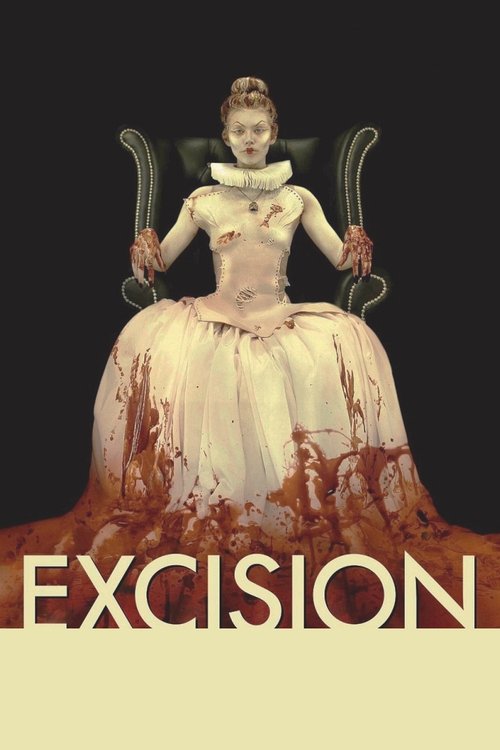
Excision
2012 · Richard Bates Jr.
For when you want something genuinely twisted and transgressive — a dare of a movie for strong stomachs and fans of outsider cinema. Absolutely not a comfort watch.
What it's about
Pauline is a high-school outcast with bad skin, no friends, and a fixation on surgery — she dreams in blood-soaked, operatic fantasy sequences and dreams, awake, of becoming a doctor. At home she wages war with her rigid, controlling mother while her younger sister slowly declines from cystic fibrosis, and Pauline hatches a plan to save her that no one should trust a teenager to attempt. Suburban satire, family melodrama, and body horror share one roof.
The experience
Pitch-black funny, squirmy, and increasingly dread-soaked — it keeps you laughing at Pauline's deadpan transgressions right up until it stops being funny at all. The ending hits like a dropped scalpel.
Performances
AnnaLynne McCord, then known as a glamorous TV actress, deglamorizes herself completely and gives a fearless, fully committed performance as Pauline; Traci Lords is startlingly good as her brittle, desperate mother.
The craft
Richard Bates Jr. expanded his own short into a feature that splits its visual world in two: flat, pastel suburban realism against Pauline's lush, stylized fantasy tableaux, staged like grotesque fashion editorials. The contrast gives the film its charge and its cult-object look.
Why it matters
A Sundance Midnight premiere that became a cult favorite through the genre-festival circuit and home video, it's a touchstone for the 2010s wave of provocative American indie horror and famous for McCord's transformation.
Snapshot
Excision is a low-budget American feature that combines suburban teen satire, family melodrama and body horror. Its central figure is Pauline (AnnaLynne McCord), a socially awkward high-school senior with acne and a fixation on surgery. She has blood-soaked erotic fantasies and an increasingly dangerous plan to "save" her younger sister Grace (Ariel Winter), who has cystic fibrosis. Writer-director Richard Bates Jr. expanded the film from his own 2008 short of the same name. It premiered in the Park City at Midnight section of the 2012 Sundance Film Festival and built its reputation mostly on the genre-festival circuit and home video.
The film is best known for three things:
- The cast. McCord, then known as a glamorous television actress, is deliberately deglamorised. Former adult-film star Traci Lords plays her rigid, image-conscious mother.
- The cameos. A run of cult-figure appearances includes John Waters, Malcolm McDowell, Ray Wise and Marlee Matlin.
- The ending. It moves from deadpan comedy to real tragedy, and that final turn has earned the film a lasting place in discussions of female-centred body horror.
Industry & production
Excision is an independent production of the early 2010s. Microbudget genre filmmaking was then being sustained by festival premieres, video-on-demand windows and cheap digital production. In the United States the film was released by Anchor Bay, a distributor associated with genre titles headed mainly for home video and VOD, after a limited theatrical presence. Reliable public figures for its budget and gross are scarce, and none are given here.
The short-to-feature route is central to how the film came about. Bates first worked through Pauline's world in his 2008 short, which gave him a proof of concept for the feature. The casting shows how independent genre films of the period worked. Recognisable cult names in one- or two-scene roles gave the film a marketing hook and a sense of lineage, while the small budget went towards a short shoot and a concentrated set of suburban locations.
Technology
The public record on the film's capture format and post-production pipeline is thin. As an early-2010s American independent feature, it belongs to the moment when affordable high-resolution digital cinema cameras had become normal for low-budget work, though the specific camera system is not well documented. The technology that matters most is the film's practical makeup and gore work in the fantasy sequences, where prosthetic and fluid effects carry the body-horror imagery. Digital colour grading separates those fantasies from the flatter real world, as described below.
Technique
Cinematography
The film's look rests on a firm split between two registers. The everyday suburban scenes are shot plainly, often in static, frontal framings with flat light. They resemble a sitcom gone sour, and the people in them seem pinned in place. Pauline's fantasy sequences are composed with formal symmetry, saturated colour and clean, high-key backgrounds. In them she appears made-up, poised and in control, surrounded by blood, viscera and bodies laid out like tableaux. The photography credit belongs to Itay Gross. The contrast makes the fantasies read as staged images, closer to fashion photography or performance art than to horror's usual shadows. This has a moral as well as a visual effect: the viewer is shown how beautiful Pauline's imagination is to her, at the same moment its content repels.
Editing
The film is structured as short scenes in sequence, broken up by fantasy interludes and by Pauline's repeated conversations with God. This structure supports the deadpan comedy, letting awkward exchanges end abruptly. It also prepares for the ending, because the film has trained the viewer to read Pauline's violence as fantasy. When the final operation happens in reality, the cuts no longer give the release of a dream, and the last scene holds on the family's reaction instead of cutting away. Reliable detail about the editor and the cutting process is limited in the public record.
Mise-en-scène / staging
Production design sets off a manicured, middle-class suburban interior against Pauline's unkempt look: slouching posture, greasy hair, visible acne and unflattering clothes. The mother, Phyllis, keeps an orderly, appearance-driven household, and its neatness becomes a kind of pressure. The fantasy sets are close to empty, almost theatrical spaces where the costumes and the bodies are everything. Church, classroom, school nurse's office and therapist's office all appear as institutions of correction, staged with comic rigidity. The final sequence turns the family's garage or domestic space into a makeshift operating theatre, bringing the private fantasy register into the home.
Sound
The score is credited to Steve Damstra II. Music supports the gap between the fantasies' trance-like beauty and the comic flatness of daily life. The fantasy sequences use sound to strengthen their ritual, dreamlike quality. The dialogue scenes rely on deadpan timing and silences. Pauline's voice-over prayers, delivered in a frank, conversational tone, give the film one of its signature recurring sounds and much of its comedy. Detailed accounts of the sound design are not well documented.
Performance
AnnaLynne McCord's performance is the film's centre, and most critics singled it out. Then best known as a sleek antagonist on the 90210 reboot, she took on a deliberately unappealing physical presence: hunched, dull-eyed, abrasive and blunt. She plays Pauline without asking for sympathy, yet lets loneliness and a need for her mother's approval show through.
The supporting performances matter as well:
- Traci Lords plays Phyllis with clipped, suburban severity. Critics often noted the irony of casting her as an enforcer of propriety.
- Roger Bart plays the father as passive and conflict-avoidant.
- Ariel Winter gives Grace a gentleness that makes the ending hurt.
The cameos are pitched as dry character turns, not winks: John Waters as a clergyman, Malcolm McDowell as a teacher, Ray Wise as the school principal, and Marlee Matlin as a teacher.
Narrative & dramatic mode
The story follows a loose coming-of-age arc. Pauline is at odds with her mother, fails to fit in at school, and is sent to church and therapy. She plans to lose her virginity on her own terms, and the scene is played for grotesque comedy. Throughout, she dreams of becoming a surgeon. The dramatic engine is the bond between the sisters. Grace's illness, and the family's anxiety about a lung transplant, give Pauline a goal in which her fantasy of mastery over the body joins a real wish to be loved and validated.
The film's mode is tonal displacement. For most of its running time it works as black comedy and satire of suburban conformity, religiosity and parental narcissism, while the fantasies keep horror at a stylised distance. In the final act Pauline attempts the operation for real, which involves the death of a neighbourhood girl and leads to Grace's death. The ending drops the comic frame and closes on the mother's horrified reaction and Pauline's collapse. The ending changes how the whole film reads. It recasts the earlier comedy as a record of the warning signs everyone missed. Viewers and critics have tended to find the turn either devastating or tonally jarring.
Genre & cycle
Excision sits where several cycles meet:
- Body horror, in its focus on the opened, eroticised and medicalised body.
- The teen film and high-school satire, in its outcast protagonist and its institutions of school, church and family.
- Female-centred horror about adolescence, sexuality and the body, a lineage running from Carrie (1976) through Ginger Snaps (2000), May (2002) and Teeth (2007).
It also belongs to the broader independent wave of the late 2000s and early 2010s that blended horror with deadpan comedy and the dysfunctional-family drama, aimed at festival midnight sections and genre festivals rather than wide theatrical release. Its generic label has always been unstable; it is filed variously as horror, comedy and drama. That instability is part of its identity.
Authorship & method
Richard Bates Jr. wrote and directed the film, his feature debut, developed from his short. His later features include Suburban Gothic (2014), Trash Fire (2016), Tone-Deaf (2019) and King Knight (2021). Together they show a consistent sensibility: abrasive, darkly comic stories about outsiders and dysfunctional families, cult-figure casting, and a readiness to swerve from comedy into brutality. Trash Fire in particular returns to the nightmare of family and religion. The authorial signature already visible in Excision is a deadpan, sometimes deliberately crude comic voice under tight formal control, used to approach disturbing material.
Key collaborators include cinematographer Itay Gross, who executed the film's split visual system, and composer Steve Damstra II. Public information about the wider crew's working methods is limited. Casting is part of Bates's method. Choosing performers with strong prior screen personas (Lords, Waters, McDowell, Wise) gives the film layers of intertextual meaning, and those choices are widely read as statements of lineage.
Movement / national cinema
The film is a product of American independent cinema, specifically its genre-festival branch, not the prestige-drama side of Sundance. It is not part of a formal movement. It does share a loose generational sensibility with other American indie horror of the period, much of which mixed genre with character study and personal or comic idiosyncrasy. Its satirical target, the conformist, religious, image-obsessed American suburb, ties it to a long national tradition. That tradition includes John Waters's suburban provocations, David Lynch's Blue Velvet and Todd Solondz's bleak comedies of adolescence such as Welcome to the Dollhouse.
Era / period
Excision arrived early in the 2010s, a decade in which horror became a central field for independent cinema. It came several years before the commercial and critical success of the films later labelled (often contentiously) "elevated horror". Distribution was moving quickly towards VOD and streaming, which helped small genre films reach cult audiences over time without large theatrical runs. The film's handling of female adolescence, menstruation, sexual agency and the medicalised body also anticipates a growing critical and popular interest during the decade in horror about women's bodies, much of it made by women.
Themes
- Bodily autonomy and control. Surgery becomes Pauline's fantasy of mastery over bodies, her own included, in a life where she has little power. Her fixation on blood and menstruation, and her calculated approach to sex, recast the female body as something she can command, not something done to her.
- The mother–daughter bond. The film is a study of a daughter starved of maternal approval. Many of Pauline's actions can be read as distorted bids for Phyllis's love, which is what gives the final image its force.
- Normalcy and appearance. The family, the school and the church all prize order and presentability. Pauline's grotesqueness is partly a refusal of those standards, and the film suggests that the institutions' obsession with appearances stops them from seeing real danger.
- Faith and its failure. Pauline's prayers to God are comic in their frankness, but they also express a real longing to be understood. The official religion represented by Waters's minister has nothing to offer her.
- Fantasy versus reality. The aestheticised fantasy sequences raise the question of what happens when an inner life of extreme images finds no outlet or recognition. The ending answers that question with catastrophe.
- Illness and sacrifice. Grace's cystic fibrosis gives the film a moral centre and gives Pauline's fantasies a terrible goal: healing as the ultimate proof of worth.
Reception, canon & influence
Critical reception. At its Sundance premiere and in subsequent release, reviewers were divided but attentive. Many praised McCord's performance, the visual control of the fantasy sequences and the nerve of the ending. Others found the film's mix of crude comedy and tragedy uneven, or its satire of suburbia familiar. Critics often cited the cast of cult names as a highlight and as a sign of the film's allegiances. It played widely on the international genre-festival circuit, where it found a receptive audience. Over time its standing rose mainly through home video and streaming, and it is now regularly named in critical lists and fan canons of cult horror and female-centred body horror. A precise record of its festival prizes is not well documented and is not listed here.
Influences on the film. The film's affinities are clear, and some are signalled by its casting:
- John Waters gave permission to treat transgression and bad taste as satire of suburban propriety.
- David Cronenberg's body horror frames the body as a site of identity and transformation.
- Todd Solondz's adolescent comedies supply a template for the cruel, deadpan high-school picture.
- The female adolescent horror tradition runs from Carrie (repressive mother, religion, menstruation, an outcast daughter) through Ginger Snaps and May, which has a lonely young woman's fixation on assembling a perfect body, to Teeth.
- McDowell's presence inevitably evokes A Clockwork Orange, though the film works more by tonal echo than direct homage.
Legacy. Excision is not usually credited with founding a cycle. It is better seen as an early marker of a wider movement in which female-centred body horror moved from the margins towards the centre of art-house and festival cinema. Later films have been discussed alongside it: Julia Ducournau's Raw (2016) and Titane (2021), Cory Finley's Thoroughbreds (2017) and later films about monstrous girlhood. These comparisons are critical affinities, not documented lines of influence. In particular, the film's fusion of a glamorous, composed fantasy aesthetic with adolescent abjection anticipates the polished visual approach of much later horror about women's bodies. Within Bates's own career, it set the tonal and thematic template his later features have worked through. As a cult object it stays a touchstone for viewers drawn to horror that is funny, cruel and emotionally serious at once, and for its ending, which is still one of the most discussed final images in 2010s independent horror.
Influences: the films it descends from and the films it influenced
- Carrie (1976) — Sets the template Excision reworks: a fanatically religious mother, menstrual blood as the mark of a daughter's monstrous puberty, and a set-piece climax where suppressed adolescent rage turns into carnage.
- Female Trouble (1974) — Waters's deadpan, prop-heavy staging of a bratty daughter's war with her family and her ambition to become a 'criminal artist' is the model for Pauline's bad-taste self-mythologizing, and Bates acknowledges the debt by casting Waters himself.
- Serial Mom (1994) — Its fake-cheerful pastel suburbia, which hides violence and gore, is the visual register Excision uses for its household, and it shares the cult cameo of Traci Lords, recast in Excision as the starchy, approval-hungry mother.
- Welcome to the Dollhouse (1995) — Solondz's flat, static framing of an unpopular girl humiliated by her family and classmates, with no lyrical relief offered, supplies the cruel deadpan register of Excision's daytime scenes.
- Heavenly Creatures (1994) — Cuts a teenage girl's lavish, effects-built fantasy world against a drab domestic reality and builds to a real act of violence, the same structure as Excision's tableau interludes breaking into the suburban scenes.
- Dead Ringers (1988) — Cronenberg's fetishized surgical instruments and red operating-theatre tableaux feed directly into Pauline's surgical fantasies, where gynecological gore is staged as ritual and erotic display.
- A Clockwork Orange (1971) — Its symmetrical, theatrical tableaux of stylized violence and its institutions that try to 'correct' a deviant youth are echoed in Excision's composed fantasy frames, and casting Malcolm McDowell as a school authority makes the reference explicit.
- May (2002) — Shows a socially stunted young woman's medical and craft obsession turning into literal body assembly, using homemade practical gore in a low-budget indie register that Excision raises to a surgical finale.
- Ginger Snaps (2000) — Ties the onset of menstruation to bodily transformation, framed by sardonic teen-outcast humor and a protective sister bond, the same mix of satire and the abject that Excision pushes further.
- Teeth (2007) — Satirizes abstinence-era suburban religiosity through deadpan sexual body horror with practical genital gore, the immediate tonal precedent for Excision's mix of crude comedy and purity culture.
- Trash Fire (2016) — Bates brings back Excision's fundamentalist-family nightmare, deliberately abrasive comic voice and sudden swerve from comedy into brutal tragedy, with a monstrous religious matriarch at the center.
- Raw (2016) — Carries the girl's appetite and medical curiosity as body horror into the art-house mainstream, using controlled, polished photography against moments of graphic practical gore.
- Thoroughbreds (2017) — Uses icy, formally composed frames and a flat, affectless lead performance to satirize affluent suburban parenting while a teenage girl moves calmly toward violence.
- Swallow (2019) — Sets a young woman's compulsive bodily self-harm inside saturated, symmetrical, catalogue-perfect domestic interiors, the same split between glossy surface and abjection that Excision built through digital color grading.
- Pearl (2022) — Sets a farm girl's oversaturated fantasies of stardom against a disapproving, repressive mother, and the gap between them ends in violence, the same fantasy-versus-home structure and mother-daughter approval wound as Excision.
- Titane (2021) — Goes further with a heroine's DIY self-mutilation and bodily remaking, shot in a neon-polished register that treats grotesque practical effects as glamorous spectacle.
- The Substance (2024) — Turns Excision's fusion of a glossy fantasy aesthetic with practical-effects body abjection into a full feature-length system, using a casting-against-glamour star performance to satirize what women do to their bodies to win approval.
- Jennifer's Body (2009) — Released in the same pre-elevated-horror moment, it also fuses high-school satire with female body horror, swinging between quippy comedy and brutal gore inside one scene.
- Lisa Frankenstein (2024) — Sibling in staging teen female interiority through pastel-lit dream/fantasy sequences and clinical body-horror imagery as the outsider heroine's monstrous-feminine escape.
Similar films
- The Substance (2024) — influence & lineage
- Ginger Snaps (2000) — influence & lineage
- Carrie (1976) — influence & lineage
- Raw (2017) — shared sensibility
- The Ugly Stepsister (2025) — shared sensibility
- Teenage Sex and Death at Camp Miasma (2026) — shared sensibility
- Freaky (2020) — shared sensibility
- Evil Dead Rise (2023) — shared sensibility