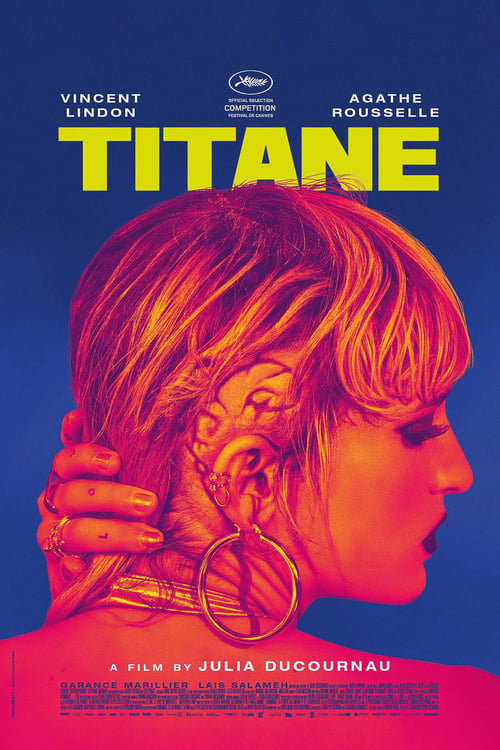
Titane
2021 · Julia Ducournau
Titane's Palme d'Or made her the face of the "new extremity goes mainstream" conversation; her follow-up Alpha divided Cannes and fed the "was Titane a fluke" discourse. Invoked whenever body horror and prestige collide.
For when you want cinema that grabs you by the collar — a dare of a movie for a night when comfort is the last thing you're after. Not for the squeamish; absolutely for anyone who wants to feel something extreme and then argue about it for a week.
What it's about
Alexia survived a childhood car crash with a titanium plate in her skull and grew up into something feral: a dancer at motor shows whose bond with cars runs far past obsession, and whose encounters with people tend to end in blood. On the run, she crosses paths with Vincent, an aging fire captain still hollowed out by the son who vanished ten years ago — and the collision of these two damaged people becomes the film's strange, molten heart.
The experience
The first stretch is a gauntlet — shocking, violent, darkly funny, the kind of thing that makes audiences squirm and occasionally walk out — and then it blindsides you by turning tender. You come for the provocation and leave unexpectedly moved, and more than a little rattled.
Performances
Agathe Rousselle, a first-time lead, is fearless in a nearly wordless role that demands total physical commitment, and Vincent Lindon matches her with a heartbreaking portrait of brute strength masking grief. Together they make the film's wildest ideas land as emotion.
The craft
Julia Ducournau directs with total control: chrome-and-neon visuals, bruising sound design, prosthetic body effects that you feel in your own skin, and needle drops that swing from menace to grace. It's a sensory assault built for a big screen and loud speakers, if you can take it.
Why it matters
It won the Palme d'Or at Cannes — Ducournau becoming the first woman to take the prize outright on her own — and instantly made her one of the most talked-about directors in world cinema, dragging body horror into the arthouse spotlight.
Snapshot
Titane is the second feature by French writer-director Julia Ducournau, a body-horror drama that detonated at the 2021 Cannes Film Festival, where it won the Palme d'Or — making Ducournau the second woman to take the festival's top prize and, by most accounts, the first to win it outright on her own rather than as a shared award. The film follows Alexia (Agathe Rousselle), a woman fitted with a titanium plate in her skull after a childhood car crash, who works as an erotic dancer at auto shows, kills with cold efficiency, conceives a child after a sexual encounter with a car, and — fleeing the police — disguises herself as Adrien, a boy who vanished a decade earlier, to be taken in by his grieving father, a fire-brigade captain named Vincent (Vincent Lindon). What begins as a transgressive serial-killer provocation curdles into something stranger and more tender: a study of monstrous bodies, manufactured kinship, and love that survives the dissolution of gender and identity. It is at once a calculated shock object and a sincere melodrama about parenthood, and that tonal collision is the film's signature.
Industry & production
Titane was produced by Kazak Productions, the Paris company headed by Jean-Christophe Reymond that had also backed Ducournau's debut Raw (2016), in a French-Belgian co-production with Frakas Productions. It carried the institutional support typical of French auteur cinema — public funding mechanisms, regional support, and pre-sales — that allow a difficult, genre-coded film with explicit content to be financed outside the Hollywood system. Diaphana handled French distribution; the U.S. independent distributor Neon, which had recently ridden Parasite to a Best Picture Oscar, took North American rights, signaling the film's positioning as a prestige-provocation crossover.
The Palme d'Or was the decisive industrial event in the film's life. Awarded by a jury presided over by Spike Lee — who famously blurted the winner at the very start of the closing ceremony, before the lesser prizes — the prize converted a hard-sell extreme-cinema title into an internationally distributed art-house event and a talking point far beyond genre circles. France selected Titane as its submission for the Academy Award for Best International Feature, though it did not advance to the nominations, a reminder of the limits of mainstream institutional appetite for its content. Its commercial footprint was modest by blockbuster standards but substantial for a film this confrontational, and it cemented Ducournau as one of the most bankable difficult directors of her generation.
Technology
Titane is a film of conventional contemporary digital production turned toward extreme physical effects. Its most distinctive technological dimension is not the camera or post-production pipeline but the prosthetic and practical-effects work required to render Alexia's pregnancy: a body that swells, splits, scars, and leaks motor oil, with a fetus whose nature is mechanical as much as biological. Ducournau, who came up steeped in practical body-horror traditions, privileges tactile, in-camera transformation — bound and flattened bodies, taped breasts, the slow distension of a prosthetic belly, lacerations and bruising — over digital effects, so that the audience reads the body as a real object under stress. The film also makes a fetish of automotive technology: the chrome, hydraulics, and flame-decaled bodywork of show cars are photographed as erotic and animate, machinery rendered as flesh's lover and partner rather than its tool.
Technique
Cinematography
The cinematography is by Ruben Impens, the Belgian director of photography who also shot Raw and is closely associated with Felix Van Groeningen. Impens gives Titane a hard, saturated, metallic palette — fire-engine reds, sodium oranges, and the cold blue-white of fluorescent and clinical light — that literalizes the film's fusion of flesh and machine. The celebrated opening is a sinuous, prowling tracking shot that threads through a tuning expo and arrives at Alexia writhing atop a flame-painted car, establishing both the film's confidence and its eroticized relationship to metal. Impens favors mobile, prowling camerawork and tight, clammy framing of bodies, alternating with the harsh frontality of the fire-station sequences. The lighting grows warmer and more enveloping as Alexia becomes Adrien and enters Vincent's orbit, a visual softening that tracks the film's drift from horror toward intimacy.
Editing
Edited by Jean-Christophe Bouzy, the film is structured as a brutal tonal hinge: a first movement of staccato, shock-driven violence and propulsive set-pieces, and a longer second movement that slows into the durational rhythms of cohabitation and domestic dread. The cutting is patient where it could be sensational — Ducournau and Bouzy hold on discomfort and on the labor of bodily transformation rather than cutting away — and the film trusts long, unbroken passages, including its dance sequences, to do dramatic work. The structural gamble is the abrupt pivot from killer-on-the-run thriller to father-and-"son" melodrama; the editing manages this rupture without smoothing it over, letting the seam show.
Mise-en-scène / staging
Ducournau's staging is built on bodies in charged spaces: the neon carnality of the auto show, the antiseptic horror of a bathroom self-mutilation, the masculine ecology of the fire station with its trucks, dormitories, and ritualized physical drills. The film repeatedly stages dance as a site of identity and display — Alexia's commercial striptease, and later a loose, ecstatic dance among the firefighters — using choreography to expose what characters cannot say. Vincent's body, swollen by injected steroids, is staged as its own grotesque parallel to Alexia's pregnancy: two people remaking their flesh by force of will. The fire engine, washed and tended like a living thing, anchors the household's iconography.
Sound
The score is by Jim Williams, the British composer who scored Raw as well as Ben Wheatley's Kill List and Brandon Cronenberg's Possessor; his work here moves between menacing drone, lyrical strings, and surges that lend the body horror an unexpected romantic grandeur. Titane is also built around emphatic needle-drops and diegetic music, with its dance set-pieces engineered as audiovisual peaks. Sound design foregrounds the textures of the mechanical-organic body — the creak and groan of metal, engines, the wet sounds of transformation — so that the aural world insists on the film's central metaphor. Because the film is in part about a near-silent protagonist who barely speaks, the soundtrack and the body carry meaning that dialogue withholds.
Performance
The two central performances are studies in opposition. Agathe Rousselle, in her feature debut — she came from a background in modeling and photography rather than acting — gives an almost wordless, physically punishing performance as Alexia/Adrien, conveying menace, terror, and finally vulnerability through posture, gaze, and endurance. Vincent Lindon, one of France's most respected actors and a Cannes best-actor laureate, plays Vincent with a bruised, overpowering tenderness, his hulking steroid-pumped frame at odds with the desperation of a father clinging to a fantasy. The film's emotional credibility rests on his willingness to make grief look like willful self-deception, and on the strange, unsentimental bond the two performers build.
Narrative & dramatic mode
Titane operates in a deliberately bifurcated dramatic mode. Its first act is the propulsive, amoral grammar of the serial-killer film — terse, shocking, almost picaresque in its accumulation of violence. Its longer second act shifts into chamber melodrama, even something close to a fractured family drama, as Alexia hides inside the identity of Adrien and is absorbed into Vincent's life. The film withholds psychological explanation; Alexia is never given the tidy backstory that would domesticate her, and her motivations remain partly opaque. This refusal of conventional motivation, combined with the literalized impossibility of her pregnancy, pushes the film toward the register of fable or myth rather than realism. The narrative is less interested in plausibility than in the emotional truth of two damaged people who agree, tacitly, to be family to each other.
Genre & cycle
The film sits at the intersection of body horror, art-house drama, and crime thriller, and belongs most clearly to the lineage of transgressive French genre cinema often grouped under the "New French Extremity" — the wave of confrontational, body-focused filmmaking associated since the early 2000s with directors such as Gaspar Noé, Claire Denis (in Trouble Every Day), Marina de Van, and Pascal Laugier. Within Ducournau's own work it forms a diptych with Raw, sharing that film's preoccupation with appetite, the unruly female body, and metamorphosis. It also participates in a longer body-horror tradition descended from David Cronenberg, and in a contemporary cycle of "elevated" or auteur horror that festivals and prestige distributors began to champion in the 2010s.
Authorship & method
Ducournau, born in 1983 and trained in screenwriting at France's national film school La Fémis, is both writer and director, and Titane is unmistakably a single-authored vision: a continuation of the thematic obsessions — flesh, transformation, the limits of the body, the violence of becoming — announced in Raw. Her method fuses a horror fan's love of practical, visceral effect with an art-cinema sensibility for ambiguity and duration, and a willingness to risk ridicule in pursuit of feeling. Her authorship is inseparable from a tight circle of returning collaborators: cinematographer Ruben Impens and composer Jim Williams both carried over from Raw, lending visual and sonic continuity across her filmography, with editor Jean-Christophe Bouzy shaping the film's audacious structure. Producer Jean-Christophe Reymond of Kazak Productions has been a consistent backer of her work. The discovery and casting of Agathe Rousselle, a non-professional, and the deployment of Vincent Lindon's gravitas as ballast against her rawness, are themselves authorial decisions central to the film's effect.
Movement / national cinema
Titane is a product of French national cinema and its distinctive ecosystem, in which public funding, festival prestige, and a tolerance for formal and sexual transgression allow extreme genre work to be made at an auteur level rarely possible elsewhere. It extends the New French Extremity's project of using the horror and erotic-thriller idioms to interrogate the body, gender, and the nation's anxieties, while its Belgian co-production reflects the integrated Franco-Belgian production landscape that has produced much of recent European art cinema. Ducournau's Palme d'Or also marked a moment in which French festival culture explicitly elevated a woman working in a historically male, historically disreputable genre.
Era / period
The film belongs firmly to its early-2020s moment. It arrived as one of the first major titles to premiere at the 2021 Cannes Festival, held after the pandemic-forced cancellation of the 2020 edition, and its triumph carried symbolic weight as a marker of cinema's return to the festival stage. Thematically it speaks to a contemporary period preoccupied with the fluidity of gender and identity, the porousness of the boundary between body and technology, and the reconstruction of family outside biological or normative lines — concerns it renders in deliberately mythic, non-didactic terms rather than as topical argument.
Themes
At its core Titane is about transformation and the instability of identity — bodily, sexual, and familial. Its governing metaphor is the fusion of flesh and metal: the titanium in Alexia's skull, her mechanical conception, the oil that runs in place of blood, all literalizing a self that is part machine. From this springs a sustained meditation on gender as performance and disguise, as Alexia binds, mutilates, and reshapes her body to become Adrien, slipping the categories of male and female. The film's second great theme is parenthood and chosen family: Vincent's refusal to disbelieve that Alexia is his lost son becomes an act of willed, unconditional love, and the film argues — against all its surface ugliness — that care, not biology or truth, constitutes kinship. Running beneath these is a fascination with the monstrous and the abject as sources not only of horror but of grace, and with bodies remade by violence, desire, and grief into something new.
Reception, canon & influence
Critically, Titane was among the most polarizing and discussed films of 2021, greeted with a mixture of awe, revulsion, and admiration; its Palme d'Or both validated and intensified the debate, with many critics hailing Ducournau's audacity and others finding the provocation hollow or the tonal shifts unearned. The consensus that emerged credited the film with genuine originality, formal control, and an unexpected emotional payoff, and praised the performances of Rousselle and Lindon. The win, and Spike Lee's premature on-stage announcement, became part of the festival's lore.
The influences on the film are legible and frequently noted: David Cronenberg's body horror and especially Crash, with its eroticization of automobiles and wounds; the metal-fusing nightmare of Shinya Tsukamoto's Tetsuo: The Iron Man; the killer-car mythology of films like Christine; and the tradition of the monstrous, uncanny pregnancy in horror. Closer to home, it is in direct dialogue with Ducournau's own Raw and with the New French Extremity.
Its forward influence is still consolidating, given how recent it is, so any claim about a long legacy would be premature. What can be said with confidence is that the film, and Ducournau's Palme d'Or, materially advanced the legitimacy of horror and body-horror as Palme-worthy art cinema and strengthened the standing of women directing in extreme genre modes. It confirmed Ducournau as a major auteur and raised expectations for her subsequent work, and it has become a touchstone in critical and academic conversation about gender, the post-human body, and the boundaries of festival prestige. Its durable place in the canon will depend on the years ahead, but its immediate impact on the discourse around genre cinema is already clear.
A Deleuzian reading
Start with the chrome.
The full Deleuzian reading of Titane →
Reception
It landed at Cannes 2021 as the scandal of the festival — walkouts, gasps, and then the shock of the Palme d'Or itself. Five years on it's less 'did that really win?' and more a fixture of the modern body-horror canon, the film that proved the Palme could go feral.
How Titane was received, from release to now →
Influences: the films it descends from and the films it influenced
- Crash (1996) — The eroticization of the car interior, the wound, and the scar as sexual surfaces is lifted directly into Alexia's congress with the Cadillac, down to the clinical, affectless framing of bodies fused with machinery.
- Tetsuo: The Iron Man (1989) — Supplies the flesh-becoming-metal transformation and the industrial mechanical-organic sound design — grinding, clanging, biomechanical noise standing in for interior states — that Ducournau's sound team echoes around the titanium plate.
- Videodrome (1983) — Establishes the 'new flesh' grammar of practical prosthetic mutation — the body splitting, leaking, and growing new apertures — that Titane stages with motor oil seeping from Alexia's body.
- Christine (1983) — Provides the killer-car mythology and the conceit of an automobile as an autonomous, desiring agent, which Titane literalizes by making the car a sexual partner and sire.
- Raw (2016) — Ducournau's own prior film carries over DP Ruben Impens and composer Jim Williams, and the same craft of bodily appetite-as-coming-of-age shot in cold institutional spaces with prowling camera and visceral practical effects.
- Possession (1981) — Model for the wordless, convulsive female physical performance — the body thrown into spasm and contortion to externalize a transformation that dialogue refuses to explain.
- Rosemary's Baby (1968) — Founds the monstrous-uncanny-pregnancy tradition of withheld dread, the gestation of a non-human child treated with mounting bodily horror rather than exposition.
- Trouble Every Day (2001) — A New French Extremity touchstone for the sensual, prowling camera that treats skin and appetite as texture, fusing eroticism and predation without explanatory dialogue.
- In My Skin (2002) — New French Extremity precedent for the clinical, near-silent depiction of a woman compulsively breaching her own body, performance carried through physical self-injury rather than speech.
- The Brood (1979) — Supplies the figure of monstrous birth as the literal externalization of psychic rage, the body producing offspring as a horror set-piece.
- Climax (2018) — Extends the New French Extremity use of dance-as-identity — choreography and the moving body as the primary narrative engine rather than plot or dialogue.
- Possessor (2020) — Shares the cold metallic palette and clinical practical-effects approach to identity dissolving into another body, performance built on physical inhabitation over interior monologue.
- The Substance (2024) — A French woman-directed body-horror that inherits Titane's festival-prestige legitimacy, its commitment to escalating practical-gore transformation and flesh-splitting birth imagery over CGI.
- Under the Skin (2013) — Shares the wordless predatory female protagonist, the prowling tracking camera, and an abstract sound-and-metal design rendering an inhuman embodiment from the inside.
- Border (2018) — Parallel fable-register genre cinema built on a non-normative body, withheld motivation, and the discovery of a chosen family outside the human-normative order.
- Crimes of the Future (2022) — The originating body-horror auteur's contemporaneous return to flesh-as-site and surgery-as-intimacy, running the same metallic, clinical practical-effects vocabulary in dialogue with Titane.
- Saint Maud (2019) — Shares the fable-register ambiguity and a near-wordless physical performance in which bodily mortification and transcendence carry a withheld, unexplained interior drive.
- Poor Things (2023) — Ducournau's Palme d'Or-winning feminist body-horror surrealism — featuring a female protagonist whose bodily transformation operates simultaneously as horror and liberation within prestige production — establishes the festival/awards viability of formally aggressive, sexually frank female-body surrealism that *Poor Things* enters and consolidates.
- The Ugly Stepsister (2025) — Extends the contemporary feminist body-horror cycle through extreme, transgressive transformation of the female body treated as a site of pain, mutation, and remaking.
Similar films
- Crash (1996) — influence & lineage · same viewing thread
- Possession (1981) — influence & lineage · often watched together
- Climax (2018) — influence & lineage · often watched together
- The Substance (2024) — influence & lineage
- Videodrome (1983) — influence & lineage · often watched together
- It Was Just an Accident (2025) — often watched together
- 4 Months, 3 Weeks and 2 Days (2007) — often watched together
- Anatomy of a Fall (2023) — often watched together
All the films related to Titane →
Watch it with: curated runs of related films
- Midnight Movie Provocations — Watch these when you want cinema at its most gorgeously deranged — cult objects that turn desire, violence, and pure anarchy into their own strange grace.