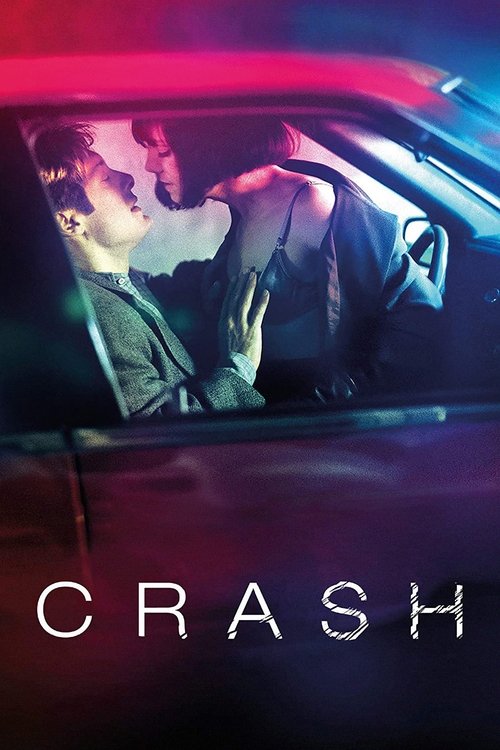
Crash
1996 · David Cronenberg
For when you want transgressive, adults-only cinema that tests where your limits are — strictly a challenge, never a comfort watch. Reach for it when 'disturbing but fascinating' sounds like a recommendation rather than a warning.
What it's about
After a violent car crash, a Toronto film producer discovers the accident has left him aroused rather than traumatized — and he's not alone. He and his wife are drawn into an underground subculture of crash survivors who restage famous collisions and pursue the collision of metal and flesh as an erotic act. Adapted from J.G. Ballard's novel, it follows their descent with total, unblinking commitment.
The experience
Cold, hypnotic, and deliberately airless — the film refuses to moralize, judge, or reassure, and that clinical calm is exactly what makes it so unsettling. It generates dread without a single conventional scare; you leave feeling like you've been somewhere you shouldn't have been.
Performances
James Spader, Holly Hunter, and Deborah Kara Unger all commit to an eerie, deliberate flatness — performances drained of normal affect that make the characters' compulsion feel genuinely alien rather than sensationalized.
The craft
Cronenberg turns a supposedly unfilmable novel into something rigorously controlled: chrome, glass, and highway light shot with surgical precision, and a droning, metallic score that locks you into its trance. The crashes are staged with disquieting intimacy rather than action-movie spectacle. Its cold beauty rewards a dark room and good sound.
Why it matters
One of the great scandals of nineties cinema — condemned, banned in places, and fiercely defended — it's since been reclaimed as a landmark of body-focused filmmaking and one of the boldest literary adaptations ever attempted.
Snapshot
David Cronenberg's adaptation of J.G. Ballard's 1973 novel is among the most rigorously realized acts of literary transposition in modern cinema — a cold, formally precise study of bodies reconfigured by technology, trauma, and desire. Where most filmmakers approached Ballard's notoriously difficult text as unfilmable, Cronenberg recognized it as an extension of his own long-running preoccupations: the permeability of flesh, the libidinal charge of machinery, the body as a site of involuntary metamorphosis. The result is a film of sustained tonal coherence and deliberate emotional distance, generating unease not through conventional horror mechanics but through an unflinching clinical detachment that refuses to moralize or reassure. Its controversy upon release — substantial and international — was essentially a measure of how precisely it achieved its aims.
Industry & production
Crash was produced by Jeremy Thomas, the British producer whose career has been defined by a commitment to singular, risk-taking projects (Bernardo Bertolucci's The Last Emperor, Cronenberg's own Naked Lunch). Thomas had acquired the rights to Ballard's novel and brought the project to Cronenberg, whose previous collaboration with him on Naked Lunch (1991) had demonstrated a shared appetite for formally adventurous literary adaptation. The film was financed as a Canada-UK co-production, with Alliance Communications and The Movie Network among the primary backers, allowing Cronenberg to shoot in Toronto while retaining the internationalist texture of Ballard's London-set source material — a geographical displacement that, paradoxically, suits the novel's vision of placeless, highway-mediated modernity.
Fine Line Features distributed the film in North America, where it faced significant institutional resistance. Ted Turner, then overseeing the parent company of Fine Line's parent, attempted to prevent or limit its release after a screening, reportedly describing it in extreme terms. Fine Line ultimately distributed it without substantial alteration, though the controversy shaped its commercial positioning. The film performed modestly at the box office, finding its audience primarily through art-house circuits and subsequent home-video release, where its reputation has only deepened.
Technology
Crash was shot on 35mm film, and Cronenberg's longstanding cinematographer Peter Suschitzky deployed its photochemical properties with deliberate intent: grain, color temperature, and depth of field are all calibrated to produce an image that feels simultaneously hyperreal and alienated. The production used practical locations around Toronto's highway infrastructure — expressways, underpasses, airport approach roads — rather than constructed sets, which gave the film's chromium-and-asphalt world an unglamorous, functional authenticity. Crash predates the widespread integration of digital effects into studio filmmaking; its crash sequences were executed through practical stunt work and the use of real wrecked vehicles, a material specificity that reinforces the film's central argument about the irreducible physicality of metal meeting flesh.
Technique
Cinematography
Suschitzky's work on Crash is among the most distinctive in his extensive collaboration with Cronenberg. The dominant palette is metallic and cold: silver, gray, the blue-white of highway lighting, the dull gleam of industrial glass. Natural light is rarely warm; even interiors feel climatically sealed. Suschitzky frames bodies in relation to cars with insistent geometrical precision — flesh against steel, wound against seam — so that the film's thesis (human and machine as co-evolving systems) is enacted at the level of the image rather than merely stated. The camera moves deliberately, unhurriedly, often holding on surfaces — scarred skin, crumpled hoods — long enough to discomfort the viewer's expectation of narrative momentum.
Editing
Ronald Sanders, who edited many of Cronenberg's films across this period, maintains a rhythm throughout Crash that resists conventional dramatic pacing. Cuts are not motivated by action or emotional beat but by a more neutral, observational logic; the film proceeds at the pace of inquiry rather than event. This editing strategy is central to the film's effect: it refuses to organize experience into climax and release, denying the viewer the cathartic structures that genre cinema ordinarily provides. Scenes elongate past the point of narrative utility, dwelling in a post-dramatic space that mirrors the novel's own refusal of resolution.
Mise-en-scène / staging
Cronenberg's staging of the film's sex scenes — and Crash is a film in which sexuality and violence are formally inseparable — is consistently anti-erotic in conventional terms, yet never parodic. Bodies are arranged with the precision of autopsy: observed, documented, and placed in explicit spatial relation to machinery. A recurring motif has characters coupling in or against vehicles, the metal of the car functioning as both partner and prosthesis. Staging throughout privileges surfaces — the film is obsessed with contact, with the literal point at which one material meets another — and this obsession is realized through careful blocking that always keeps the car visible, present, and implicated.
Sound
Howard Shore's score is among his most unusual and arguably most effective: built primarily around heavily processed electric guitar, it generates a metallic, sustain-heavy texture that refuses melodic comfort. The guitars — played by slide and manipulated through distortion — sound simultaneously human and mechanical, enacting in sonic terms the human-machine hybridity the film depicts. The sound design is equally precise: crash sequences foreground the specific acoustic qualities of compressing metal and breaking glass, while quieter scenes attend to the ambient hum of highway infrastructure. The film's soundscape is never soothing; it maintains a state of low-level agitation that functions as the acoustic equivalent of Ballard's prose style.
Performance
James Spader, as James Ballard (named directly after the novel's author), delivers a performance of studied blankness that might superficially read as absence but is more accurately described as a particular form of openness — a character defined by receptivity rather than interiority. Elias Koteas as Vaughan is the film's demonic catalyst, bringing a charged, dangerous physicality that offsets Spader's quieter affect. Holly Hunter, cast against the grain of her public persona, conveys Dr. Helen Remington's transformation with restrained precision. Deborah Kara Unger brings a glacial, almost spectral sensuality to Catherine Ballard. Rosanna Arquette, as Gabrielle, delivers the film's most overtly expressive work, her performance centered in the body and its scars. Collectively, the ensemble performs at a register of emotional flattening that mirrors Ballard's prose — not affectless for its own sake, but affectless as symptom.
Narrative & dramatic mode
Crash is closer to tone poem or essay film than to narrative cinema as conventionally practiced. It possesses the external markers of narrative — a protagonist, a series of encounters, a trajectory — but deliberately withholds the psychological development, dramatic conflict, and emotional resolution that those markers conventionally promise. Characters function as types or vectors rather than rounded individuals; they move through the film's world as if compelled by forces they neither fully understand nor resist. The film's structural logic is accretion rather than escalation: each scene adds another layer to the film's central phenomenological proposition rather than advancing a plot. This mode is faithful to Ballard's novel, which operates similarly, and it is the quality most likely to divide viewers, since it demands an accommodation to a mode of cinematic experience organized around contemplation rather than identification.
Genre & cycle
Crash occupies the category of body horror that Cronenberg had effectively invented as a coherent cinematic genre with films like Shivers, Videodrome, and The Fly. But it also participates in the 1990s art-house transgressive cinema that included films by Larry Clark, Harmony Korine, and, in Europe, provocateurs working under the influence of Fassbinder and later iterations of extreme European art cinema. It is emphatically not an erotic thriller in the commercial sense — though it deploys the genre's surface elements — but rather a work that uses the transgressive potential of sexuality to probe questions of embodiment, modernity, and desire that belong to a much older philosophical and literary tradition.
Authorship & method
Cronenberg wrote the screenplay himself, adapting Ballard with notable fidelity while finding equivalences for the novel's literary texture in visual and sonic terms. His directorial method on Crash, as documented in interviews and on-set accounts, was one of extreme clarity of intention: the film was precisely storyboarded and executed with minimal improvisation, reflecting a conviction that Ballard's vision required precision rather than spontaneity to survive transposition. Peter Suschitzky brought his usual rigor and his deeply calibrated understanding of Cronenberg's visual requirements; the two had by this point developed a working shorthand that allowed for economical communication of complex aesthetic choices. Howard Shore's collaboration with Cronenberg — one of the more sustained director-composer partnerships in contemporary cinema — reached a distinctive peak in Crash's unconventional score. Ronald Sanders's editorial contribution maintained the film's refusal of conventional dramatic tempo.
Movement / national cinema
Cronenberg is the central figure of Canadian genre cinema — specifically the Toronto-based strand of body horror that emerged in the 1970s and defined a recognizably Canadian engagement with American genre conventions filtered through European art-cinema seriousness. Crash, though shot in Toronto, resists easy identification as a Canadian film in any nationalist sense; its co-production structure, its international literary source, and its deliberate geographical ambiguity reflect a transnational mode of production that Cronenberg had adopted by the early 1990s. Nevertheless it belongs to the tradition of Canadian cinema that has consistently used the genre film as a vehicle for cultural self-examination — a concern with surfaces, with media, with the body that has some connection to the theoretical legacy of Marshall McLuhan, whose influence on Ballard and on Cronenberg's broader thematic project is more than coincidental.
Era / period
Crash arrives at a particular convergence point in mid-1990s cultural history. The post-AIDS discourse around bodily risk and sexual danger had transformed the cultural meaning of physical contact and erotic transgression; the film's simultaneous eroticization and wounding of bodies exists in dialogue with that transformation, though it neither endorses nor critiques it explicitly. The mid-1990s were also a moment of intensifying debate about cinema's capacity and obligation to represent extreme human experience, a debate to which Crash's British reception contributed substantially. The film also precedes the widespread digitization of both production and culture — it is emphatically a film of the analog, of metal and film grain and physical collision, which gives it a different relationship to its machinery-fetishism than a later film on the same subject might have.
Themes
The film's central proposition — that the car crash constitutes a new form of eroticized experience unique to modernity — is not argued but enacted. The merger of flesh and technology that Cronenberg had explored in earlier films here becomes literal and systematic: bodies bear the marks of car crashes as evidence of transformation, not damage. The film is concerned with celebrity death (Vaughan's obsessive recreation of James Dean's and Jayne Mansfield's fatal crashes situates it within a distinctly twentieth-century iconography of spectacular destruction), with the aestheticization of trauma, and with the question of whether desire is a fixed or infinitely malleable quantity. Ballard's original text drew on Wilhelm Reich and Norman O. Brown in its conception of libidinal energy as something that can be redirected through any available channel; Cronenberg's film carries this proposition without illustrating its intellectual genealogy.
Reception, canon & influence
At Cannes 1996 — where the competition jury was presided over by Francis Ford Coppola — Crash received a Special Jury Prize, with the jury citing its audacity and originality as formally distinct from the films competing for the Palme d'Or (which went to Mike Leigh's Secrets & Lies). The Cannes recognition established the film's art-cinema credentials before it reached wider audiences.
The British reception was the most turbulent. Westminster City Council voted to ban the film within its jurisdiction — a decision without legal effect on the BBFC certificate but with significant symbolic force — and the tabloid press generated sustained outrage that served, paradoxically, to amplify the film's profile. In North America, the critical response was more divided: Roger Ebert, who awarded the film four stars, wrote one of its most perceptive appreciations, noting its absolute tonal consistency and rejecting the charge of gratuitousness; other critics found its deliberate coldness alienating to the point of incoherence.
Backward: influences on the film. Ballard's novel is the irreducible source, but Cronenberg brought to it a set of pre-existing cinematic references. Godard's Weekend (1967) — with its vision of highway civilization collapsing into carnage — is a clear predecessor in its use of the car crash as civilizational symptom. Kenneth Anger's Scorpio Rising (1963) established the eroticization of automobile culture as an avant-garde possibility. Andy Warhol's Death and Disaster silkscreens placed the crash in the domain of aestheticized repetition. Within Cronenberg's own filmography, Videodrome is the closest precursor: its vision of media technology rewiring the nervous system and the flesh anticipates Crash's conceit almost directly. William Burroughs's transgressive literary mode, which Cronenberg had already engaged in Naked Lunch, also runs through the film's sensibility.
Forward: legacy and influence. Crash has remained a persistent reference point in discussions of cinematic transgression, adaptation theory, and body horror. Its demonstration that Ballard's work — widely considered unfilmable — could be rendered with formal integrity influenced subsequent attempts to adapt similarly resistant literary material. The film is routinely cited in academic discussions of posthumanism, technology studies, and the intersection of sexuality and media theory. Its specific aesthetic — cold, metallic, anti-cathartic — can be detected in strands of subsequent art-horror and transgressive cinema, though direct formal influence is difficult to isolate. Paul Haggis's entirely unrelated film of the same title (2004) caused substantial confusion in the popular record, a coincidence that has complicated the film's cultural visibility without diminishing its standing in the serious literature on Cronenberg or on 1990s art cinema. Among Cronenberg's own films, Crash occupies a position of singular formal achievement — the work in which his thematic obsessions and his directorial method are most completely and uncompromisingly realized.
A Deleuzian reading
The camera holds on a scar longer than you want it to.
The full Deleuzian reading of Crash →
Reception
Booed and celebrated in equal measure at Cannes 1996 — where it took a rare Special Jury Prize 'for audacity' — then hounded by a Daily Mail ban-this-film campaign in Britain; now it's widely reappraised as one of Cronenberg's coldest, greatest films, cemented by a 2019 4K restoration and Criterion release.
How Crash was received, from release to now →
Influences: the films it descends from and the films it influenced
- Shivers (1975) — Establishes Cronenberg's foundational mode of staging transgressive sexuality as clinical medical observation — detached handheld camera, affectively flattened performances, and body-horror in a Canadian urban environment — the template that Crash distills into pure essay form without genre scaffolding.
- Videodrome (1983) — The flesh-technology merger — hand absorbing gun, stomach opening to receive cassette — staged as body-horror through affectively flattened performance and clinical framing; Crash strips away Videodrome's pulp-thriller mechanics to pursue the identical preoccupation at essay-film remove.
- Dead Ringers (1988) — Ronald Sanders' anti-cathartic editing rhythm and Peter Suschitzky's cold steel-blue palette — the precise cinematographic and editorial vocabulary of Crash — were locked in here: the autopsy-precise staging of bodies as medical objects is Crash's most direct formal predecessor within Cronenberg's own work.
- Naked Lunch (1991) — The Cronenberg/Jeremy Thomas/Sanders/Suschitzky unit's method of literary adaptation as essay-film accretion was developed here in immediate precedence; Howard Shore's processed-instrument scoring mode — organic sound mechanically distorted until it reads as inhuman — originates in this collaboration.
- Last Year at Marienbad (1961) — The anti-cathartic editing that refuses climax-release cycles and the accretion structure of non-escalating inquiry — Crash's refusal to organize experience into conventional dramatic arc — descends from Resnais's model of time-suspended, unresolved observation in which scenes end without emotional discharge.
- Weekend (1967) — Car crashes aestheticized as formal-erotic objects through distanced, non-judgmental observational camera — Crash's treatment of automotive wreckage as aesthetic-libidinal material rather than shock spectacle derives its observational distance and tableau staging directly from Godard's highway carnage sequences.
- Blow-Up (1966) — Surface-dwelling holds on objects as ends in themselves — photographs, grass, fabric — and anti-cathartic non-resolution sustained without apology: Antonioni's patient camera treating surfaces rather than events establishes the observational permission that Suschitzky exploits on scarred skin and crumpled hoods.
- Titane (2021) — The most explicit inheritor: flesh-steel automotive merger as central erotic-horror conceit, with anti-cathartic narrative structure, autopsy-precise staging of sexuality against vehicular surfaces, and body horror deployed through transgressive art-cinema distance — Ducournau's debt to Crash's formal system is structural, not incidental.
- Raw (2016) — Ducournau's debut applies Crash's clinical art-cinema body-horror mode — autopsy-precise staging of transgressive flesh, affective flattening in the face of desire, anti-cathartic editing that denies horror's conventional release — establishing the formal lineage she extends directly into Titane.
- Cosmopolis (2012) — Extends Crash's automotive-surface obsession — a limousine as the film's primary observational space and the body's insulation from the world — through the same essay-film accretion structure and cold observational staging, transposing Crash's highway environment into a stalled financial corridor.
- Possessor (2020) — Deploys the metallic cold palette, flesh-technology merger imagery, and anti-cathartic editing of Crash as inherited methodology — practical body-horror effects against industrial surfaces with affectively flattened performance — a conscious formal inheritance that treats the father's visual system as both subject and technique.
- Crimes of the Future (2022) — A self-conscious methodological return to Crash's full formal apparatus: autopsy-precision staging of body modification as public performance, affective flattening throughout, Howard Shore's processed-instrument score, and practical body-horror effects — the same clinical essay-film inquiry applied to surgical transgression thirty years on.
- Shame (2011) — Films compulsive sexuality with clinical coldness and numbing repetition rather than heat, draining the erotic from explicit acts — the affective register Shame inherits.
- The Piano Teacher (2001) — Haneke deploys the same anti-cathartic editing rhythm and clinical staging of sexual transgression through affectively flattened performance — scenes that elongate past narrative utility, denying cathartic release — as a parallel essay-film treatment of transgressive desire without moralization.
- Trouble Every Day (2001) — Denis applies Crash's observational tempo, surface-dwelling camera, and anti-cathartic elongation to transgressive body-desire — flesh meeting surface staged with clinical distance — using editing that refuses conventional horror payoff in the same mode of sustained, non-judgmental inquiry.
- eXistenZ (1999) — Howard Shore's processed-instrument scoring — organic textures mechanically distorted into metallic sustain — and the affectively flattened performance mode continue directly from Crash as Cronenberg pursues body-technology merger through game-interface flesh rather than automotive steel.
- Exotica (1994) — Toronto's other anti-erotic film: sexual acts staged with clinical framing and affectless delivery, repeated as a ritual meant to recover an original wound, so that the erotic surface is drained precisely to expose the compulsion underneath.
Similar films
- Titane (2021) — influence & lineage · same viewing thread
- Videodrome (1983) — influence & lineage
- Naked Lunch (1991) — influence & lineage
- Weekend (1967) — influence & lineage
- eXistenZ (1999) — influence & lineage
- Dead Ringers (1988) — influence & lineage
- Possessor (2020) — influence & lineage
- Mulholland Drive (2001) — often watched together
All the films related to Crash →
Watch it with: curated runs of related films
- Midnight Movie Provocations — Watch these when you want cinema at its most gorgeously deranged — cult objects that turn desire, violence, and pure anarchy into their own strange grace.