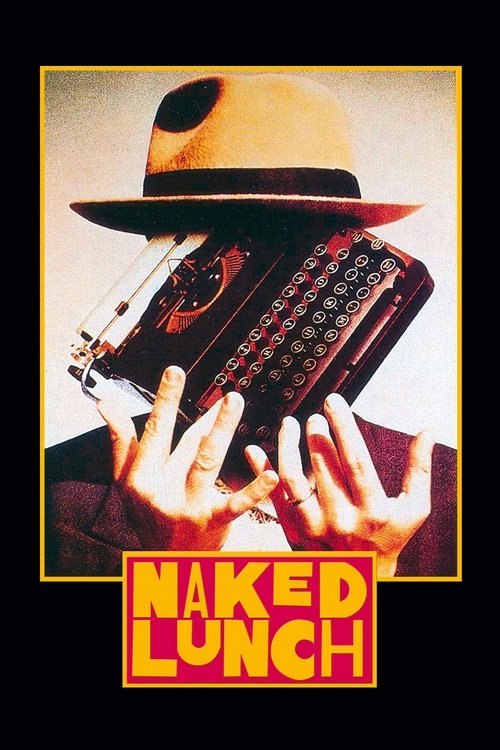
Naked Lunch
1991 · David Cronenberg
For when you want the weird stuff — a challenging, chew-on-it-for-days art film for an adventurous night, not a comfort watch. Best approached in a patient, curious frame of mind, ideally with a taste for body horror and literary lore.
What it's about
A New York bug exterminator named Bill Lee, who gets high on his own insecticide alongside his wife and their literary friends, is pulled into a shadow world after a domestic catastrophe. He washes up in Interzone — a hallucinated North African port city — where his typewriter turns into a talking insect, everyone may be an agent, and the 'reports' he's ordered to file start to look a lot like a novel. It's less an adaptation of Burroughs' book than a fever dream about the writing of it.
The experience
Deadpan, druggy, and deeply strange — a slow hallucination delivered with a completely straight face. It's queasy and darkly funny in equal measure, and it makes you feel pleasantly (or unpleasantly) unmoored; you don't follow it so much as submit to it.
Performances
Peter Weller's flat, affectless calm as Bill Lee is the film's anchor — the more grotesque things get, the drier he plays it, and that tension is where the comedy and the horror both live. Judy Davis is mesmerizing in a haunting dual role.
The craft
Cronenberg's grotesque practical creature effects — talking insect typewriters, mutating flesh — are rendered with tactile, handmade conviction that CGI still can't touch, and Howard Shore's score, laced with Ornette Coleman's free-jazz saxophone, keeps the whole thing woozy and off-kilter. The trick of the writing is fusing an 'unfilmable' novel with its author's real, tragic biography into one continuous hallucination.
Why it matters
A landmark of literary adaptation as reinvention — proof that the way to film an unfilmable book is to film the writing of it — and a high-water mark of Cronenberg's run as cinema's great poet of the body.
Snapshot
Naked Lunch is David Cronenberg's adaptation of William S. Burroughs' notoriously "unfilmable" 1959 novel — though "adaptation" understates the maneuver. Rather than dramatize the book's fragmentary, scatological routines, Cronenberg fuses scraps of the text with the biographical legend of its author: the addict-writer as exterminator, the typewriter that metamorphoses into a talking insect, and above all the killing of a wife in a drunken game of William Tell, which Burroughs lived through in Mexico City in 1951 and spent a lifetime processing into prose. The result is a hermetic, deadpan fever dream in which the writing of Naked Lunch becomes the subject of Naked Lunch. Bill Lee (Peter Weller), bug exterminator and reluctant agent, drifts from a monochrome New York into Interzone, a hallucinated North African city of mutating architecture, secret-agent assignments dictated by insectile machines, and viscous secretions. It is at once Cronenberg's most literary film and one of his most personal — a study of addiction, creation, sexuality, and control that refuses both the novel's anarchy and the biopic's tidiness.
Industry & production
The film was produced by Jeremy Thomas's Recorded Picture Company, the British outfit behind Bertolucci's The Last Emperor and Nagisa Oshima's Merry Christmas, Mr. Lawrence — a producer with a taste for difficult, transnational art cinema. It was structured as a UK–Canada co-production (with Japanese financing through Thomas's networks), and made through Cronenberg's Toronto base. Cronenberg had circled the material for years; he reportedly secured Burroughs' blessing and visited the writer in Lawrence, Kansas, and the script is his own, written without a collaborator.
The defining production fact is geographic. Cronenberg intended to shoot the Interzone sequences in Tangier, the real Moroccan city that shadowed Burroughs' Interzone. The outbreak of the Gulf War in early 1991 made location shooting in the region untenable; the production retreated almost entirely to soundstages in Toronto, with only a brief second-unit presence in Tangier for establishing material. The retreat proved aesthetically decisive: confined to controlled stages, the film acquired its airless, claustrophobic artificiality, an Interzone that is explicitly a mental space rather than a travelogue. The constrained budget — modest by the standards of its effects ambitions — likewise pushed the creature work toward suggestive, hand-built solidity rather than spectacle.
Distribution fell to Twentieth Century Fox in North America, an incongruous studio home for so forbidding a picture, and the film performed as a specialty release — a critical event more than a commercial one. Precise grosses are not something I'll assert here, but its theatrical life was that of an art-house title that found its durable audience on video and in repertory.
Technology
The film's signature technology is practical creature effects, supervised by Chris Walas, the effects artist who had won an Academy Award for Cronenberg's The Fly (1986). The Mugwumps — slack, addicted, eyeless humanoids who dispense an intoxicating fluid from stalks on their backs — were animatronic puppets, operated by hidden performers and cable systems, and they remain among the most uncanny figures in Cronenberg's bestiary precisely because they are physically present, lit and shadowed like actors. The talking typewriters that bulge into beetles and sphinctered "Mugwriters," the giant aquatic centipede, and the various secreting, speaking orifices were likewise built objects, combining puppetry, animatronics, and on-set operation rather than the optical or nascent digital compositing that was beginning to dominate elsewhere in 1991.
This commitment to in-camera, tactile illusion is itself a technological argument. Cronenberg's "body horror" had always depended on the thingness of its grotesques, and Naked Lunch arrived at the threshold of the CGI era as a near-valedictory demonstration of the older craft. The film's textures — wet, ribbed, glistening — are the product of foam latex, lubricants, and mechanical movement, and the deliberate slight stiffness of the creatures reads less as a limitation than as a deadpan affect, machines and monsters performing with the same narcotized blankness as the human cast.
Technique
Cinematography
Peter Suschitzky, Cronenberg's cinematographer since Dead Ringers (1988) and his collaborator on nearly every film thereafter, shoots Naked Lunch in a restrained, almost clinical register. The New York scenes are drained and cool; Interzone is warmer, sallow, lit with a sickly amber that suggests both desert heat and nicotine. Suschitzky favors stable, composed framing and unhurried camera movement, refusing the subjective hand-held chaos a "drug film" might invite. The hallucinations are presented with the same even, observational lucidity as the mundane scenes — the camera never signals "this is unreal" — which is exactly what makes the picture so disorienting. The lighting models the creatures with sculptural care, treating a Mugwump's secreting stalk with the same grave attention a portrait would give a face.
Editing
Ronald Sanders, Cronenberg's longtime editor, cuts the film with patient, even rhythms that flatten the boundary between event and fantasy. There are no jolting transitions to mark the slide into hallucination; scenes dissolve into Interzone and back with a continuity that implies all of it occupies one unbroken consciousness. The pacing is measured, sometimes deliberately torpid, matching the narcotized stupor of its protagonist. This refusal of montage pyrotechnics is a structural choice: the film's surrealism is load-bearing precisely because the cutting treats the absurd as ordinary.
Mise-en-scène / staging
Production designer Carol Spier — another core Cronenberg collaborator — builds an Interzone of mutable, oppressive interiors: shabby rooms, bazaars, the decadent villa of the Frosts. Because the city was constructed on Toronto stages, it has the sealed, theatrical quality of a dream set, every space enclosed and slightly wrong. Cronenberg stages scenes with a frontal, deliberate stillness; figures are often planted and immobile, delivering grotesque dialogue without flinching. The blocking emphasizes isolation — Bill Lee is repeatedly framed alone with a typewriter-creature or a single interlocutor — and the props (the bug powder, the black meat, the secreting machines) are handled as matter-of-fact domestic objects, which is the film's central staging joke and horror.
Sound
The sound design treats the creatures' wet articulations, the clack and murmur of the typewriters, and the ambient hum of Interzone as a continuous organic texture. Howard Shore's score is the film's other great collaborator-driven coup: Shore, Cronenberg's near-permanent composer, wrote orchestral writing into which he integrated the free-jazz alto saxophone of Ornette Coleman, performing with his group. The pairing is inspired — Coleman's harmolodic improvisation supplies the bebop-era, junk-sick energy of Burroughs' world, while Shore's orchestrations give it a brooding architecture. The music is at once period-evocative (the Beat 1950s) and abstract, and it functions as the connective tissue of Lee's disintegrating mind.
Performance
The entire ensemble plays in a register of affectless calm that is the film's defining performance idea. Peter Weller delivers Bill Lee in a flat, clenched monotone modeled audibly on Burroughs' own dry drawl — a man narrating his own dissolution from behind a wall of opiate detachment. Judy Davis, in a dual role as Joan Lee and Joan Frost, is the film's volatile center, sardonic and wounded, doubling the dead wife into a living temptation. Ian Holm brings frayed gentility to Tom Frost; Julian Sands oozes as the predatory Yves Cloquet; Roy Scheider relishes the malign theatricality of Dr. Benway; and Cronenberg regular Robert A. Silverman and Nicholas Campbell fill the margins. The cast's collective refusal to "act high" — to play the surreal as surreal — is what lets the grotesque register as deadpan comedy and genuine grief at once.
Narrative & dramatic mode
The film operates as a recursive hallucination structured around a single trauma. Its ostensible plot — exterminator becomes addict, accidentally kills his wife, flees to Interzone, takes assignments from insect-machines, is told he has written a book he doesn't remember — is repeatedly looped back to the killing of Joan, which recurs at the climax in a second William Tell routine. The dramatic mode is subjective unreliability taken to its limit: there is no stable "real" against which to measure the fantasy, only the proposition that writing is the metabolizing of unbearable experience. Burroughs' own dictum — that he became a writer through the "appalling event" of Joan's death — is the film's structuring principle, and Cronenberg dramatizes creation itself as the plot. The agents, conspiracies, and typewriter-handlers are externalized figures of authorship and addiction; the "mission" is the manuscript.
Genre & cycle
Nominally crime and drama, Naked Lunch sits within Cronenberg's own genre — the body-horror art film — while extending into hallucinatory literary adaptation. It belongs to a small cycle of late-1980s/early-1990s "unfilmable book" films and to the lineage of paranoid, drug-inflected American surrealism. Within Cronenberg's filmography it forms a hinge: it carries forward the somatic dread and disease imagery of Videodrome, The Fly, and Dead Ringers, and it inaugurates a run of adaptations of difficult literary and theatrical sources — M. Butterfly, Crash, eXistenZ, Spider — in which the director's bodily preoccupations are channeled through other authors' texts.
Authorship & method
Naked Lunch is a near-perfect index of Cronenberg's method as the orchestrator of a stable repertory company. He wrote the screenplay alone, and his great structural decision — to braid the novel with Burroughs' biography rather than transcribe it — is an authorial act of interpretation that most "faithful" adaptations would not risk. Around him sit his recurring collaborators, each essential: cinematographer Peter Suschitzky, editor Ronald Sanders, production designer Carol Spier, and composer Howard Shore, whose decision to feature Ornette Coleman marks the film's boldest single creative choice. Effects supervisor Chris Walas supplies the physical monsters. The film demonstrates Cronenberg's authorship as a matter of consistent sensibility realized through trusted hands — cool, precise, unsensational technique deployed in service of the most outrageous content. His stated reverence for Burroughs, and his refusal to caricature the writer's homosexuality (which the film treats as inseparable from Lee's identity and his writing), give the project its gravity.
Movement / national cinema
Cronenberg is the central figure of an English-Canadian art cinema that turned the country's tax-shelter genre infrastructure of the 1970s into a vehicle for a distinctive, intellectual horror. Naked Lunch is a Toronto film in its bones — shot in Ontario, crewed by Cronenberg's Canadian collaborators — even as its financing and producer were British and its setting nominally Moroccan and American. It thus exemplifies the transnational art-house co-production model of the era while remaining a cornerstone of the Canadian canon; it was honored heavily at the Genie Awards, the national prizes, where it was among the most decorated films of its year.
Era / period
Made in 1991, the film is a product of two pressures: the immediate one of the Gulf War, which drove it onto soundstages, and the longer one of a fin-de-millennium American culture revisiting the Beats. Its diegetic world is the early-to-mid 1950s of Burroughs, Kerouac, Ginsberg, and the Bowleses — the Tangier of the International Zone — refracted through 1991's appetite for transgressive literary heritage. Technologically it stands at the cusp between the analog effects tradition and the digital one, and it reads now as one of the last great showcases of fully practical monster-making before CGI reorganized the field.
Themes
Addiction is the film's surface and its grammar: Lee's drugs (bug powder, the black meat of the centipede, Mugwump jissom) are interchangeable, and addiction stands in for any apparatus of control — chemical, sexual, bureaucratic, literary. Writing is figured as another addiction and another control system, the typewriter literally an insect that issues orders. Sexuality, and specifically homosexuality, is treated as a truth Lee evades and Interzone forces into the open, entangled with shame, espionage, and creativity. Guilt over Joan's death is the buried engine, the trauma that all the fantasy exists to encode. And throughout runs Burroughs' and Cronenberg's shared obsession with control — the suspicion that agency is an illusion managed by unseen handlers, whether they are insects, doctors, or the act of writing itself.
Reception, canon & influence
Critically, Naked Lunch was received as a serious and singular achievement rather than a crowd-pleaser. The National Society of Film Critics named it the best film of 1991 and honored Cronenberg's direction, a striking endorsement for so uningratiating a work, and it was widely praised for solving the "unfilmable" problem by refusing literal fidelity. It was heavily recognized at the Genie Awards, Canada's national honors, taking top prizes including direction and adapted screenplay. Reviews were not unanimous — some found it cold, opaque, or inaccessible to viewers unversed in Burroughs — and that very hermeticism has shaped its reputation as a cult object and a touchstone of "difficult" adaptation.
Looking backward, the film's influences are unmistakable: Burroughs' novel and biography above all; the Beat milieu (Lee's friends Hank and Martin shadow Jack Kerouac and Allen Ginsberg, the Frosts evoke Paul and Jane Bowles); the surrealist tradition of Buñuel and the paranoid fictions of Cold War espionage; and Cronenberg's own prior body-horror cinema. Looking forward, its legacy is less a school than a permission. It stands as the model for how to adapt a "structurally impossible" text by dramatizing its making, and it deepened the cultural image of Burroughs that would soon proliferate. Within Cronenberg's career it opened the door to the literary adaptations that followed, and its fusion of practical grotesquerie with chilly intellectual control has influenced filmmakers drawn to surreal, somatic, author-haunted cinema. It endures as one of the defining literary adaptations of its decade — a film about the violence and intoxication of writing that could only have been made by an artist as disciplined as his material was unruly.
A Deleuzian reading
The typewriter clears its throat.
The full Deleuzian reading of Naked Lunch →
Reception
In 1991 it split critics down the middle and bombed at the box office, though the National Society of Film Critics still handed Cronenberg best director and screenplay. Today it's settled comfortably into the canon as one of the great acts of literary adaptation-by-refusal — a Criterion staple and a peak-Cronenberg pick.
How Naked Lunch was received, from release to now →
Influences: the films it descends from and the films it influenced
- Videodrome (1983) — Establishes Cronenberg's signature collapse of hallucinated and diegetic reality with no transitional cue, plus Rick Baker's wet practical prosthetics for orifice-like body apertures that the typewriter-anus and Mugwumps directly extend.
- The Brood (1979) — Pioneers his method of literalizing psychic trauma as externalized physical creatures, the template for rendering Lee's repression and guilt as autonomous talking bugs and Mugwump flesh.
- The Fly (1986) — Same effects supervisor Chris Walas builds gradual, clinically photographed organic-mechanical transformations, the animatronic vocabulary reused for the Interzone creatures.
- Eraserhead (1977) — Models the hermetic single-soundstage dream-world built from practical creature puppetry, droning industrial sound design, and affectless deadpan performance that Cronenberg's enclosed Interzone borrows wholesale.
- Belle de Jour (1967) — Surrealist editing that splices fantasy into reality with straight-faced continuity and no marked threshold, the seamless-transition grammar the dossier credits as Buñuel's bequest.
- Mishima: A Life in Four Chapters (1985) — Braids an author's biography with stylized soundstage dramatizations of his fiction, the exact structural solution Cronenberg adopts to make a 'structurally impossible' text filmable.
- Performance (1970) — Uses drug-induced dissolution of identity and fractured subjective cutting to fuse two personae, anticipating Lee's narcotic merging of self, agent, and writing.
- The Manchurian Candidate (1962) — Supplies the Cold War espionage-paranoia architecture of handlers, coded missions, and mind-control that the talking-typewriter 'reports' and Interzone spy intrigue parody.
- The Empire Strikes Back (1980) — Suschitzky's sustained partnership with Cronenberg — launched here — extends the shadow-textured, deep-focus sensibility he developed for Empire's interiors into body horror, the chiaroscuro of bureaucratic dread and physical transformation drawing on the same vocabulary of unease that defined his Empire work.
- Dead Ringers (1988) — The interiorized, literary cinema Dead Ringers opened the path to, made by the same consolidated unit — Suschitzky, Shore, editor Sanders, designer Spier — extending its psychology-over-spectacle approach.
- Under the Volcano (1984) — Belongs to the impossible-adaptation tradition this film anchors, solving an un-dramatizable interior text by inventing external equivalents rather than transcribing it.
- Crash (1996) — Extends the clinical-restraint aesthetic — Suschitzky's cool framing and affectless performance applied to taboo somatic content without sensationalism — to another 'unfilmable' literary source.
- eXistenZ (1999) — Carries forward the bio-organic practical props (umbilical game pods) and recursive nested-reality structure with no stable ground level, a direct evolution of Interzone's layered hallucination.
- Spider (2002) — Deepens the unreliable-subjectivity device, staging a disturbed protagonist's confabulated memories as literal present-tense events with the same affectless restraint.
- Adaptation (2002) — Solves an 'unfilmable' book by dramatizing the agonized act of writing the adaptation itself, the meta-solution Naked Lunch made permissible.
- Requiem for a Dream (2000) — Renders addiction-as-control through subjective montage and bodily grotesquerie, extending the film's treatment of the drug as an external agency colonizing the user.
- A Scanner Darkly (2006) — Adapts an interior, narcotic literary text about surveillance and split identity by making drug-induced perceptual dissolution the film's formal substance rather than illustrating plot.
- Queer (2024) — The prior solution to unfilmable Burroughs — invent a framing conceit the book doesn't contain — which licenses Guadagnino's invented coda, even as Queer refuses Cronenberg's route of externalizing hallucination into prosthetic creature effects.
- Barton Fink (1991) — Same-year vision of writing as horror staged in a hermetic, decaying interior where the creative act manifests physical menace, sharing the writing-as-metabolized-trauma conceit.
- Kafka (1991) — Contemporaneously dramatizes an author by dissolving him into the paranoid bureaucratic fictions he writes, the same author-haunted braiding of life and text.
- Fear and Loathing in Las Vegas (1998) — Literalizes drug hallucination with practical creature effects and amber-saturated subjectivity to adapt a hermetic countercultural prose voice deemed unadaptable.
- Jesus' Son (2000) — Companion experiment in adapting 'unfilmable' interior prose by privileging an author's voice and hallucinatory logic over conventional plot fidelity.
- Drugstore Cowboy (1989) — Adapts Burroughs directly, fusing addiction with creation and dissolving documentary realism into hallucination — the literary-Beat-addiction lineage Van Sant invoked via the Burroughs cameo, now feature-length.
Similar films
- Crash (1996) — influence & lineage
- Videodrome (1983) — influence & lineage
- Eraserhead (1977) — influence & lineage
- eXistenZ (1999) — influence & lineage
- Fear and Loathing in Las Vegas (1998) — influence & lineage
- The Fly (1986) — influence & lineage
- The Brood (1979) — influence & lineage
- Naked (1993) — shared sensibility
All the films related to Naked Lunch →