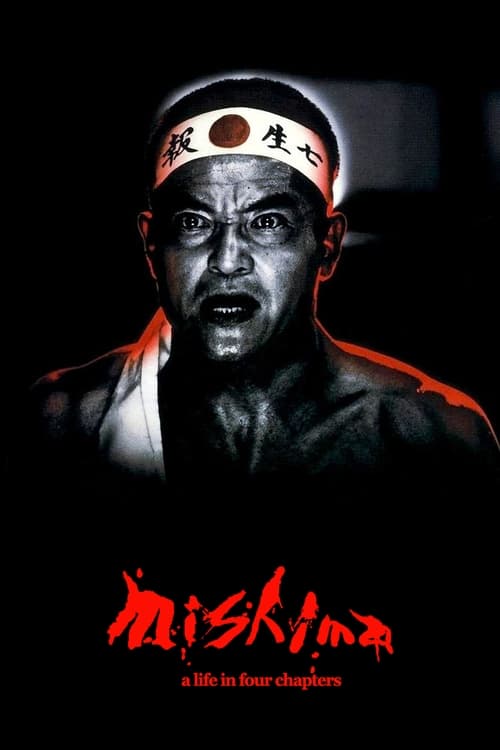
Mishima: A Life in Four Chapters
1985 · Paul Schrader
For a night when you want ambition — a film to chew on for days about art, obsession, and the gap between the life one lives and the self one performs. Challenge, not comfort, but ravishing challenge.
What it's about
A portrait of Yukio Mishima — Japan's most famous postwar novelist, bodybuilder, and nationalist provocateur — built around the last day of his life in November 1970, when he and members of his private militia stormed a military garrison. Rather than straight biography, the film braids three strands: the final day in naturalistic color, his life story in black-and-white, and dazzling theatrical stagings of scenes from his novels, letting the fiction explain the man.
The experience
Hypnotic and formally thrilling — you're pulled between three visual worlds while a relentless score drives everything toward a conclusion history already wrote. It's cerebral but never dry; the sheer beauty keeps you leaning forward.
Performances
Ken Ogata plays Mishima with coiled control, making a man of extreme contradictions — aesthete and militarist, celebrity and ascetic — feel like a single burning person.
The craft
Eiko Ishioka's production design turns the novel sequences into jewel-box theater sets of saturated color, John Bailey's camera moves between three distinct visual registers, and Philip Glass's surging score — one of his greatest — binds it all together. It absolutely rewards a big screen and good speakers.
Why it matters
A famously uncommercial gamble (produced with backing from Coppola and Lucas, effectively unreleasable in Japan) that became Schrader's most acclaimed directorial work and a model for what a biographical film can be.
Snapshot
Mishima: A Life in Four Chapters is Paul Schrader's formally audacious biographical film about the Japanese novelist Yukio Mishima (born Kimitake Hiraoka), organized around the last day of his life — November 25, 1970 — when, with four members of his private militia, the Tatenokai (Shield Society), he seized command of a garrison of Japan's Self-Defense Forces at Ichigaya, delivered a balcony harangue calling for the restoration of imperial reverence, and then committed ritual suicide by seppuku. Rather than tell this story as conventional biography, Schrader braids three registers: naturalistic color scenes of the coup attempt and suicide; black-and-white episodes reconstructing Mishima's life from a sickly, aesthetically obsessed childhood to literary fame; and highly stylized, theatrically artificial dramatizations of three of his novels, staged on soundstage sets. The film is divided into four titled chapters — "Beauty," "Art," "Action," and "Harmony of Pen and Sword" — with each of the first three anchored by one novel, and the last collapsing biography and present-tense action into a single arc toward death. It is at once a work of formal art-cinema experiment and a deeply personal statement from a director whose recurring subject is the man who wills his own destruction to redeem a compromised life.
Industry & production
The film was an unusual international co-production, American in authorship and financing but Japanese in cast, crew, language, and setting. It carried the imprimatur of two of the era's most powerful New Hollywood figures: Francis Ford Coppola and George Lucas served as executive producers, lending the project the credibility (and studio leverage) that allowed a determinedly non-commercial art film to be made and distributed. It was produced under the Zoetrope banner with Tom Luddy and Mata Yamamoto among the producers, drew on Japanese production partners for its on-the-ground shoot, and was released in the United States through Warner Bros. The screenplay was written by Paul Schrader with his brother Leonard Schrader — long a Japan specialist — and Leonard's wife Chieko Schrader contributed substantially to the Japanese-language dialogue.
The picture was shot in Japan with a largely Japanese cast headed by Ken Ogata. Its production was shadowed by controversy that has followed it ever since. Mishima remained (and remains) a charged figure for the Japanese right, and his widow, Yoko Hiraoka, objected to the project — reportedly in part over its treatment of Mishima's homosexuality — withholding rights to certain material and, according to the long-standing account, forcing changes to the depiction of his private life. The film has never received a proper theatrical release in Japan, owing to a combination of family objection and the threat of right-wing reprisal; that suppression is one of the defining facts of its reception history. It premiered in competition at the 1985 Cannes Film Festival, where it won the Best Artistic Contribution prize (Prix de la contribution artistique), an award that pointedly recognized the collaborative achievement of its cinematography, production design, and music.
Commercially the film was not a success, and it is fair to say the record here is one of modest returns rather than documented figures I can responsibly cite; it was received as a prestige art film and found its lasting audience on home video and, decades later, through the Criterion Collection.
Technology
Mishima is a photochemical, 35mm production of the mid-1980s, made before digital tools would have offered any shortcut to its layered look; its formal complexity is achieved entirely through in-camera and on-set means — physical set construction, controlled studio lighting, colored gels, and the deliberate use of monochrome versus color stock as a structural device. The most consequential "technology" of the film is arguably theatrical and architectural rather than cinematic: purpose-built, stylized stage sets that could be lit and shot like cinema but read like theater. The score, by Philip Glass, belongs to his mature minimalist idiom for large ensemble and strings; the film is a landmark instance of that repetitive, arpeggiated compositional language being deployed as a driving cinematic force rather than as background underscore.
Technique
Cinematography
John Bailey, Schrader's frequent collaborator (from American Gigolo onward), shot the film, and his central task was to give each of the three narrative registers a distinct and legible visual identity. The biographical past is rendered in expressive black and white, evoking both memory and the period textures of prewar and postwar Japan. The final day — the drive to Ichigaya, the seizure of the base, the suicide — is shot in relatively restrained, observational color, grounding the fantastical material in documentary-like immediacy. The novel adaptations, by contrast, are photographed in saturated, jewel-toned color against manifestly artificial sets, the camera embracing frontality and theatrical framing. The interplay of these palettes — and the movement between them — is the film's primary expressive engine, and it earned Bailey a share of the Cannes artistic prize.
Editing
Michael Chandler edited the film, and the editing is where its ambition truly lives, because the four-chapter architecture depends on cross-cutting among three time frames and modes without disorienting the viewer. The film continually intercuts the present-tense coup with biographical flashback and with the relevant novel, so that fiction, memory, and action comment on one another — a passage from Runaway Horses, for instance, rhyming with Mishima's own march toward violent self-immolation. The cutting builds toward a climactic convergence in the fourth chapter, where the boundaries between the novelist's imagined deaths and his actual one dissolve.
Mise-en-scène / staging
The staging of the novel sequences is the film's signature, and it is the work of the Japanese art director and graphic designer Eiko Ishioka, for whom this was a career-defining project. Ishioka designed the fictional worlds as overtly theatrical constructions — sets that split open, rotate, and reconfigure, bathed in bold monochromatic color fields (the burning gold of the pavilion, an intense rose-pink interior, and so on). These are spaces that announce their own artifice, insisting that we are inside Mishima's imagination rather than in a reconstructed reality. Against them, the naturalistic staging of the final day gains its terrible weight. The contrast dramatizes the film's central idea: the collision between the beautiful, controlled world of art and the irreversible fact of the body and death.
Sound
The Philip Glass score is inseparable from the film's identity and functions almost as a fourth narrative voice, its pulsing, cyclical figures propelling the action and unifying the disparate registers. Glass wrote distinct material across the film's sections, and the music's momentum lends even static, tableau-like images a sense of inexorable forward drive. The film also carries voice-over narration drawn from Mishima's own writings and reflections; in the English-language version the narration is delivered by Roy Scheider, while the Japanese version uses Ken Ogata's voice. Beyond the score, the sound design leans on the quiet of ritual and the sudden ruptures of violence.
Performance
Ken Ogata anchors the film as the adult Mishima, and his performance holds together a character presented across multiple modes and ages — the public intellectual, the bodybuilder and martial-arts aesthete, the disciplined leader marching his followers to catastrophe. Ogata plays Mishima with a contained intensity that resists both hagiography and mockery, allowing the contradictions — vanity and rigor, tenderness and fanaticism — to coexist. The surrounding Japanese ensemble populates both the biographical scenes and the stylized novel worlds, several performers appearing in more than one register, which reinforces the sense that Mishima's fictions are populated by refractions of himself.
Narrative & dramatic mode
The film's mode is essayistic and reflexive rather than conventionally dramatic; it is a biography that refuses biography's usual claim to transparent access to a life. By dramatizing Mishima's novels alongside his life, Schrader advances an argument — that the man cannot be understood apart from his art, and that his death was the final work in which pen and sword were fused. The four-part structure is itself a thesis: "Beauty," "Art," and "Action" name successive stages of Mishima's project, and "Harmony of Pen and Sword" names its consummation. The result is a film built on parallelism and rhyme, in which meaning arises from the juxtaposition of fiction and fact rather than from a linear cause-and-effect plot. It is, in the fullest sense, an art film about the relationship between an artist's imagination and his fate.
Genre & cycle
Nominally a biographical drama (biopic), Mishima stands almost entirely apart from the conventions of that genre, which typically pursue a cradle-to-grave arc grounded in verisimilitude. It belongs more truly to a lineage of formally ambitious, modernist artist-portraits — films that treat a creative life as an occasion for cinematic experiment. Within Schrader's own filmography it belongs to his cycle of self-destructive protagonists and men of obsessive, ascetic discipline. It also participates, at a distance, in the tradition of films about writers and the problem of representing interior, literary creation on screen — a problem Schrader solves not by illustration but by staging the novels as theater.
Authorship & method
Mishima is widely regarded as Paul Schrader's most fully realized film and the clearest statement of his artistic preoccupations. A former critic who wrote the influential study Transcendental Style in Film (on Ozu, Bresson, and Dreyer) and who scripted Taxi Driver and Raging Bull, Schrader was drawn to Mishima as the ultimate expression of his lifelong subject: the ascetic, self-loathing man who seeks transcendence through a violent, purifying act. The film was a genuinely collaborative authorship. The screenplay's Japanese dimension owed much to Leonard Schrader's deep knowledge of the country and to Chieko Schrader's work on the language. John Bailey's tripartite cinematography, Michael Chandler's architectural editing, Eiko Ishioka's theatrical production design, and above all Philip Glass's score are not decorative contributions but co-equal authorial voices — the Cannes jury's decision to honor the film for its collective artistic contribution recognized precisely this. Glass's music, in particular, went on to have an independent life: he later adapted material from the score into a work for string quartet, extending the film's cultural footprint well beyond the screen.
Movement / national cinema
The film occupies an unusual position between national cinemas. It is an American auteur's film about the most Japanese of subjects, made in Japanese with a Japanese cast and crew, yet financed and authored from within the New Hollywood/American independent orbit associated with Coppola and Lucas. It is not a Japanese film in any institutional sense — indeed it was effectively exiled from Japanese screens — but it is saturated with Japanese aesthetics, from its evocation of Noh and Kabuki theatricality in the staged sequences to its engagement with the samurai ethos and the iconography of the imperial nation. It thus belongs to a small category of cross-cultural art films in which an outsider's formal sensibility is brought to bear on a national mythology from within.
Era / period
Made in the mid-1980s, Mishima reflects a moment when ambitious American directors could still, with the backing of powerful patrons, mount uncompromising art films inside or alongside the studio system. Its subject reaches back across the twentieth century — Mishima's prewar childhood, the trauma of Japan's wartime defeat and the emperor's renunciation of divinity, and the ideological ferment of 1960s Japan against which Mishima's reactionary romanticism took shape. The film's central event, the 1970 coup and suicide, is treated as the culmination of postwar Japan's crisis of identity as Mishima diagnosed it: a nation, in his view, that had traded spirit for prosperity.
Themes
The film's governing theme is the fusion of art and action — the "harmony of pen and sword" (bunbu-ryōdō) that gives the fourth chapter its name — and Mishima's conviction that words are insufficient and must ultimately be authenticated by the body and by death. Around this cluster its other themes: the pursuit of beauty and its entanglement with destruction; the discipline and cult of the body as a defense against decay; purity and the longing for a transcendent, sacrificial act; the tension between the artist's controlled inner world and the uncontrollable real; and nationalism, emperor-worship, and the romance of a lost heroic ideal. The staged novels function thematically as well as formally — a young acolyte's obsession with, and destruction of, a perfect building; the worship of the physical form; a young zealot's political martyrdom — each rehearsing an aspect of the death Mishima would ultimately enact himself. The film also touches, within the constraints imposed on it, on repression and desire.
Reception, canon & influence
Critical reception outside Japan was strong, with particular praise for the film's formal daring, Ishioka's designs, and Glass's score; the Cannes artistic prize confirmed its standing among critics and festival audiences. Its reputation has grown steadily, and it is now widely regarded as among the finest films of the 1980s and Schrader's masterpiece, its canonization sealed by its inclusion in the Criterion Collection. The most persistent fact of its reception, however, remains its suppression in Japan, where objections from Mishima's family and the threat of nationalist violence kept it from theatrical release — a striking case of a film's afterlife being shaped as much by political circumstance as by aesthetic judgment.
Backward, the film draws on a rich set of influences: Mishima's own novels and public persona; the theatrical traditions of Japan; Schrader's transcendental-style touchstones (Ozu, Bresson) and his abiding interest in the redemptive violent act that runs through his Taxi Driver/Raging Bull work; and the modernist biographical film's refusal of linear life-storytelling. Forward, its influence is felt wherever filmmakers have sought to dramatize a creative interior through overt stylization rather than realism, and in the enduring cultural presence of Philip Glass's music, which — carried into the concert hall through his string-quartet adaptation — became one of the most recognizable film scores of its era. The film's fusion of biography, adaptation, and stylized theater remains a reference point for ambitious portraits of the artist, and its reputation as a singular, uncompromising achievement has only deepened with time.
A Deleuzian reading
A gold pavilion burns on a stage that can rotate and split apart.
The full Deleuzian reading of Mishima: A Life in Four Chapters →
Reception
A box-office flop in 1985 that couldn't even open in Japan — right-wing threats and objections from Mishima's widow kept it off Japanese screens — it's since been canonized as Schrader's masterpiece, with the Criterion treatment and a standing reputation as the biopic done right.
How Mishima: A Life in Four Chapters was received, from release to now →
How to watch Mishima: A Life in Four Chapters: what to notice on a first viewing
- Notice the film switch between black and white and two different colors. Bailey shoots Mishima's past in black and white, the final day in restrained color, and the novel scenes in saturated, jewel-toned color. The palette alone tells you which register, memory, present, or fiction, you're inside at any moment.
- Watch the novel scenes' sets openly announce themselves as sets. Ishioka designs rotating, splitting constructions bathed in single bold colors that never pretend to be real places. The artifice insists you are inside Mishima's imagination, not a reconstruction of his life.
- Listen for the same pulsing musical figure returning across scenes. Glass's cyclical patterns run through all three registers, giving even still, tableau-like images a constant forward drive. The music does the connective work a director's cut usually does, gluing three worlds into one momentum.
- Notice a chapter title appear before each new section. Beauty, Art, and Action each open with one of Mishima's own novels before folding back into his biography. The structure argues that his books and his life are being read as one continuous text.
- Watch Ogata hold both vanity and discipline in the same expression. He plays the writer, the bodybuilder, and the militant leader as versions that coexist rather than replace one another. None of his selves cancels the others out. They all stay visible at once.
The whole guide to watching Mishima: A Life in Four Chapters, with the keys for a rewatch →
Influences: the films it descends from and the films it influenced
- Citizen Kane (1941) — Established the prismatic biopic that assembles a life from non-chronological, competing fragments rather than a linear cradle-to-grave account — the modernist refusal of life-storytelling Mishima inherits directly.
- Pickpocket (1959) — The ascetic protagonist seeking transcendence through a single decisive act, narrated in first-person literary voiceover — a Bressonian model Schrader literally theorized in Transcendental Style in Film and rebuilt around Mishima's suicide.
- Late Spring (1949) — The frontal, static, tatami-height framing and contemplative stillness Schrader codified as 'transcendental style' underwrites the film's theatrical frontality and its refusal of conventional coverage.
- Hiroshima mon amour (1959) — Pioneered the essayistic literary voiceover braided across cross-cut timeframes, letting past and present interpenetrate as memory rather than flashback — the temporal grammar of Mishima's three interwoven strands.
- The Conformist (1970) — Storaro's color-coded flashback architecture, keying distinct timeframes to distinct palettes while probing a fascist interior, prefigures Bailey's tripartite color scheme and Mishima's nationalism theme.
- Throne of Blood (1957) — Imported Noh's masklike frontal performance and stylized theatrical staging into cinema — the same Noh/Kabuki artifice that governs Ishioka's stages and Ken Ogata's contained, ritualized intensity.
- Kwaidan (1964) — Built entire worlds from studio-bound, painted, overtly artificial theatrical sets — the anti-realist stagecraft that Eiko Ishioka's saturated, proscenium-like dramatization chapters extend.
- Taxi Driver (1976) — Schrader's own template of the self-loathing man narrating a diaristic voiceover toward a purifying violent act — the 'redemptive violence' throughline he then transposed onto a real artist's body.
- Edvard Munch (1974) — Structures a life through recurring motifs and interleaved registers of biography and artwork rather than linear chronology, inheriting Munch's associative, form-as-argument approach to the art biopic.
- Bram Stoker's Dracula (1992) — Eiko Ishioka's theatrical, hand-crafted, saturated costume-and-set design method carries forward from Mishima; Coppola, who executive-produced Mishima with Lucas, here foregrounds the same anti-realist stagecraft.
- The Fall (2006) — Extends Ishioka's production-design language of stylized, color-blocked tableaux into a story-within-a-story, dramatizing an interior life through overt artifice exactly as Mishima's fiction chapters do.
- The Hours (2002) — Uses a Philip Glass minimalist score as connective tissue binding three cross-cut timeframes of a literary life into a single triptych — Mishima's editing architecture and scoring strategy fused.
- I'm Not There (2007) — Shatters the artist-biopic into stylistically distinct, non-realist facets, dramatizing a creative persona through mode and metaphor rather than chronology — the modernist artist-biopic Mishima helped legitimize.
- Velvet Goldmine (1998) — Applies the Citizen Kane investigative structure to a stylized musician-artist, refracting the subject through theatrical set-pieces and testimony rather than linear biography.
- Steve Jobs (2015) — Stages a life in a rigorously partitioned act structure of discrete set-pieces rather than continuous chronology — the architectural, chaptered biopic form Mishima pioneered with its four titled movements.
- Jackie (2016) — Anti-realist biopic that fractures chronology and drives the portrait with a dissonant modernist score (Mica Levi), treating an icon's public performance of self as subject — Schrader's stylized-interior method updated.
- Love & Mercy (2014) — Cross-cuts two eras of a creative mind to externalize an artist's interior breakdown through formal juxtaposition rather than realist through-line, echoing Mishima's timeframe-interleaving to dramatize creativity.
- Before Night Falls (2000) — Interweaves a writer's own prose/fiction with a non-chronological biography so the author's texts narrate his life — the literary-voiceover-as-posthumous-coauthorship method Schnabel uses with Arenas's words.
- Naked Lunch (1991) — Braids an author's biography with stylized soundstage dramatizations of his fiction, the exact structural solution Cronenberg adopts to make a 'structurally impossible' text filmable.
- Leviathan (2014) — The use of Philip Glass's cyclic minimalism not as underscore but as an impersonal, oceanic frame that lends a single mortal a mythic scale — the curatorial move Zvyagintsev repeats with Akhnaten.
- Thirty Two Short Films About Glenn Gould (1993) — Replaces chronology with a declared numbered container and shifts register between color-saturated stylized stagings, monochrome biography and present-tense action, with Philip Glass's score composed as the structural spine that carries the cuts between incompatible worlds.
- Koyaanisqatsi (1982) — Immediately preceding Mishima, it made Philip Glass's arpeggiated, additive minimalism the structural engine driving the image rather than mere accompaniment — the co-equal scoring role Glass reprises here.
- First Reformed (2017) — Schrader's fullest late return to Bressonian transcendental style — ascetic diarist-protagonist, austere frontal framing, redemptive-violence crisis — the same authorial system that produced Mishima.
- Capote (2005) — The anti-cradle-to-grave artist biopic that compresses a life to a charged structure and stages contrasting worlds, prefiguring Futterman's single-episode compression.
- The Face of Another (1966) — Descendant in stylized staging: Eiko Ishioka's color-coded, overtly theatrical studio sets treat Japanese modernist space as psychological diagram — the heir to Isozaki's expressive clinical architecture.
Similar films
- Mind Game (2004) — often watched together
- Seven Samurai (1954) — often watched together
- In the Realm of the Senses (1976) — shared sensibility
- Godzilla Minus One (2023) — shared sensibility
- Ran (1985) — shared sensibility
- The Life of Oharu (1952) — shared sensibility
- Kokuho (2025) — shared sensibility
- Rashomon (1950) — shared sensibility