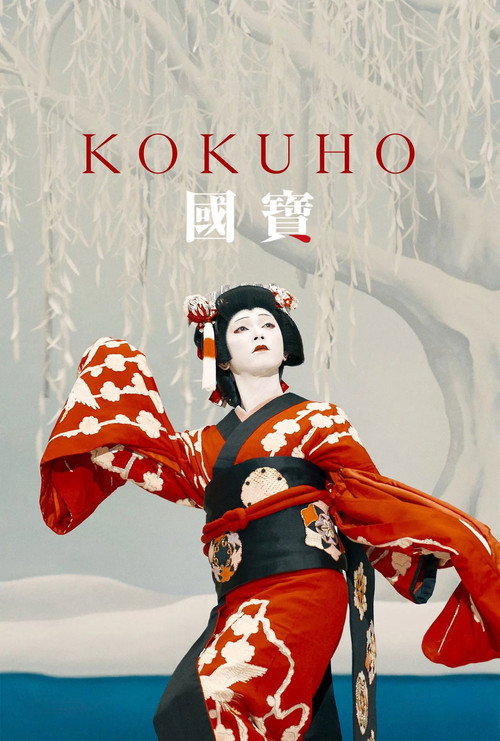
Kokuho
2025 · Sang-il Lee
For when you want a grand, decades-spanning epic about art and ambition — the kind of long, engrossing drama you clear a whole evening for and come out of slightly changed.
What it's about
Nagasaki, 1964: after his yakuza father is killed, fifteen-year-old Kikuo is taken in by a famous Kabuki actor and raised alongside the master's own son, Shunsuke. Both boys give their lives to the art of the onnagata — the male actor who plays female roles — and the film follows their intertwined rivalry and devotion across five decades, as one of them climbs toward becoming the greatest living master of the form.
The experience
Sweeping and sumptuous, it moves like a saga — decades pass, fortunes reverse — while the extended Kabuki performances themselves are hypnotic set pieces where the real drama plays out on stage. It's a film about obsession and the price of greatness, and it leaves you both exhilarated and bruised.
The craft
Director Lee Sang-il stages the Kabuki sequences with genuine theatrical splendor — costume, makeup, and stylized movement filmed to let you feel why an audience would worship these performers. At 175 minutes, adapted from Shūichi Yoshida's two-volume novel, it earns its scale, and the stagecraft alone rewards a big screen.
Why it matters
A phenomenon in Japan, it became the highest-grossing domestic live-action film in the country's history and brought the closed world of Kabuki to a massive contemporary audience.
Snapshot
Kokuho (国宝, "National Treasure") is a 175-minute period drama that follows a single Kabuki onnagata — the male specialist in female roles — across half a century, from Nagasaki in 1964 to the mid-2010s. Adapted from Shūichi Yoshida's two-volume 2018 novel, it charts Kikuo, the orphaned son of a slain yakuza boss, as he is absorbed into the household of a great Kabuki actor, raised beside the master's biological son Shunsuke, and slowly overtakes him to become the supreme interpreter of the form — ultimately designated a Living National Treasure, the honorific that gives the film its title. Directed by Lee Sang-il and premiered in the Directors' Fortnight at Cannes in May 2025, the film became a genuine cultural event in Japan: it surpassed Bayside Shakedown 2 to become the highest-grossing domestic live-action film in the country's history, a record that had stood for more than two decades. It is at once an intimate two-hander about artistic rivalry and a lavish institutional epic about a tradition that consumes its practitioners.
Industry & production
Kokuho was produced by Myriagon Studio and Credeus and distributed by Toho, on a reported budget of roughly ¥1.2 billion (about US$8 million) — substantial by Japanese standards, though modest against the scale of what appears onscreen. Its commercial performance dwarfed that outlay many times over, and its box-office run reframed a prestige literary adaptation about a cloistered classical art as one of the most successful Japanese films ever made domestically — an outcome that ran against the received industry wisdom that Kabuki is too rarefied to draw a mass audience.
The production's defining choice was time and immersion. The two leads, Ryo Yoshizawa (Kikuo) and Ryusei Yokohama (Shunsuke), trained for roughly eighteen months under the Kamigata Kabuki actor Nakamura Ganjirō IV before a compressed three-month shoot. That preparation is the film's economic and artistic hinge: because the performers execute recognizable passages of classical repertoire on camera rather than being doubled or elided, the film could stake its authority on visible craft. Lee has described the adaptation itself as the hardest problem — condensing an 800-plus-page novel first into a four-and-a-half-hour assembly and then down to three hours, a reduction that governs the film's elliptical, decade-skipping structure. The Oscar-nominated makeup and hairstyling work is inseparable from this production model, sustaining both period-accurate onnagata transformation and the aging of two men across fifty years.
Technology
Detailed technical specifications for Kokuho — capture format, camera systems, aspect ratio, color pipeline — are not well documented in the accessible public record, and I won't guess at them. What can be said with confidence is where the film's "technology" actually lives: in the applied crafts of the body and the stage rather than in visible digital spectacle. The most decorated technical achievement is its makeup and hairstyling, recognized with an Academy Award nomination — a discipline doing double duty here, reconstructing the white oshiroi base, painted features, and elaborate wigs of onnagata presentation while also carrying the actors convincingly through decades of aging. The other technical substrate is theatrical rather than cinematic: the reconstruction of stage machinery, lighting, and playing spaces so that Kabuki's own apparatus — the hanamichi runway, revolving stage, and highly codified lighting states — reads authentically. The film's engineering problem is fidelity to a living craft, not the invention of a new image technology.
Technique
Cinematography
The cinematographer is Sofian El Fani, the Tunisian-French director of photography best known internationally for Abdellatif Kechiche's Blue Is the Warmest Colour (2013) and Abderrahmane Sissako's Timbuktu (2014). Hiring an art-cinema DP from outside the Japanese studio system is itself an authorial statement, and the choice pays off in reviews that repeatedly single out the film as a visual achievement — it won the cinematography prize at the Japan Academy Prize. El Fani's sensibility, on the evidence of his prior work, favors close, mobile, skin-attentive observation of faces, which suits a film obsessed with the onnagata's made-up mask and the human strain beneath it. The film's central formal tension is between two registers of looking: the frontal, presentational geometry demanded by the Kabuki stage, and the intimate, roving camera that finds the private cost of performance in the wings. Where the record is thinner is in the specifics of individual set-ups; I'll describe the strategy the film clearly pursues rather than claim shot-by-shot detail I can't verify.
Editing
Cut by Lee's collaborator Tsuyoshi Imai, the film's editorial task was severe: to render a fifty-year, two-volume novel as a coherent three-hour arc after an initial four-and-a-half-hour version. The consequence is a structure built on ellipsis — decades collapse between scenes, and the audience is asked to read time through changed faces, altered status, and shifts in the two men's relative standing. Reviewers describe the film as "propulsive" despite its length, which points to an editorial rhythm that uses the recurring performance set-pieces as tent-poles, letting fully staged dances and plays run at length while narrative connective tissue is compressed hard around them. The performances are, in effect, the film's paragraph breaks.
Mise-en-scène / staging
This is the film's richest technical dimension, because Kokuho is a film about staging. Its mise-en-scène operates on two planes at once: the diegetic Kabuki stage, with its rigorous conventions of pose (mie), the hanamichi extending into the audience, and the flat brilliance of theatrical lighting; and the offstage world of dressing rooms, family compounds, and the institutional machinery of a hereditary art. Lee stages the contrast between blood and talent spatially — the biological heir and the adopted outsider are repeatedly composed within the same familial and theatrical frames, their positions within them shifting as the balance of gift and legitimacy changes. The featured repertoire is chosen for its onnagata prestige: the dances Sagi Musume (Heron Maiden) and Fuji Musume (Wisteria Maiden), the twin-role Ninin Dōjōji, and Chikamatsu's love-suicide play Sonezaki Shinjū. These are not decorative; each is a woman conjured entirely by a man's body, and the film uses them as arguments about what the art demands.
Sound
The score is by Marihiko Hara, a Japanese composer and sound artist associated with contemporary-classical and ambient idioms and with the interdisciplinary performance milieu around Dumb Type. His involvement suggests a scoring approach that sets restrained, texture-forward modern music against the diegetic sound-world of Kabuki — the shamisen, percussion, and chanted narration (gidayū) that accompany the classical performances. The productive friction in the film's sound design is between that codified traditional music, which belongs to the stage, and the sparer contemporary score that belongs to the characters' inner lives. Precise cues and mixing choices are not documented in the sources available to me, so I'll flag that as a genuine gap rather than describe it in invented detail.
Performance
Performance is the film's subject and its medium, and its two central turns were widely singled out. Yoshizawa, as Kikuo, must be persuasive both as a man and as the women he embodies onstage — a double transformation that the eighteen-month training regimen exists to make credible — while tracing an arc from feral outsider to consecrated master. Yokohama, as Shunsuke, carries the more thankless and arguably more difficult role: the legitimate heir whose diligence cannot close the gap left by a rival's genius. Around them, Ken Watanabe anchors the older generation as the master Hanjirō, and the presence of the legendary Butoh dancer Min Tanaka in the cast signals how seriously the film treats embodied movement. The Japan Academy Prize acting awards confirm the consensus that the film's authority rests, finally, on bodies that have actually learned the art they depict.
Narrative & dramatic mode
Kokuho works in the mode of the artist's-life epic crossed with the melodrama of rivalry — closer to the tradition of A Star Is Born or Amadeus than to a docudrama of Kabuki. Its engine is the ancient tension between talent and legitimacy: the gifted outsider versus the dutiful bloodline heir, in an art where lineage is not incidental but structurally decisive, since Kabuki families pass down names, roles, and standing across generations. The dramatic mode is unashamedly emotional and expansive, using the long time-span to convert rivalry into something more elegiac — the two men bound for life by a love and competition neither can escape. The film also sustains a persistent double meaning around performance itself: the onnagata's art is the impersonation of a woman, and the drama keeps asking what is sacrificed, in a life, to sustain a mask that convincing.
Genre & cycle
Formally the film sits at the intersection of the jidaigeki-adjacent tradition of Kabuki-set drama and the modern prestige literary adaptation. It belongs, most specifically, to a small but real cycle of Japanese films about the onnagata and the price of the female-role art — a lineage whose most famous ancestor is Kon Ichikawa's An Actor's Revenge (1963), also centered on a male performer of women's roles. It also belongs to the broader international cycle of "great artist" biographical fictions and to a Japanese wave of high-gloss, novel-derived adult dramas backed by major studios. Its commercial success suggests it may itself define a template — proof that a classical-art subject can carry a blockbuster — rather than merely following one.
Authorship & method
Lee Sang-il (b. 1974, Niigata) is a Zainichi Korean director whose body of work — Hula Girls (2006), Villain (2010), Unforgiven (2013, his transposition of Eastwood's Western), and Rage (2016) — returns insistently to outsiders, belonging, and the violence of social judgment. Kokuho is his third feature drawn from Shūichi Yoshida, after Villain and Rage, and it is easy to see why the material suited him: a story about an outsider seeking legitimacy inside a closed, hereditary Japanese institution maps directly onto Lee's career-long preoccupations, arguably inflected by his own position as a Korean-Japanese artist working at the center of Japanese culture. His method here is one of immersion and craft-realism — long actor preparation, an insistence on real onstage execution — married to a willingness to hire outside the national norm.
That last instinct shapes his collaborators. The screenplay is by Satoko Okudera, a veteran adapter best known for animation (The Girl Who Leapt Through Time, Summer Wars, Wolf Children), whose task was the brutal compression of Yoshida's two volumes. The cinematography is by the international art-house DP Sofian El Fani; the score by the contemporary sound artist Marihiko Hara; the editing by Lee's regular collaborator Tsuyoshi Imai. The overall authorial signature is a fusion of Japanese institutional subject matter with a deliberately cosmopolitan craft team.
Movement / national cinema
Kokuho is a work of mainstream Japanese national cinema that nonetheless carries the traces of a border-crossing authorship. It stands in the modern tradition of the Toho-backed prestige adaptation, but its creative team — a Zainichi Korean director, a Tunisian-French cinematographer — quietly complicates any purely national reading. The film's subject, meanwhile, is one of the most nationally coded imaginable: Kabuki as a designated Important Intangible Cultural Property and its masters as literal National Treasures. The film thus enacts a productive paradox — a story about the guardianship of Japanese cultural essence, told partly from perspectives that sit at the edges of that essence, and it became Japan's official submission for the Best International Feature Film Oscar, its national standard-bearer abroad.
Era / period
The film is a period piece spanning roughly 1964 to the 2010s, and its historical frame is meaningful. Beginning in 1964 — the year of the Tokyo Olympics, a moment of national self-fashioning — it tracks the postwar decades during which traditional arts negotiated their place in a modernizing, commercializing Japan. The half-century sweep lets the film register the changing status of Kabuki itself: from mid-century vitality through the anxieties of relevance to the late-period apparatus of official cultural preservation that crowns its protagonist. The period detail — production design, hair, and makeup evolving across the decades — is part of the film's Oscar-recognized craft achievement and part of its argument that an art form and the men who serve it age together.
Themes
At its core the film is about the price of art — what a total commitment to a demanding, self-erasing craft costs a human life. Braided through that are its persistent oppositions: talent versus lineage; the outsider versus the insider; authenticity versus performance. The onnagata premise sharpens all of these, making gender and impersonation a recurring theme — the highest artistic truth achieved through the most complete disguise. The film also meditates on legacy and succession, the transmission of names and roles across generations, and on rivalry as a form of love that outlasts every other bond. Beneath these runs a quieter interrogation, resonant with Lee's other work, of who is permitted to embody a culture's most sacred forms, and what belonging finally requires of them.
Reception, canon & influence
Critically, Kokuho was received as a major achievement, premiering to strong notices at the Directors' Fortnight in Cannes and drawing consistent praise for its performances, direction, cinematography, and makeup; it swept the Japan Academy Prize, winning Best Film, Director, Actor, Screenplay, and Cinematography, among others, alongside Blue Ribbon, Hōchi, and Kinema Junpō honors. Internationally it earned an Academy Award nomination for Best Makeup and Hairstyling and stood as Japan's Best International Feature submission. Commercially, it became the highest-grossing Japanese live-action film in domestic history, ending a record that had held since 2003.
The influences flowing into the film are legible: Yoshida Shūichi's novel as source; Lee's own prior Yoshida adaptations as method; and, in the wider culture, the tradition of onnagata cinema descending from Ichikawa's An Actor's Revenge, together with the international "artist's-life" epic. What it will shape forward is only beginning to be knowable, and honesty requires caution here — a film barely a year old has not yet accrued a documented legacy. But its commercial breakthrough has an obvious potential consequence: it demonstrated that a serious, nearly three-hour film about a classical art can become a national blockbuster, which may embolden Japanese studios to back ambitious prestige adaptations rather than treat them as niche. Whether Kokuho becomes a durable canonical reference for future films about Kabuki, or simply a spectacular one-off success, is a judgment the record cannot yet support.
Reception
It premiered quietly in Cannes' Directors' Fortnight in May 2025, then became the sleeper phenomenon of the decade at home: a three-hour kabuki drama that word-of-mouth carried for months until it dethroned Bayside Shakedown 2's 22-year-old record to become the highest-grossing Japanese live-action film ever. By early 2026 it had swept the Japan Academy Prize nominations — from arthouse curio to national event in under a year.
How Kokuho was received, from release to now →
Influences: the films it descends from and the films it influenced
- The Story of the Last Chrysanthemum (1939) — Mizoguchi's Kabuki artist's-life template — an adopted heir who must prove genuine talent against an inherited name, dramatized in long unbroken takes of onstage rehearsal and backstage discipline — supplies Kokuho's talent-versus-lineage spine and its craft-realist staging of real performance.
- An Actor's Revenge (1963) — Ichikawa founded the onnagata-protagonist film, framing the female-impersonator's mie in frontal widescreen theatrical geometry with footlight/stage-facing compositions that Kokuho directly revives in its hanamichi-and-mie stage framing.
- The Red Shoes (1948) — The premise that a performer is consumed and destroyed by total devotion to an art, dramatized through an extended fully-staged diegetic performance sequence rather than backstage summary, is the price-of-art tragic architecture Kokuho inherits.
- Amadeus (1984) — Forman's rival structure — a prodigious outsider talent measured against a rival who possesses legitimacy and status but not genius — is the 'blood-versus-talent' engine Kokuho transposes into a closed hereditary Kabuki house.
- The Last Emperor (1987) — Bertolucci's decade-skipping ellipsis binding one life to a closed ceremonial institution across mid-century national upheaval models Kokuho's editing compression of a 1964-to-2010s epic without losing the immersive institutional world.
- Farewell My Concubine (1993) — A near-exact analog: a male opera performer trained from childhood into the female dan role across a decade-skipping national epic, sharing the onnagata gender-impersonation, the blood-versus-talent brotherhood rivalry, and the tragedy of a man who becomes the woman he plays onstage.
- Floating Weeds (1959) — Ozu's rigorously frontal, stage-facing geometry and his portrait of a Kabuki-derived traveling troupe's offstage domestic lives inform Kokuho's frontal-stage framing and its onstage/backstage counterpoint.
- Hula Girls (2006) — Lee's own craft-realism performance-training film — outsiders drilled into a real dance discipline whose execution is shot for real, not faked in cutaways — is the method rehearsal for Kokuho's insistence on authentic onstage Kabuki performance.
- Villain (2010) — Lee's first Yoshida Shūichi adaptation established his method of compressing the novelist's long social-judgment narratives about outsiders seeking legitimacy — the same authorial adaptation craft, honed again on Rage, that produces Kokuho.
- Blue Is the Warmest Color (2013) — Kokuho's DP Sofian El Fani deploys the same mobile, skin-attentive extreme-close-up handheld register he pioneered here, reading emotion off pores, sweat, and faces in tight pursuit rather than composed master shots.
- Black Swan (2010) — Aronofsky's performer-doubling — a single body transforming into its feminine stage role at literal bodily cost, shot in close pursuit of skin and back — parallels Kokuho's onnagata double-transformation and price-of-art self-consumption.
- Whiplash (2014) — Chazelle's craft-realism of punishing training, where mastery is drawn literally in blood and the rehearsal room is filmed as a site of violence, matches Kokuho's real-execution ethic and its blood-versus-talent moral.
- The Wrestler (2008) — Aronofsky's following-camera locked to a performer's back and skin, treating the ring as a craft-realist stage and the aging body as the medium, prefigures Kokuho's mobile-skin cinematography and its makeup-technology of aging a performer across decades.
- The King and the Clown (2005) — A Korean sibling to the onnagata cycle: a male performer of feminine court roles whose gender-ambiguous artistry becomes both his gift and his doom, extending the same gender-impersonation-as-craft and price-of-art within a hierarchical performance institution.
- M. Butterfly (1993) — Cronenberg's Peking-opera dan illusion — a female-role male performer whose art sustains a total, believed gender illusion — is a sibling meditation on onnagata impersonation as a craft so complete it overwrites the performer's own identity.
Similar films
- Ran (1985) — shared sensibility
- The Life of Oharu (1952) — shared sensibility
- The Handmaiden (2016) — shared sensibility
- Memoirs of a Geisha (2005) — shared sensibility
- In the Realm of the Senses (1976) — shared sensibility
- The Boy and the Heron (2023) — shared sensibility
- Gate of Hell (1953) — shared sensibility
- Moving (1993) — shared sensibility