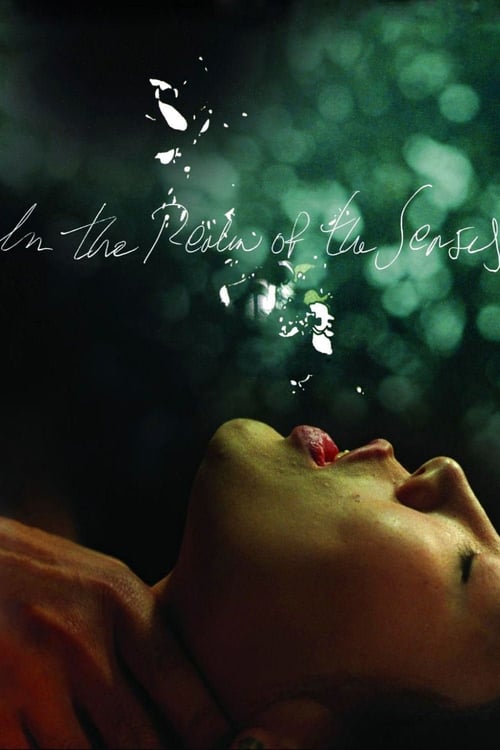
In the Realm of the Senses
1976 · Nagisa Ōshima
Strictly for when you're up for a challenge: a transgressive landmark to approach with clear eyes and an open mind, not date-night viewing. Reach for it when you want cinema that tests where the line is and why it's there.
What it's about
Tokyo, 1936, drawn from a true story: Sada, a former prostitute working as a maid in an inn, begins an affair with Kichizō, the married man who employs her. The two withdraw from the world almost entirely — into rented rooms, sake, and an erotic obsession that keeps escalating in intensity and risk, feeding on jealousy and shutting out everything else.
The experience
Claustrophobic, hypnotic, and genuinely confrontational — the sex is unsimulated and unblinking, and the film's hothouse intimacy becomes suffocating by design. It's meant to unsettle, and it does.
The craft
Ōshima staged the sexual content for real, as a deliberate assault on Japanese obscenity law and on the wall between art film and pornography — the film had to be processed and released through France to exist at all. Within its sealed interiors, the compositions are formally rigorous and richly colored, closer to ritual than titillation.
Why it matters
One of the most famous censorship battles in film history, banned or cut in many countries for decades, and a permanent reference point in every argument about explicit sex on screen.
Snapshot
In the Realm of the Senses (愛のコリーダ, Ai no Korīda; released in France as L'Empire des sens) is Nagisa Ōshima's most notorious and most internationally visible film: a dramatization of the 1936 Sada Abe affair rendered as a chamber piece of escalating, finally fatal erotic obsession. Two lovers — Sada, a former prostitute working as a maid, and Kichizō, the married innkeeper who employs her — withdraw progressively from the world into a sealed circuit of sex, jealousy, and ritualized risk, until Sada erotically asphyxiates Kichi and severs his genitals. What made the film an event, and a legal cause célèbre, was Ōshima's decision to stage its sexual content unsimulated, with actual penetration shown on screen. Conceived as a deliberate assault on Japanese obscenity law and on the boundary between pornography and art cinema, the film could not legally be processed in Japan; it exists as a Japanese film made, in effect, in legal exile. It remains a touchstone in any account of explicit content in serious cinema, and the central work of Ōshima's late period.
Industry & production
The film was a Japanese–French co-production, and the structure was not incidental but essential. Japan's penal code criminalized "obscene" material, and the explicit footage Ōshima intended could not be developed, edited, or exhibited domestically without prosecution. The French producer Anatole Dauman, of Argos Films — whose résumé already included Hiroshima mon amour, Bresson, and later Sans Soleil — financed the picture, with Ōshima's own production entity on the Japanese side. The practical arrangement, much repeated in accounts of the film, was that exposed negative was shipped undeveloped to France for processing and post-production, so that the legally sensitive material never had to clear a Japanese lab. The film could thus be classed as a French production while being, in authorship, language, cast, and setting, entirely Japanese.
This came at a particular moment in Ōshima's career. He had broken from the studio system years earlier and run his own independent company, Sōzōsha, through the 1960s and into the early 1970s; by the mid-1970s that vehicle had dissolved, and the Dauman partnership offered both funding and a way around domestic constraints. The picture premiered in 1976 on the international festival circuit — it screened at Cannes (in the Directors' Fortnight) and at the New York Film Festival, where it provoked controversy and customs/seizure problems that would recur in multiple territories. In Japan itself the film has only ever circulated in censored form, with the explicit imagery optically obscured (fogging/mosaic). The most consequential legal episode attached not to the film print directly but to a published book pairing the screenplay with still photographs: Ōshima was prosecuted for obscenity over that volume and was ultimately acquitted, a verdict he treated as a vindication of his larger argument about expression. The film generated enormous notoriety; precise box-office figures are not something I can reliably state, and I won't invent them.
Technology
Technically the film is conventional for its moment — 35mm color, standard exhibition format — and Ōshima makes no display of technical novelty. The significant "technology" is procedural rather than equipment-based: the cross-border lab-and-post pipeline described above, which turned a question of film processing into the load-bearing solution to a legal problem. The other relevant technical fact is negative one. Because of censorship, the version seen by Japanese audiences was altered at the optical stage, so that the "Japanese" Realm of the Senses and the version known abroad are materially different objects — a rare case where the censoring intervention is itself part of the work's technological history.
Technique
Cinematography
The cinematography is by Hideo Itō, and it is the film's most evident artistic signature alongside the performances. Itō works in saturated, lacquered color — deep reds, warm flesh tones, the patterned fabrics of kimono and bedding — and frames the lovers' encounters with a stillness and frontality that consciously evokes traditional Japanese pictorial art, in particular shunga, the erotic woodblock prints of the Edo period. The compositions are painterly and often static, privileging the arrangement of bodies, cloth, and screens within the tatami interior over camera movement. This pictorial restraint is deliberate: rather than the agitated handheld grammar associated with parts of the Japanese New Wave, Ōshima and Itō adopt an almost classical poise, which has the effect of presenting the explicit material with gravity rather than frenzy.
Editing
The editing (credited to Keiichi Uraoka, with the post-production completed in France) favors observational duration over fragmentation. Sexual scenes are frequently allowed to run, presented in sustained takes rather than cut into suggestive fragments, which is part of what distinguishes the film's address from both mainstream eroticism and conventional pornography. The overall structure is one of progressive narrowing — as the lovers retreat from the social world, the cutting and scene geography contract with them, so that the film's rhythm enacts its theme of enclosure. Where the world does intrude (the famous street passage discussed below), the editing registers it as a brief, pointed counter-movement before the door closes again.
Mise-en-scène / staging
This is fundamentally an interior film, staged in inn rooms, brothels, and tatami spaces, and its mise-en-scène is correspondingly theatrical — sliding screens, low furniture, futon and fabric, the architecture of the traditional Japanese room used as a frame and a stage. Critics have long noted a kabuki-like quality to the staging and a frieze-like arrangement of the figures. Period detail anchors the action in 1936, and the production design (art direction by Jusho Toda) sustains the closed, decorative world the lovers build around themselves. The single most cited staging gesture breaks this enclosure: Kichi walks down a street past a column of soldiers marching to war, moving against their direction — a wordless image that sets the lovers' inward, erotic withdrawal directly against the outward, militarist current of the era.
Sound
The score is by Minoru Miki, a composer associated with the revival and modern use of traditional Japanese instruments, and the soundtrack draws on idioms — shamisen and the textures of classical and popular Japanese song — that reinforce the period and cultural setting rather than importing a Western romantic vocabulary. Diegetic music (geisha song, instrumental performance) is woven into the inn world. The sound design otherwise stays close and intimate, matching the film's tactile, enclosed register.
Performance
The film rests almost entirely on its two leads. Tatsuya Fuji plays Kichizō, and Eiko Matsuda plays Sada Abe; the roles demanded not only the unsimulated sexual performances but a sustained emotional escalation from playfulness to obsession to a kind of trance. Fuji, already an established screen actor, gives Kichi a yielding, almost passive sensuality, the man increasingly subsumed by Sada's desire; the role significantly raised his international profile, and he would return for Ōshima's companion film. Matsuda's Sada carries the film's gravitational center — possessive, escalating, finally beyond reach of the ordinary world — and the performance is extraordinary, but it is also widely reported that the exposure and stigma attached to it effectively closed off her subsequent career in Japan and that she left the country; I'd flag that the biographical record here is thinner and more anecdotal than the production record, and should be treated with care.
Narrative & dramatic mode
The dramatic mode is that of a folie à deux told as tragic love story rather than as true-crime case study. Although it is grounded in a documented 1936 killing, the film declines the procedural or investigative frame; there is no detective, no trial, no moralizing external viewpoint. Instead the narrative is monomaniacal and centripetal, organized as a steady intensification in which each erotic episode raises the stakes — jealousy, role-play, pain, and finally erotic strangulation entered into by mutual consent. The lovers' world contracts until almost nothing outside the bedroom remains visible. The ending is presented less as crime than as consummation: Sada kills Kichi at the height of intimacy and severs his genitals, and a closing text situates the aftermath — her days of wandering Tokyo afterward — in the register of legend. The film thus converts a sensational scandal into a meditation on desire pushed to its absolute and self-annihilating limit.
Genre & cycle
The film sits at a charged intersection of genres. It is an erotic drama and an art film, but it was made in a Japanese commercial context saturated with sexual cinema — the pinku eiga tradition and, contemporaneously, Nikkatsu's "Roman Porno" line. Ōshima's project was in part to seize the explicitness of that commercial sphere and redeploy it as serious, politically conceived art, refusing the distinction between "pornography" and "cinema" as itself an object of critique. Internationally the film arrived amid a broader 1970s moment of explicit content entering theatrical respectability, but it is consistently distinguished from that cycle by its formal seriousness and its self-conscious theorization. Within Ōshima's own work it forms a clear pairing with his subsequent Empire of Passion (Ai no bōrei, 1978), again with Tatsuya Fuji and again a period story of illicit passion and death, for which Ōshima won the director's prize at Cannes.
Authorship & method
In the Realm of the Senses is a thoroughly authored film, and Ōshima approached it programmatically. He had articulated, in his critical writing, a conception of pornographic or explicit film as a legitimate and even necessary field of cinematic experiment, and the film is best read as the practical execution of that argument: a test of where the law, and the culture, drew the line around the body's representation, and a deliberate effort to cross it from within a rigorously composed art film. His key collaborators served that vision — Hideo Itō's lacquered, shunga-inflected cinematography; Minoru Miki's traditional-instrument score; Jusho Toda's period interiors; Keiichi Uraoka's editing, completed within the French production apparatus that Anatole Dauman's Argos Films made possible. Dauman's role as producer is itself part of the authorship story, since it was the French financing and post-production that allowed Ōshima to make the uncompromised film at all. Ōshima also wrote the screenplay, building it from the historical Sada Abe material.
Movement / national cinema
Ōshima is the central figure of the Japanese New Wave (Nūberu bāgu), the cohort that emerged around 1960 in reaction against both the classical studio cinema of the older masters and the political quiescence of postwar Japan. His earlier work was marked by political provocation, formal radicalism, and a confrontational stance toward Japanese institutions. In the Realm of the Senses belongs to a later phase of that trajectory, after his independent company had run its course, and it transposes the New Wave's confrontational energy from overt politics onto the terrain of the body and censorship — a shift that is, in his hands, still political. The film also belongs to the history of the 1970s international art-cinema co-production, in which a national auteur's vision was realized through European (here French) capital and infrastructure.
Era / period
Two periods matter. The film is set in 1936, and that date is not arbitrary: it is the threshold of intensifying Japanese militarism, the year associated with attempted military coup and the slide toward war, and the soldiers Kichi walks past make the historical backdrop explicit. The lovers' total absorption in private desire is staged against, and as a refusal of, that gathering national mobilization — eros as a withdrawal from history. The film was made in the mid-1970s, in a Japan whose obscenity regime Ōshima meant to confront, and its production and legal afterlife belong to that decade's larger contest over sexual representation in cinema worldwide.
Themes
The governing theme is the union of eros and death — desire followed without limit until it arrives, logically and almost serenely, at killing. Around that core the film develops several others: the body and sexuality as a sanctuary or refuge from politics and the demands of the state, set pointedly against the militarist 1936 backdrop; obsession and possession, with Sada's love curdling into a need to absolutely have and finally to keep Kichi; the inversion of conventional gender power, as the woman becomes the agent and the man the yielding object of consuming desire; and, at the meta-level, the politics of representation itself — what may be shown, who decides, and whether the line between art and obscenity can survive scrutiny. The film treats transgression not as titillation but as a route to a kind of transcendence, the lovers passing beyond the social world entirely.
Reception, canon & influence
Critically, the film was divisive from the start and has remained so, received by some as a masterpiece of erotic seriousness and by others as pornography under an art-house alibi. Its festival screenings drew both acclaim and scandal, and it ran into censorship, seizure, and customs obstruction across multiple countries, with delayed or altered releases in various territories; in Japan it has never been shown uncensored, and the associated obscenity prosecution of the screenplay book — ending in Ōshima's acquittal — became a landmark in Japanese debates over free expression. Over time the film has settled into the canon as the definitive case study in unsimulated sex within serious cinema and as one of Ōshima's defining achievements.
Looking backward, the film draws on the documented Sada Abe incident of 1936 (already a subject of Japanese fascination and earlier screen treatment), on the pictorial tradition of shunga, and on Ōshima's own theorization of explicit film; the French title's play on the imperial-of-the-senses construction also signals its dialogue with French intellectual culture of the period. Looking forward, its influence on later explicit art cinema is substantial and frequently invoked: it stands as a key precedent for the wave of directors who later incorporated unsimulated or extreme sexual content into auteur cinema — among them Catherine Breillat, the broader "New French Extremity," and English-language provocations such as Winterbottom's 9 Songs and Vincent Gallo's work — and for ongoing arguments about where art ends and pornography begins. Whenever that argument is had, In the Realm of the Senses is the film that gets named first.
A Deleuzian reading
A man walks down a street.
The full Deleuzian reading of In the Realm of the Senses →
Reception
A scandal on arrival — seized by US customs before its 1976 New York Film Festival screening and banned or cut in country after country — it's now a Criterion-canonised landmark of art cinema, though it has still never been shown uncensored in Japan.
How In the Realm of the Senses was received, from release to now →
Influences: the films it descends from and the films it influenced
- Tokyo Story (1953) — Bequeaths the tatami-height static frontal camera and rigid geometric framing of the Japanese interior, which Ōshima inherits wholesale and then turns to erotic, claustrophobic ends.
- Gate of Hell (1953) — Pioneers the lacquered, hyper-saturated period-color palette and meticulous historical interior reconstruction that Hideo Itō's shunga-inflected cinematography descends from.
- Kwaidan (1964) — Models the painterly artificial-color tableau, kabuki-frieze flattened staging, and traditional-instrument score (Takemitsu) that recur in Itō's compositions, Toda's interiors, and Miki's koto-driven music.
- Woman in the Dunes (1964) — Supplies the folie-à-deux structure of enclosure — two bodies sealed in a single confined space until the world outside dissolves — that organizes Realm's whole architecture.
- Daydream (1964) — Establishes the theatrically-released Japanese erotic film and the pinku-eiga context against which Ōshima defines his 'serious' explicit cinema.
- Death by Hanging (1968) — Ōshima's own Brechtian, frontally-staged chamber piece working a real criminal case toward political critique — the method Realm reapplies to the Sada Abe incident.
- Hiroshima mon amour (1959) — An eros-and-death two-hander produced through Anatole Dauman's Argos Films — the same French production-and-post apparatus that later financed Realm's uncensored form.
- Belle de Jour (1967) — Oshima films explicit sexual obsession with formal sobriety, no non-diegetic score, and clinical staging that refuses erotic titillation, inheriting Buñuel's method of defamiliarizing extreme content through equal visual register and scored silence rather than aestheticizing it.
- Last Tango in Paris (1972) — Oshima extends Last Tango's central wager — unsimulated/explicit sexuality as the engine of a serious art film about an obsessive sealed-off couple — pushing the erotic art-film toward literal hardcore within an authored frame.
- Empire of Passion (1978) — Ōshima's direct Argos-produced follow-up, extending the eros-and-death folie into a period ghost story with the same saturated interior craft.
- Romance (1999) — Carries forward the integration of unsimulated sexual performance into rigorously authored art cinema, the precedent for which Realm is the named first case.
- Intimacy (2001) — Stages unsimulated sex inside a chamber folie-à-deux of repeated enclosed encounters, descending from Realm's enclosure-plus-explicitness model.
- 9 Songs (2004) — An explicitly-cited heir using unsimulated sex as the structuring repetition of an enclosed two-person relationship.
- The Brown Bunny (2003) — Invokes Realm's gambit of placing a single unsimulated sexual act at the climactic center of an austere auteur film.
- Irréversible (2002) — A New French Extremity work extending Realm's wager that explicit corporeal violence and sex belong in serious cinema, weaponizing long-take duration.
- Lust, Caution (2007) — Builds extended near-explicit sex into a folie-à-deux of gender-power inversion set against 1930s–40s militarism — Realm's exact thematic-formal knot in a new register.
- Sympathy for Mr. Vengeance (2002) — East Asian art cinema's formal precedent for depicting bodies in extremity without moral framing or aesthetic distancing; the tradition of clinical representation that the Korean New Wave absorbed and redirected toward class-based violence.
- Thirst (2009) — Oshima's staging of transgressive sexuality within a claustrophobic domestic interior as a consuming, self-annihilating force provides the structural parallel Thirst inherits: vampiric desire recast as the same kind of total compulsion that literally destroys its subjects.
- Shame (2011) — Pioneered filming sexual compulsion through unbroken, clinically observed takes that refuse the titillating cutaway, the durational unflinching gaze Shame adopts toward addiction.
- Love Exposure (2008) — Explicit desire pushed past pornography into spiritual crisis — the transgressive fusion of eros and the sacred/obscene threshold Love Exposure lives on.
- Nymphomaniac: Vol. I (2013) — Pioneers unsimulated sex staged as rigorous art cinema tracking a woman's escalating, self-annihilating desire — the serious-cinema-explicit-content lineage Nymphomaniac consciously extends and complicates.
- A Woman Called Sada Abe (1975) — A Nikkatsu Roman Porno dramatization of the identical 1936 Sada Abe incident made one year earlier, whose pinku-eiga vocabulary Ōshima directly answers and elevates.
- Eros + Massacre (1969) — A Japanese New Wave companion fusing sexuality with historical-political critique through fragmented, frieze-like formal experiment.
- Funeral Parade of Roses (1969) — Shares the JNW project of yoking transgressive sexuality to radical formal device and a confrontational address of the body.
- Salò, or the 120 Days of Sodom (1976) — The immediate transgressive counterpart: explicit sexuality pushed past representability and into prosecution, posing the same art-versus-obscenity legal test that defined Salò's reception.
Similar films
- Hiroshima Mon Amour (1959) — influence & lineage · often watched together
- Woman in the Dunes (1964) — influence & lineage
- Gate of Hell (1953) — influence & lineage
- Lust, Caution (2007) — influence & lineage
- Enter the Void (2010) — often watched together
- The Night Porter (1974) — often watched together
- The Life of Oharu (1952) — shared sensibility
- Salò, or the 120 Days of Sodom (1976) — shared sensibility
All the films related to In the Realm of the Senses →
Film essays and courses that include it
- From Riot to Trial: A Century of Banned Cinema
- The Japanese Eye: Stillness, Violence, and the Grammar of a Cinema
- The Grammar of Longing: Cinema's Great Forbidden Love
- Eros Unrepressed: Cinema's Century of Desire
- Skin and Obsession: The Erotic Film from Provocation to Revival
- The Film They Tried to Stop: A Century of Festival Scandal
- The Wave Against the Masters