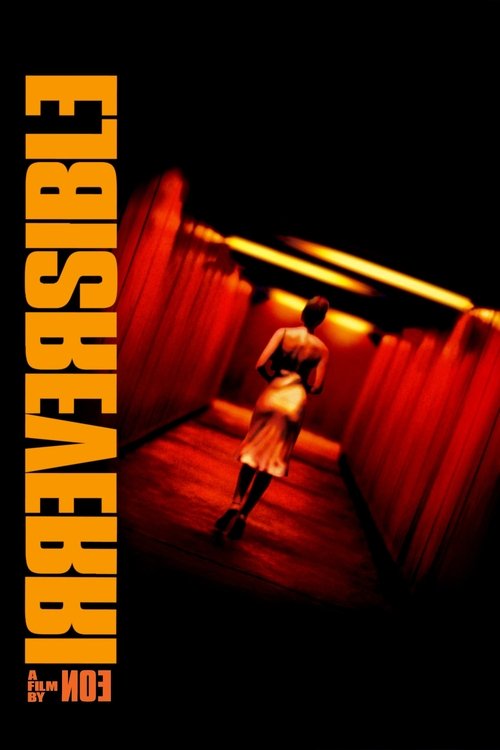
Irreversible
2002 · Gaspar Noé
Only for when you deliberately want cinema at its most confrontational — a film to test yourself against and argue about afterward, and one to avoid entirely if depictions of sexual violence are a line you don't want crossed.
What it's about
One night in Paris spirals out of a horrific crime: after a woman is brutally assaulted, her lover and her ex-boyfriend set out through the city's underworld to find the man responsible. The catch is the telling — the film runs in strict reverse, opening at the rage-blind end of the night and moving backward toward the tenderness where it all began.
The experience
An ordeal by design — its two centerpiece scenes are among the most notoriously hard-to-watch in modern cinema, and the lurching camerawork and droning sound are built to make you physically uneasy. Yet the backward structure means the film gets gentler as it goes, ending in warmth that the earlier horror makes almost unbearable to watch.
Performances
Monica Bellucci carries the film's most harrowing passage with shattering commitment, and Vincent Cassel — her real-life partner at the time — burns through the night scenes with feral, unraveling intensity.
The craft
Gaspar Noé's camera swirls, tumbles, and refuses to settle, each scene playing out in long unbroken takes stitched into a backward chain, while a subterranean electronic score weaponizes low frequencies to induce dread before anything even happens. It's filmmaking as sensory assault, engineered down to the sound mix — which is exactly why it's so divisive.
Why it matters
A scandal at Cannes and the flagship provocation of what critics dubbed the New French Extremity, it forced a lasting argument about whether depicting atrocity unflinchingly is moral seriousness or exploitation.
Snapshot
Irreversible is Gaspar Noé's second feature, a French drama-thriller built around a single brutal premise — a revenge spiral following a sexual assault — told in strict reverse chronological order. Beginning with credits that scroll the wrong way and ending in a sunlit park, the film inverts cause and effect so that the viewer arrives at tenderness only after passing through atrocity. It is best known for two extended, near-unwatchable set pieces: a fatal beating in an underground sex club, and a roughly nine-minute static-shot rape in a pedestrian underpass. The film became one of the defining provocations of early-2000s European cinema, a touchstone of what critics labeled the "New French Extremity," and a lightning rod for debates about screen violence, form, and moral responsibility. Its governing maxim, spoken and repeated — le temps détruit tout, "time destroys everything" — names both its theme and its formal wager.
Industry & production
Irreversible was a French production, financed and distributed within the milieu of audacious auteur-driven cinema that French companies tolerated more readily than most. Noé made it on the strength of his debut feature Seul contre tous (I Stand Alone, 1998), which had announced him as a transgressive talent. The casting of Monica Bellucci and Vincent Cassel — then one of the most visible couples in French cinema, married at the time — gave the project marquee value disproportionate to its budget and confrontational content; their real-life partnership lent the film's intimate scenes an additional charge that the marketing did not shy from.
The production was unusually loose by design. Noé worked without a conventional screenplay; the film was built from a roughly three-page outline, with scenes structured around situations and beats rather than scripted dialogue, and the actors improvising extensively. This method suited a film whose power depends on duration, escalation, and the appearance of unmediated event. The picture premiered in competition at the 2002 Cannes Film Festival, where it became the festival's scandal of the year, generating widely reported walkouts and faintings during the underpass sequence, and dividing critics sharply between those who saw moral seriousness and those who saw exploitation. That reception — notoriety as a form of publicity — shaped its international distribution as an art-house cause célèbre.
Technology
The film was shot largely on Super 16mm, a format whose grain and relative lightness suited both the budget and the restless handheld camerawork of the early reels. Noé and cinematographer Benoît Debie exploited the latitude of the gauge in extreme low light, particularly in the murky red interior of the club sequence.
Two technical interventions are central to the film's reputation. The first is acoustic: Noé has said the opening movement of the film employs a low-frequency tone of around 27 hertz — a near-subsonic rumble below comfortable hearing, in the range associated with nausea and unease — sustained beneath the imagery to physically destabilize the audience before any overt violence occurs. The second is the post-production manipulation of the image: the swirling, vertiginous camera of the early scenes was achieved through a combination of physically rotating handheld operation and digital intervention, the picture twisted and inverted so that floors become ceilings and the frame loses its bearings. Noé also used digital effects to render the film's most graphic moments more convincing, including computer assistance in the underpass and the climactic facial trauma in the club, though he has generally emphasized practical performance over disclosing technique.
Technique
Cinematography
Benoît Debie's cinematography is the film's signature, and Irreversible effectively launched his international reputation. The early sequences are governed by a camera that never settles: it corkscrews, banks, and tumbles through space, often unmoored from any human point of view, gliding up walls and across ceilings in long unbroken movements. This restlessness is calibrated to the film's reverse logic — the world is most disordered at the "end" (the chronological aftermath of the crime) and gradually stabilizes as the film moves backward toward the calm of the beginning. By the final reels, the camera has slowed and steadied into something nearly serene, the lens settling on Bellucci in a sunlit park, the visual chaos resolved into stillness. The palette likewise modulates: the hellish reds and sodium-lit murk of the club and the streets give way, as time runs backward, to daylight greens and domestic warmth. The famous underpass sequence breaks the pattern entirely — the camera, having writhed for the entire first act, abruptly stops and holds, locked off on the floor at a low angle for the duration of the assault, its refusal to move or cut becoming its own form of brutality.
Editing
Reverse chronology is the film's structural spine, and editing is therefore inseparable from its meaning. Irreversible unfolds in roughly a dozen long sequences arranged from last to first, each scene preceding (in story time) the one before it on screen. The opening even runs its own credits backward. Within sequences, Noé favors very long takes and disguised cuts, so that the film often appears to consist of single continuous shots — most notoriously the underpass scene, presented as one unbroken nine-minute take. The structural model is openly indebted to fractured, reverse, and non-linear narratives that preceded it, but Noé pushes the device toward a specific ethical effect: because the viewer already knows the horror that "follows," the gentle final scenes are saturated with dread. The editing does not merely rearrange events; it weaponizes foreknowledge, ensuring that every tender moment is haunted by a catastrophe the audience has already witnessed.
Mise-en-scène / staging
The film's spaces are conceived as descending circles. Le Rectum, the underground club where the revenge plot culminates, is a labyrinth of red-lit corridors and writhing bodies, staged as a literalized inferno. The pedestrian underpass is its inverse — flat, bare, fluorescently lit, offering no shadow to hide in and no escape from the frame. The domestic apartment of the final reels, with its bookshelves and bric-a-brac, is staged as ordinary life, deliberately mundane. Noé plants details across these spaces that reward and unsettle: a poster for Kubrick's 2001: A Space Odyssey in the apartment, a copy of J.W. Dunne's An Experiment with Time glimpsed in Alex's possession — props that quietly thematize the film's preoccupations with predestination, time, and the irreversibility named in the title.
Sound
Thomas Bangalter, of Daft Punk, composed the score, and his work is integral rather than decorative. The early sound design fuses the sub-bass rumble of the opening with a pulsing, oppressive electronic throb that mirrors the camera's disorientation. As with the image, the soundscape gradually clarifies as the film moves backward, the abrasive low-end giving way to gentler textures — Bangalter's score eventually opening, in the final movement, into a passage of melodic calm, and the film closes on the strains of Beethoven's Seventh Symphony as the camera spins into white. Diegetic sound in the club and underpass is rendered with claustrophobic intimacy: breath, impact, and the absence of rescue.
Performance
The performances are remarkable for their endurance and apparent rawness, products of the improvisatory method. Monica Bellucci anchors the film; the underpass sequence demanded a sustained physical and emotional commitment that critics across the spectrum acknowledged even when they condemned the scene's existence. Vincent Cassel plays Marcus as a creature of escalating, drug-fueled rage, while Albert Dupontel's Pierre is his foil — restrained, rational, and ultimately implicated. The chemistry of the final apartment scenes, with Cassel and Bellucci as a real couple playing a couple, gives the film's most ordinary passages an unforced naturalism that sharpens the contrast with the horror.
Narrative & dramatic mode
The dramatic mode is tragic in the strict sense: the outcome is fixed before the story begins, and the telling moves not toward suspense but toward irony. By reversing chronology, Noé converts a revenge thriller — a genre built on the satisfaction of retribution — into a structure that denies catharsis. The audience sees the vengeance first (and learns, devastatingly, that it is misdirected, that the wrong man is destroyed), then the crime, then the innocence that preceded both. The film's emotional logic depends on dramatic irony so total that it borders on fatalism: every hopeful line in the final reels — a pregnancy, a plan, a promise — lands as elegy. The mode is less "what will happen" than "what has already been lost," and the title supplies the thesis the form enacts.
Genre & cycle
Irreversible sits at the intersection of the rape-revenge thriller and the European art film, and belongs squarely to the loose cycle that the critic James Quandt would name, in an influential 2004 Artforum essay, the "New French Extremity" — a body of turn-of-the-millennium French work (associated with figures such as Catherine Breillat, Bruno Dumont, Claire Denis, Marina de Van, and Noé himself) characterized by graphic sexuality, visceral violence, and a confrontational refusal of conventional taste. Within that cycle, Irreversible is among the most notorious entries. It also engages the rape-revenge tradition critically rather than straightforwardly: where that subgenre typically organizes its violence toward audience gratification, Noé's reverse structure strips the revenge of its triumph and exposes its futility, positioning the film as both an instance and an interrogation of the form.
Authorship & method
Irreversible is a thoroughgoing auteur work. Noé directed, wrote the outline, operated the camera himself in many sequences, and exercised control over editing and sound design, making the film an extension of the formal and thematic obsessions already visible in I Stand Alone: cyclical time, bodily abjection, on-screen warnings and intertitles, provocations aimed directly at the spectator. His method — minimal scripting, improvisation, very long takes, and the integration of subliminal acoustic and visual destabilization — treats cinema as a physiological as much as a narrative medium.
He worked with a small core of collaborators whose contributions are essential to the result. Cinematographer Benoît Debie translated Noé's conception into the vertiginous, unmoored visual language that became their shared signature across later collaborations. Composer Thomas Bangalter supplied a score that functions as the film's nervous system, from sub-bass dread to closing serenity. Bellucci and Cassel were not merely cast but, given the improvisatory process, effective co-creators of their scenes. The film is thus authored in the auteurist sense — unmistakably Noé's — while being inseparable from this specific company of collaborators.
Movement / national cinema
The film is a product of French national cinema's tolerance, even cultivation, of extremity within an auteur framework. It belongs to the New French Extremity moment, but Noé's own formation complicates a purely national reading: born in Argentina and shaped by a cinephile sensibility steeped in international art cinema and exploitation alike, he brings a cosmopolitan and deliberately transgressive lineage to French production structures. Irreversible exemplifies a strain of early-2000s European filmmaking that used the freedoms of the art-house system to mount assaults on the audience that mainstream cinemas would never have financed.
Era / period
Irreversible is a film of the early 2000s, and bears the marks of its moment: the post-Memento vogue for fractured and reversed chronology; the maturation of affordable digital post-production that made its camera manipulations feasible; and a particular fin-de-millénaire appetite in European art cinema for bodily extremity as a response to a perceived exhaustion of conventional realism. It arrived when festival culture, particularly Cannes, was actively staging confrontations between provocation and taste, and the film became emblematic of that period's tensions.
Themes
The film's central theme is announced by its title and its repeated maxim, le temps détruit tout: the irreversibility of time and the irrevocability of certain acts. Reverse narration is the formal embodiment of this idea — by literally undoing time on screen, the film makes the audience feel, against the grain of the structure, that what has happened cannot be unmade. Adjacent themes radiate outward: the futility and moral corruption of vengeance, which the film exposes by revealing the revenge as both botched and aimed at the wrong target; the fragility of happiness and the proximity of the idyllic to the catastrophic; fate and predestination, signaled by the Dunne and Kubrick references; and the human capacity for violence — "man is an animal," in the film's own framing. Critics have also read the film's confrontational sexuality and the staging of Le Rectum in relation to anxieties about transgression, masculinity, and the body.
Reception, canon & influence
Critical reception was intensely polarized from the Cannes premiere onward, and remains so. Detractors condemned the film as gratuitous, even pornographically violent, and questioned whether its formal ambition redeemed or merely aestheticized its assaults; defenders argued that the reverse structure transforms exploitation into a genuine meditation on time, loss, and the cost of revenge, and praised the audacity of Debie's camera and the commitment of the performances. The underpass sequence in particular became one of the most debated single scenes in modern cinema. This divisiveness was itself the film's cultural footprint: it became a reference point in arguments about screen violence and the ethics of representation.
Looking backward, the film's influences are legible. Its reverse chronology participates in a lineage running through Harold Pinter's Betrayal and, most immediately, the contemporaneous wave of non-linear narrative films; the explicit homage to Kubrick's 2001 and the citation of Dunne's writing on time root its temporal preoccupations in earlier art. Its rape-revenge framework engages a long exploitation tradition that it both inherits and critiques.
Looking forward, Irreversible secured Noé's status as one of the era's signal provocateurs and consolidated his ongoing partnership with Debie, whose unmoored, vertiginous camerawork influenced a broader visual vocabulary in subsequent art cinema. The film became a canonical example of the New French Extremity and a perennial case study in scholarship and criticism on cinematic violence, duration, and structure. Its reputation has proved durable: it is regularly revisited in writing on Noé's career, on the ethics of the long take, and on the rape-revenge genre, and Noé himself later returned to and recut the material, a measure of the film's continuing hold on its maker and its audiences. Where the record of its production specifics is thin — exact budget figures and box-office returns are not reliably established in the public record — its critical and art-historical significance is not in doubt.
A Deleuzian reading
A lawn sprinkler turns in slow circles.
The full Deleuzian reading of Irreversible →
Reception
Its 2002 Cannes premiere is the stuff of legend — mass walkouts, fainting spectators, medics on standby — and critics split between 'masterpiece' and 'vile stunt.' Two decades on it's canonized as the defining work of the New French Extremity, a reappraisal helped along by Noé's 2019 chronological 'Straight Cut' re-edit.
How Irreversible was received, from release to now →
Influences: the films it descends from and the films it influenced
- 2001: A Space Odyssey (1968) — Directly cited via the poster in Marcus's flat, and quoted formally in the centrifugal spinning camera and strobing white-out coda that dissolve linear time the way the Star Gate does, anchoring Noé's Dunne-derived meditation on time.
- I Stand Alone (1998) — Noé's own prior feature establishes the toolkit imported wholesale: the deep subsonic dread-tone, on-screen intertitle warnings, hard whip-pans, and a countdown provocation aimed at the spectator's body rather than the narrative.
- Carne (1991) — Introduces the Butcher and Noé's signature grammar of punishing slow zooms, percussive gunshot-cuts as scene transitions, and abattoir-derived bodily abjection.
- Betrayal (1983) — Pinter's reverse-chronology screenplay tells a love affair backwards so each scene's pathos comes from foreknowing its ruin — the structural template Noé adapts so consequence precedes cause.
- Memento (2000) — Contemporaneous reverse-ordered scene sequencing that hands the audience the outcome before its cause, weaponizing dramatic irony as the engine of dread.
- A Clockwork Orange (1971) — Choreographs sexual assault as a set-piece scored to canonical classical music to force the viewer into complicity — the aestheticized-atrocity strategy Noé escalates and Beethoven's Seventh answers.
- Salò, or the 120 Days of Sodom (1975) — Durational, relief-denying confrontation with atrocity that turns spectatorship into an endurance test — the ethics-of-duration Noé adopts for the unbroken underpass take.
- The Last House on the Left (1972) — Supplies the raw rape-revenge exploitation grammar — assault answered by brutal reprisal — that Irreversible inherits, then critiques by reversing it so vengeance comes first and lands on the wrong man.
- Possession (1981) — Convulsive untethered handheld that pursues bodies in hysteria through real locations — a forerunner of Debie's vertiginous, gravity-defying unmoored camera.
- In the Realm of the Senses (1976) — A New French Extremity work extending Realm's wager that explicit corporeal violence and sex belong in serious cinema, weaponizing long-take duration.
- Decalogue V (1989) — Noé forces violence into agonizing real-time duration specifically to strip it of catharsis and pleasure, radicalizing the protracted, anti-aestheticized killing that made Episode Five morally punishing.
- Enter the Void (2009) — Extends the unmoored 360° technique into a sustained free-floating first-person camera with subliminal flicker, the Debie/Noé visual language taken to its logical extreme.
- Climax (2018) — Pushes the 'descending circles' staging further into a long-take collective descent into hell, with an electronic score and a camera that literally inverts the frame.
- Spring Breakers (2012) — Photographed by Benoît Debie, transplanting his neon-lit, weightless, vertiginous camerawork from Irreversible into American cinema.
- Martyrs (2008) — Carries the New French Extremity escalation of endurance-violence into metaphysical inquiry, treating sustained on-screen suffering as the film's formal subject.
- 5x2 (2004) — Tells a French marriage in five reverse-chronological episodes directly in Irreversible's wake, using foreknowledge of the divorce to recolor each earlier scene.
- Revenge (2017) — Stylized rape-revenge that, like Noé, foregrounds and interrogates the genre's mechanics through saturated, kinetic formalism — while reclaiming it via the female gaze.
- I Saw the Devil (2010) — The sustained, unsegmented wide shot during violence — refusing editorial cutting to manage audience affect — establishes the New French Extremity formal syntax I Saw the Devil inherits for its assault sequences; duration rather than spectacle becomes the mechanism of viewer implication.
- Strange Darling (2024) — Demonstrates reverse-chronology as a craft engine, letting effect precede cause so dread and recontextualization accrue from sequence alone.
- Vortex (2021) — Noé's rigorously structured descent toward death established his habit of building a film as an inexorable formal slide, here inverted from reverse-chronology into linear decline.
- Polytechnique (2009) — Benoît Debie's untethered camera rolling and inverting through corridors as a purely spatial assault on orientation — the vertiginous device Villeneuve compresses into one slow corridor inversion at the moment the building stops being a school.
- Antichrist (2009) — Art-cinema body horror that ritualizes sexual violence and grief through a formal prologue-and-chapters architecture, sharing Irreversible's New French Extremity confrontation with the spectator.
- Requiem for a Dream (2000) — Noé shares the commitment to percussive, physically assaultive sound design as a primary vehicle for dread, and deploys an anti-redemptive fixed-catastrophe structure — the ending is predetermined, escape formally foreclosed — which is the identical structural logic as Requiem's winter finale, arrived at independently within months.
- Oldboy (2003) — Noé's reverse-chronological structure is the European parallel to Oldboy's temporal fragmentation: both deploy non-linear editing as a retroactive contamination device, making pleasure in early scenes unbearable once the film's terrible information arrives; both also center an extended, physically punishing corridor-violence sequence filmed with sustained duration and no relief.
- Funny Games (2008) — Noé's nine-minute single-take rape sequence uses duration itself as a moral instrument — the refusal to cut denies the viewer the relief of editing and makes endurance a form of spectatorship guilt — which is precisely the craft logic behind Haneke's ten-minute static take after the child's death; both directors weaponize the long take against the viewer's appetite for cinematic closure.
- We Need to Talk About Kevin (2011) — The reverse-chronological structure that opens on the violent outcome and works backward creates foreknowledge that transforms every prior scene into retroactive dread — a spectatorial position Kevin constructs through fragmented rather than reversed time, producing the same suffocating retrospective logic.
- Peppermint Candy (2000) — Runs strictly backward from atrocity to lost innocence so the closing (chronologically first) idyll is unbearable for what we know follows — the identical reverse-chronology-as-elegy-for-innocence structure.
- Stuart: A Life Backwards (2007) — Pushes reverse-chronology into formal shock, proving the device can make a foreknown catastrophe unbearable rather than suspenseful — a sibling experiment in the temporal-inversion craft Stuart deploys more gently.
Similar films
- Possession (1981) — influence & lineage
- Martyrs (2008) — influence & lineage
- Climax (2018) — influence & lineage
- Memento (2000) — influence & lineage
- Antichrist (2009) — influence & lineage
- Titane (2021) — shared sensibility
- Vortex (2021) — shared sensibility
- Last Tango in Paris (1972) — shared sensibility
All the films related to Irreversible →