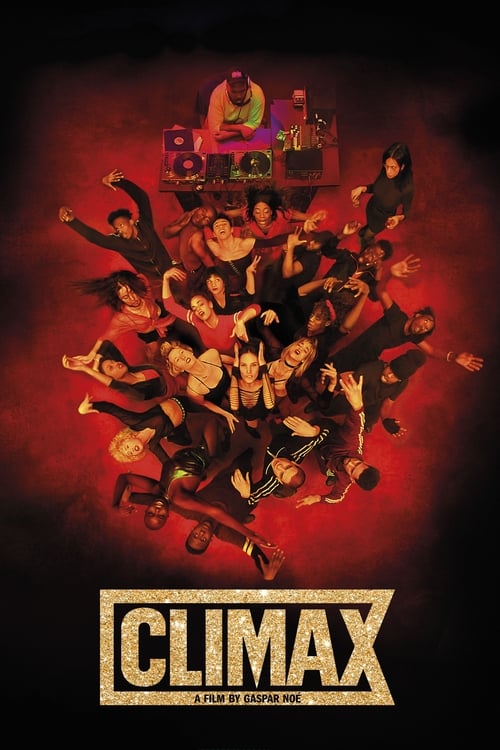
Climax
2018 · Gaspar Noé
For when you want cinema as an endurance test — something to feel in your body, not just watch. Absolutely a challenge, not a comfort: pick it for a fearless night when you want to be rattled, and know that it earns its horror label without ever being a monster movie.
What it's about
A French dance troupe gathers in a shuttered boarding school in the dead of winter to rehearse, then celebrate — until the communal bowl of sangria turns out to have been spiked with LSD. Over one night, a room full of young, beautiful, hyper-physical people slides from euphoria into paranoia and cruelty as they try to figure out who dosed them and simply survive until morning.
The experience
It opens as pure joy — one of the most electric dance sequences ever filmed — and then tightens into a sustained, disorienting nightmare you experience almost physically. The camera never lets you out; by the end you feel like you've been through it with them.
Performances
Sofia Boutella is the anchor — a trained dancer who can act, she makes the descent legible and human amid a cast of real dancers whose physicality is the film's raw material.
The craft
Noé shoots in long, prowling takes that turn the school's corridors into a maze, with a first-half dance number staged and cut like nothing else in recent cinema. The thumping soundtrack runs nearly wall to wall, and the film was shot fast and largely improvised, which gives the unraveling a scary spontaneity. Loud speakers and a dark room are practically required.
Why it matters
It consolidated Noé's standing as European cinema's great provocateur while winning over many who'd resisted him — widely cited as his most accomplished film, and a touchstone for dance-driven horror since.
Horror · New French Extremity & extreme · Art-horror · Psychological horror. A dance party in a snowbound school curdles into a drugged, real-time frenzy, shot in prowling long takes that never let you out of the room.
Snapshot
Climax is Gaspar Noé's fourth narrative feature, a 95-minute descent that begins as a euphoric dance rehearsal and ends as a chemical inferno. A troupe of twenty-odd dancers, gathered in a shuttered boarding school in the depths of a French winter, share a communal bowl of sangria that has been dosed with LSD; the second half of the film watches their solidarity curdle into paranoia, cruelty, and self-destruction. The film is unusual in Noé's catalog for being made fast and cheap, largely improvised, and built around performers who were dancers first and actors second — with the notable exception of Sofia Boutella. It is at once his most physically joyous work and one of his most punishing, and it consolidated the reputation he had built across Irréversible (2002) and Enter the Void (2009) as European cinema's foremost engineer of controlled sensory ordeal.
Industry & production
Climax was produced through the orbit of Vincent Maraval and Wild Bunch, the French sales-and-production powerhouse that had long championed Noé, alongside partners including Rectangle Productions; A24 handled the U.S. release. Its defining production fact is speed. Noé shot the film in roughly two weeks with only a skeletal treatment rather than a conventional screenplay, having assembled a company of real street and club dancers through casting calls and workshops. This lean model — small budget, compressed schedule, non-professional ensemble, single confined location — is central to the film's identity: the economics enabled the improvisational method, and the method in turn justified the economics.
The film premiered in the Directors' Fortnight (Quinzaine des Réalisateurs) at the 2018 Cannes Film Festival, a sidebar rather than the main Competition, and took that section's top prize, the Art Cinema Award. That placement is itself a small industry story: after the Competition scandal and walkouts around Irréversible and the mixed Competition reception of Love (2015), Climax arrived in a parallel section and emerged as one of the most acclaimed titles of the festival — a rehabilitation of sorts for a director whose brand had been provocation. Noé has repeatedly framed the film as loosely inspired by a real incident he claims occurred in France in the winter of 1996; that origin is asserted in the film's opening titles and in interviews but is thinly documented, and it is best treated as part of Noé's authorial mythology rather than established fact.
Technology
Climax was shot digitally, the format that had underwritten Noé's long-take ambitions since Enter the Void. Digital capture is not incidental here: it permits the very long unbroken takes around which the film is organized, the low-light shooting in corridors lit by practical and colored sources, and the fluid handheld and Steadicam movement that would be far costlier on film stock. I do not want to overstate the specifics of the camera package, which is not something I can confirm with precision — but the aesthetic dividend is clear. The film's saturated reds, greens, and blues, its willingness to plunge into near-darkness, and its capacity to keep a roving camera going for many minutes at a stretch all depend on the flexibility and sensitivity of digital sensors. Where earlier Noé films used digital tools for effects-heavy, out-of-body camerawork, Climax uses the same toolkit for something more austere: an unbroken observational presence inside a single building.
Technique
Cinematography
The cinematography is by Benoît Debie, Noé's essential collaborator since Irréversible and the author of the neon delirium of Enter the Void and Love. In Climax, Debie's camera is a participant. The film's centerpiece opening number is a sustained overhead-and-tracking dance sequence performed in effectively one continuous take, the lens gliding among the dancers as they trade solos. As the drug takes hold, Debie's strategies mutate: the camera drifts down corridors in extended Steadicam runs, watches conversations in long uninterrupted masters, and in the final movement literally inverts, turning the image upside down so that the school's ceiling becomes a floor and the dancers appear to crawl across it. Debie also exploits practical color — the interiors are washed in stark reds and sickly greens — so that the space itself seems to register the poisoning. The palette and the roving long take are continuous with Noé and Debie's prior work, but stripped of the digital-effects layer that dominated Enter the Void.
Editing
Climax is edited to feel unedited. Much of its power derives from withholding the cut: the long takes force the viewer to remain inside events without the relief of montage. Yet the film is also structurally reorganized in a way that only editing can achieve — it opens with what is chronologically its ending (a bloodied woman thrashing in the snow, shot from above), then runs its end credits near the start, and defers its opening titles until roughly forty minutes in, splashing them across the screen during the dance. Noé is credited as an editor on the film alongside a collaborator; I want to be careful not to misattribute the specific co-editor credit, but the governing sensibility is unmistakably Noé's — the same taste for temporal inversion, aggressive title cards, and duration-as-assault that runs through his filmography.
Mise-en-scène / staging
The single location does enormous work. The disused boarding school — corridors, a communal hall dominated by a large French tricolore hung on the wall, side rooms, a locked electrical closet — becomes a maze in which bodies are trapped. The French flag as backdrop is a deliberate provocation, inviting a reading of the ensemble (multiethnic, queer, working from the club and street-dance scenes) as a fractious image of the nation. Staging is choreographic in the literal sense: the dancers' bodies fill and organize the frame, and Noé blocks the descent as a kind of anti-choreography, the disciplined ensemble unity of the opening number dissolving into isolated writhing, huddles, and attacks. Props are sparse and pointed — most of all the punch bowl, the film's chemical Rosetta stone.
Sound
Sound is arguably the film's true engine. Climax is close to wall-to-wall music, most of it diegetic, spun by a DJ inside the fiction, so that the same beats that fuel the ecstatic opening later hammer the disintegration. The soundtrack is a curated history of electronic and dance music — I'm confident it draws on the likes of Cerrone, Daft Punk, Soft Cell, Aphex Twin, and Gary Numan, among others, though I'd caution against treating any track list I reproduce from memory as exhaustive. The music's relentlessness is the point: it never stops to let the characters (or the audience) recover, and its shift from communal pleasure to oppressive throb dramatizes the trip's turn better than any dialogue. Layered against it are screams, sobs, and fragments of overlapping speech captured in long takes.
Performance
Because the cast were dancers cast partly for their movement, performance in Climax means two things at once. In the dance passages, it is virtuosic physical expression across styles — voguing, waacking, krump, house — executed by performers drawn from real scenes. In the dramatic passages, it is largely improvised, built by Noé from a short outline and character sketches rather than scripted lines, which lends the confrontations a raw, overlapping, half-articulate quality. Sofia Boutella, the one established professional (herself a trained dancer before her acting career), anchors the film as Selva and carries its most harrowing solo passages of physical unraveling. The ensemble includes performers such as Romain Guillermic, Souheila Yacoub, and the DJ-musician Kiddy Smile; their non-professional status is not a limitation Noé works around but the raw material he works with.
Narrative & dramatic mode
The film's dramatic mode is closer to situation than to plot. There is a premise (a party, a poisoning, a search for the culprit) and a fragile whodunit thread, but Noé is uninterested in resolution; the accusation and the hunt for who spiked the bowl function mainly as accelerants for cruelty. Narrative time is deliberately deranged — ending first, credits scattered, aphoristic intertitles ("birth is a unique opportunity," "death is an extraordinary experience," and their kin) punctuating the fall like chapter headings for a moral treatise that never quite coheres. The mode is processual and durational: we are made to undergo the trip in something approaching real time rather than to follow a story about it. This is Noé's characteristic dramaturgy of experience over incident, the same logic that ran Irréversible backward and dissolved Enter the Void into a floating point of view.
Genre & cycle
Climax sits astride several genres by design — TMDB's tagging as Drama, Horror, and Music is apt. It is a horror film without a monster, its threat purely pharmacological and social; a musical whose numbers metastasize; and a chamber drama of a group under pressure. It belongs to a long lineage of confinement-and-contagion narratives — the bottle film in which a sealed group turns on itself — and to a specifically European art-horror tradition of the collective bad trip. Within the late-2010s moment it can be grouped loosely with a wave of elevated, sensation-forward art horror, though Noé predates and stands somewhat apart from that cycle. Its most distinctive generic move is to fuse the dance film's celebration of the body with horror's desecration of it.
Authorship & method
Climax is a near-perfect distillation of Noé as auteur: the temporal inversion, the confrontational intertitles, the saturated color, the long take as endurance test, the fixation on ecstasy shading into abjection. His method here — a treatment rather than a screenplay, real dancers over actors, two weeks of shooting, extensive improvisation — is the film's signature and its risk. The authorship is genuinely collaborative in its key departments: Benoît Debie's cinematography is inseparable from the film's identity; the choreography by Nina McNeely gives the opening its structure and the ensemble its vocabulary; and the "score" is a work of curation rather than composition, a DJ-set dramaturgy assembled from existing dance tracks rather than written by a credited composer. Noé's own editing hand shapes the temporal architecture. The film is thus a case study in how a strong directorial signature can be realized through delegation to movement and music specialists rather than through a traditional writing-and-scoring pipeline.
Movement / national cinema
Noé is a central figure in what critics christened the New French Extremity — the turn-of-the-millennium tendency in French cinema (Claire Denis's Trouble Every Day, Bruno Dumont, Marina de Van, Catherine Breillat, Pascal Laugier) toward transgressive bodies, sex, and violence. Climax is a mature outgrowth of that movement, and a French film pointedly about Frenchness: the tricolore on the wall and the multiethnic, largely working-class, queer-inflected ensemble stage the nation as a body that dances together and then tears itself apart. Noé's own position is transnational — Argentine-born, French-based — and the film's musical DNA reaches into international club culture even as its imagery is nationally coded.
Era / period
Made and released in 2018, Climax is a product of the digital, festival-driven European art cinema of the 2010s, in which a director of Noé's standing could mount a lean, improvised feature and premiere it to acclaim at Cannes within months. Yet it is set — per its titles — in the winter of 1996, a period detail reinforced by boxy televisions, VHS tapes, and a soundtrack rooted in disco, new wave, and early electronic dance. That 1990s setting is not nostalgic decoration so much as a frame: it lets Noé stage the film as a kind of recovered artifact, the "true story" he claims to be reconstructing.
Themes
The film's governing themes are ecstasy and its inversion — the thin membrane between communion and cruelty, pleasure and pain, the disciplined body and the body out of control. It is about the group: how solidarity is manufactured through shared rhythm and how quickly it collapses into scapegoating, hierarchy, and violence once trust is poisoned. There is a persistent thread of the body as site of both transcendence and horror, continuous with all of Noé's work. Underneath runs a bleak, quasi-nihilist metaphysics — the intertitles announce it — in which life is figured as a "collective impossibility" and existence as a "fleeting illusion." Read against the tricolore, these become a sardonic national allegory; read against the dance, a meditation on art as the last thing holding chaos at bay.
Reception, canon & influence
Climax was widely regarded as one of the strongest films of the 2018 Cannes and won the Directors' Fortnight's Art Cinema Award, and it drew notably warmer, more consensual critical reception than the polarizing Love or the walkout-generating Irréversible — many critics read it as Noé's most disciplined and least gratuitous provocation, precisely because its violence is chemical and social rather than graphic. I'd flag that any single set of review quotations or aggregate scores I reproduced from memory could be imprecise, so I'll characterize the reception in general terms: broadly positive, with dissenters objecting to Noé's familiar cruelty and thin characterization.
The influences on the film are unusually explicit: Noé literally arranges VHS tapes and books around the television in the opening frame as a citation shelf, invoking touchstones such as Dario Argento's Suspiria, Andrzej Żuławski's Possession, Luis Buñuel, and Rainer Werner Fassbinder, among others — a curated genealogy of derangement, hysteria, and the body in extremis. Beyond that shelf, the film draws on the disco and rave cultures whose music it uses, on the bottle-film tradition of confinement, and on Noé's own prior long-take experiments.
Its forward legacy is still consolidating, as one would expect of a 2018 title, so any claim of definitive influence should be modest. What can be said is that Climax has become a reference point for the dance-horror hybrid and for the idea of building a feature around real dancers and improvisation rather than a script — a model taken up as an alternative to conventional production. It has entered the canon of Noé's own filmography as arguably his most accessible entry point and one of his most admired, and it stands as a landmark of the mature New French Extremity: proof that the movement's transgressive charge could be delivered through rhythm, duration, and the poisoned communion of a group rather than through explicit atrocity alone.
A Deleuzian reading
A woman crawls through snow, filmed from straight overhead, dragging a red smear behind her.
The full Deleuzian reading of Climax →
Reception
The twist with Climax was that critics who'd spent two decades recoiling from Noé mostly embraced it on arrival — it premiered at Cannes' Directors' Fortnight in 2018, won the Art Cinema Award, and was widely called his best film. Since then it's settled in as the consensus 'gateway Noé,' the one people recommend to newcomers.
How Climax was received, from release to now →
How to watch Climax: what to notice on a first viewing
- Watch the opening dance number play out in one shot. Benoît Debie's camera glides among the dancers as they trade solos, holding the whole troupe in frame without a cut. This unbroken shot shows solidarity built through shared rhythm before anything poisons it.
- Listen for the music never stopping, even as things turn ugly. The same DJ-spun tracks that fuel the euphoric opening keep playing straight through the violence, without pause or silence. The relentless beat shows the trip has no exit and no relief, for the dancers or you.
- Notice the room's color shift from warm light to red and green. As the drug spreads, Debie washes the corridors in stark reds and sickly greens instead of natural light. The building itself seems to register the poisoning before any face does.
- Look at the large French flag hanging in the main hall. The multiethnic, queer dance troupe rehearses and later unravels directly beneath the tricolore, never out of its frame. The flag turns the group's collapse into a portrait of a fractious, multiethnic nation.
The whole guide to watching Climax, with the keys for a rewatch →
Influences: the films it descends from and the films it influenced
- Suspiria (1977) — Literally shelved in Climax's opening frame, it supplies the template of a dance academy as a chromatic slaughterhouse, where Argento's gelled primary-color lighting turns architecture into an expressionist trap Debie's palette openly echoes.
- Possession (1981) — Also cited on the VHS shelf, it models the convulsive, full-body improvised breakdown — actors driven to physical collapse and hysteria — that Noé's dancers reproduce once the sangria hits.
- The Exterminating Angel (1962) — Buñuel's cited presence delivers the bottle-film logic Climax runs on: a group inexplicably unable to leave a single room, its bourgeois veneer decomposing into cruelty through confinement alone.
- Querelle (1982) — Fassbinder's shelved influence surfaces as the artificial single-set staging drenched in unnatural, non-motivated color, a stylized theatrical box that Climax's tricolore backdrop restages.
- Irréversible (2002) — Noé's own reverse-chronology architecture and vertiginous, ceaselessly spiraling handheld/Steadicam camera are the direct precursors to Climax's temporal inversion and roving long takes.
- Enter the Void (2009) — The Debie–Noé collaboration here establishes the drifting, untethered, sometimes-inverted camera and the DMT-neon practical-color scheme that Climax weaponizes for its floor-level descent.
- Rope (1948) — Hitchcock's single-apartment experiment in concealed cuts and continuous-time illusion is the granddaddy of Climax's withheld-cut long takes that make duration itself the source of dread.
- Russian Ark (2002) — Sokurov's feature-length unbroken choreographed Steadicam proves the long take can be an endurance-structured tour through bodies in space, the formal ambition Climax scales down to a single rehearsal hall.
- Beau Travail (1999) — Denis frames choreographed bodies as pure cinema and ends on a solitary dance-to-exhaustion, the ecstatic movement-as-collapse grammar Climax expands into an ensemble.
- Salò, or the 120 Days of Sodom (1975) — Pasolini's single-location, formally partitioned descent into orchestrated cruelty models the closed-system dramaturgy by which communal ecstasy is engineered, stage by stage, into atrocity.
- Love Exposure (2008) — Escalating collective descent driven by relentless energy and moral vertigo, extending the transgressive-cinema stamina Love Exposure demanded of audiences.
- Kotoko (2011) — Uses music as the trigger for collective perceptual rupture, camera and edit collapsing into derangement—the song-as-rupture principle Kotoko builds from Cocco's own songs.
- Lux Æterna (2019) — Noé's own follow-up bottle film about a collapsing film shoot pushes Climax's method further — single location, intertitles, and a climactic stroboscopic sensory assault as duration turned to punishment.
- Titane (2021) — Extending New French Extremity's body-in-extremis charge, it opens on a bravura roaming-camera dancer set piece and treats the transgressive physical performance, not gore alone, as the shock.
- Athena (2022) — Gavras builds the film from extended choreographed single-take set pieces, inheriting Climax's conviction that a virtuoso unbroken camera coursing through a confined crowd is itself the dramatic engine.
- Vortex (2021) — The method of building loose situations for actors to inhabit rather than scripted lines — casting people for what they are — is the working process Vortex reuses.
- Talk to Me (2023) — Noé's long-take party choreography: an unbroken handheld push through rooms of intoxicated bodies that maps the geography before it introduces the threat — the architecture of Talk to Me's opening shot.
- Spring Breakers (2012) — Shot by Benoît Debie in the same neon-saturated practical-color idiom, it runs the identical ecstasy-to-cruelty arc — hedonic euphoria curdling into violence — under the same cinematographer's hand.
- Suspiria (2018) — Released the same year, it independently builds dance-horror in which choreography itself becomes the mechanism of bodily violence, casting real dancers and letting movement carry the terror.
- Mandy (2018) — A contemporaneous descent film built from saturated practical color and immersive drone-scored duration, staging the same slide from altered-state reverie into red-lit cruelty.
- Raw (2016) — A New French Extremity initiation film that stages communal degeneration through a hazing rave, letting a party's intoxicated collective body tip into appetite and violation.
- The Neon Demon (2016) — Synth-driven, strobe-lit descent of a beautiful performing collective into bodily horror — sibling in the mid-2010s art-horror mode of sensory assault over narrative.
- Boiling Point (2021) — Extended single-take sequences within a confined ensemble performing in a real location (community center), with choreographic blocking replacing editing and practical lighting throughout; the descent-into-chaos structure with no catharsis and the commitment to sustained unbroken time as escalating pressure directly parallels Boiling Point's formal logic.
- Son of Saul (2015) — Bodies tracked through a closing-in space in extended takes where off-screen and peripheral horror accrue, sound design carrying the unseen — a parallel deployment of immersive long-take dread.
- Sirāt (2025) — Cuts bodies to a relentless techno/electronic score and pivots a communal scene into lethal chaos via structural rupture, the cut-to-the-beat tonal swerve Sirāt mirrors.
- Happyend (2024) — Uses a techno-scored youth collective as a single-space pressure vessel where communal ecstasy tips into fracture, the dancefloor-as-political-body device Happyend deploys in its rave scenes.
- Infinity Pool (2023) — Climax's drug-fuelled communal descent, with rotating, inverted long takes, is the closest model for Infinity Pool's orgy-as-rebirth, where a group high becomes a collective unravelling filmed as sensory overload.
Similar films
- Titane (2021) — influence & lineage · same viewing thread · often watched together
- Possession (1981) — influence & lineage · often watched together
- Mandy (2018) — influence & lineage · often watched together
- Irreversible (2002) — influence & lineage
- Suspiria (2018) — influence & lineage
- Suspiria (1977) — influence & lineage
- Athena (2022) — influence & lineage
- High Tension (2003) — same viewing thread
All the films related to Climax →
Watch it with: curated runs of related films
- Extreme Cinema's Breaking Point — A run of films from the New French Extremity, Asia Extreme and the European art-house provocateurs, all rhyming on the body as the place where grief, desire, revenge and power break open, best watched near each other so you can see how differently each director uses shock.
- Baroque Cruelty at Fever Pitch — A run of operatic, over-styled thrillers in which torment, envy, religious mania or chemical delirium is filmed with hallucinatory excess. Watch them close together and they rhyme on how style itself becomes the poison.